|
The Reliant Review
January 2025
| |
|
Rates, Growth, and Governance: Preparing for 2025 | |
|
Legendary investor Warren Buffett once remarked, "To the extent we have been successful, it is because we concentrated on identifying one-foot hurdles that we could step over rather than because we acquired any ability to clear seven-footers." In a world that seems increasingly unpredictable and volatile, we have found it important to use that quote as a helpful mantra. We strive to use the data available to make the most informed decisions that we can for you, our clients. Certainly, part of investing requires accepting a level of risk, but managing that risk using what we know and what we think are the most likely range of outcomes helps us best serve you. Every decision we make, we make with you in mind. We are grateful for that opportunity and wish you all the best in 2025.
2024 gave way to a large anti-incumbent movement across the globe. 40% of the world’s population went to the polls during the year, and in most developed countries the incumbent party was soundly defeated (US, UK, Germany, France, etc.). Economic frustrations and lingering fallout from the pandemic have left voters increasingly disenchanted with the problem solving, or lack thereof, the ruling political class has proposed or enacted. One theme we are focused on in 2025 is how the newly elected majorities around the world will govern given their mandates from voters. Will the Trump Administration’s talk on the campaign trail become a reality, or will the political process of Washington grind those efforts to a halt?
Domestically, best estimates show that GDP grew at 2.8% over the past year, while inflation fell from an intra-year high of 3.5% to about 2.7%. The unemployment rate rose gradually through the year, but it has held steady at the level typically considered to be full employment. You’ve probably heard by now, but the S&P 500 gained more than 20% for the second year in a row. There have only been four times in American history that we’ve seen back-to-back 20% gains (3 in the 1990s and 1 in the 1950s), but after each of those instances, stocks were positive in the 3rd year. While history is never a perfect indicator for how the future will play out, we don’t think investors should be worried simply because the last two years have produced above average returns.
| |
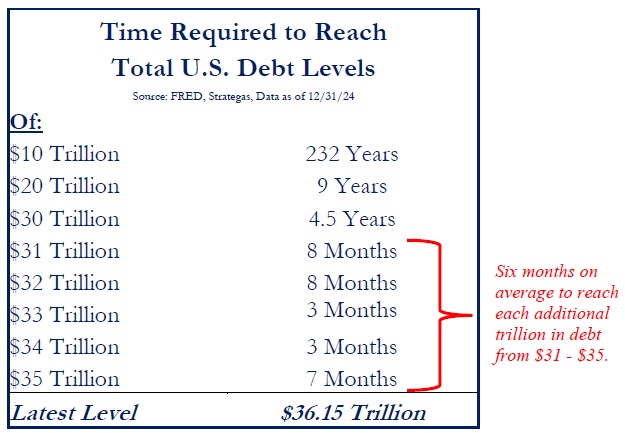
 | | We believe growth will be the primary focus of financial markets in 2025. At this point, we still think the chances of an imminent recession are low given current economic conditions—declining inflation, steady employment, and the strength in corporate profits. The current consensus estimate for 2025 is 13% earnings growth for the companies making up the S&P 500. While markets may advance, we do also believe the Trump Administration is potentially inheriting an economic mess, particularly if it is not serious about putting the country on a more sustainable fiscal path. The problem of unchecked spending is not a new problem in Washington, but it is an ever concerning one. The rate at which US debt continues to grow is unsettling, as you'll see from the chart above. Adding to the problem is the fact that more than 60% of the $6 trillion US annual budget is mandatory spending—Medicare, Social Security, interest on debt, etc. The Trump Administration faces a difficult challenge of being equally nimble and adept in providing an environment in which the public sector passes the economic baton to the private sector without putting undue pressure on markets. It does seem reasonable to expect some periods of volatility as these changes take place, but such changes should present new investment opportunities as well.
| |
|
In 2024, the Federal Reserve initiated an easing cycle by cutting the Fed Funds rate by half a percentage point in September and then followed up by cutting the rate by another half a percentage point over the next two meetings. In the waning weeks of the year, noting stalled inflation, the Fed signaled a slower rate of easing for 2025. Regarding the Fed, the main questions now are (1) when will they resume a lowering of the Fed Funds rate and (2) how much lower will they go before pausing again? If inflation does prove more difficult to fully pare back to the long-term Fed target of 2% (last month’s reading was 2.7%), then we could easily find ourselves in an interest rate environment that is quite different from the long stretch of low rates that preceded it.
Currently, the bond market is pointing to a higher level of longer-term rates, perhaps a sign that investors are expecting either a second wave of inflation or policy proposals from the incoming Administration that could lead to increased prices for businesses and consumers. President-elect Trump has promised deregulation and lower taxes to boost growth. However, his other promises of deportations and permanent (instead of negotiable) tariffs have the bond market pointing to lower growth and increased inflation. Historically, higher bond yields caused by stronger growth are usually fine for stocks, because stronger growth means higher profits. But higher yields without more growth just means pain for everyone. We are carefully watching the movements of interest rates, currencies, and commodities, and we have taken some initial steps to protect capital should equity volatility pick up.
| |
|
New year = New tax season. April 15 will be here before we know it! Be on the lookout for tax documents from employers, banks, and investment account companies, etc. If the tax report is treated as ordinary income, it will be issued and postmarked by 1/31. Standard investment and brokerage account statements should follow shortly thereafter.
Did you inherit an IRA after January 1, 2020? If so, then this year you will be required to take a required minimum distribution from that account. The IRS has updated their requirements for inherited IRAs and no longer allows for heirs to withdraw the full amount of the IRA in the 10th year after inheritance. Call us if you have questions on what this may mean for you.
Here are the new contribution limits to retirement accounts for 2025.
-
401(k), 403(b) and most 457 plans: $23,500 (+$7,500 for those over age 50)
-
IRAs (both traditional and Roth): $7,000 (+$1,000 for those over age 50)
- If you are between the ages of 60-63, new special "super catch-up" provisions apply. Let us know if you would like more information.
Here are the new gift tax limitations for 2025.
-
Annual gift tax exclusion: $19,000 per recipient
-
Lifetime gift & estate tax exemption: $13,990,000 per person
Review and optimize your investment accounts. Optimize your accounts and investments by consolidating accounts when and where you can. Did you retire and need to roll your company 401k plan into a rollover IRA? Do you have any “orphan” accounts sitting in old employer plans that need to be consolidated into a rollover IRA? Am I saving enough to meet my financial goals? Am I properly allocated and diversified across all my investment accounts? Can I afford to spend more in retirement than I originally budgeted? Schedule a meeting with Reliant to review your financial position as we head into the new year.
| | |
|
As always, please do not hesitate to contact us with any questions, ideas, or concerns. We are happy to meet with you in person or via video conference. | | | |
1715 Aaron Brenner Drive Suite 504 | Memphis, TN 38120 | 901-843-0600
| |
| | | |