School of the Month:
Mitchell Elementary School
| |
Building Brain-Ready Classrooms:
How Mitchell Elementary Supported Regulation and Learning
| | |
At Mitchell Elementary School, the goal was never simply to introduce another classroom resource.
The goal was to help students and adults understand the connection between the brain, regulation, and learning, and to build the skills and systems necessary for every learner to access their full potential.
Through its partnership with the NC Center for Resilience & Learning, Mitchell Elementary spent year one of its two-year partnership intentionally creating a shared language around regulation and equipping its school community with practical strategies to support student learning, relationships, and resilience.
Following a season of significant change and uncertainty for the Mitchell community following Hurricane Helene, the school recognized the importance of supporting not only academic needs but also the emotional and physiological needs of students and staff. The work centered around a powerful belief:
Learning happens best when students and adults are regulated, connected, and supported.
| |
Understanding the Connection Between Regulation and Learning
"When our neuroceptive mechanisms confirm that our surroundings are physically, socially, and intellectually safe, we go into a state of relaxed alertness and are primed for learning."
—Zaretta Hammond, Culturally Responsive Teaching and the Brain (2015)
Before implementing any strategies, Mitchell Elementary began by building a shared understanding of the science behind regulation.
Through professional learning, staff explored the relationship between the brain, stress, and learning. Educators learned that when students experience stress, their nervous systems may shift into a protective state. During these moments, areas of the brain responsible for higher-level thinking, including attention, memory, problem-solving, flexible thinking, and impulse control, can become more difficult to access.
This understanding helped shift the conversation from:
"Why is this student not engaging?" to "What does this student need in order to return to a state where learning is possible?"
Regulation came to be understood not as a separate initiative but as a foundation for learning.
Students do not need to eliminate emotions to learn. They need opportunities to understand their emotions, recognize signals from their bodies, and develop strategies that help them return to a learning-ready state.
| |
The Resilience Team Built the "Why" Before the Tool
The implementation of Rapid Reset Boxes was not a quick solution or a resource placed into classrooms without preparation.
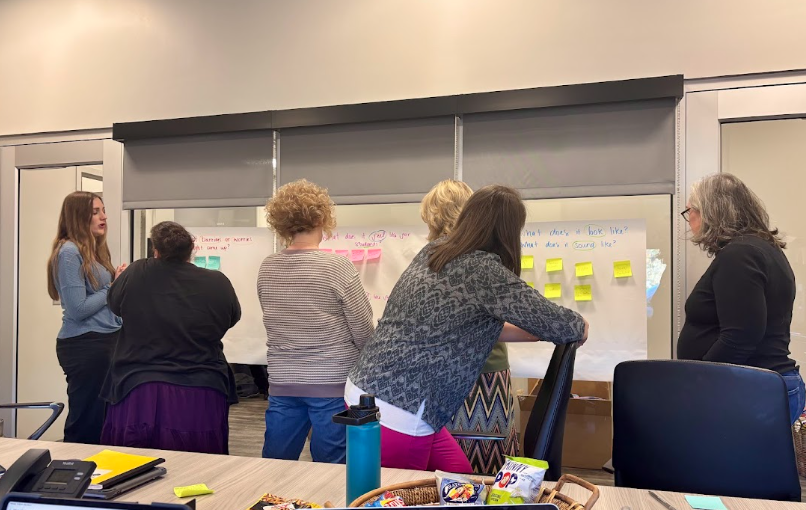
During the fall semester of Year 1, Mitchell Elementary’s Resilience Team worked diligently to explore what meaningful regulation support could look like within their school community.
Before choosing tools, the team focused on the purpose behind the work:
- How does regulation impact learning?
- What do students need to understand about their own nervous systems?
- How can we create a support that builds skills rather than simply provides a temporary break?
- How do we ensure students maintain voice, choice, and dignity?
The team carefully considered the logistics of implementation, including how students would access the support, how staff would introduce strategies, and how the process could become part of the classroom environment without disrupting instruction.
This intentional planning ensured the Rapid Reset Box was never viewed as “just a box of fidgets.” It became one component of a larger system designed to teach students lifelong regulation skills.
| | |
Starting with Adult Regulation
The next step was building adult capacity.
Educators participated in professional learning focused on understanding the nervous system, co-regulation, and the role adults play in shaping classroom environments.
Research on co-regulation highlights that students develop self-regulation through relationships with calm, responsive adults who model regulation and provide support as students learn these skills themselves.
“Positive relationships keep our safety-threat detection system in check.”
—Zaretta Hammond, Culturally Responsive Teaching and the Brain (2015)
At Mitchell Elementary, this meant recognizing that adult regulation is a powerful part of the learning environment. Before students can independently regulate, they need consistent experiences with adults who can help them feel safe, connected, and supported.
This shifted the focus from simply responding to student needs to intentionally creating environments where students had opportunities to develop regulation skills.
| | |
Teaching Students to Listen to Their Bodies
Once the foundation was established, Mitchell Elementary began explicitly teaching students about regulation.
Using the children’s book, Listening to My Body by Gabi Garcia, Mitchell Elementary’s school counselor and NC Center for Resilience and Learning’s coach, MKayla, helped students understand the connection between emotions and physical sensations.
| | |
Students explored how stress might manifest as changes in breathing, muscle tension, heart rate, or physical discomfort.
This work helped students understand that emotions are not problems to eliminate. They are information their bodies provide.
By developing self-awareness, students gained the
first skill needed for self-regulation: noticing what is happening internally.
| | |
Practicing Regulation Through Rapid Reset Boxes
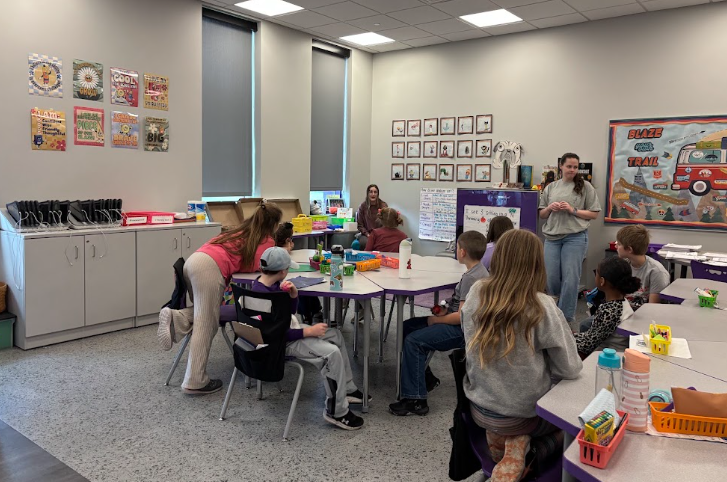
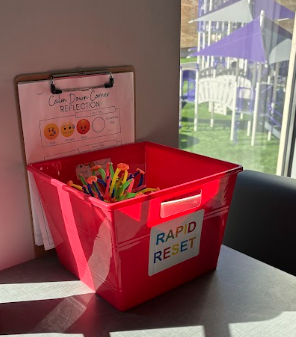
With the foundation in place, Mitchell Elementary introduced Rapid Reset Boxes throughout classrooms.
The boxes were intentionally designed to connect tools with specific coping strategies. They were not simply filled with sensory items; each tool had a purpose.
Students learned how different strategies supported their nervous systems.
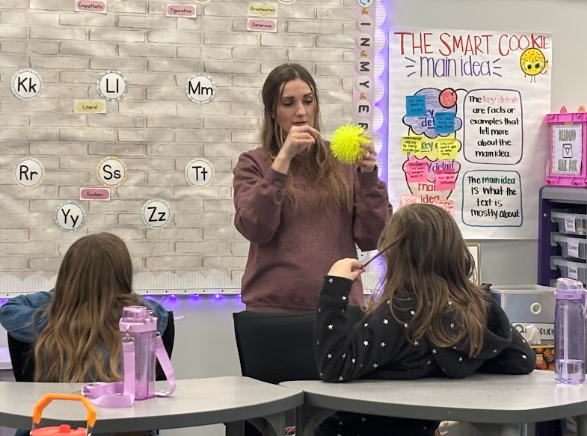
For example, the expandable breathing sphere was used to practice deep breathing. Students expanded the sphere while breathing in and slowly contracted it while breathing out, creating a visual and physical reminder of controlled breathing.
| |
Other tools supported:
- grounding strategies,
- sensory regulation,
- mindfulness,
- movement,
- reflection
- and emotional awareness.
The focus was never the tool itself. The focus was teaching students strategies they could carry with them.
To create a predictable process, Mitchell Elementary also implemented a purple ticket system. Teachers could provide students with a ticket when they noticed a student may benefit from a reset, and students could request one when they recognized they needed support.
This system created voice and choice while reducing stigma. Students learned that recognizing their needs was not a disruption; it was part of being a successful learner.
| |
From External Support to Internal Skill
Initially, students used designated Rapid Reset spaces within classrooms to practice regulation strategies with teacher support.
However, the goal was never for students to depend on the space itself.
The Rapid Reset Box was designed as a scaffold, providing students with external supports while they developed internal skills. Similar to how educators gradually release responsibility when teaching academic skills, students were intentionally guided from adult-supported regulation toward independent regulation.
Throughout the year, students practiced identifying their body's signals > selecting strategies > returning to learning.
By the end of the school year, staff noticed a meaningful shift.
Students were increasingly able to recognize when they needed to regulate and apply strategies directly at their desks without leaving instruction. Many students who initially needed the physical Rapid Reset space were now able to use breathing strategies, grounding techniques, or sensory tools while remaining engaged in classroom learning.
The measure of success was not how often students used the Rapid Reset Box.
The measure of success was that students were building the skills to need it less.
| |
The Impact: Building Independence and Increasing Access to Learning
Throughout the school year, Mitchell Elementary gathered feedback from staff to understand the impact of the Rapid Reset initiative.
Educators reported increased student independence, improved awareness of emotional needs, and a greater ability for students to return to learning after experiencing stress.
Staff also observed a reduction in the number of students visiting the school counselor or nurse with physical symptoms often connected to stress responses, including headaches and stomachaches.
While physical symptoms can have many causes, stress and dysregulation can often show up in the body. By teaching students to recognize their body's signals and practice regulation strategies earlier, students had additional tools to respond before stress escalated.
The impact extended beyond individual students. Classrooms experienced fewer disruptions, students maintained more instructional time, and regulation became part of the everyday learning environment rather than something addressed only after a challenge occurred.
| |
Creating a Culture of Regulation
Mitchell Elementary's Rapid Reset initiative demonstrates what is possible when schools invest in regulation as a foundational skill for both adults and students.
The boxes themselves are simple.
The transformation comes from the intentional teaching, relationships, and shared understanding surrounding them.
When educators understand how their own regulation shapes the classroom, and when students are explicitly taught to recognize, understand, and respond to their own nervous systems, regulation becomes more than a strategy; it becomes part of the school's culture.
At Mitchell Elementary, Rapid Reset Boxes became a pathway toward greater student independence, stronger learning environments, and a school community that understands resilience is not something we simply have; it is something we build.
One skill. One relationship. One reset at a time.
| | |
New Policy Brief: A Case for Incorporating Trauma-Informed Practices into NC Educator Preparation Programs
To build true long-term resilience and success for North Carolina’s students, trauma-informed training must begin before an educator ever steps into a classroom.
The NC Center for Resilience & Learning has released a new policy brief advocating for the integration of trauma-informed practices and content directly into Educator Preparation Programs (EPPs) statewide.
Why this matters:
-
Proactive Preparation: Equipping future teachers with these vital tools from day one reduces burnout and helps them manage challenging classroom dynamics early in their careers.
-
Student Success: Teachers trained in trauma-informed practices are better equipped to recognize the signs of trauma and create safe, supportive learning environments where every student can thrive.
-
Systemic Impact: Integrating this content into statewide EPPs ensures consistent, high-quality preparation for the next generation of North Carolina educators.
We encourage you to read the full analysis to learn more about how we can better support both our educators and students.
This policy brief was created in collaboration with the Duke Center for Child and Family Policy.
| |
| |
As suspension numbers drop, Durham Public Schools credits restorative practices
Data presented to the Durham Public School Board earlier this year shows a decrease in suspensions, and the district is crediting its focus on restorative practices.
READ MORE
| | | |
| |
The business case for mental health: NC Chamber hosts summit highlighting importance of youth well-being
“One of the biggest emerging risks to business leaders is the mental health of children and young adults, and implications that that will have on our workforce."
READ MORE
| | | |
| |
Adding It Up: The Impact of Supportive SEL Policies and Conditions on Math Proficiency
Our analysis found that the states that integrate SEL into academics tended to have higher rates of eighth-grade math proficiency. Together, these patterns show how state-level SEL policies and conditions are connected to SEL practices in school, as well as academic outcomes.
READ MORE
| | | | Resources & Opportunities | | |
Belonging & Engagement in the Classroom offers teachers and school staff practical, actionable ways to bring SEL directly to students. You'll learn from leading experts in the field of SEL and see examples of SEL in action in classrooms, featuring SELect programs and curricula from the SEL Program Guide.
What is included?
This is a 12-hour, self-paced virtual course for classroom teachers and staff who want to take a deeper dive into social and emotional learning (SEL) so they can leverage it to create a classroom where all students thrive.
|
Follow us on INSTAGRAM!
We want to share our story on Instagram- join us there!
| | Want your school to begin the journey to becoming trauma-informed? | | |
Orlando Dobbin, Jr
Senior Eastern Regional Program Manager
NC Center for Resilience & Learning
(Greenville, NC)
| | |
Eulanda Thorne
Senior Program Manager
NC Center for Resilience & Learning
(Wilson, NC)
| | |
Brian Randall
Senior Western Regional Program Manager
NC Center for Resilience & Learning
(Asheville, NC)
| | |
Leslie Blaich
Program Manager
NC Center for Resilience & Learning
(Marshall, NC)
| | |
Angela Mendell
Senior Program Manager
NC Center for Resilience & Learning
(Elizabethtown, NC)
| | |
Stacey Craig
Senior Program Manager
NC Center for Resilience & Learning
(Raleigh, NC)
| | |
MKayla Nelson
Program Manager
NC Center for Resilience & Learning
(Newland, NC)
| | |
Jessica Edwards
Impact Specialist
NC Center for Resilience & Learning
(Spring Hope, NC)
| | |
Ervin Jones
Program Consultant
NC Center for Resilience & Learning
(Elizabeth City, NC)
| | |
Rebecca Stern
Program Consultant
NC Center for Resilience & Learning
(Carrboro, NC)
| | |
Quintin Mangano
Program Manager
NC Center for Resilience & Learning
(Rocky Mount, NC)
| | |
Katie Rosanbalm
Research & Evaluation Partner
NC Center for Resilience & Learning
(Duke University)
| | |
Victor Jones
Consultant
NC Center for Resilience & Learning
(Rocky Mount, NC)
| | |
The Resilience Reader is published monthly by the Public School Forum of NC and distributed to Forum members, educators, policymakers, donors, media, and subscribers -- or anyone interested in issues such as Adverse Childhood Experiences (ACEs), childhood trauma, resilience and the power of trauma-informed schools and communities.
Please pass the word! Forward The Resilience Reader to anyone who may find this information useful.
If you received this email from a friend, subscribe to this newsletter by clicking here.
Archived editions will be located at https://resilienceandlearning.org/newsletter/.
©2024 Public School Forum of North Carolina. All Rights Reserved.
Public School Forum of North Carolina
919-781-6833
Follow us at @theNCForum
www.ncforum.org
| |
|
|
Subscribe to this Monthly Newsletter | | | | NC Center for Resilience & Learning | www.resilienceandlearning.org | |
| | | |