Volume 5 Issue 11 | November 2024 | |
November reveals the plant world without its leafy covering—the colors, the structure and shapes that lie beneath summer's emerald robe. | |
The Root of It newsletter ends with our monthly quotation. If you find your newsletter has been clipped by your email provider please click HERE for a webpage version of the newsletter. | |
|
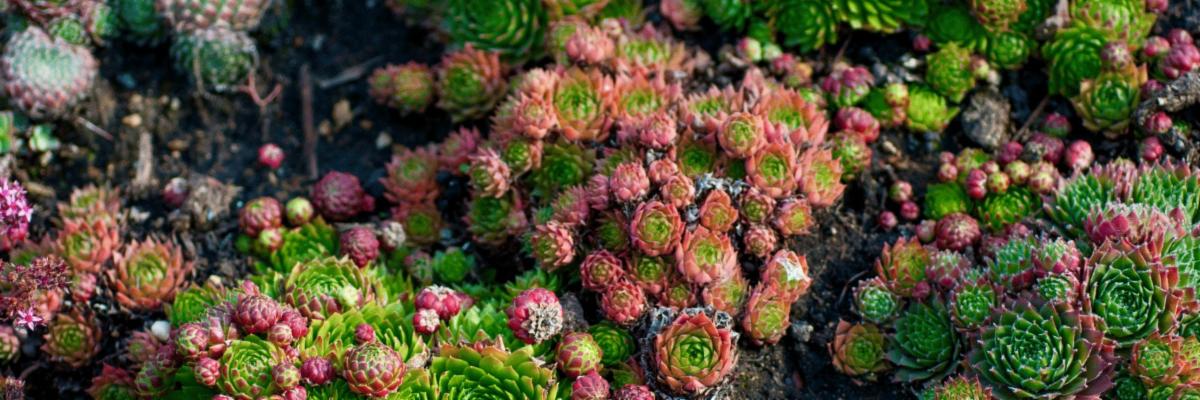
Sempervivums (Hens and Chicks) are drought embracing plants.
photo by E Barth-Elias
| |
|
The drought of ’24 seems to be over. We received 3” of rain in my Wooster gardens in the past few days with more in the forecast. My heart sang as thunder roared, lightning flashed, and rain pelted down. For weeks on end, my gardener friend and I had discussed the lack of rain during our daily chats. Our eyes searched the skies each time we ventured out. We tracked our losses, one by one. We mourned them; each plant is a carefully chosen part of the vignettes we create. To date, my friend counts seven conifers that did not survive the drought. I lost a smattering of shrubs, several perennials and a couple of small conifers. So far. Conifers in mortal distress are often green for a long period before they admit to their demise.
Which plants were most at risk?
- New plants lack the root development to survive under duress.
- Some plants need regular, abundant water to thrive. These are the ones whose descriptions say “prefers moist, well-drained soils” (shorthand for needy). My Eclipse Hydrangea is one, and wilted at the first sign of drought. I remember planting it and saying, “We’ll see…”. It has me well-trained to provide a lengthy drink at regular intervals. Clethra was also surprisingly needy, spending months in a near-wilt state despite the subsistence watering it received.
- Plants lacking a steely nature planted in tough spots found the drought challenging. A chamaecyparis planted under my towering Norway spruce trees was an early casualty.
Deciduous plants often get crispy leaves and drop them during drought, a survival mechanism during times of stress. These plants will likely be back next year, perhaps with an attitude. Many plants did not exhibit the growth I would have expected this year, instead focusing their energy stores on survival.
Interestingly, the perennials I lost were ones I had grown from seed and not yet established and those purchased on sale at a local box store. One of the differences between the box store plants and local nursery plants is the potting medium. Our local nurseries use a bark-based potting soil that has good drainage and some disease resistance properties. The box store perennials are planted in a peat-based medium, which has poor drainage. As my box store yarrows, which should have been quite tolerant of dry conditions, bit the dust, I thought to myself, “So much for a bargain!” I wonder if the medium-removing, root-soaking planting treatment now recommended for trees would have better served these plants. I will try it next spring and keep a plant in the original medium for a side-by-side comparison.
As the dry weeks continued, my strategy was to give each of my plants a targeted, weekly watering. Not as much as they would have preferred during hot and often windy days, but enough to keep them going. Yes, a drip system would have served me well, and it is always on my wish list…for another year.
It seems petty to complain about dry weather in my garden when Ohio farmers face huge crop losses and loss of livelihood. But we are gardeners, and our beds and borders are our small world. Will my friend and I replace our lost plants? He is still mourning, but I am heading out to the plant sale at our local arboretum. There is real estate to fill, and there are plant “opportunity spots” in my beds. I’ll just look around…
Postscript: As this article goes to press drought conditions throughout most of Ohio continue. Current rainfall has not penetrated to lower soil levels, and unless prolonged rains fall, gardeners are advised to deeply water plants to take them through the winter months.
K Edgington
| |
Leaf Brief - Feeling Your Oats | |
|
Sea Oats (late summer, left and autumn, right)
photo by E Barth-Elias
| |
|
Sea oats in Ohio? But where’s the sea? If you remember sea oats from your favorite beach vacation, running through the dunes to reach the surf, you are thinking of Uniola paniculata. This grass grows in sand and prevents erosion. The ones you’ll find here are a distant relative, inland sea oats (Chasmanthium latifolium), found in the Eastern U.S. from the Great Lakes to the Gulf States. This versatile grass can be found along streams and flood plains in woodland areas. Its distinctive seed heads, as well as the ability to tolerate shady conditions, set it apart from other ornamental grasses. Growing in moist or well-drained soil, inland sea oats is drought-tolerant once established. Like its beach counterpart, the clumping habit makes inland sea oats great for erosion control on streambanks or hillsides and is ideal for quickly filling a large area. By the way, neither type of sea oats is related to common oats, the cereal grain.
Inland sea oats, also called Indian wood oats, Northern sea oats, river oats, wild oats, and fish-on-a-fishing pole is a charming and dependable ornamental grass. It emerges from the ground in the springtime with bright green shoots and forms a manageable clump in sand, loam, or clay soil; acidic or basic pH; shade or part sun. Tolerating a wide range of temperatures, it thrives in zones 3-8. Inconspicuous green flowers develop into green seed heads during summer. In the fall, the grass and seed heads transition to a coppery-bronze color, and later fade to tan. The golden seed heads are quite eye-catching as they dangle on arched stems and shimmer in the autumn breezes.
Getting started with inland sea oats is easy. To grow from seeds, place them ¼ inch deep in prepared soil and keep them moist but not soggy. Temperatures in the 70s are ideal for germination. With container plants, place the crown at ground level, lightly mulch (but do not cover the blades), and keep watered until established. The grass can spread quickly and self-seed freely; in optimal conditions, it can be quite prolific. Consider displaying it in a pot as an accent or diligently removing the seed heads to control the spread. This grass is more suited to a naturalized setting versus a more structured perennial garden. The foliage will need a haircut in early spring—cutting it back to the basal rosette. Leaving the foliage until then provides refuge for insect larvae. The “oats” also persist all winter, providing seasonal interest. Don’t discard seed pods as they add texture to live and dried flower arrangements.
As a native, inland sea oats fits well into the ecosystem, providing shelter to small mammals and birds while they snack on the seeds, stems, or leaves. Many birds use the blades for nesting material. Plus, inland sea oats is a larval host plant for several species of butterflies, most of which are skippers.
Winter interest is appreciated as we enjoy the sparkle of sea oats swaying in the breeze on a cold winter day. With a little imagination, you can even pretend you’re at the beach.
J Gramlich
| |
Creature Feature - Life in the Slow Lane | |
|
Eastern Box Turtles
photo by EI Tony
| |
|
In all my years of chronicling creatures for the Root, I have never actually wanted to be one—until now. The eastern box turtle (Terrapene Carolina Carolina) has an amazing defensive technique that could be quite useful. This guy can pull into its carapace (top shell), snap its plastron (bottom shell) shut, and be almost completely impervious to predators—and oblivious to the world around it. Not a bad strategy in an election year…
In addition to being able to shut out the news cycle, turtles are just way cool. They predate (by like 20 million years) dinosaurs, and outlived them. Twelve families of turtles make up the order Testudines, 7 of which are in North America. There are about 350 species of turtles world-wide, with 58 in the U.S. and Canada. Turtles may be categorized depending upon whether they live in freshwater, saltwater or on land. Eleven species are found in Ohio, the most terrestrial of which is the eastern box turtle (ET), located in woods, fields, marshes and maybe your backyard. The diurnal ET is a homebody, generally never moving farther than 250 yards from his birth site and doing everything possible to return home if relocated. That’s why if you see one crossing a road, move it in the direction it is heading—otherwise it will just re-cross. Given that ETs can live 50 to 100 years, their hometowns may change dramatically in their lifetimes.
The ET’s high-domed carapace and plastron are brownish black with yellow and orange markings that are also on their legs, head, and neck. The hinge on the plastron is located behind their front legs. They have hooked upper jaws, an overbite, and four toes on their hind feet. Males are generally brighter colored, with red or orange eyes; females are more subdued with brown or dark red eyes. Males may also be identified by an indentation in their plastron. ETs are shy and non-aggressive.
ETs adjust their activity to maintain their body temperature. In summer they seek shade or water during the heat of the day, in fall and spring they seek out the sun to warm up—but they only have one speed—sloooow. ETs take their time. Sounds kind of nice, doesn’t it?
ETs take all day to travel 165 feet. They take ten years to reach maturity. After mating, females can store sperm for up to 4 years, so they can take their time before mating again. Pregnant Mom digs a shallow nest, lays 3-8 eggs, covers them up and then she returns to full, slow speed, her maternal duties are done. Watch HERE.
ET eggs also take their time—hatching in about 2-3 months—which is not good because hungry crows, skunks, raccoons, snakes and foxes love them. Interestingly, weather influences the gender of the hatchlings—warmer temperatures make females, cooler temps make males. Babies take 5 years to develop their protective hinged shell, leaving juveniles almost as vulnerable to predators as eggs, although their dark mottled coloring provides good camouflage. The fully developed shell is excellent protection from everything but cars (and lawn mowers); mortality by machine is a significant danger. Baby ETs eat more protein than adult ETs and are more likely to hunt in water, but all ETs are omnivores, slowly enjoying tasty worms, frogs, berries, dead animals, fruit, leaves and grass. Watch their life cycle HERE.
Winter is coming, and we humans scurry about, sporting giant puffy coats and runny noses. ETs brumate the winter away (the cold-blooded equivalent to hibernate). They develop glycogen (stored glucose), which provides energy, and dig a two-feet deep burrow (a hibernacula) in dirt, mud or leaf litter. They may share the hibernacula with other ETs, and may return to the same one year after year. ETs tolerate each other’s company quite well. Soil and leaves provide insulation to keep the hibernacula from freezing, and their metabolic rate slows, minimizing energy output and saving resources. ETs (slowly) emerge as temperatures warm around April.
Scientists believe the annuli (growth rings) found on ET carapace scutes (scales made of keratin), can help determine its age, but not as accurately as growth rings on trees. HERE'S how to count the annuli.
The ET is a “species of concern” in Ohio, which means it is at risk. Factors impacting ET population include roadkill, decline in habitat, and the pet trade. It is illegal in Ohio to capture, kill or sell a wild ET. We need to protect these fascinating creatures—they definitely have some traits we could learn from. In the meantime I’m gonna make like an ET and hide under the bed…
Here are two videos about these fascinating creatures:
THE EASTERN BOX TURTLE DOCUMENTARY
ALL ABOUT EASTERN BOX TURTLES
C Christian
| |
Time for a Rosemary Topiary | |
|
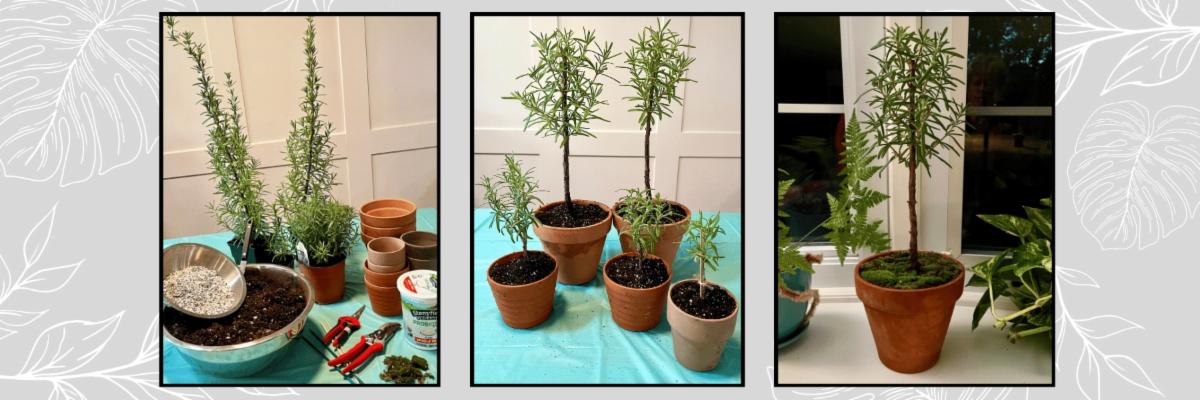
Supplies, newly trimmed and planted rosemaries, and a rosemary topiary as it starts to branch out.
Photos by K Edgington
| |
|
Clipping plants into unnatural shapes is not my idea of garden beautification. Yews trimmed into cubes and boxwood bowling balls will never grace my gardens. Yet I have a soft spot for topiary plants that brighten a window sill or table during winter’s darker months. Topiaries are fun to make, and now is the ideal time to create one and watch it develop during the coming season. Many plants can be pruned to create topiaries—juniper, boxwood, miniature ivies, lavender. When choosing, select small-leaved plants that can handle winter indoor conditions. Wire frames are an option, and are easily purchased—raised circles, squares, spheres, even animals. Let’s dig into the method for creating a rosemary tree topiary.
Supplies:
-
Rosemary plant. Choose one that has a vertical stem that can be trained as a trunk. Larger, fuller plants make this project easier, but for those with patience, a small plant can be trained into a topiary over time. Do not choose one of the low-growing varieties.
-
Pot with a drainage hole. Terra cotta pots are classic for this project. The pot size is important for aesthetic and growing reasons. Hold your plant up with your pot and see if the proportions work.
-
Screen, hardware cloth, or a small piece of coffee filter to cover the drainage hole.
-
A good potting mix. No fertilizers or water retention crystals, please—they lead to failure.
-
Small aggregate, such as turkey grit. Rosemary requires very good drainage and adding aggregate to your mix will enhance it.
- Pruners and clippers.
- A plant support, such as a small wooden dowel or slender bamboo, and twine or similar to attach the rosemary trunk to the support (optional).
- Top dressing material such as pea gravel, haydite, living moss, or sheet moss.
Directions:
- Mix the aggregate with your potting mix, approximately one part aggregate to three parts potting mix.
- Remove the rosemary from its original pot. Remove and discard as much of its potting mix as possible (the rosemary was likely grown in a peat mix, which has poor drainage), and if needed trim roots so that the root ball fits into your pot.
- Hold your rosemary in front of you and if it has multiple stems choose one that is upright and has nice branching, pruning away the others. Remove the lower branches at the stem, without cutting into it, aiming for a clean, flush cut. Eyeball where the foliage sphere will be, and cut the leader (main stem) just below the top of your imaginary sphere, cutting just above a leaf or branch. Cut side branches so that they fall within your imaginary sphere. By cutting just above a leaf or branch, hormones that stimulate branching and growth will be activated.
-
Rosemary cuttings readily root—use the cuttings to create more rosemary plants! See how HERE.
- Cover the drainage hole with your hardware cloth, screen, or coffee filter, and put some of your potting mix into the pot. Plant the topiary, keeping the “trunk” in the center and straight, and with the root flare just below the soil surface. It is fine to plant your rosemary and then prune, but I find it easier to prune first, when I can hold and manipulate the plant at different angles.
- If needed, insert your plant support rod into the soil right next to the rosemary stem, which is now the rosemary trunk. Attach the trunk to the rod as needed to create and train a straight trunk.
- Top dress the soil with pea gravel, haydite, moss or other material.
Rosemary likes a lean soil and when outside should rarely be fertilized. These topiaries, however, need a bit of help to flush the growth that will fill in their spheres. Water weekly (or as needed), using a weak soluble fertilizer solution every other week, BUT do not water unless the soil is dry—rosemary prefers to dry out between waterings.
Rosemary can be a finicky houseguest. The best rosemary grower I know suggests that keeping it by a slightly open window gets it happily through the winter. Right. For those of us whose windows remain closed against the winter cold, keeping rosemary in a cool, bright spot away from heat registers and misting regularly with water should do the trick.
Enjoy creating this bit of winter greenery. What fun to show up on a friend’s doorstep on a gloomy January day, topiary in hand. Spread the joy!
K Edgington
| |
The armchair gardening season begins. Here's is a worthy addition to your stack of catalogues and garden mags. | |
|
The Backyard Parables, Lessons on Gardening, and Life
By Margaret Roach
I don’t know what possessed me to start gardening. Lord knows I wasn’t raised in places that could accommodate even a couple rows of flowers, or vegetables or even yard art. My earliest memory of digging in dirt (I use the term “dirt” intentionally) was trying to grow things in the gravel parking lot behind the apartment where I lived from ages 6 to 9.
When I finally did give in to the urge to grow beauty and nourishment, I had no clue what to do. As I recently read Margaret Roach’s The Backyard Parables, Lessons on Gardening, and Life and saw that she, too, started in a state of ignorance, I could appreciate her journey, having spent a couple of decades figuring out what I could grow. I, and anyone who thinks soil is magic, should be grateful she told us the stories—parables —of her gardening journey.
Her experience, as described in Backyard Parables, details the garden year of 2011 on her upstate New York farm (Zone 5B). It reveals much of what a new or experienced gardener needs to know: the physical reasons for success and failure in the garden; and most importantly, why most gardeners are drawn almost magnetically to soil, how it feeds the soul. As she says, she writes of “horticultural how-to and woo-woo.”
She crafts her chapters as seasonal elements: Water (winter), Earth (spring), Fire (summer) and Wind (fall). She starts the horticultural journey thus: “Let’s start at the beginning and see what the elements—those bossy bastards who hold almost all the cards—had in mind for us.”
The first scene describes her awakening to gunshots that turn out not to be gunshots. Instead, she later realizes, “It is winter, a very cold night in winter, and the trees are talking back”—trees’ freezing internal liquids expanding too quickly for the solid wood infrastructure to hold those forces in check.
So it goes, season, story, reflection, story, description, new season. Each anecdote is filled with humor, reverence and knowledge. For anyone with woodchuck issues, she lets us in on her efforts—mostly unsuccessful—to rein in their damage. She talks about the physical limitations of an aging body and the realization that she needs to ask for help. And does.
Her paragraphs are interspersed with separate, pull-out offerings on everything from making a bird-friendly garden, garden design, seed-shopping, the basics and necessities of mulch, to Dan Koshansky’s Refrigerator Pickles. And so much more.
Her years at Martha Stewart Living reveal themselves in cooking tips, how to store herbs, and design suggestions. She explains why planting tulips or lilies is futile in any area with animals that like to munch on tender bulbs. Helpfully, she offers a list of bulbs that will survive animal predation.
Even in 2011 she talks about the effects of climate change, and notes that her zone 5B garden’s no-frost ground the winter before was very unsettling. She’s like your funny, smart next door neighbor who loves to share her tomatoes and the latest tussle with that chipmunk! Down-to-earth, serious with a light tone.
Ultimately, what makes this book so compelling goes far beyond the information it holds, no matter how helpful. It is her reverence for nature and her ability to craft words that bathe the garden in spirit. This is no religious treatise. She is adamant in separating dogma from what delights the soul. And it is that delight that embellishes the science and makes us want to learn more. I can’t think of a better reason to read the Backyard Parables than that.
Margaret Roach has been an editor at the New York Times and Newsday, the first garden editor at Martha Stewart Living magazine and editorial director of Martha Stewart Living Omnimedia. By this stage in her career, she was already an accomplished gardener and had bought a little more than 2 acres in upstate New York, near the Berkshires in Massachusetts, where she literally planted herself and created her future. Her other books are, And I Shall Find Some Peace There and A Way to Garden, named the Best Garden Book of the Year by the Garden Writers Association of America, first published in 1998 and updated and reissued in 2019.
S Vradenburg
| |
|
November Checklist:
- Continue to plant spring bulbs if the ground is not frozen.
- Mulch roses for winter protection; cut back to about two feet to prevent wind whipping.
-
Do a final garden clean up: Harvest leftovers, clear plants and their supports and mulch vegetable beds to protect soil. UNIVERSITY OF MINNESOTA EXTENSION: Putting Your Garden to Bed
- Discontinue fertilizing house plants.
- Clean and lubricate garden tools.
- Bring in garden hoses and ceramic pots. Turn off and clear outside water faucets and sprinklers.
- Take advantage of nice weather to pick weeds and rake lawn leaves.
J Gramlich
| |
More learning opportunities:
| |
|
It was November — the month of crimson sunsets, parting birds, deep, sad hymns of the sea, passionate wind-songs in the pines..
L. M. Montgomery, Anne of the Island
| |
We invite you to share The Root of It with your friends and family. If you would like to subscribe to our mailing list please visit our website, scroll to the bottom, and follow the link under Join our email list. | |
The Root of It staff: Karen Edgington (Editor), Emma Barth-Elias (Photo Editor), Nichole Callicutt, Carolyn Christian, Jennifer Gramlich, Sarah Vradenburg, and Geoff Kennedy (Technical Advisor) | |
We Would Like your Feedback
Contact us at: newsletterscmg@gmail.com
To discontinue receiving this newsletter please click on the UPDATE YOUR PROFILE link below. You may then choose what types of information you would like to receive from us.
| | | | |