Volume 7 Issue 10 | October 2026 | | Under the spell of October... | | The Root of It newsletter ends with our monthly quotation. If you find your newsletter has been clipped by your email provider please click HERE for a webpage version of the newsletter. | | |
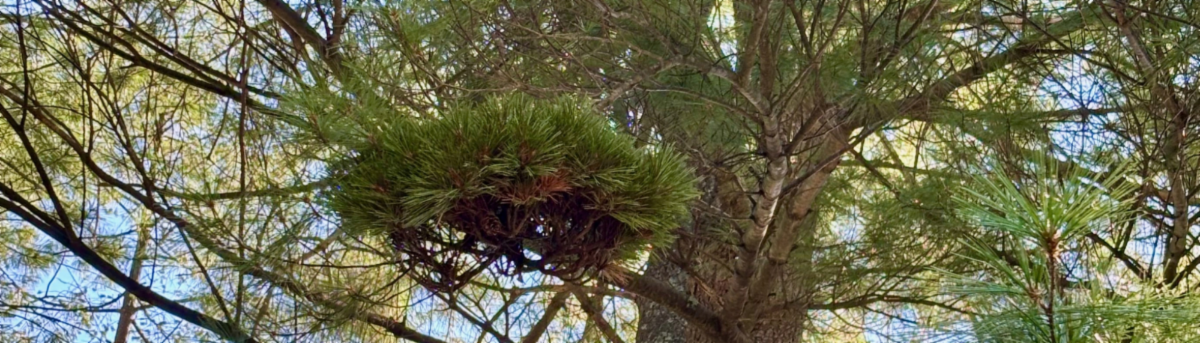
Note the congested foliage on this witches' broom found on a Pinus strobus.
photo by John Verbrugge
| | |
It’s October—a time when tomfoolery and witchery are in the air—a great time for a few words about witches' brooms...
When a plant’s reproductive cells go haywire, producing a dwarfed, congested mass of branches, twigs, and leaves, the resulting tissue is called a witches' broom* or sport. The name witches' broom originated in Medieval Europe from the belief that witches placed these distorted clusters of plant material high in trees, perhaps as a resting place. Witches' brooms can be found on all types of plants, from herbaceous to trees, and are caused by viruses (rose rosette disease), nematodes, mites, fungi, mistletoes, phytoplasmas (bacteria-like organisms that have no cell walls), or even herbicides. They can also be the result of natural genetic mutations, in which case the plant tissue is usually reproductively stable—the new characteristics can be reproduced through cuttings, grafting, and sometimes even seeds. Notably, pathogen and pest-created witches' brooms usually occur on unhealthy trees, while genetically-caused witches' brooms occur on healthy hosts, and the sport appears to be a tiny version of the host tree. They may differ in habit (weeping branches, twisted foliage, different form), color, or size. Typically, the growth of witches' brooms and their progeny is slower, the leaves are smaller, and the internodes (areas between leaves, buds, or branches) are shorter.
In their quest for more diminutive, colorful, or interesting plants, propagators are in constant search of witches' brooms. They have learned to look up—witches' brooms on mature trees are often on branches far from the ground. When the word goes out that a broom has been sighted, propagators are off with their tree climbing gear, pole saws, backhoes, or even shotguns to remove a portion of the broom. The plant material is kept moist until it can be propagated by grafting, seed, or rooted cuttings. Then the waiting begins—seed germination, rooting, and the graft union formation are slow processes, requiring several months or more and often particular growing conditions.
Local conifer propagator Bill Barger prefers to take plant material from witches' brooms in winter, when the plant is dormant and the cuttings can be kept refrigerated for months. He’ll root cuttings from hemlocks, arborvitae, and some chamaecyparis, but finds grafting more successful for spruce, pines, and other conifers. Plants created from witches' brooms are usually named on the spot, often with reference to the location: Juniperus vir. ‘Maumee', Larix laricina ‘Bear Swamp’, Abies bal. ‘Canada Creek Ranch’. It usually takes two years from the time Bill locates a witches broom until its progeny are available for sale.
Harvesting witches' brooms has brought us wonderful new plant options: Blue Star juniper, Mops mugo pine, Little Gem Norway spruce, Kahout’s Ice Breaker Korean fir. Bill's garden beds are filled with interesting and enchanting dwarf and miniature plants created from witches' brooms.
Once you are aware of and on the lookout for witches' brooms, a walk through the woods is never quite the same. Is that a squirrel’s nest up there? Or does it present the opportunity to create that beautiful giant in a back-yard size—the best kind of witchery! Look Around!
*In horticulture-speak witches brooms are known as virescences, meaning a growth consisting of multiplied and distorted plant parts, either leafy or woody/twiggy.
WITCHES BROOMS: WHAT THEY LOOK LIKE AND WHY THEY FORM: Woodland Trust
K Edgington
| | |
LEAF BRIEF
Go Big or Go Home
| | |
We all know that Ohio is popular with the pumpkin crowd. We are a major producer of fresh-market and ornamental pumpkins (not canned like Illinois), ranking near the top nationwide with close to 970 pumpkin-producing farms and about 5% of total pumpkin production. What about the folks that want to take it to the next level with a giant pumpkin? Not only does it take a lot of special effort, it takes a special seed.
If you want to play with the big boys and grow your own record-breaking pumpkin, your best bet is to start with a Dill’s Atlantic Giant Seed. Bred by Canadian Howard Dill, he spent the better part of 30 years cross-breeding giant varieties. This variety, officially known as Cucurbita maxima ‘Atlantic Giant’, holds every major record, growing anywhere from a “small” 200 pounder to a 2000+ pound behemoth.
These seeds are available online or by mail from most seed catalogues but, this being Ohio, you might be able to find them at your local hardware or farm supply store. A $10 packet supplies the genetic potential to produce a 100 to 300 pound pumpkin. These make very cool jack-o-lanterns! Prices rise with the size of the bounty, and to produce a record breaker you’ll want to purchase your seeds from a previous winner. These can set you back $50 per seed sold online or at seed auctions. (Yes, there is such a thing.)
Ready to get going? Get a head start on growth by starting seeds (more than one, just in case) indoors in late April in sterile medium. They are ready to transplant after the soil has warmed in late May or early June. Allow a generous 1000 square feet of gardening space for your baby. Protect it from excess heat, cold and wind, and water with at least an inch of water per week at first, then keep watering!
Pollination occurs primarily with bees but most serious growers use hand pollination to control the genetic mix. You’ll want to allow only 4-6 fruits per plant and when they reach volleyball size you will have to pick the most robust and sacrifice the rest, forcing all the nutrients into a single pumpkin.
The vines, which can grow one and a half feet per day, will need to be trained and pruned throughout the summer to control stem splitting, kinks and torsion as the pumpkin grows. Healthy doses of fertilizer are needed with nitrogen early on for vine development, transitioning to more phosphorus/potassium to drive rapid fruit growth. Soil testing is important.
Your pumpkin fruit will require shade to keep the outer skin supple enough to continue to expand. Most growers make a small tent of burlap or old sheets. Mulch is important to suppress weeds, keep soil temperature uniform, and keep the pumpkin from having contact with moist or infected soil.
Warding off pests and disease is a constant battle. The striped cucumber beetle can transmit bacterial wilt and aphids are vectors for viruses. It’s pretty much a given that you will face powdery mildew, which can be treated with a fungicide but other soil-borne bacterial diseases and squash vine borers can also threaten. You will need to be observant and have a treatment plan. Pumpkin crops should be rotated every three years.
A pumpkin's size will depend on a number of factors: the grower's skills and experience, geographical location, soil and air temperatures, soil nutrients, moisture and a little luck. They are ready to harvest in 120-150 days. Watch it grow here HERE.
When harvest arrives, it’s time for a party—you’ll need plenty of friends to help move your giant to its place of honor! Anything over about 700 pounds calls for heavy equipment and special lifting harnesses. Not surprisingly, giant pumpkin pulp is stringy and tough, so they aren’t grown for food. However, they can fetch thousands of dollars in prize money: The Operation Pumpkin Festival in Hamilton offers $9000 for its grand prize winner, while the Ohio Valley Giant Pumpkin Growers in Canfield offers a total purse of $25,000 for all winning entries. In addition to prize money, pumpkins are grown for their high-value seeds, sold to businesses and festivals for display purposes or perhaps purchased by that couple in your neighborhood who just likes to show off!
J Gramlich
| |
|
CREATURE FEATURE
A Look Back at Bats
| |
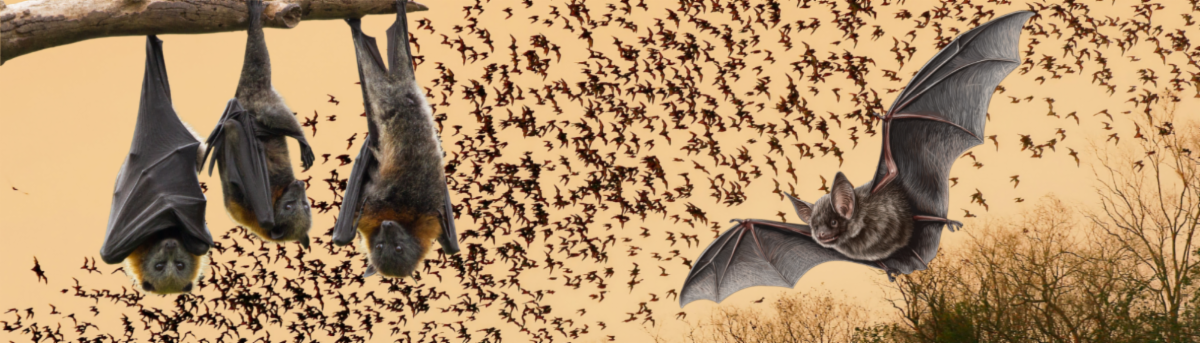
Three hanging fruit bats and a grey long eared bat
photos by Craig J David
| |
It’s October, so everything’s a bit spooky. You’re admiring the glistening night sky when a small shadow streaks across the moon —what was THAT?? No worries, it’s just a bat. Bats are amazing creatures that have gotten a bad rap. Let’s explore some common misconceptions…
Bats are flying rodents. Bats are flying mammals. You (primates) are more closely related to rodents than bats are. Some scientists believe bats had hands that evolved into wings. Imagine the skin between your fingers growing wider and thinner—voila, bat wings! With those wings bats fly superfast—some clocking in at 100 mph.
Bats suck blood. Most bats eat pesky annoying insects – incredible amounts of mosquitoes, moths, beetles and flies. One bat can eat thousands in a single night. Some bats eat fruit, nectar and pollen, serving as major pollinators and seed dispersers. About300 species of fruits depend on bats for pollination, including bananas, avocadoes and mangoes, and bats spread seeds for almonds, cashews, figs and cacoa. Bats play a major role in rainforest reforestation. Bats are hugely important to our environment.
Uh, the blood? Was hoping you’d forget. Of 1400 species world-wide, three species in Mexico, Central and South America eat blood. They make a tiny incision in their prey and lap it up. Ugh. On the positive side, scientists have discovered a natural agent in bat saliva that prevents blood from clotting. This blood thinning compound has been used to develop an anticoagulant that may help heart attack or stroke patients. It’s called Draculin…
She’s blind as a bat. She’s not, because bats are not blind. Some see quite well. But because bats hunt in the dark at high speeds, they use a sonar system called echolocation to locate prey, bouncing sound off objects, instead of vision. Scientists are studying this amazing ability to develop navigational aids for humans!
I’ve never seen a bat, so they must not be around. Bats are shy, nocturnal, stealthy and almost everywhere. Twenty percent of the world’s mammals are bats. Of the 11-14 species identified in Ohio, the Little Brown Bat and the Big Brown Bat are most common. Active from March to September, by Halloween these bats will be holed up for the winter in cozy spots like caves, mines, and possibly your attic. The natural roosting spot for bats is hollow trees or under peeling bark, but bats have learned humans provide good habitats, and will invite themselves in through a thumb-sized hole. Brown bats establish colonies in the spring to have their pups, so if you don’t want batty guests you must exclude them before May or after August, to make sure pups aren’t separated from moms. If you do have bats in your belfry, you might try building them a bat house once they’ve been excluded. See HERE for more information.
Bats carry rabies—that's terrifying! Relax—you’re statistically more likely to die from leprosy than rabies from a bat bite. Bats are generally docile but they will bite, so take all precautions if you must handle a bat or leave it to experts. Bat droppings (guano) can harbor a fungus that causes histoplasmosis, which generally has mild symptoms but can be severe. Care should be used around large amounts of bat (or bird) droppings. For more info click HERE.
A face only a mother could love. With their pointy noses, beady eyes, and razor-sharp teeth, bats are not what humans call cute. But you might change your mind after seeing THIS…
Bats are creepy. Bats are incredibly helpful to humans and the environment. All bats in Ohio are protected by law, so you cannot harm them and shouldn’t want to. Hawks and snakes are natural predators, but the bat’s worst enemy is White-Nose Syndrome. This infection has killed over 6 million bats since its introduction in the U.S. in 2006. (It was brought on the boots of a caver who had been spelunking in Europe, where bats are not impacted by it). Bats only produce one pup a year (one of the slowest reproducing mammals on earth), so the population is at risk.
Bats turn into vampires. Don’t be ridiculous…I gotta go. Acme’s having a sale on garlic and wooden stakes…
C Christian
| | |
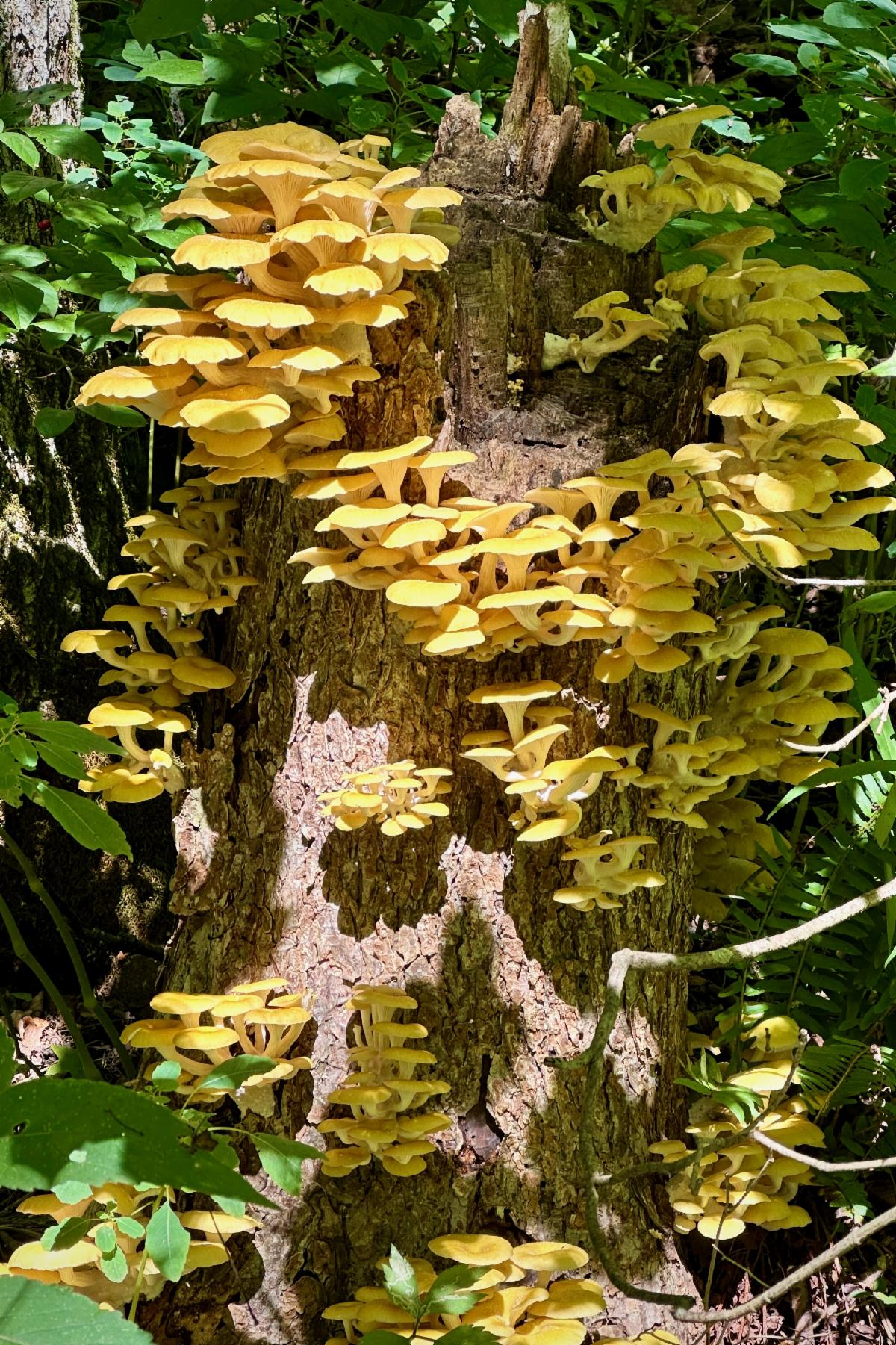
Golden oyster mushrooms breaking down a stump. You’ve got to love nature!
photo by E Barth-Elias
| | |
GARDEN DESIGN GREATS
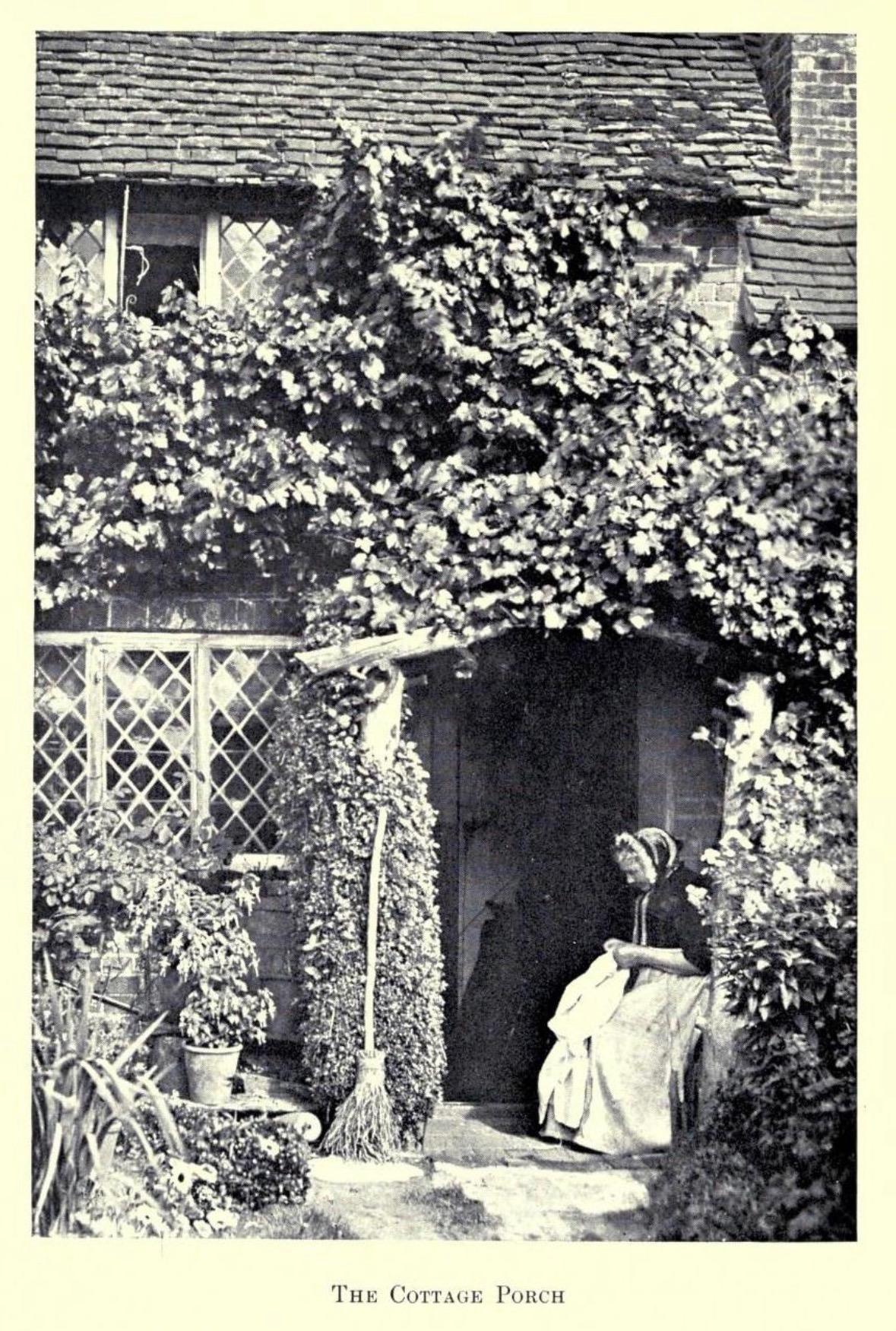
Gertrude Jekyll and the Cottage Garden
| | |
Had Gertrude Jekyll different parents, less talent or less gumption, the history of the Arts and Crafts movement on garden design might have been very different. Lucky for us, lovers of planted beauty have a rich trove of designs, words, pictures and, of course, actual gardens to inspire our modern-day works of art, painted in colorful flowers and greenery.
As it was, Gertrude was born at the height of the Victorian era, when designs were very formal and everyone’s role in society, especially women’s, was proscribed by rigid expectations of behavior.
However, with 13 generations of Jekylls behind her, including at least four as part of the British upper classes, she landed on the less traditional but freer side of that generation.
| |
Gertrude Jekyll in her Garden at Munstead Wood.
photo by Herbert Cowley, from Gardens for Small Country Houses (1913) [Public Domain]
| | |
Born in 1843 in London, Gertrude's family lived five years in the big city before they moved 30 miles southwest, to Bramley in Surrey. Although her father was never very strong physically, he had a prodigious intellect, encompassing the arts and sciences in almost all their forms. Luckily for us, his large garden at Bramley captured Gertrude’s interest, and she began exploring her “pleasure in working and seeing things grow.”
Her education was broad, starting at the Kensington School of Art, where she developed her talent for painting. Along with that first subject, Gertrude started to branch out into botany, anatomy and optics, or as it was described then, the science of color.
The family moved away from Bramley for a short time, until they returned to Surrey. Gertrude began to try her hand at garden design, and it was here that her parents’ encouragement was crucial, allowing her to take these interests as far as they could go, away from the strictures of the Victorian era.
For the next several years she expanded her artistic education to include interior design, singing, painting, carving, embroidery, metal work and photography. and expanded her gardening palette to include plant breeding.
She started a nursery at her mother’s home, Munstead House, and then, in partnership with architect Edwin Luytens, at her own home, Munstead Wood, across from her mother’s. After her mother died, Gertrude developed her nursery and, along with garden designer William Robinson, fully immersed herself in the burgeoning Arts and Crafts movement being promoted by John Ruskin and William Morris. Designers finally had the freedom to break with Victorian rigidity and choose plants, colors and bed shapes with a freer, more natural, hand.
This blending of art and horticulture has become embedded in the landscape. Now, we are no longer ruled by strict aesthetic boundaries, but encouraged to step back, see what nature has to offer and move our gardens forward with color, form and natural lines. Gertrude Jekyll forever changed the way we garden. We should rejoice.
Over her lifetime, she designed 400 gardens in the United Kingdom, Europe and America. She and William Robinson published The English Flower Garden in 1883, one of 13 books Gertrude authored. She wrote, edited or contributed to more than 1,000 articles.
Her home, Munstead Wood, became part of the U.K.’s National Trust in 2023.
Gertrude Jekyll died in 1932. Her friend Edwin Lyutens, engraved “Artist ~ Gardener ~ Craftswoman” on her tombstone. Fitting.
GERTRUDE JEKYLL: The Official Website of the Gertrude Jekyll Estate
S Vradenburg
| | |
October Checklist:
- Continue putting the vegetable garden to bed, cover with straw mulch, or a cover crop to prevent soil loss.
- Plant garlic cloves before the ground freezes.
- Plan, purchase, and plant spring bulbs.
- Divide overcrowded spring and summer blooming perennials and plant larger trees and shrubs.
-
Dig up tender bulbs, corms and tubers like dahlias, canna lilies, gladiolus, and caladiums before frost. Store in a cool, dry location. STORING TENDER "BULBS" FOR WINTER: Wisconsin Horticulture
- Enjoy locally grown apples.
-
Aerate lawns where the soil is compacted. Cut grass to 2-2 ½ in height to combat snow mold in winter. LAWN AERATION: West Virginia Extension
- Bring in house plants when nighttime temperatures dip below 50°. Inspect for insects and give them a good spray of water to dislodge any hitchhikers.
- Keep an eye out for spotted lanternfly egg masses on trees and other surfaces and destroy them when possible.
J Gramlich
| | |
I don't see how a pumpkin patch could be more sincere than this one.
Linus (It's the Great Pumpkin, Charlie Brown)
| | |
October 9th – Springfield Coffee Chat, 2491 Canfield Road 9:00am to 10:00am.
Plant Swap/Group Event
Contact: Frank Crawford Spinelli fspin53@gmail.com
October 23rd – Springfield Coffee Chat, 2491 Canfield Road 9:00 to 10:00am.
Garden Failures presented by Frank Crawford Spinelli
Contact: Frank Crawford Spinelli fspin53@gmail.com
More learning opportunities:
| | We invite you to share The Root of It with your friends and family. If you would like to subscribe to our mailing list please visit our website, scroll to the bottom, and click on the subscribe link. | | The Root of It staff: Karen Edgington (Editor), Emma Barth-Elias (Photo Editor), Carolyn Christian, Jennifer Gramlich, Sarah Vradenburg, and Geoff Kennedy (Technical Advisor) | |
We Would Like your Feedback
Contact us at: newsletterscmg@gmail.com
To discontinue receiving this newsletter please click on the UPDATE YOUR PROFILE link below. You may then choose what types of information you would like to receive from us.
| | | | |