Volume 6 Issue 12 | December 2025 | | Winding down the year with talk of this and that. | | The Root of It newsletter ends with our monthly quotation. If you find your newsletter has been clipped by your email provider please click HERE for a webpage version of the newsletter. | | |
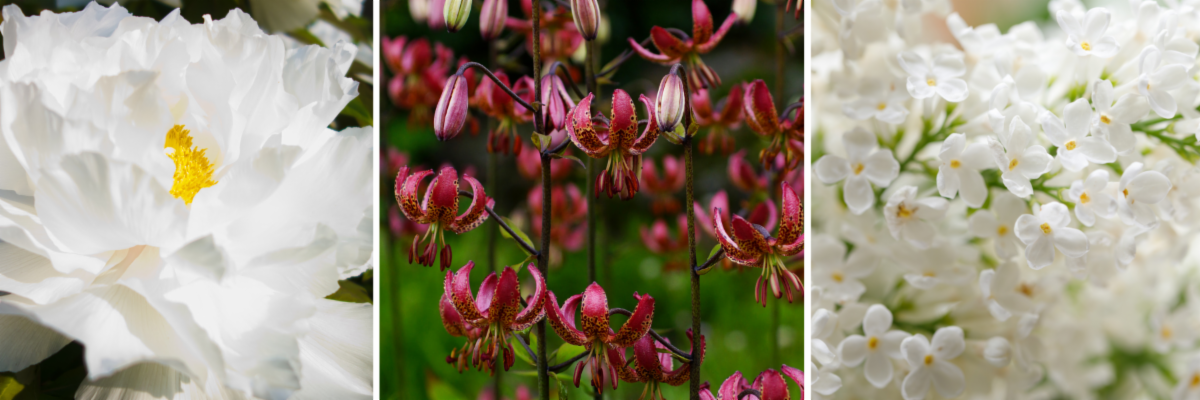
The beautiful blooms of a peony, Martagon lilie, and lilac
photos by E Barth-Elias
| | |
For years the plants in my garden designs have had to check all the boxes: right zone, correct soil and light requirements, a mature size that fits the space, the requisite multi-season interest. Lots of bang for your buck—that’s multi-season interest in a nutshell. These plants provide beauty season-to-season, and abound in color and texture. But a comment by plantsman Joseph Tychonievich at a seminar last January gave me pause, and I’ve pondered his words in the year since. Tychonievich noted the loss when short-term plants are excluded from the mix. Some of his favorite one-season wonders—a dwarf spring-blooming iris, ephemerals such as Virginia bluebells and trilliums, the goldenrods that end the season with an exclamation point—are highlights of his gardens. He gladly gives space to short-term beauties.
I’ve been thinking about the plants that give us those ahhhh moments and then fade into the background. Peonies come to mind. Their fragrance and beauty are hard to match. Martagon lily blooms are thrilling with their downward-facing, recurved petals and dramatic colors. The purple berries of beautyberry shrubs (Callicarpa spp.) are riveting during late-season strolls. Forsythias certainly aren’t star performers season-to season, but are balm to late-winter, color-starved eyes. Lilacs—what better reminder of an age gone by than the beautiful panicles and scent of lilacs! The diminutive blooms of toad lilies (Tricyrtis spp.) beg closer inspection.
Perhaps the best feature of short-term garden beauties is the anticipation they inspire. The apprearance of their long-awaited blooms, berries, or fall color are cause for celebration.
Will I give up on my interest in multi-season plants? Certainly not—they are the backbone of my gardens. But I will approach single-season plants with a greater respect and cede space for the pleasures they offer. Look around!
K Edgington
| | |
LEAF BRIEF
A Cactus That Isn't
| | |
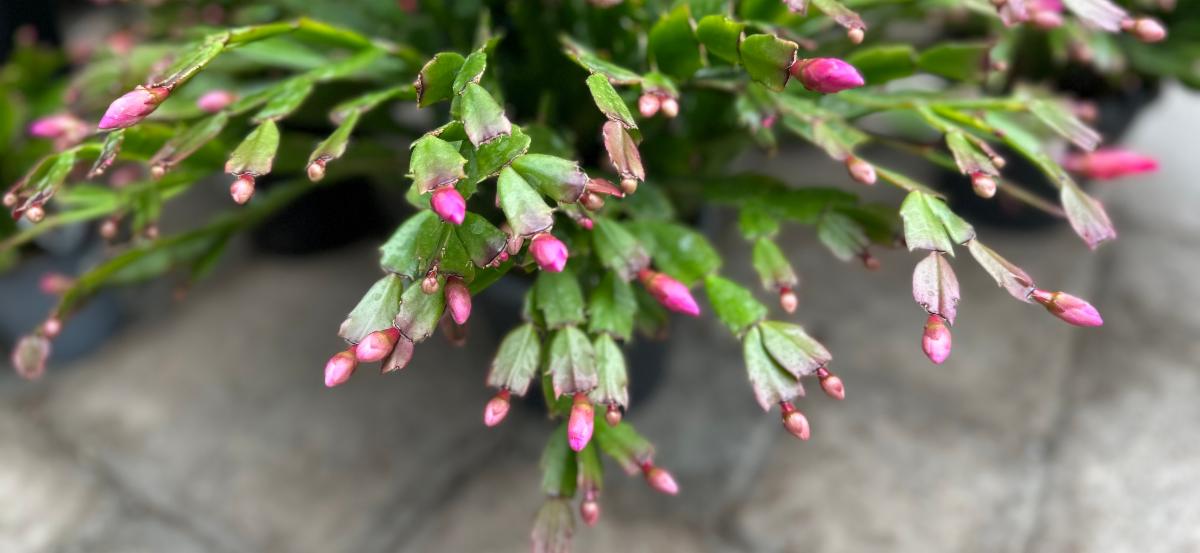
The glowing buds of a Christmas cactus
photo by E Barth-Elias
| | |
While snow falls outside, the Christmas cactus (Schlumbergera × buckleyi) brings a burst of tropical joy indoors, adding festive holiday spirit to any home—no green thumb required!
Despite its name, the Christmas cactus isn’t a typical desert cactus but a rainforest epiphyte that requires different care than you might expect. Native to the tropical rainforests of Brazil, it grows on tree branches or in rock crevices with consistent moisture and filtered light. It thrives in well-draining soil that holds some moisture. Unlike its desert relatives, it dislikes harsh, direct sunlight, especially at midday. For healthy foliage and reliable flowering, place your plant in bright, indirect light such as an east or west-facing window.
Most of us cross our fingers and hope the vibrant magenta or pink blooms open with the Christmas holiday. There are some things we can do to make this more likely. To trigger blooming, shorter days and cooler night temperatures are key. The Christmas cactus requires a period of longer nights (often 12 or more hours of uninterrupted darkness) and overnight temperatures around 60–65°F for several weeks to set flower buds. Once buds appear, avoid moving the plant to a new location or offering inconsistent care—jarring changes in its environment often lead to bud drop.
Year-round care is relatively easy. After the blooming period ends (January, if you’ve played your cards right), the plant benefits from a “rest” phase—lighter watering, cooler night temperatures, and reduced light help it rebuild and prepare for the next cycle. During the active growing season (spring through early fall), feed it monthly with a balanced houseplant fertilizer. It can be placed outside in summer as long as temperatures are above 55°F and it is out of full sun. As the flowering season approaches, reduce or stop fertilization to focus the plant’s energy on bloom production.
So, what if your cactus isn’t budding or blooming in December? You need to ask yourself, do I really have a Christmas cactus? Cactus cousins like the Thanksgiving cactus (Schlumbergera truncata) and the Easter cactus (Rhipsalidopsis gaertneri) look similar and bloom during their respective holidays. The easiest way to tell them apart—besides bloom time—is by the differences in leaf segments called cladodes, which connect to form the drooping, branching shape. The Christmas cactus has smooth, rounded edges, while the Thanksgiving cactus's edges are more pointed. Look for rounded edges and tiny bristles at the joints to identify an Easter cactus. Unfortunately, some growers confuse things by calling all varieties Christmas cacti.
Other factors to consider are whether the cactus is receiving the continuous darkness needed to trigger blooming (too near a bright light or screen?). Soil that is too moist can cause yellowing and discourage blooms, and changing locations can trigger bud drop.
The Christmas cactus is long-lived, reaching 2 feet tall and spreading 3 feet wide. With a little TLC, your Christmas cactus can become a cherished holiday tradition for decades to come.
CHRISTMAS CACTUS: University of Florida Extension
J Gramlich
| | |
CREATURE FEATURE
A holiday tale...
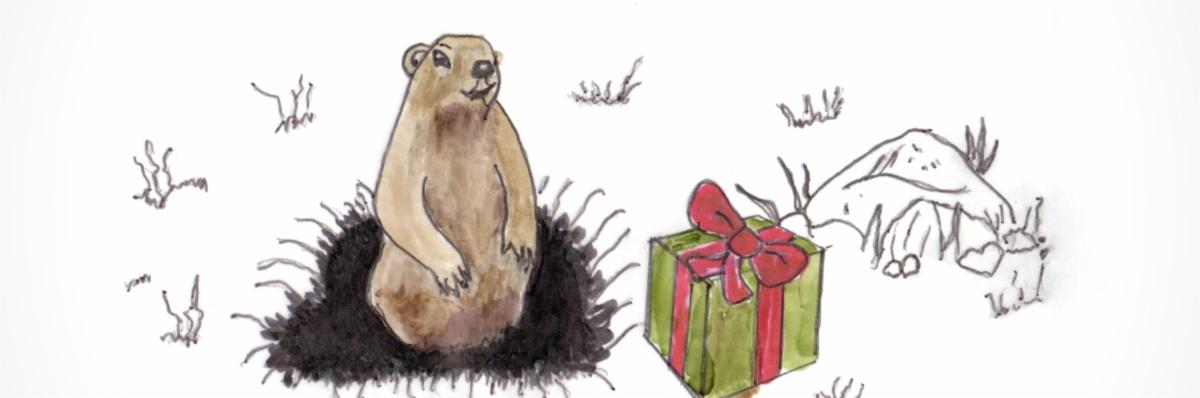
| | Illustration by K Edgington | | |
Dawn was fast approaching, and the Boss was worried. He had a million more stops—literally—and a lot of sad faces come morning if he didn’t finish. Luckily, he was used to thinking on the fly.
Northeast Ohio loomed below, and the Boss decided to delegate. He’d never done it before, but desperate times, etc. Zooming close to the ground, he tossed two crew members out onto the frosty ground. “Take care of the burrows,” he called over his shoulder as he tore off. “We’ll pick you up after we finish the houses!”
A large sack landed next to Geoff the Trainee, who was flat on his back and slightly green. “Burrows?” he said to Supervisor Sue. Sue was already checking her list. “What’s he talking about?”
Sue looked up over her glasses. “Some years we visit our animal friends. It’s relatively easy—they’re all on the nice list. Instinct isn’t naughty.” She paused. “Surely you know this?”
Geoff scrambled to his feet. “Uh, surely,” he replied.
“Hmph,” Sue said, going back to the list.
Geoff looked at the snow-covered trees and lawns, the darkened houses. The air seemed to shimmer with anticipation.
Of course, it was a special night.
“Where are they?” Geoff asked.
Sue rolled her eyes. “Holes,” she said. “Animals like groundhogs, skunks, moles, and chipmunks den in underground burrows. We find their holes.”
“We’ll start with groundhogs,” she said, rummaging through the sack. “Their holes are quite big. They’re hibernating, so we’ll leave acorns and hickory nuts—a nice treat when they wake.”
“Groundhogs like places where trees meet open spaces, near cover and food—they’re called an ‘edge’ species.” She headed towards the woods at the back of the yard. “Found one,” she called, and tucked the nuts into a soccer-ball sized hole with a mound of dirt at the entrance.
“Skunks are next,” she said. “They enter ‘torpor’, not hibernation, so they’ll wake up occasionally when the weather warms. Skunk dens are grapefruit sized holes, often under porches or decks. Entrances are smooth mounds, sometimes with pebbles around the front.”
She bent down to look under the porch. “Here we go! I’m sure you know they’re omnivores,” she said, giving him a look that said she wasn’t sure at all. “They’ll eat almost anything. However, we usually don’t gift animal to animals—not the holiday spirit. The skunks like a nice fruit basket. Temperatures are warming, so they’ll wake soon and enjoy it.”
“What about rabbits?” Geoff suggested, hoping to be helpful. “Don’t they dig burrows?”
“Not here,” Sue replied, ears twitching in annoyance. “Eastern cottontails, the most common rabbits in Ohio, don’t dig warrens like European Watership Down types. Rabbits here shelter in heavy brush, cavities or abandoned dens. They’ll be out at dawn to feed—soon! We’d better hurry. Here’s dandelions for the bunnies.”
She scanned her list. “Now the moles. They prefer moist, loose soil, so look around the garden and lawn. They stay active in winter, but burrow deep below the frost line, so you won’t find ridges pushing up the ground like you would in warm weather. Molehills are raised mounds of dirt, no visible entrance—and the hole is usually filled in.” They tromped around the yard. “There’s one.” Sue pointed, then pulled a plastic bin from the sack. “Worms and grubs for the moles—no other options, really.”
The stars were fading. “The Boss will be back any minute,” Sue said, glancing up. “But the list says chipmunks, and we can’t miss them—the Boss has a soft spot for Alvin and the gang.” She looked around. “Chipmunk tunnels may be thirty feet long and three feet deep, but the entrances (there can be many) are only a few inches wide—and might be filled in with leaves for insulation. Check near rocks, log piles, buildings. Maybe by that stump over there.”
They looked everywhere—nothing. The clock was ticking. As a faint jingling sounded in the distance, Sue’s ears bristled with nerves. At the last possible moment…Geoff spotted the hole! They left a bag of corn just as the Boss swooped down. In a flash they all whirled up and vanished into the sky.
A glorious morning dawned, filled with happy faces.
And then the real miracle happened. Sue turned to Geoff and said, “Nice work.”
C Christian
| | |
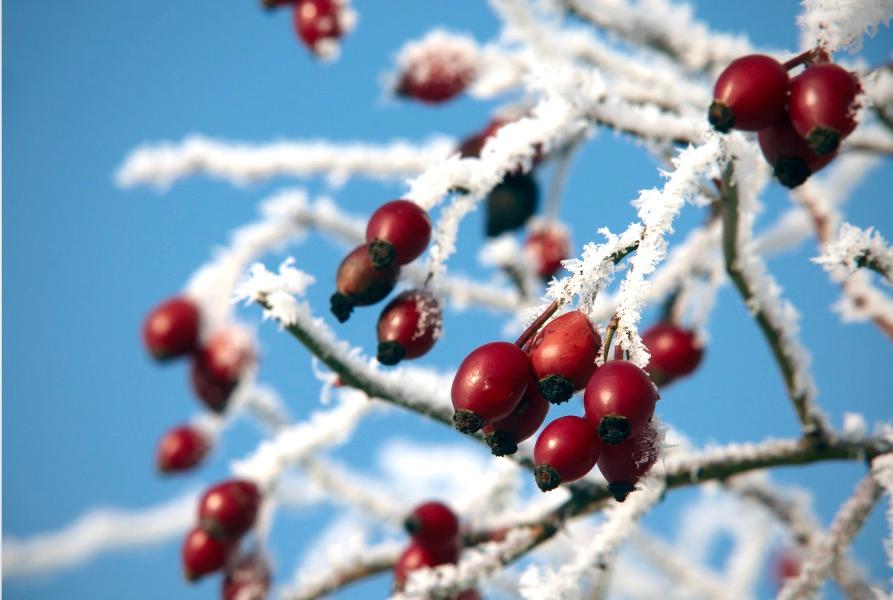
Rose hips on a wintry day
photo by E Barth-Elias
| | HOW LOVELY ARE THY BRANCHES | | |
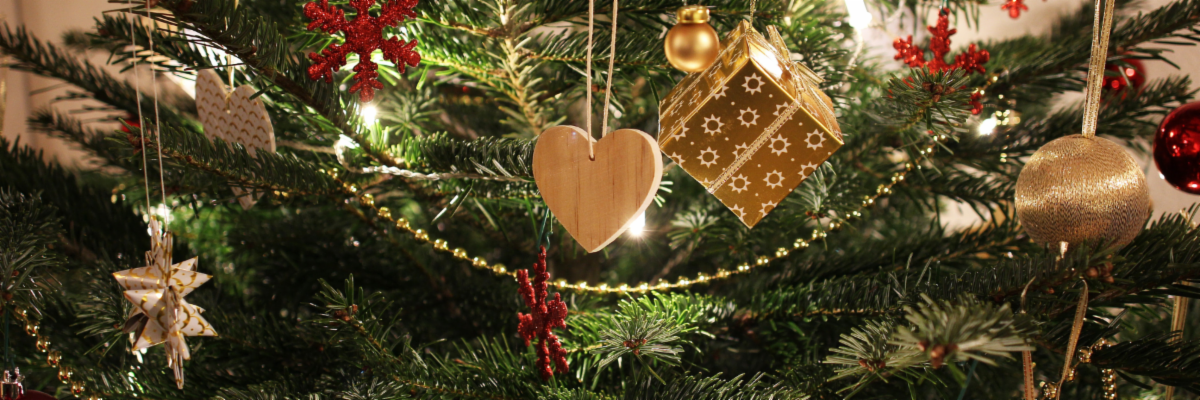
It’s December and for many of us that means putting up a holiday tree. Even people who worship faiths other than Christianity, or not at all, find the evergreen expression of this festive season an important part of their family tradition. It’s a cultural phenomenon that includes most people—about 77 percent in the United States. For those who do put up a tree, the question often comes down to real or artificial. Before we get into the real vs. fake debate, it’s worth exploring how the Christmas tree became such a fixture in our holiday traditions.
A holiday celebrating the return of light after the darkness of winter has been a part of human culture for thousands of years. The celebration centers on evergreens, which hold their color throughout the winter. From Egypt to Rome to Europe, the winter solstice is made festive by evergreen boughs hung on doorways and strewn throughout houses to acknowledge the return of light to the world.
Germans are credited with actually “inventing” the Christmas tree. Stories tell of Martin Luther, the Protestant reformer, who saw stars twinkling through the branches of an evergreen one night. He brought a tree into his home and wired candles to the branches to imitate the starlight.
The popularity of Christmas trees got a boost during Victorian England when, in 1848, Queen Victoria encouraged Prince Albert to put a tree in Windsor Castle, helping to recreate his childhood Christmases in Germany. Soon, East Coast Americans began to emulate the royal family, and evergreen trees took root in the United States.
That tradition has evolved, and most Americans put up a tree each year, which brings us back to the debate: What is better, real or artificial trees?
Most families that buy trees, about 64 percent, buy an artificial one. They cite the convenience of having a tree ready when it’s time to decorate. There isn’t any need to water, allergies are not a factor, and cleanup is a snap. They can be used year after year.
For people who prefer real trees, creating memories is often mentioned as a plus. There is the real tree smell, and, as long as the tree is well-watered, little fire hazard.
When citing the environmental benefits of artificial trees, experts say that the annual trips to tree lots or farms for a real tree put a lot of climate-warming pollution into the atmosphere, as well as the transportation costs involved in moving the trees from the tree farms, many on the West Coast, to where they are sold.
However, when other costs are factored in, it’s a more complicated picture. Real trees support wildlife, sequester carbon and are recyclable when ground to become compost or used as mulch. They are usually grown as crops and support tree farms.
Artificial trees are made with petrochemicals, most often polyvinyl chloride. Once they are disposed of, after the average 4 years that most families keep artificial trees, and even if donated afterward and reused many times, eventually they will sit in a landfill—forever.
Ultimately, the tree buyer decides on which side of the debate to plant the family holiday tree.
HISTORY OF CHRISTMAS TREES: History.com
S Vradenburg
| | CHRISTMAS DOWN ON THE FARM | | |
Sugargrove Christmas Tree Farm
Photo by S Vradenburg
| |
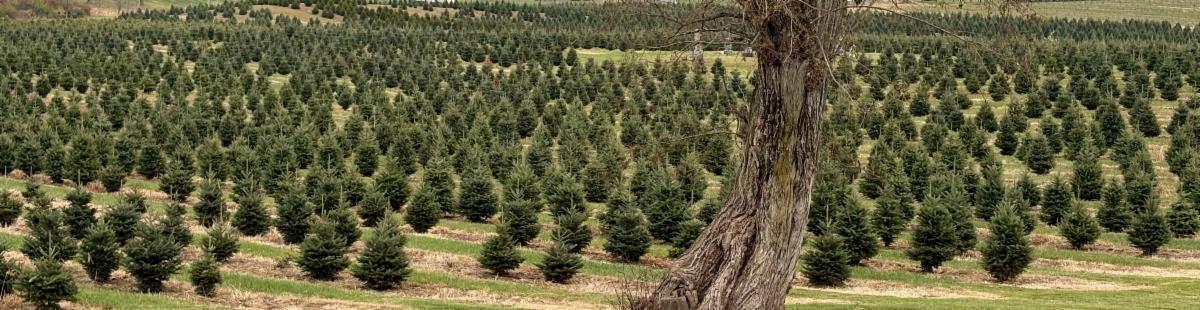
Some people believe that buying a real Christmas tree means depleting our forests. Rest easy, most Christmas trees are grown on farms, just like corn or soybeans or any other agricultural crop. My visit to Sugargrove Christmas Tree Farm outside of Ashland gave me a glimpse into how such a farm operates.
Blake Rafeld, part owner of Sugargrove and a Franklin County Master Gardener volunteer, grew up on this farm when it still produced farm commodities: cattle, corn and soybeans—in short, a working farm as we think of them. On a gray Friday morning in November, he drove me around 40 acres at Sugargrove now devoted to growing Christmas trees. The rows were filled with a variety of evergreens: long-needled white pines, Colorado blue spruce, and Norway, Fraser and Canaan firs. The rows of stick-straight central leaders marched into the distance like soldiers in a holiday parade. He explained that Fraser firs are the most popular. This will be the last year for the spruces— battling rhizosphere needle cast makes growing them a losing proposition.
Like many nurseries, Sugargrove grows its own stock from seed supplied by Berkey Seed in Spartanburg, Pa. The farm is divided into 10 approximately 4-acre blocks, with about 4,000 trees in each harvested annually. Before the just-harvested field is replanted, the soil is tested and amended as necessary. “Frasers are finicky,” Blake explained, saying that they like loamy soil. The rest aren’t quite so picky.
Growing the trees is just the one part of the process. Much of the harvesting is done by the hundreds of families that traipse to the Ashland County countryside to find their own tree. Blake said that about 75 percent of the customers in any given year have visited at least once before.
Wagons with families on board, some pulled by tractors and some by teams of draft horses, head into the fields to choose just the right tree. Once the wagons return to the barn, the trees are put on a shaking machine to loosen anything sitting in the branches. Each tree is then drilled from the bottom and placed on a tree stand where it is leveled and bolted in place. Then it is put through a baler or tree netter ready for its trip home and decoration. The farm also provides balled and burlapped trees for families who want to plant their tree after the holidays.
Of course, trees aren’t the only things available at Sugargrove. While the tree is being processed, the families are directed into a modern barn for hot chocolate and goodies and to pick up some other Christmas trinkets as mementos of the day. The process can take anywhere from about an hour to many more depending on when the families visit. The lines are long and slow the weekend after Thanksgiving.
Blake and his wife Christine are the sixth generation of farmers at Sugargrove. Blake sold all but a few of the farm’s 90 acres to Ben Smith, a neighbor who now runs the tree farm. Ben’s wife is also from the area, and her father devotes his nearby farm to staging a fall festival, Christmas’s logical companion. Regardless of ownership, the farm itself has marked two centuries of continuous cultivation.
S Vradenburg
| | |
December Checklist:
- Continue to plant spring bulbs if the ground is not frozen.
- Mulch roses for winter protection; cut back to about two feet to prevent wind whipping.
-
Do a final garden clean up: Harvest leftovers, clear plants and their supports and cover to preserve soil. https://extension.umn.edu/yard-and-garden-news/putting-your-garden-bed
- Take advantage of nice weather to pick weeds and rake leaves on the lawn. One last mowing keeps things tidy and helps curb disease.
- Consider forcing bulbs. Paperwhites and amaryllis are good choices.
- Bring in garden hoses and ceramic pots. Turn off and clear outside water faucets and sprinklers.
- Clean and lubricate garden tools.
J Gramlich
| | |
More learning opportunities:
| | |
Gardening is the handiest excuse for being a philosopher. Nobody guesses, nobody accuses, nobodoy knows, but there you are, Plato in the peonies, Socrates force-growing his own hemlock. A man toting a sack of blood manure across his lawn is kin to Atlas letting the world spin easy on his shoulder.
Ray Bradbury
| | We invite you to share The Root of It with your friends and family. If you would like to subscribe to our mailing list please visit our website, scroll to the bottom, and follow the link under Join our email list. | | The Root of It staff: Karen Edgington (Editor), Emma Barth-Elias (Photo Editor), Carolyn Christian, Jennifer Gramlich, Sarah Vradenburg, and Geoff Kennedy (Technical Advisor) | |
We Would Like your Feedback
Contact us at: newsletterscmg@gmail.com
To discontinue receiving this newsletter please click on the UPDATE YOUR PROFILE link below. You may then choose what types of information you would like to receive from us.
| | | | |