Volume 7 Issue 2 | February 2026 | | The Root of It newsletter ends with our monthly quotation. If you find your newsletter has been clipped by your email provider please click HERE for a webpage version of the newsletter. | | |
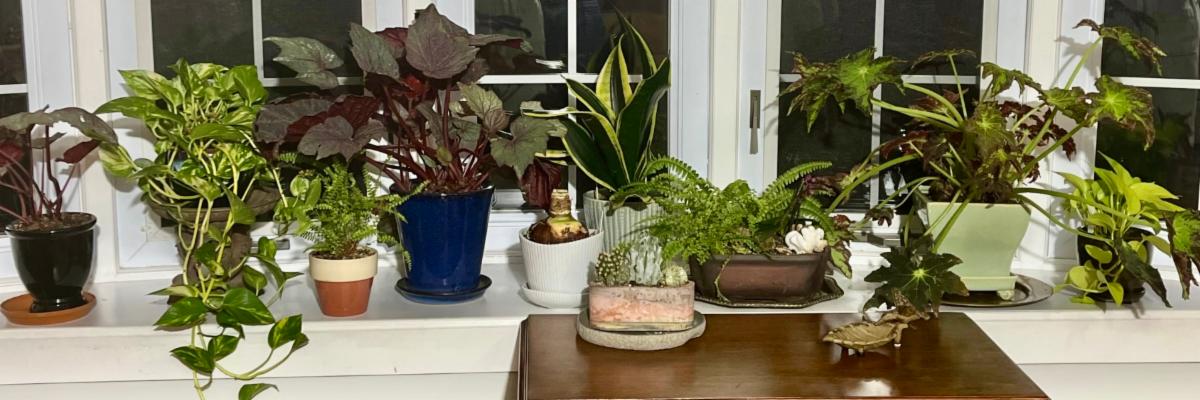
Has your bungalow turned into a “jungalow,” with plants on every windowsill, spilling onto counters and floors? You are not alone—America's phytophilia (love of plants) has moved into the home. Houseplants are a fixture in the American lifestyle. The US indoor plant-growing industry brought in $4.76 billion last year, and that doesn’t include lights, fertilizers, and other plant-related items. Millennials (ages 29-44 years old) are in the forefront of the wave, responsible for about 35% of houseplant purchases. Facebook Marketplace gardening listings reveal a population trading cultivars of fancy houseplants far removed from their plain, green-leaved parents.
Enthusiasm for houseplants has ebbed and flowed throughout history. In the 19th century Victorians had a love affair with tropical plants, and those that could built glass houses or orangeries to pursue their hobby. Ferns were hot, and few respectable parlors were without them, even coining the word pteridomania (fern madness). The enthusiasm continued in the years following Victoria’s reign, with the development of the Edwardian (sometimes called the Wardian) case, a terrarium-like box for transplanting and growing plants.
There was renewed interest in houseplants when women entered the work force in the 1940s and brought a bit of green to soften work environments and to remind them of their homes. The back-to-nature movement in the 1970's saw another spike.
When the pandemic of 2020 created a housebound world, houseplants were the perfect antidote, offering distraction and companionship, and creating a green space for those unwilling to leave the safety of their homes. Fueled by social media, houseplant interest soared, with the houseplant industry generating billions of dollars in the US during the pandemic years. (Considered part of essential agriculture, nurseries were allowed to stay open.) Post-pandemic, houseplant enthusiasm has continued, particularly among Millennials and Gen Zers.
The advent of new lighting technologies and the growing interest in indoor growing has resulted in a wide range of lighting options. Shelving units, spotlights, under-counter units, floor lamps—there’s a style for each situation. LEDs make the units inexpensive to operate and many have color options, with different ranges of wave lengths suited to different aspects of growth. That being said, a bright window will suit most plants. (Do pay attention to light preferences—plants vary in their need for bright light).
The houseplant craze has meant the development of colorful leaves and flowers and new shapes and textures. Some carry a hefty price tag. A Domesticum Philodendrum can run $125 and a White Variegated Monstera $150! Well-heeled collectors are happy to purchase these beauties. However, a perusal of the offerings of online or local houseplant purveyors will show that there is a wide variety of colorful, interesting, and enticing houseplants at affordable prices.
Aside from the beauty they add, plants offer real benefits in home interiors. Studies show that having houseplants around reduces stress and improves mood, suppressing sympathetic nervous system activity and lowering diastolic blood pressure. Per University of Michigan research, studying in the presence of plants increases concentration, memory function, and productivity. Houseplants moisturize dry air, and some help purify it. There’s a lot going on when you bring a plant into your home.
Studies have shown that one in seven people has a highly connected relationship with their houseplants, a love for the plants in their home. Whether you are an anthophile (obsessed with plants and flowers) or have a more casual relationship, it is a golden age for the enjoyment of these indoor beauties. Look Around!
15 COMMON HOUSEPLANTS PERFECT FOR YOUR HOME: PHS
THE BENEFITS OF HAVING HOUSEPLANTS: South Dakota State Extension
HOUSEPLANT ENCYCLOPEDIA A-Z: Guide to Houseplants
K Edgington
| | |
LEAF BRIEF
Passion in the Shade: Bleeding Heart
| | |
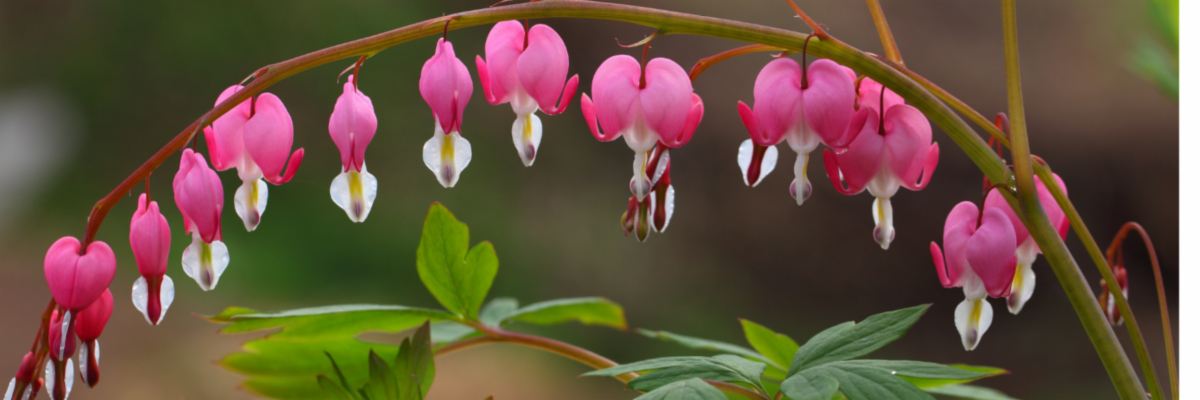
Lamprocapnos spectabilis
photo by E Barth-Elias
| | |
Plant names can run the gamut from weird to curious and plants named after body parts are no exception. Does one really picture a foot with the mention of a lady slipper? Does that gnarled buddha’s hand citrus truly resemble fingers? Fortunately, the bleeding heart lives up to its name, instantly calling to mind its Cupid-inspired form.
Bleeding heart (Lamprocapnos spectabilis) starts appearing in mid to late spring, thriving in cool shade alongside other spring ephemerals. Its gracefully arching stems are lined with dainty rows of heart-shaped blooms finished with a tiny dangling “drop.” The flowers consist of four petals: two large outer petals form the classic heart shape and two smaller inner petals protrude below, creating a “tear.” The resemblance to a Valentine heart is uncanny.
Unsurprisingly, bleeding heart has come to symbolize passion, romance, and unconditional love but is also linked to heartbreak, loss and sorrow, adding to its universal appeal. It adds a touch of drama to the garden be it a classic cottage, woodland, pollinator-friendly or romantic design.
Passion can be fleeting and so is the bleeding heart. As the heat of summer sets in, the leaves yellow and die back completely, leaving ferns, hostas and astilbes to fill the gaps.
Despite its dainty appearance, bleeding heart is fairly low-fuss. Water occasionally during dry spells and it should be good to go. Divide the rhizomes in early spring before flowering or in fall after the foliage has died back. Deer and rabbits may occasionally sample, but these plants are generally pest resistant.
The bleeding heart has had a bit of an identity crisis. Once widely known as Dicentra spectabilis, botanists have since reclassified it as Lamprocapnos spectabilis which loosely translated from Greek means “spectacular sparkling smoke.” While the former name is still commonly used, it is now considered obsolete, having changed way back in 1997.
Though common in American gardens, Lamprocapnos spectabilis is not native to the United States but hails from Asia. Similar native varieties include Dicentra eximia, the fringed bleeding heart found at higher elevations of the Appalachians and Dicentra formosa, the Pacific bleeding heart, only found out west. Explore more about the different varieties HERE.
If you appreciate a plant with romance as well as a flair for the dramatic that demands little in return, the bleeding heart is for you. Lingering among the blossoms may call to mind the great loves of your life or even the one that got away. Gardening’s special moments may be fleeting but leave lasting memories. Happy Valentine’s Day!
J Gramlich
| |
|
CREATURE FEATURE
Love is a Mystery
| |
BFFs?
Photo by Jeff Anderson
| |
Love is a mystery—one that humans have explored for centuries through art, literature, music, science, religion—and TikTok videos—to understand what draws people together. The answer is always the same.
We have no clue.
But non-human creatures also pair up and procreate. Are they equally subject to this seemingly capricious force that can result in life-changing events like children and someone else to take out the garbage? Is their success rate better than our 60% of first marriages that stay together? Can we learn something from them? (Click HERE to see where humans rank as monogamous compared to other species.)
These are not simple questions, and scientific theory on animal pair bonding is evolving. But you may be surprised to learn that most mammals—96%—are not monogamous.
Even birds, who scientists long believed were mostly monogamous, are just good at sneaking around. Using DNA fingerprinting technology developed in the 1980s, scientists now believe most birds practice what they call ‘social monogamy’—wink wink. A couple forms a pair bond for mating and raising offspring that may last one or multiple seasons, but is punctuated by occasional, furtive flings. Scientists refer to these as “extra-pair copulations (EPC) instead of ‘cheating’, but I wouldn’t try that at home.
So why is sexual monogamy (one partner for life) so unusual?
Because promiscuity is good for evolution. The most common type of polygamy (more than one partner) is polygyny—a male mating with multiple females. A creature Casanova with many gal pals spreads his genes around, increasing genetic diversity and his species’ survival.
Less common is polyandry—females mating with multiple males. A female with a disappointing partner may hook up with the stud down the street to produce better quality (more likely to survive) babies. Ladies also may engage in EPC for food or nesting materials (expensive restaurants and jewelry?).
Given all this guilt-free fun, why does anybody stay together beyond the morning after?
Ensuring offspring survival appears to be a significant reason, one linked to the biology of the species. Consider that most mammals gestate inside Mom’s body—Dad’s got nothing to do with it. Once babies are born, Mom feeds them with her milk for at least the beginning of their lives, leaving Dad free to hit the bars and romance others—with the noble excuse of perpetuating his kind. Mom mammals generally don’t need Dad’s help—but it certainly wouldn’t hurt.
Bird eggs, on the other hand, are laid outside Mom’s body, so both parents can share in incubating and protecting them, as well as feeding and defending the newborns. The babies survival may depend on Dad’s participation, which may explain most birds’ socially monogamous lifestyle. But there are exceptions—hummingbird males are the avian equivalent of deadbeat dads.
Birds may also stay with their mate to conserve the energy required to find a new one, or in places with few females, males may stay with their gal out of fear somebody else will fly in and ‘cheep’ talk her away (also sounds familiar).
These DNA-based findings have made scientists reluctant to classify any species as truly sexually monogamous without definite proof (and that’s difficult to get). However, current research indicates that certain neurochemicals found in humans and associated with feelings of love (dopamine and oxytocin) are also found in animals. Some scientists think these chemicals play a role in encouraging animals to form social bonds. Applying our notions of romantic love to animals is probably silly, but only they know for sure. Read THIS RESEARCH on the monogamous prairie vole.
Although they may not be 100% faithful, certain species do form strong, long-time pair bonds, such as trumpet swans, wolves, beavers and snowy and barn owls. Many of these share parental duties. Canada geese co-parent for up to 9 months, foxes do the same for 7 months. Bald eagle pairs add to their same nest year after year—the size of an Ohio nest indicated a 30-year relationship! A male barn owl provides food to the female while she’s keeping eggs warm, then helps her feed the babies. Read HERE about the life-long connections of these and other animal partnerships.
So apparently love is a mystery in the animal world too—and as capricious. The most faithful mammal on the planet may be the California deer mouse. Who’s to say a mouse can’t love? I’m sticking with roses, chocolate—and my illusions.
C Christian
| | |
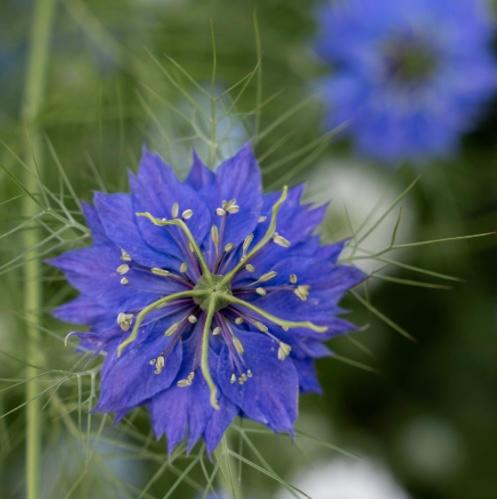
Nigella damascena aka Love-in-a-Mist
photo by E Barth-Elias
| | |
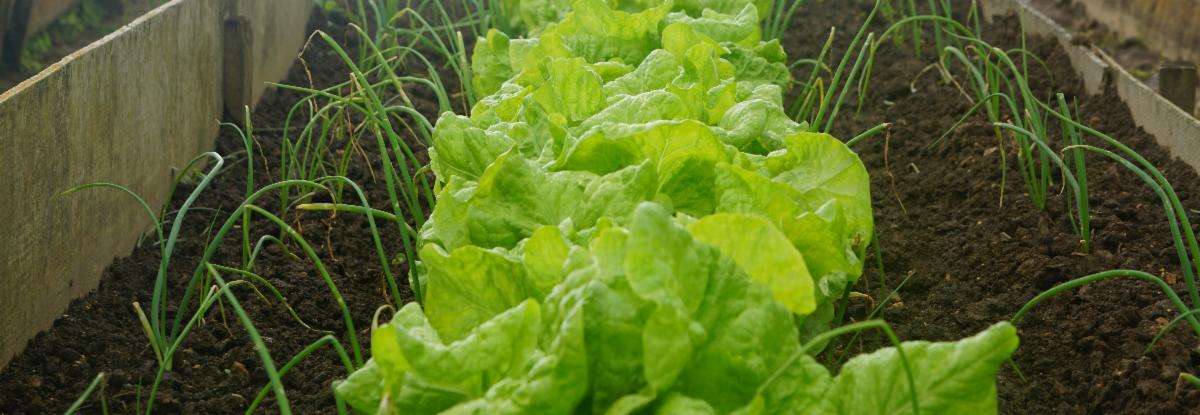
Lettuce and chives are good partners.
Photo by Kenan Kitchen
| | |
Carrots Love Tomatoes and Roses Love Garlic are two titles that have lived among my gardening books for decades. The late Louise Riotte’s bibles of companion planting speak to the desire among many gardeners to harness nature’s ability to help us grow beautiful flowers and tasty, nutritious vegetables as free of chemicals as possible.
Some of the ideas she puts forward seem to make sense. It seems logical that aromatic plants like mint and rosemary would repel certain insects. We know that plants in the bean family fix nitrogen, enriching the soil for next season’s plants.
Many of the beliefs at the heart of companion planting are just that: beliefs. They are presented as simple truths handed down through generations without real proof. The science behind companion planting makes clear that, while some old beliefs belong in the realm of folklore, others are rooted in research. Indeed, using plant combinations often helps their “partners” thrive.
There are real benefits to companion, or partner, planting, among them soil conditioning, attracting pollinators, keeping pests and weeds under control, aiding in disease prevention, and providing structure.
Cover crops are well-known soil conditioners, grown either before or after the gardening season. This green manure can be left after cutting to slow evaporation or, especially if it’s a nitrogen-fixer such as red clover, turned into the soil to feed plants. If the soil is compacted, plants like turnips and radishes, also good as cover crops, are excellent at breaking up hardened soil. Some cover crops such as oats have allelopathic properties inhibiting competing weeds.
Companion plants can support their neighbors. Sunflowers, with their thick, straight stems, are ideal plant trellises for beans, mini gourds and other small melons. Okra, sunchokes or quinoa also support vining vegetables.
Plant partners help control pests. Trap cropping seeks to divert pests from the targeted plant. Chinese mustard is effective in luring flea beetles from such plants as cabbage, broccoli and cauliflower. Other companions are used to visually confuse the pest or mask the host plant’s volatile chemicals, sending the insects somewhere else.
Another way to control pests is to grow plants that attract beneficial insects. Aphids, prolific and widespread pests, love plants in the aster family. To prevent an infestation of aphids on your brassicas, a stand of daisies and/or zinnias are likely to help keep aphids at bay. In fact, in keeping with Integrated Pest Management, interplanting several species of asteraceae can help prevent a major aphid outbreak.
Let’s not forget the workers among our insect friends. Most plants need pollination to reproduce, so finding companions that encourage pollination should be top of every gardener’s list. Tomatoes and eggplant need buzz pollination. Snapdragons or lupines lure buzz-pollinating bumblebees to their ideal flower shapes. Don’t stint. Interplant these flowers throughout your garden.
It’s too simplistic to pair compatible or complementary species on a one-to-one basis. Companion planting is successful because it enhances biodiversity. The greater the variety of plants, the more resilient a garden. Knowledge of specific beneficial pairings adds to the array of tools in the gardener’s belt.
As always, the more we know the hows and whys of gardening, the more we can appreciate the many ways the natural world is our companion in this journey we call gardening.
GARDENING WITH COMPANION PLANTS: WSU Extension
Plant Partners: Science-based Companion Planting Strategies for the Vegetable Garden, Jessica Walliser, 2020, Storey Publishing, North Adams, MA.
S Vradenburg
| | |
February Checklist:
- Plan for and buy annual and vegetable seeds.
- Take stock of your equipment for seed starting such as lights, heat mats, and sterile medium.
-
Start indoor seeds for cool-season vegetables like broccoli, cabbage, kale, and onion. COOL-SEASON VS. WARM-SEASON VEGETABLES: PennState Extension
-
Keep an eye out for spotted lanternfly egg masses on trees and other wood and remove them. PENN STATE EXPERTS ADDRESS WHAT SHOULD BE DONE WITH LANTERNFLY EGG MASSES: PennState Extension
- Clean out bird houses in preparation for new arrivals.
- Fertilize houseplants, rotate them toward the light, and keep checking for pests. Repot if root-bound.
- Trim oak trees while dormant. This may require a professional.
- Force forsythia once the buds have started to swell. Cut branches, bring indoors, and place in water.
J Gramlich
| | |
More learning opportunities:
| | |
The glory of gardening: hands in the dirt, head in the sun, heart with nature. To nurture a garden is to feed not just the body, but the soul.
Alfred Austin
| | We invite you to share The Root of It with your friends and family. If you would like to subscribe to our mailing list please visit our website, scroll to the bottom, and follow the link under Join our email list. | | The Root of It staff: Karen Edgington (Editor), Emma Barth-Elias (Photo Editor), Carolyn Christian, Jennifer Gramlich, Sarah Vradenburg, and Geoff Kennedy (Technical Advisor) | |
We Would Like your Feedback
Contact us at: newsletterscmg@gmail.com
To discontinue receiving this newsletter please click on the UPDATE YOUR PROFILE link below. You may then choose what types of information you would like to receive from us.
| | | | |