Volume 5 Issue 3 | March 2024 | |
Take a journey to a magical vernal pool, and learn about a plant and an animal that thrive there. Continue with a look at Japanese maples in the home landscape and advice from a home pond expert. Happy March to spring! | |
The Root of It newsletter ends with our monthly quotation. If you find your newsletter has been clipped by your email provider please click HERE for a webpage version of the newsletter. | |
|
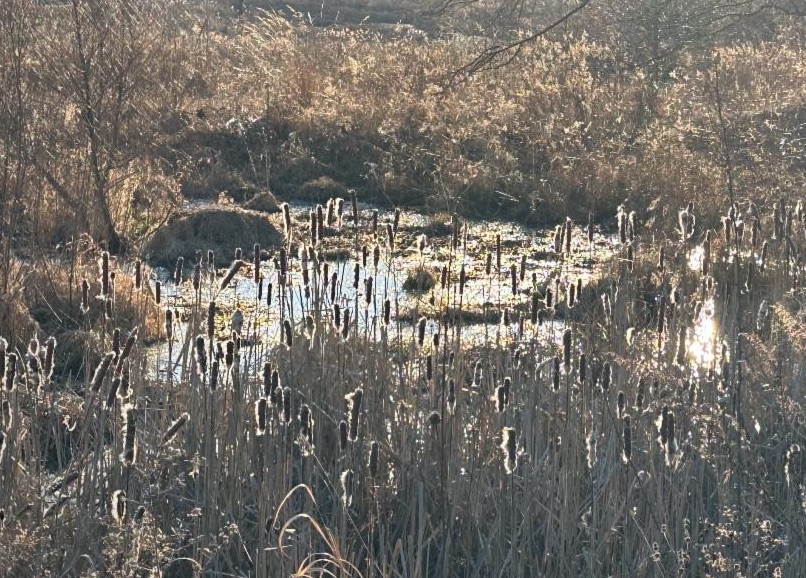
A Vernal Pool in Cascade alley Metro Park
photo by E Barth-Elias
| |
|
Fleeting beauty is ever the more sweet. For a short period each year, spring rains and snowmelt in forested areas create shallow, temporary pools of water over impervious ground surfaces, known as vernal pools. The party begins as the pools erupt with animal and plant life that call these transitory waters home.
Animals such as wood frogs, mole and other species of salamanders, and fairy shrimp require vernal pool habitats during the early stages of their life; they are vernal pool indicator species.
| |
|
A vernal pool is ideal for these creatures, because the pools lack the fish species that prey on eggs and larvae. Other crustaceans and macro-invertebrates, such as dragonflies and crayfish, often live their brief lives near or in vernal pools and feed salamanders, insects, and other wildlife.
Some animals, called facultative species, take advantage of the vernal pool environment but do not require these ephemeral pools to survive. The red-spotted newt, wood and spotted turtles, American toad, and beloved spring peepers are in this group. Further up the food chain are a host of animals that feed on amphibians and other vernal pool inhabitants or visit for a drink during a hot summer day (snakes, owls, raccoons, etc).
Plants are an important piece of the vernal pool ecology, providing structure and habitat for animals and helping to regulate pool temperatures and the physical and chemical properties of the water. Red maples, Shumard oak, buttonbush, sedges, skunk cabbage, marsh marigold, and other wet-soil-loving plants live near vernal pools. An experienced wetland botanist can determine the quality of the vernal pool ecosystem by the types of plants it supports.
Vernal pool amphibians are creatures of habit. Despite nearer pools or obstacles to their progress, 85% will return to breed in the pool where they were born. It is critical to maintain and protect wetlands. With the loss of forested lands, vernal pool sites are dwindling. Check out THIS information on creating your own vernal pool. A bit daunting, but doable!
As you walk through forested areas, look out for shallow depressions in low spots with no means of water egress. When spring rains and snows create pools, be prepared for a riot of biological activity, as eggs, tadpoles, and other marvelous life forms emerge in this de facto amphibian hatchery. Watch for the beautiful, dark-colored buds of skunk cabbage. Listen for the mating songs of spring peepers and other frogs. Toward mid-summer, when temperatures warm and leaf canopies fill in, these transitory pools will disappear, and most inhabitants will move into surrounding areas for food and shelter. Magical! Look Around!
OHIO VERNAL POOL NETWORK
A FIELD GUIDE TO THE ANIMALS OF VERNAL POOLS: Massachusetts Division of Fisheries and Wildlife
K Edgington
| |
Leaf Brief - Distinctive Flowers and Aroma | |
|
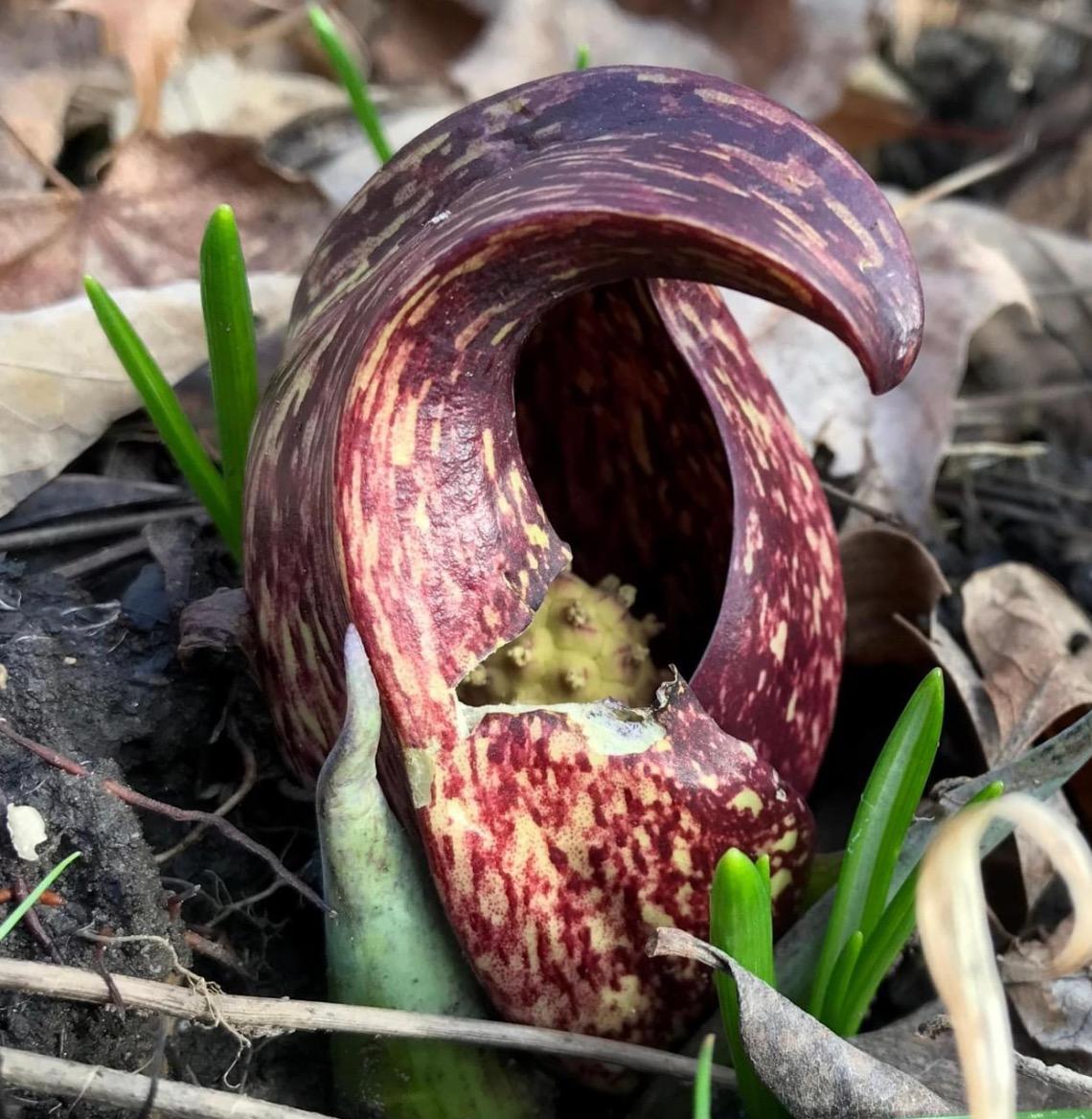
Skunk Cabbage
photo by E Barth-Elias
| |
Skunk cabbage is a distinctive name for a rather distinctive flower found right here in Ohio. This strange native’s botanical name is Symplocarpus foetidus, an ode to its bad smell (foetidus = fetid), and it is a member of the arum family. The cabbage nickname comes from the way the large leaves unfurl. It is native to eastern Canada and the United States, west to Minnesota and south to North Carolina, and grows in swamps, bogs, marshes, and wetlands in shade or dappled sunlight. Skunk cabbages can often be spotted near vernal pools, signifying a high water table. | |
|
Skunk cabbage is unique in that it is one of the few plants in the world that exhibit exogenesis, the ability to produce heat metabolically, enabling this unique plant to grow and bloom through snow and ice. The spadix (a spike of tiny flowers arranged around a fleshy stalk) can actually generate temperatures up to 20 degrees higher than air temps for up to two weeks at a time! This allows for flower maturation and pollination to occur, even in below-freezing temperatures. Read about it HERE
As you might expect, skunk cabbage has stinky flowers and leaves. This is a good thing because it attracts bees, gnats, beetles and other insects that are drawn to its smell of rotting flesh (and its warmth) at a time when there are few other nutritional sources. The burgundy-toned flower buds emerge from the ground before the leaves. The spathe (bracket enclosing the flower) is typical of the arum family and can be burgundy or mottled with yellow, and surrounds a 4-6” tall spadix. Once pollinated, the flower heads develop into fruits, the spathe withers away and new life begins as the fruits scatter and reproduce. Remember, all this happens while most plants are still dormant. As a spring ephemeral, the leaves die back as the trees leaf out and temperatures warm.
Skunk cabbage leaves can reach up to 36” tall and emerge from a single bud that was set in the fall. When crushed, the leaves have a distinctive skunk smell, but you wouldn’t want to eat them anyway, since they have compounds that are irritating to the mouth and throat. Some animals, such as bears and certain birds and ducks, will eat the young shoots or fruits.
Though skunk cabbage is found in the wild in lowland areas, home gardeners can cultivate it, given lots of space and the right conditions. It does have a deep and extensive root system, spreading a couple of feet in all directions, which supplies the nutrients to produce exogenesis. It is difficult to transplant mature plants so harvesting the seeds (or visiting a well-stocked plant nursery) is your best chance at success.
Take notice of this unusual and captivating plant during your late winter forays in our local parks. You don’t have to travel to some far-flung locale to see an exotic plant. Just don’t forget to hold your nose.
J Gramlich
| |
Creature Feature - Fairy Shrimp | |
|
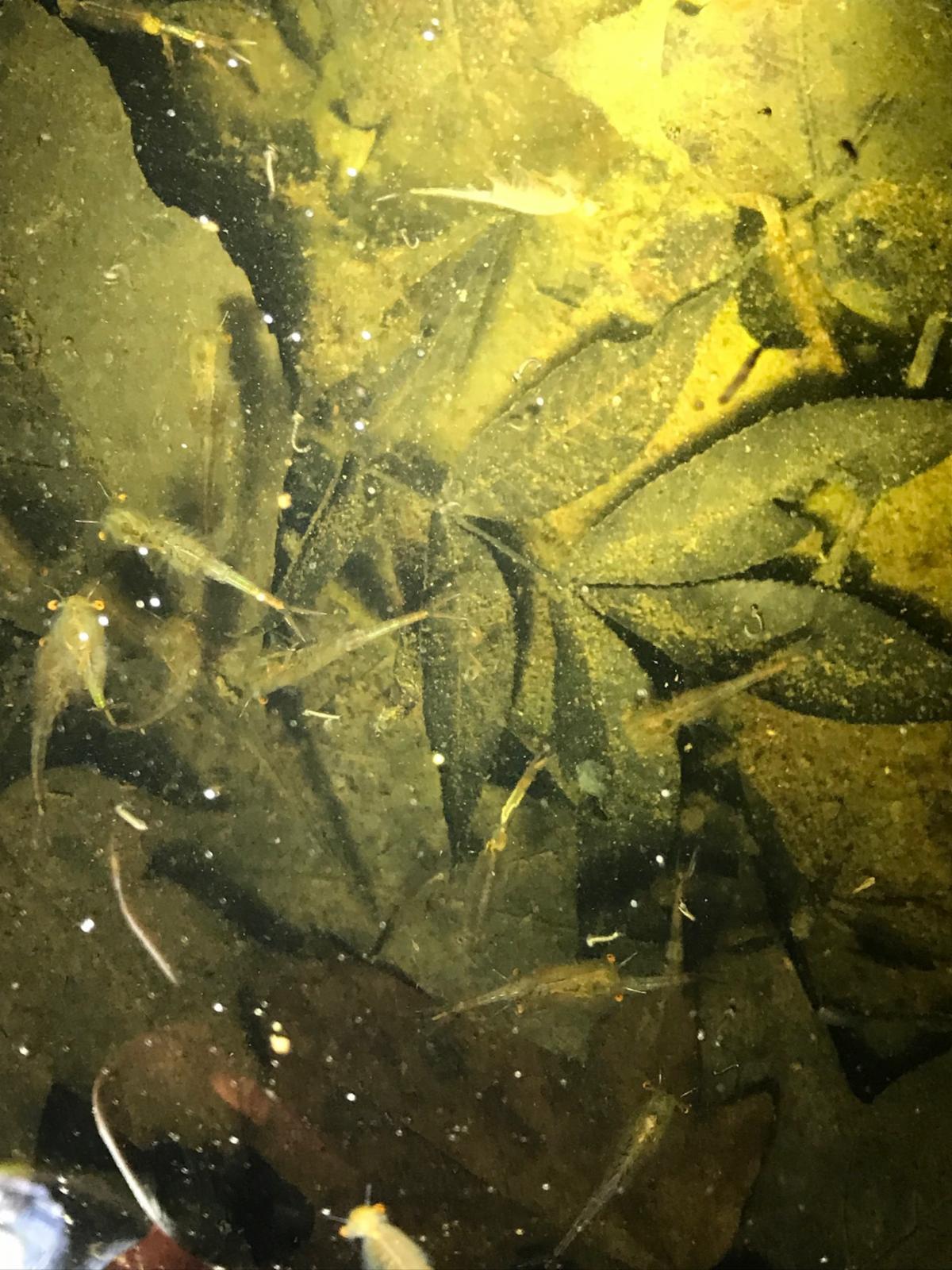
Fairy Shrimp
photo courtesy of MAD Scientist Associates
| |
|
The aptly named “fairy shrimp” appears to have magical qualities of its own, making it one of the most fitting inhabitants of ephemeral vernal pools. In fact, this tiny crustacean (a relative of lobsters and crabs) is an indicator species, confirming that a pool is present. Unlike other wildlife that frequent or live in these temporary, watery homes, Eubranchipus veralis, known as eastern fairy shrimp or springtime fairy shrimp, only appears when a vernal pool does. When the pool vanishes —poof!—so do the shrimp. Does nature have a magic wand?
Not exactly, although these oddly beautiful creatures certainly look magical. SEE THE MAGIC. From .5 to 1.5 inches long, they shimmer in shades of translucent orange, blue, green or red, depending on their age, diet and bacteria in the water.
| |
|
Eyes are stalked, tails are forked, and eleven pairs of leaf-like appendages gracefully wave through the water. These remarkably useful phyllopods help fairy shrimp move, breathe (serving as gills) and push food (such as algae) to their mouths. And they do all this upside down! Males are recognized by bulges beneath their eyes that are claspers for mating, while adult females have a brood sac on their undersides that will release up to 250 eggs every 2 to 6 days.
If you were a comic book reader in the 1960s and 70s you probably remember ads for “Amazing Live Sea Monkeys.” THE SEA MONKEY MARKETING STORY. A purchase included eggs, an aquarium and two packets, which when added to water produced living creatures that don’t look remotely like monkeys. This makes sense because they are brine shrimp, saltwater cousins of the fairy shrimp. (Unsurprisingly, the sea-monkey founder also invented “X-ray specs,” which were supposed to allow the wearer to see through people’s clothing. Ha Ha.) Sea monkeys are still sold today (although because of an on-going court battle with the founder's widow they are currently being sourced from China). Learn about this interesting saga HERE.
The ”instant life” claim for sea monkeys is not hocus-pocus. Fairy shrimp produce two kinds of eggs. One type hatches immediately; the second, thicker-shelled eggs—technically referred to as “cysts”—sink to the sediment at the bottom of the pool, entering “cryptobiosis” (a state where all metabolic processes are suspended until conditions improve). Cysts (which contain developed embryos) are well-suited to survive their habitat’s rapid disappearance. They resist desiccation (drying out), and won’t hatch until the environment is suitable again, when water reappears and is at the right temperature and light and oxygen levels are appropriate. Watch HERE.
Fairy shrimp cysts can last for decades. (Sea monkey eggs were sent on two space missions!) And this fact does seem a bit supernatural—one square foot of a vernal pool may contain up to 1,000 cysts, but only about 3% may hatch when the pool is next filled. This guarantees a population of fairy shrimp in that pool for years, even if there are periods when the pool never fills. Some years a pool will have few shrimp, other years many, keeping predators like waterfowl guessing. (Fairy shrimp are also snacks for amphibians and insect larvae.) Eggs will hatch when pools fill in late winter to early spring, and in 2 weeks fairy shrimp will be adults, with another few weeks to live.
Fairy shrimp are found in vernal pools across the northeastern U.S., southwest Ontario, and parts of the Midwest. You’ll have to look carefully to spot them; they usually stay near the bottom of the pool (the benthic zone) to scrape up food, but may swim to the top when the sun shines. They can only survive as long as the pool exists; once it dries up (usually April-May) they vanish. Fairy shrimp cysts left behind may be dispersed by wind or wildlife, such as ducks and frogs, to other pools. Once hatched, fairy shrimp stay put for their short lives.
Why do fairy shrimp go through all the trouble to live in the very unstable environment of a vernal pool? Simple—vernal pools don’t have fish, and fish LOVE to munch on fairy shrimp (brine shrimp are popular food for aquariums). A fairy shrimp’s odds of survival are best in the rapidly disappearing vernal pool.
Fairy shrimp are enchanting, even if they are not really enchanted. As springtime arrives in Ohio, seek out a vernal pool and say hello to these fleeting fairies.
C Christian
| |
|
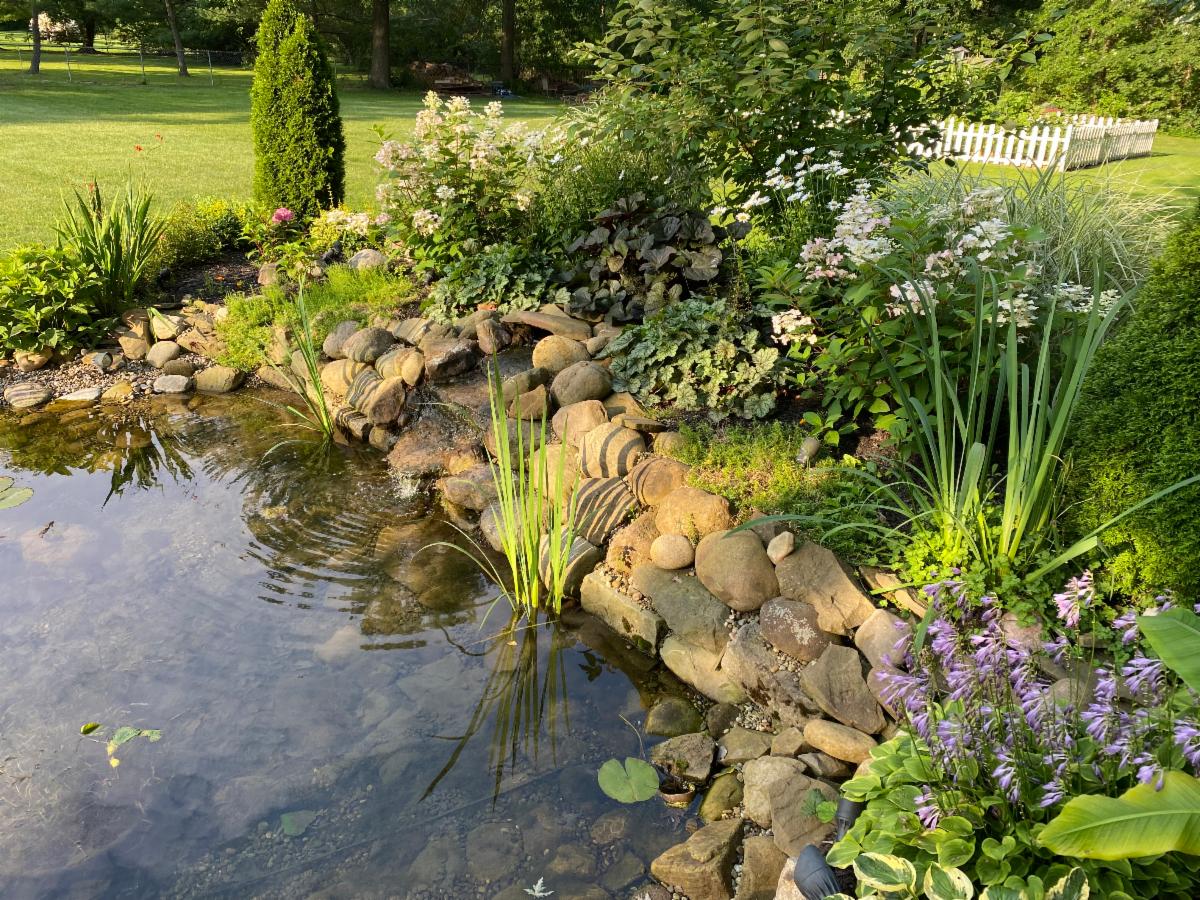
The shore of the Reeves pond
photo courtesy of Rick Reeves
| |
|
It’s a warm summer evening. The sun is going down and you have time to simply stop and rest. Next to a cool drink and a soft chair, there’s nothing like the sound of water to make the end of the day just about perfect.
Let's use the word pond as an idea more than a thing. Creating that soothing splash of water can be as easy as putting a bubbler in a bucket on a balcony, or as complex as carving a large, shallow bowl in the ground, lining it, filling it with plants and fish and installing a waterfall. A pond is pretty much what you want it to be.
| |
|
Rick Reeves, a Summit County Master Gardener Volunteer and pond lover, has had a pond in his life, well, all his life. His mother, now 91, still tends the pond Rick grew up with. Rick himself solved a serious water issue—a natural underground stream in Springfield that flooded the lower level of his house during heavy rains—by rerouting that stream about 300 yards from his house into a pond he dug. It is fed by that underground stream. The overflow from the pond is piped to a natural stream another 100 yards away.
If you’re thinking about adding some kind of water feature to your home, Rick says location is the most important decision. A pond should have a mix of sun and shade. Too much sun and algae may overgrow the pond before the summer is half over. Too little sun and any plants in or around the pond may receive insufficient light. In the fall, leaves from overhanging branches can make a real mess.
Second to location is size. It may seem counterintuitive, but Rick advises to go a little larger when determining size. That’s not to say build a lake, but he said he has heard many people say they wish they would have made the pond bigger at the start.
For those who want more than a small bubbler, there are many pre-formed ponds available in hardware and home-improvement stores that simply require digging a hole large enough to accommodate them. Free-form ponds require not only digging but also lining. Rick says it is important to make sure there is an underlayment of soft cloth under the rubber liner to protect it from rocks and sticks. It’s also crucial that the liner overlaps the edge of the pond by at least a foot and is anchored with rocks.
Regardless of the size or location, you won’t get that babbling sound without a good pump. The size of the pump depends on the distance between the surface and the fall. This is where the guidance of a pond professional is needed. There are formulas that take into account the gallons per hour and distance of lift. Those calculations are beyond the scope of this article. One thing to remember, make sure the waterfall faces your sitting area, ensuring the sound will travel toward you.
Once past the hard part (locating, digging, and lining), finding the plants, both for the pond landscape and for the pond itself, is an adventure. There are many pond plants—waterlilies come immediately to mind. Oxygenator plants are essential to filter the water and keep it clear. If fish are involved, choose plants that will give them a place to hide from the inevitable predator.
Rick doesn’t duck the reality that ponds are a lot of work. After digging, lining and hauling rock, the water feature needs attention, particularly at the beginning, to make sure the plants are doing well, the waterfall works as it should, and the new landscape thrives.
It didn’t take Rick's new pond long to attract frogs, birds, even some fish. As the pond settles, the hard work tapers off to maintenance. Nature takes over the landscape. All that’s left is to sit quietly and watch her do her work.
Humans have been living near, searching for, and creating places with water since before time. No small wonder that we continue to create those places that offer beauty and a place to rest.
WATER FOR WILDLIFE: BIRD BATHS AND BACKYARD PONDS: PennState Extension
POND PLANTS ARE A VITAL PART OF A BALANCED AQUATIC ECOSYSTEM: MSU Extension
S Vradenburg
| |
Success with Japanese Maples | |
|
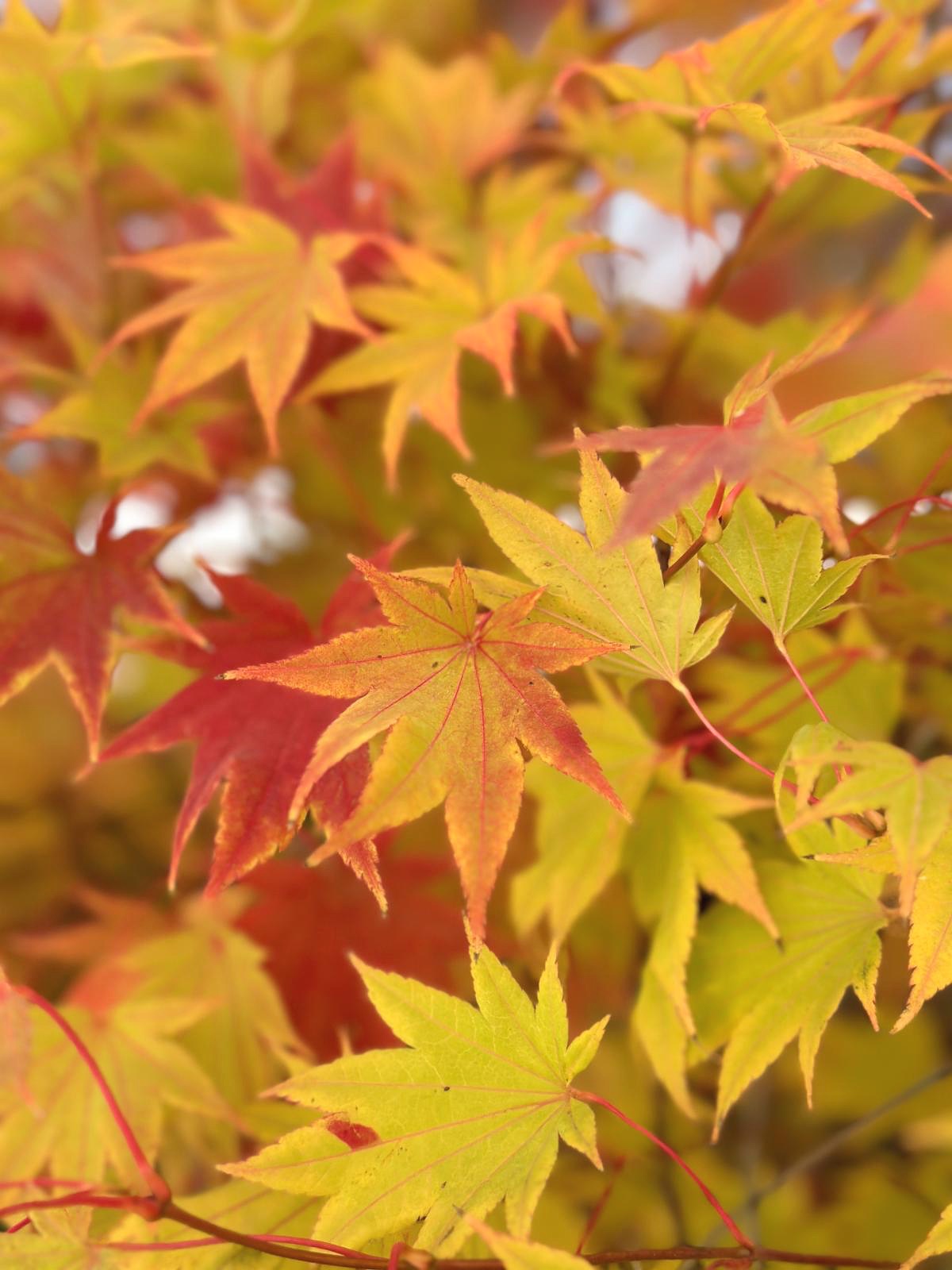
Acer Shirasawanum 'Autumn Moon' (Full Moon Maple)
photo by E Barth-Elias
| |
|
Diversity reigns and beauty knows no bounds in the world of Japanese maples. Today’s horticultural market offers an astonishing array of cultivars, each boasting unique characteristics and nuanced allure. From intricately dissected foliage to robust, upright forms displaying a rainbow of color, the options are abundant.
These exquisite, ornamental trees can thrive in a variety of environments, but selecting the optimal location is important for their long term health and beauty. Mature Japanese maples range in size from 3 feet to around 30 feet high and wide. They are categorized into three general groups; dwarf, medium, and large. Be sure to check the mature size of cultivars when considering locations.
| |
|
Location, location, location: Japanese maples are generally hardy, zoned 5-8 and prefer temperate climates with mild summers and cool winters. While they can adapt to a variety of conditions, extreme heat or cold may stress the tree and affect its growth. Planting in sheltered areas or providing protection from harsh winds and spring frosts can mitigate damage and ensure the trees maintain their graceful form and beautiful foliage.
Light: The trickiest part of finding the ideal placement may be direct versus indirect sunlight. Two issues are at play– too much sun may result in leaf scorch, while too little may sacrifice some of the most vibrant color, leaving the tree healthy but a little dull. Observing how sunlight patterns change throughout the year and day is critical when siting Japanese maples. Growers often recommend sun exposure in the morning and protection from direct afternoon rays. This could be as an understory planting in dappled or intermittent light or on the east side of a home or structure where afternoon light is still bright but indirect. As a general rule, cultivars with delicate or thin leaves and those with lighter foliage colors or variegation are at greater risk for leaf scorch in direct sun, while established green and red leaves are less adversely affected by hot direct afternoon sun.
Soil: Japanese maples are prone to root rot and therefore require well-drained soil. This cannot be overemphasized, as it is reported by several top growers to be the number one reason that trees die. They prefer slightly acidic soil (5.5 to 6.5 pH) rich in organic matter. Providing fresh, quality compost and generously mulching in spring will go a long way toward the care your tree needs to thrive. Give the trunk an inch or two of space to breathe before adding several inches of mulch to retain moisture and help regulate soil temperature.
Water: When the top one to two inches of soil is dry, water deeply at ground level. Pay particular attention during hot spells. Consistency is key here. Newly planted trees need the closest monitoring. Once established, many trees can be tapered off supplemental water except in extreme, prolonged heat. Avoid wetting the foliage to prevent fungal diseases and possible scorch.
Containers: Dwarf and mid-sized trees can be planted in a container to enhance a patio or perhaps while you’re deciding on its permanent home in the ground. Japanese maples will do best in a pot sized to accommodate two times its root ball with good drainage holes. Choose a material that will resist the weather and provide some stability and insulation for the roots.
When selecting companion plants for Japanese maples look for those with similar growing requirements such as conifers, azaleas, and rhododendrons. Most perennials and annuals will complement in the surrounding area beautifully.
Proper placement is essential for the health, longevity, and visual impact of Japanese maples. By considering factors such as light, soil, and protection from harsh elements you can create an optimal environment for these iconic trees to beautify your outdoor space for years to come. Enjoy the timeless elegance of Japanese maples for your lifetime and for generations to come.
E Barth-Elias
| |
|
March Checklist
- Start seeds indoors for summer vegetables and annuals according to packet directions.
- Continue dormant pruning to tame and shape shrubs.
- Shear ornamental grasses to 6” to tidy the plant and promote new growth.
- Trim dead areas from rose bushes and begin slow-release fertilizer.
- Finish lawn leaf clean up and remove any winter protection.
-
Trim Type C clematis. PRUNING CLEMATIS: SIMPLIFY THE ABC'S: Toronto Gardens
- Start dahlias, begonia tubers, and cannas indoors.
J Gramlich
| |
More learning opportunities:
| |
|
“...beauty consists of its own passing, just as we reach for it.
It's the ephemeral configuration of things in the moment,
when you can see both their beauty and their death.”
Muriel Barbery, The Elegance of the Hedgehog
| |
We invite you to share The Root of It with your friends and family. If you would like to subscribe to our mailing list please visit our website, scroll to the bottom, and follow the link under Join our email list. | |
The Root of It staff: Karen Edgington (Editor), Emma Barth-Elias (Photo Editor), Carolyn Christian, Jennifer Gramlich, Sarah Vradenburg, and Geoff Kennedy (Technical Advisor)
| |
We Would Like your Feedback
Contact us at: newsletterscmg@gmail.com
To discontinue receiving this newsletter please click on the UPDATE YOUR PROFILE link below. You may then choose what types of information you would like to receive from us.
| | | | |