Volume 7 Issue 5 | May 2026

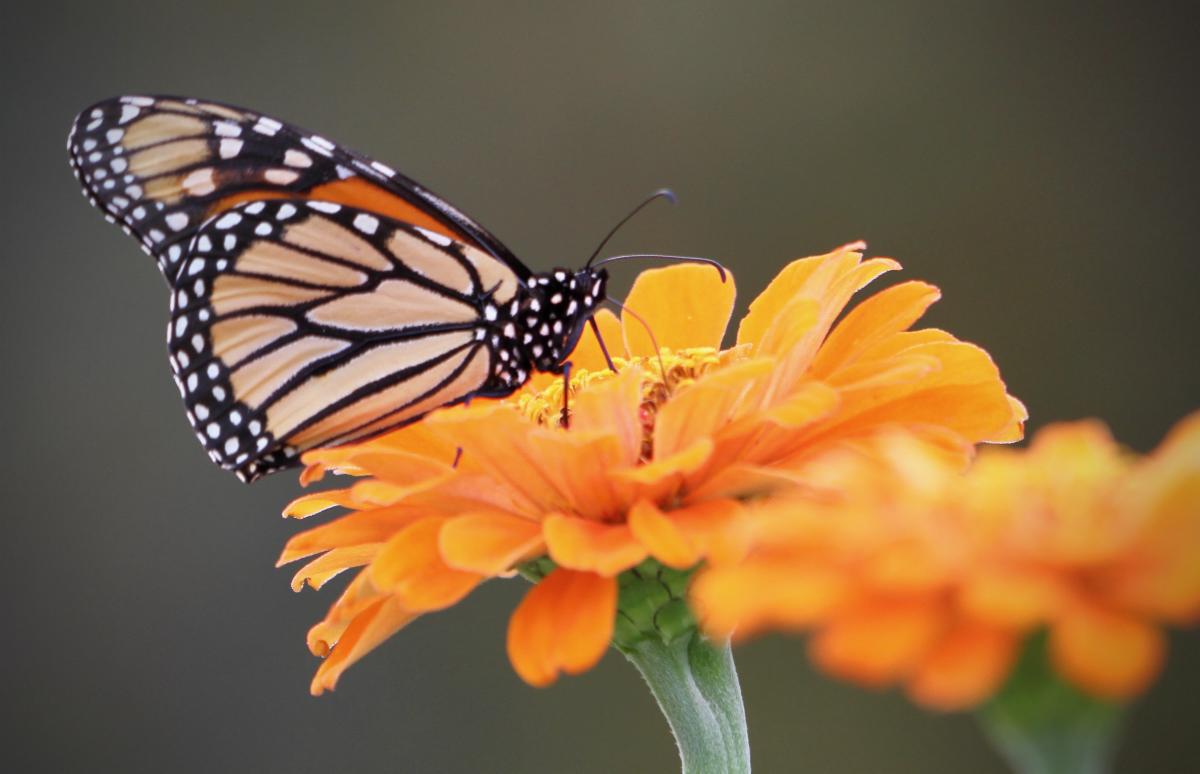
All abuzz about pollinators...

The Root of It newsletter ends with our monthly quotation. If you find your newsletter has been clipped by your email provider please click HERE for a webpage version of the newsletter.

LOOK AROUND

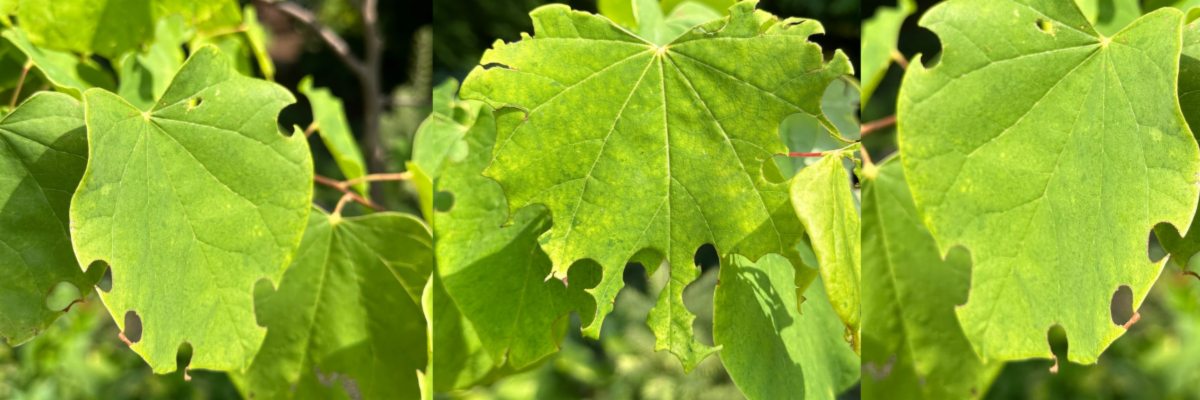
Leaf cutter bees have "decorated" this Eastern Redbud

photo by E Barth-Elias

When Erin and Ben Napier sit on their front porch, introducing one of their home renovation episodes (Hometown), Erin muses that she likes “a little imperfection.” Their goal is a home with character, not one that is flawless. I like that, and relate it to the change I’m making in my attitude about gardens. Gone are the days when a plant with pristine leaves was a sign of a skilled gardener, and a hole or a chewed edge meant a run for the spray bottle. 


Today we look at plant damage with a wider view. The first question needs to be, Who is doing the damage? A swallowtail butterfly caterpillar munching on a parsley plant is cause for celebration, a monarch caterpillar devouring Asclepias leaves (butterfly weed) is a welcome guest. The damage from the plump yellow-green caterpillar of the gorgeous clearwing (hummingbird) moth, which feeds on honeysuckle, viburnum, hawthorn and others, is a modest price to pay. If we want the beauty of butterflies and moths, and if we want to support pollinators in our gardens, we need to feed their larval stages. For the pleasure of swallowtails, warblers, woodpeckers, nuthatches, and other birds nesting nearby, a food source—insects and other small animals—must be at hand. The goal is a balanced ecosystem, in which natural predators keep pests at an acceptable level. 


Of course, not all plant damage is a sign of healthy biodiversity.  Japanese beetles are unwelcome at any time—the first scouts send out their “good eats” signal and hordes soon follow. This non-native pest lacks the predators to keep it in check. But the red, warty galls on maple leaves, caused by microscopic eriophyid mites, are a cosmetic issue, and rarely affect the overall health of the tree. Even pests like aphids occupy a niche in the ecosystem. When aphids first appear on roses, allowing them to feed for a time gives ladybugs (one of the good guys) a meal. The ladybugs multiply in reaction to the food source, and keep the aphids in check. Does this work every time? Unfortunately not, but allowing predators to multiply and do their job promotes a healthy ecosystem (and beautiful garden).


Making good remediation decisions requires knowledge about the insects and other small animals that inhabit the garden. What do they eat? Is it of consequence or just incidental to plant growth? (Will the damage kill or maim the plant?) Is there a predator that will control the pest population? Is the damage short term or season long? Spending time in the garden in “observation mode” is a great learning tool. The internet holds a wealth of information, and refining your search with the .edu or .gov parameter will yield information that is research-based and solid. The Extension agents and Master Gardeners at your county extension office are trained to help identify pests and control options.


Horticulturalists call this minimalist pest management strategy Integrated Pest Management (IPM). IPM is a common sense, science-based approach that focuses on the long-term health of the plant, taking into consideration the environmental impact of any intervention. After identifying the plant and the pest, the damage is assessed and monitored. A threshold is set—how much damage is acceptable? Possible control methods are evaluated, with non-chemical and low-impact controls being a first line of defense. When chemical control is deemed necessary, care is taken to apply the correct chemical, at the most opportune time, using the lowest strength and volume that will get the job done.   A key tenet of IPM is choosing plants that fit the growing conditions, which limits the need for chemical intervention.


Jim McCormac, renowned Ohio naturalist and photographer, eschews using pesticides in his gardens, saying Feeding evidence should be the gardener’s badge of honor*. As I move into the gardening season, I hope to approach pest damage in a more thoughtful, big-picture manner. It’s the new me. Look Around!


*Jim McCormac, Gardening for Moths webinar, December 2025

K Edgington

LEAF BRIEF

Spice It Up with Spicebush

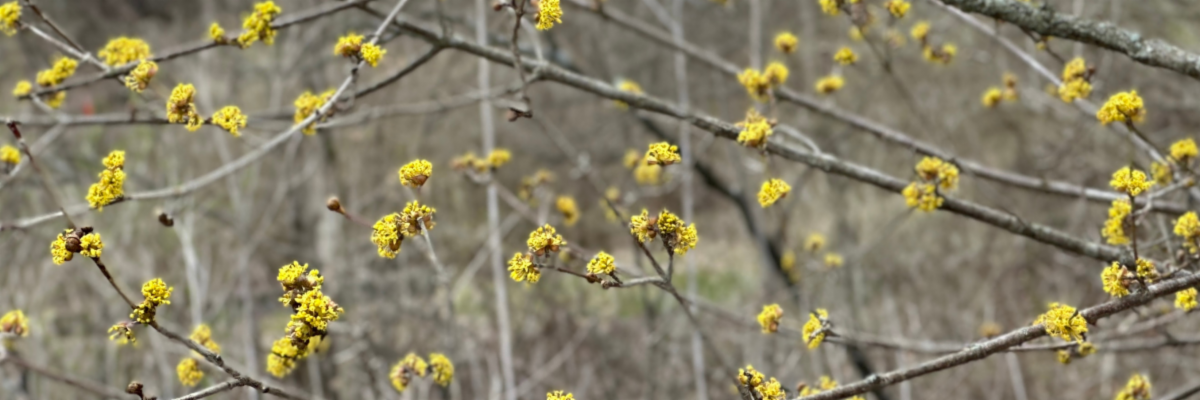
Spicebush (Lindera benzoin)

photo by E Barth-Elias

Most of us garden because we love nature and enjoy learning about individual plants and how they interact with the environment. Do we grow something strictly for the blooms or for a purpose beyond that? Consider the spicebush.


Spicebush (Lindera benzoin) offers a range of practical and ecological benefits. In North America, it supports biodiversity and is relatively carefree. Spicebush naturally grows in woodland understories, streambanks, and moist valleys in shaded or damp areas. It tolerates sunnier locations if given sufficient moisture. Typically growing 8-15 feet tall, spicebush sprawls in shadier areas and retains a more rounded shape in full sun. This shrub is sometimes called the “forsythia of the wilds” because of its early yellow blooms. While not as vibrant as the non-native forsythia, spicebush provides an early nectar source for pollinators. In fall, it shows off golden yellow leaves, giving it three-season appeal.


Spicebush has a long history of culinary uses. The name refers to its aromatic leaves and spicy berries, described as citrusy/peppery. The leaves can be steeped in water to make tea. The berries are a bit more complicated. They are not sweet or sour, as you would expect, and typically are not eaten raw. The pit inside the berry is traditionally dried and grated much like allspice or nutmeg. It can then be used as a dry rub or in desserts such as spice cake. If that’s too labor-intensive, you can enjoy the scent by simply rubbing or scratching the bark or leaves.


Spicebush is best known as the primary host for the caterpillars of the Spicebush Swallowtail butterfly. The females lay eggs directly on spicebush leaves and the caterpillars feed on the leaves as their main food source. Chemical compounds in the leaves make the caterpillars less palatable to predators. Spicebush isn’t a one-species host—it supports a small ecosystem. It’s also a host for the Promethea moth caterpillar and several other insects that rely on it for nutrition. Often considered a keystone understory shrub in forest ecosystems, it supports both insect life cycles and birds that help with seed dispersal. 


Spicebush may be difficult to find at a local nursery. You may be better served by scouting native plant sales or online sites. It can be propagated from seed but requires a 120-day cold stratification period. Because they are dioecious, plant multiple shrubs to ensure male plants are present to pollinate female flowers, which then produce red berries. If needed, pruning in late winter or early spring is recommended. Spicebook would do well in a rain garden or pollinator garden and is also fire-resistant.


If you want a garden that is both beautiful and beneficial to your local ecosystem, consider a spicebush. Along with seasonal interest, you’ll enjoy the entourage of birds, bees and butterflies that come with it.


To learn more, watch this short video.

J Gramlich

CREATURE FEATURE

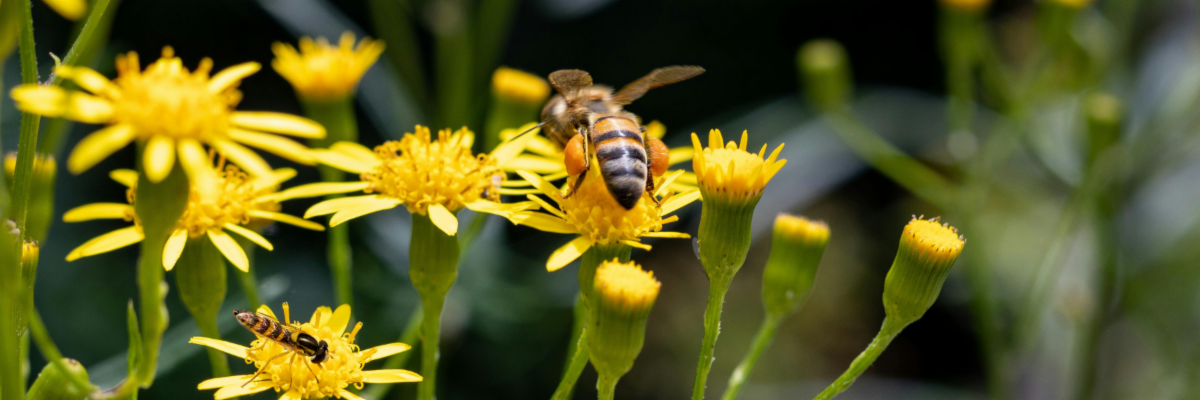
A Plea from the Pollinators


photo by E Barth-Elias

A Plea from the Pollinators…


All we’re asking for is a little respect. Me and my pals pollinate more than 80% of earth’s flowering plants and 35% of food crops. Without us, you humans are toast. And that’s worth a LOTTA coin, like three trillion dollars globally according to your U.S. Department of Agriculture. How about a little gratitude?


What we do is simple. Pollinators provide transportation—moving pollen from a flower’s anthers to the stigma of the same or another flower to produce seeds. (Basically, we help non-mobile plants have sex—but let’s keep this G-rated for the kiddos.) Self-pollination happens within the same flower or another one on the same plant. Cross-pollination occurs between different plants of the same species—better because it increases diversity and survival of the species.


We are biotic pollinators—living agents that transfer pollen. For free. Pollination also occurs abiotically, 98% by wind and 2% by water. Also, no charge. Humans got a good thing going…


Plants and animals evolved to ensure pollination happens most efficiently. Plants developed ways to attract pollinators (scent, shape and color), while we developed traits and behaviors to optimize our efforts. Of course, our real goal is food. Pollination is an accidental, essential side effect.


So who’s out there pollinating? Birds and some mammals, but insects do the heavy lifting, including butterflies, moths, beetles, flies and wasps. And bees, well, when it comes to pollination, we’re really the knees.


Like lots of insects, non-native honeybees and native bee species forage on flowers for nectar, our primary, high-energy food source. In the process pollen gets stuck on our bodies and falls off onto other flowers as we move on and—voila!—pollination.


Bees are BIG pollinators because female bees are one of few insects that actively collect pollen to take back to the nest as food for larvae. We become electrostatically charged as we fly, so negatively charged pollen “jumps” off flowers and attaches to us. Our dense, plumose (feathery) hair has tiny branches that act as a feather duster, catching pollen as we move around a flower. We generally visit only a few species at a time (flower fidelity) so chances are good pollen ends up on the same species.


Bees collect and transport pollen in various ways. Honeybees and bumblebees carry pollen in a corbicula (pollen basket), a smooth indentation on their hind legs surrounded by stiff hairs. These bees brush the pollen off their body, add nectar to form a pollen ball, then pack the ball into the basket for transport.


Bees such as leafcutters, mason and sweat bees have a thick patch of long hairs called a scopa instead of a basket. Dry pollen is either caught in the scopa or brushed into it by the bee. The yellow-faced bee has no hair, so it swallows pollen, stores it in its crop (part of digestive system) and regurgitates it once home. Pollen wasps also transport pollen in this disgusting but efficient way.


Bumblebees practice “buzz pollination” on tomatoes, potatoes and blueberries, biting into the anthers and vibrating to shake the pollen out. Watch it HERE.


About 30% of native bees are specialists, only collecting pollen from a specific species or family (although they’ll drink anybody’s nectar). Their life cycles sync with the bloom times of their favorite plants. These guys are super-efficient pollinators, but if their habitat disappears, so do they. Read HERE about specialist bees in Ohio.


Yep, bees rock at pollinating, but we gotta give some love to a few others. Flies rank second only to bees—a lot of them eat pollen so they’ve got extra incentive. Beetles are called “mess and soil” pollinators because they chew through flowers—even using them as toilets! Their bad manners result in them being coated in pollen—and thus good pollinators.


Of course butterflies pollinate gracefully—that’s how they do everything. Preferring brightly colored flowers with “landing pads”, butterflies pick up pollen while sipping nectar with their proboscis, a tube-like organ that acts as a straw and sponge. (They’d hold up their pinky finger if they had one.)


I could go on, but just watch these videos to see how amazing we pollinators are. And figure out how you’re gonna show me and my pals some appreciation...


THE POWER OF POLLINATORS: PBS Nature

THE BEAUTY OF POLLINATION: Moving Art

POLLINATION: TRADING FOOD FOR FERTILIZER: NaturalistOutreach

C Christian

AN UNEXPECTED PLEASURE

photo by E Barth-Elias

POLLINATOR POCKETS

A smorgasboard for pollinators.

photo by Jodi Jacobson

It’s planting season. We have all been itching to get our hands dirty. Perhaps the only question is where to start? While those tomato transplants need to wait for more consistently warm temperatures, there is something you can do now to ensure success later in the season: grow plants that attract pollinators. Those insect workhorses ensure we will have the food and ecosystem services we need to survive. 


We don’t need huge swaths of pollinator friendly flowers, but how much is enough? Densely grouped native plants that will bloom throughout the growing season will give the pollinators what they need. Put them in a pocket. The University of Illinois suggests these patches for pollinators need be at least 4-feet by 6-feet oval.


A pollinator pocket can be densely grouped pots full of native plants on a balcony. It can be a small corner of the vegetable garden, with a bonus of bringing insects to the vegetables. Tomatoes require buzz pollination, which requires bumblebees. However, bumblebees are attracted to the same flowers as other native bees and insects so there is no need for special plants to attract them.


We’ve heard that 30% of all food in the grocery store is made possible by pollinators. That understates their impact. According to Kim Eierman in her book Pollinator Victory Garden, more than 84 percent of food grown for human consumption needs pollination, and 80 percent of all flowering plants need pollinators to reproduce. There are many pollinators other than bees, including beetles, hummingbirds, moths, and bats.


Gardening for pollinators requires plants that have co-evolved with the insects in a particular area. Over millennia, these native flowers and insects have developed a mutually beneficial relationship. Some bees specialize in a particular species of plant, meaning they cannot exist without the pollen and nectar from that plant.


Plants, labeled nativars, are cultivars of native plants selected for specific traits, and are marketed as replacements for natives. Some haven’t had their special relationship with insects bred out of them. However, many are less than ideal for pollination. An altered flower shape or color may be more visually appealing to gardeners, but may remove signals that the flower is a good source of pollen and nectar. Nativars are almost always reproduced through cloning, meaning each plant is a genetic copy of the parent. This reduces biodiversity, a requirement for resilience.


The need for pollinators is great. It’s heartening to know that we don’t need to create fields and parks to meet the need. We can, in our own small ways, make our gardens buzz with life. Pockets carry many things. In this case they carry the ingredients for a more resilient future.


POLLINATOR POCKETS: University of Illinois

PLANNING THE POLLINATOR GARDEN: OSU Extension

S Vradenburg

DOWN AND DIRTY

May Checklist:

  • Plant summer annuals and vegetables after the last frost. (The average date is May 15th in the Akron area.) Water when dry and protect from any cold snaps.
  • Think flowers for Mother’s Day (May 10).
  • Control weeds now to prevent their proliferation in the summer.
  • Mow grass to a height of 3 inches, leaving nutritious clippings on the lawn.
  • Mulch flower (and vegetable) beds once the soil has warmed.
  • Prune spring-blooming trees/shrubs such as forsythia and lilacs after bloom. PRUNING FLOWERING SHRUBS: PennState Extension
  • Spray repellent for rabbits, deer, and other foraging guests as new growth appears.
  • Put up hummingbird feeders.
  • Tidy up spring flowering bulbs by removing spent blossoms

J Gramlich

You cannot go through a single day without having an impact on the world around you. What you do makes a difference, and you have to decide what kind of difference you want to make.

Jane Goodall

NEW GROWTH!

More learning opportunities:

We invite you to share The Root of It with your friends and family. If you would like to subscribe to our mailing list please visit our website, scroll to the bottom, and follow the link under Join our email list.

The Root of It staff: Karen Edgington (Editor), Emma Barth-Elias (Photo Editor), Carolyn Christian, Jennifer Gramlich, Sarah Vradenburg, and Geoff Kennedy (Technical Advisor)

We Would Like your Feedback
Contact us at: newsletterscmg@gmail.com

To discontinue receiving this newsletter please click on the UPDATE YOUR PROFILE link below. You may then choose what types of information you would like to receive from us.