|
Volume 7 Issue 9 | September 2026
| | The Root of It newsletter ends with our monthly quotation. If you find your newsletter has been clipped by your email provider please click HERE for a webpage version of the newsletter. | | |
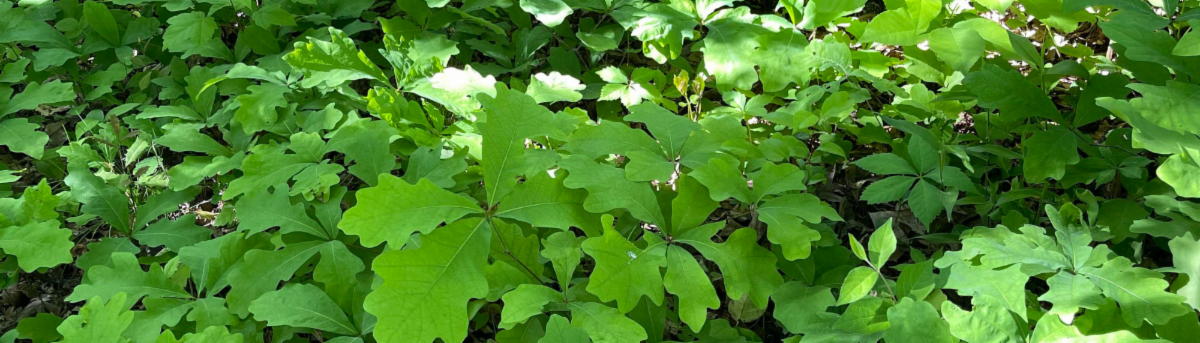
Oaks, oaks, and more oaks!
photo by E Barth-Elias
| | |
I love the tall oaks that tower over our front and back yards. They cool and shade our summer days, provide shelter for the birds we enjoy watching, and have become fast friends. This year they’ve also produced large drifts of oak seedlings in our lawn and garden beds. The lawn seedlings don’t seem to mind the regular cut-back from our lawnmower, and the bed seedlings have kept emerging throughout the spring and summer months. Pulling them is not a problem after a drenching rain, as most come out with acorn intact, but during dry periods they hold their ground. Literally. I’ve never seen anything like it.
This plethora of oak seedlings is the result of last year’s mast year of acorns. Mast refers to the nuts, seeds, and fruits of plants, and in a mast year certain trees (or grasses, shrubs, and perennials) of one species synchronously produce a massive bumper crop of seeds or nuts. Many of the trees that dominate American forests mast—oak, hickory, dogwood, maple, beech. Oaks mast every three to five years. Because of the variability among trees there isn’t a particular amount of seed production that defines a mast year, but if you feel you need a helmet when walking under an oak or there’s a carpet of acorns underfoot, if the air is filled with fluttering maple samaras, or if you look up to see a conifer covered in cones, that’s a mast year.
The reason for this vast expenditure of plant energy is still a mystery, but scientists generally agree that environmental factors, such as weather, play a part. Oaks produce the same number of flowers in mast and non-mast years, so researchers are looking for a trigger that causes more of those flowers to result in fruit. Some scientists believe that a predator satiation hypothesis is at play. When seed production varies year-to-year, and copious amounts are produced in a particular year, predator populations are not large enough to consume all the seed, securing the perpetuation of the tree species. Whatever the cause, and whatever the trigger, scientists are not yet able to predict which will be a mast year.
What is truly remarkable about the masting process is that the massive production of seed is synchronized over a population of trees, and, in fact, over a geographic region. This means that an oak in, say, Cleveland, is dropping copious amounts of acorns at the same time as an oak in Chicago. Do trees use their underground fungal communication pathways to coordinate the production of a mast year? There is speculation that trees may send organic compounds wafting through the air to get the message out. Walt Koenig, a research zoologist emeritus at the University of California and co-director of the California Acorn Survey, notes that oaks that live as far apart as 500 miles are known to produce remarkably similar crops. He says of mast phenomena, “We’re talking about hundreds of millions of trees”. He describes the process as “…mysterious, perhaps almost unfathomable!”
The abundance of acorns produced during particular years has a vast influence on wildlife and the ecosystem at large. Masting in oak forests affects populations of many acorn-eaters—deer, beetles, chipmunks, mice—and consequently affects birds, moths, and a host of other animals, including ticks—which affect humans. As Koenig says, “The world runs on acorns.” Look Around!
AN EDURING OAK MYSTERY: SYNCRONIZED ACORN BOOMS: Bay Nature
K Edgington
| | |
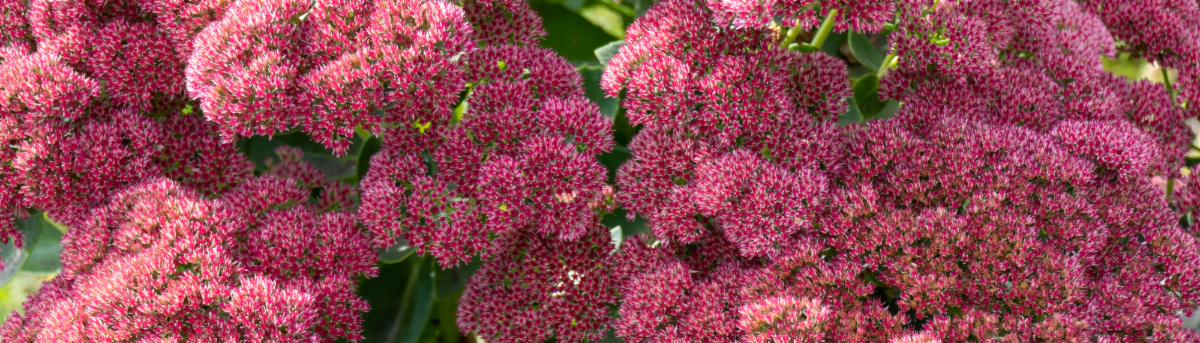
The rosy-pink flowers of Autumn Joy
photo by E Barth-Elias
| | |
What a joy to see a vibrant perennial come into flower during these waning days of summer, just as fall is adding its own color! Autumn Joy is just such a plant, a reliable workhorse that performs well, needs little attention and is loved by pollinators! It was hybridized in the mid-20th century in Germany by the famed nurseryman George Arends and has been popular ever since.
For decades, we called it Sedum ‘Autumn Joy’. But botanists have decided it is no longer a sedum and have kicked it out of the club. This favorite now has a new and difficult-to-pronounce botanical name—Hylotelephium ‘Herbstfreude’. (Herbstfreude in German is autumn joy.) Either way, it is still the same great plant.
Autumn Joy is a tough, succulent perennial that forms a manageable clump, handling both the heat and the cold in zones 3-9. Its fleshy, gray-green leaves emerge in early spring, forming a compact mound. It reaches 18-24 inches in height over the summer when the green flower buds begin to emerge. The broccoli-like flower heads open in a progression of light pink, darkening to a rosy pink, then pinky bronze to dark maroon as the season progresses. It’s a magnet for bees and butterflies that are attracted to its nectar and the easy access provided by its large, flat flower heads.
Taking care of Autumn Joy is easy because there is no care--well almost! It likes well-drained soil with medium to low fertility. Full sun is optimal but don’t stress if it gets a little light shade. Stems can be pinched back in the spring to limit plant height but may result in delayed flowering. After fall frost, they can be cut to the ground but don’t be in a hurry as the spent mahogany-brown seed heads add variety and texture to the winter landscape. It is particularly attractive when covered with frost or snow. Leaving the stems until late winter/early spring provides a habitat for insects and food for birds.
Hylotelephium (get used to it!) is long-lived, sometimes decades, given the right conditions. Less is more and too much fertilizer can lead to leggy plants that flop while too much water fosters root rot. It is considered drought resistant, and while not a favorite of deer, keep the deer spray handy just in case. Aphids, slugs and mealybugs may occasionally make an appearance.
If you are loving your Autumn Joy and want more, it’s not complicated. Propagate by division or cuttings from spring through summer. HERE'S HOW.
Joy for a gardener is an eye-catching plant that performs reliably in every season. And the fact that it didn’t take a lot of work is an added bonus. For a plant that asks so little, Autumn Joy certainly gives a lot back—no matter what you call it!
J Gramlich
| |
|
CREATURE FEATURE
Oh Nuts!
| |
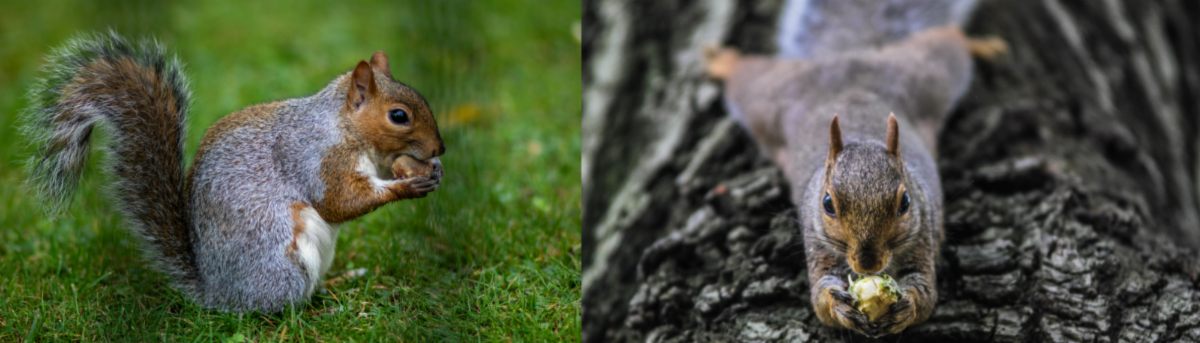
As the Dear Editor notes, fall is acorn season. Squirrels and chipmunks are busily gathering acorns, but they’re doing much more than grocery shopping for winter. These small, furry rodents are engaged in a fascinating game of one-upmanship with our mighty oak trees, a game hosted by nature to ensure the survival of both trees and critters. Let’s crack open the rules of engagement for this miraculous, nutty sport to see how it plays out. You can’t make this stuff up—but you can add a little imagination…
(Imaginary audio in bold).
Go for broke with Team OAK! Team Oak has two categories of players—white and red. White oak leaves have rounded edges—hometown heroes in Ohio include the white oak, swamp white oak, bur oak and chestnut oak. Red oaks have pointy leaf tips—local players include the northern red oak, black oak and scarlet oak. Team Oak’s goal is to spread that seed!
Let’s hear it for Team Oak! (leaves rustling).
The Team that’s fitter is Team CRITTER! Team Critter has a huge roster packed with ravenous deer, mice, voles, rabbits, wild turkey, blue jays, and woodpeckers. Today’s starting lineup is the squirrels and the chipmunks whose focus is chowing down and storing for winter as many acorns as rodently possible!
Give a big hand to Team Critter! (chatter and squeaks).
This game is all about the acorn. Encased in a hard shell (pericarp), the embryonic root and shoot of the baby plant are located at the tip of the nut, while two cotyledons store nutrients.
Team Oak sees that acorn as a perfectly packaged baby oak tree—the key to their survival. Team Critter sees that same acorn as a plentiful food source—easy to store, usually available in the coldest months—the key to their survival.
The stakes couldn’t be higher folks!
But doesn’t Team Critter have an unfair advantage because they can, well, move, while oaks can’t? Not to worry—Team Oak has a few tricks up their branches…
Like lacing acorns with tannin, an astringent chemical which tastes awful and is hard to digest. Tannin is most concentrated toward the tip of the acorn where the embryo is located. Red oak acorns contain more tannin than white ones, so critters prefer to eat white oak acorns, although they’ll eat bitter red ones when desperate. POINTS FOR TEAM OAK!
However, squirrels and chipmunks may nibble on the tastier cap end of the acorn and discard the rest—SCORE FOR TEAM CRITTER!
But the slightly nibbled acorn may still germinate if the embryo at the other end is undamaged—TEAM OAK!
It’s a high scoring game folks!
There are other factors at play. Red oak acorns mature over two years, and once they drop in late autumn, they don’t germinate until spring. Their higher levels of tannin help preserve them over winter, and Team Critter stores these less tasty nuts to eat as winter deepens and other food disappears. Team Oak is betting the critters will forget where they cached the acorns, so they’ll grow into new trees.
White oak acorns drop in September-October and germinate quickly—nutrients are converted into plant material, and the taproot anchors the nut to the ground, hiding it from predators. Once sprouted, the acorn no longer holds nutrients for critters. POINTS FOR THE OAKS!
However, squirrels have been known to nibble off the embryonic shoot so the acorn won’t germinate and can be stored as food—SCORE FOR TEAM CRITTER!
And so the game goes, season after season. Except for Team Oak’s trick play—the mast year. Mast years are when Team Oak produces unusually large numbers of acorns. Try as they might, Team Critter just can’t eat them all. Uneaten acorns turn into seedlings and then oak trees. Team Oak produces more normal levels of acorns in the following years.
Everyone wins folks! (leaves rustling, chirps and squeaks)
Except maybe THIS THIEVING CHIPMUNK, which shows the ferocity of this competition.
C Christian
| | |
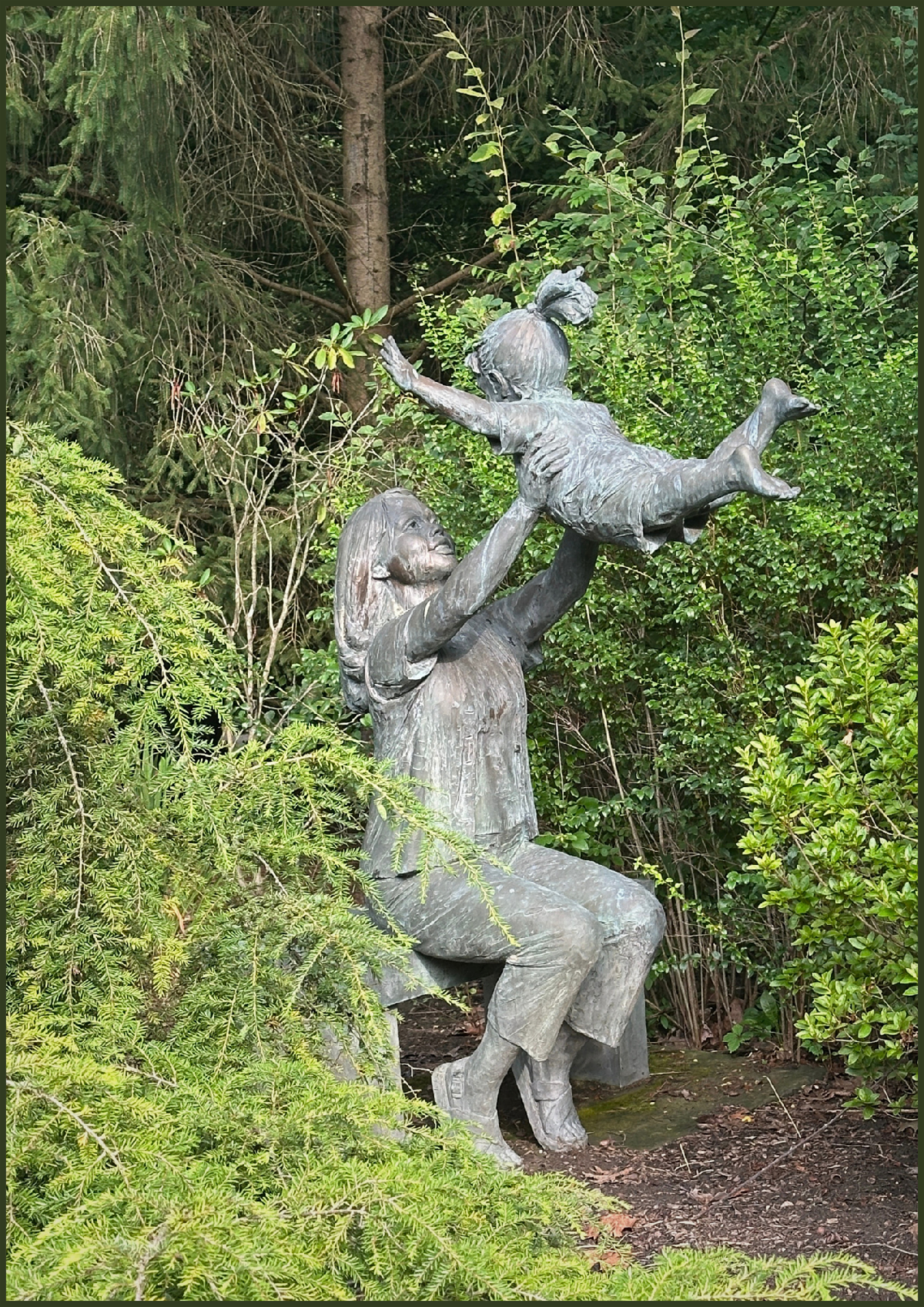
What a thrill to see the interplay of conifers and sculpture on a recent garden tour!
photo by E Barth-Elias
| | |
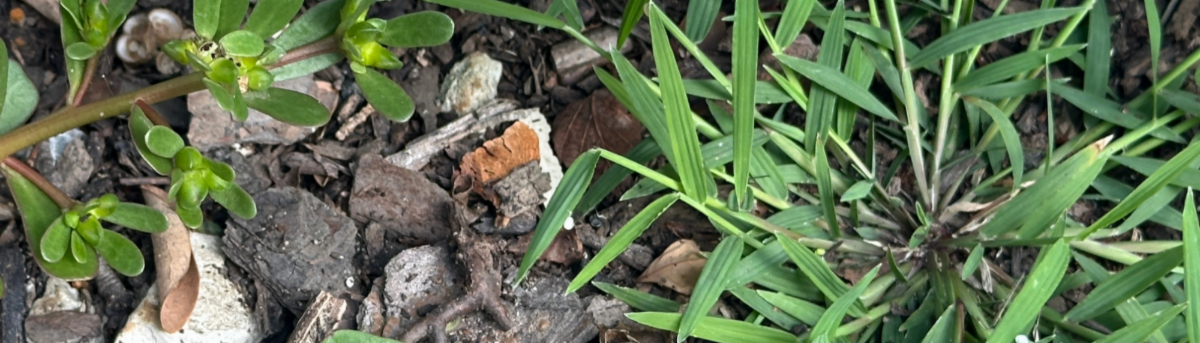
Purslane and crab grass have a tale to tell.
photo by E Barth-Elias
| | |
It might be a bit farfetched to look at weeds and see white lab coats like the ones sported by doctors. But don’t dismiss them. Those pesky plants you spend hours digging and hundreds of dollars in chemicals killing can be great indicators of your soil’s health, good or bad. And some might actually be good for your health.
Let’s take a look at some of the most common weeds and what they reveal (Follow the link in the weed name to read more.):
Henbit: Lamium amplexicaule indicates high nitrogen in soil, which can cause rapid leaf growth at the expense of flowers and fruit.
Lambs-quarters: Chenopodium album is in the Amaranth family. Its presence indicates rich soil high in potassium and low in phosphorus. Find it in compost piles and fallow fields. It will die back when subject to frequent mowing.
Common Chickweed: Stellaria media, is an annual flowering plant found throughout the world. Its name, Stellaria, comes from the small, star-shaped flowers it produces. Chickweed is often found in moist soils and will also grow well in compacted and alkaline soils. It’s edible and can be used in salads in place of lettuce.
Crabgrass; Digitaria spp. indicates soil lacking in nutrients, especially calcium.
Dandelion: Taraxacum officinale thrives in compacted soils deficient in calcium. However, its big taproot helps to break up some of that packed soil.
White Clover: Trifolium repens L. is most prevalent in low-nitrogen soils. It grows best in full sun, creating patches from branching stems that grow close to the ground and root where nodes touch the soil. It can be found in compost piles and fallow fields. It will die back when subject to frequent mowing.
Wood sorrel: Oxalis stricta is another weed that isn’t picky about soil or growing conditions although some sources suggest it thrives in acidic soil low in calcium. It hugs the ground early in the season then branches into upright stems with clover-like leaves and yellow flowers. The flowers eventually turn into capsules that, when disturbed, explode into thousands of tiny seeds.
Mullein: Verbascum thapsus requires high acid, infertile soil. It is found in neglected fields, on roadsides, at wood edges and industrial sites. It has been used as a treatment for coughs and diarrhea and a variety of skin conditions.
Plantain: Plantago spp. indicates poor, compacted soil. It is often found in heavy clay soils, something we have in abundance in this region. It has evolved to withstand being trampled and thrives in high traffic areas in the garden. It also has many proported health benefits including reducing inflammation, promoting digestive health, and healing wounds.
Purslane: Portulaca oleracea is a succulent that grows close to the ground and prefers rich soil high in phosphorus. Like dandelions, it is edible and rich in nutrients such as omega-3 fatty acids and vitamins E and C.
In many cases, knowing what soil conditions weeds prefer can help prevent them from showing up in the first place. However, weeds are an inescapable part of gardening. Some weeds have beneficial uses; others are just plain obnoxious. Knowing which is which can ease the burden of clearing them. Still, as Ralph Waldo Emerson said, "A weed is a plant whose virtues have never been discovered."
WEEDS ARE AN INDICATOR OF A SOILS HEALTH: Michigan State University Extension
S Vradenburg
| | |
September Checklist:
- Replace spent annuals with mums, asters, ornamental kale, and others for a colorful autumn.
- Get going with planting grass seed so it is well established as it gets colder. Aerate if soil is compacted.
-
Harvest herbs and dry them for future use. DRYING HERBS: Oregon State Extension
-
Tidy up perennials by removing dead/diseased or bug-infested foliage and weeds, leaving the remainder for birds and winter interest. FALL GARDEN CLEANUP WITH POLLINATORS IN MIND: Old Farmers Almanac
- Move outdoor houseplants to a less sunny location to acclimate to indoors. Check undersides of leaves and stems for insects.
- Discontinue fertilizers and major pruning to allow plants to go dormant naturally. (It’s OK to fertilize lawns.)
-
Continue garden harvest and cleanup. Plant a cover crop such as winter rye, oats, or clover in open soil. COVER CROPS FOR GARDENS: University of Maryland Extension
- Begin spring bulb shopping while selection is good!
J Gramlich
| | |
When the oak is felled, the whole forest echoes with its fall, but a hundred acorns are sown in silence by an unnoticed breeze.
Thomas Carlyle
| | |
More learning opportunities:
| | We invite you to share The Root of It with your friends and family. If you would like to subscribe to our mailing list please visit our website, scroll to the bottom, and click on the subscribe link. | | The Root of It staff: Karen Edgington (Editor), Emma Barth-Elias (Photo Editor), Carolyn Christian, Jennifer Gramlich, Sarah Vradenburg, and Geoff Kennedy (Technical Advisor) | |
We Would Like your Feedback
Contact us at: newsletterscmg@gmail.com
To discontinue receiving this newsletter please click on the UPDATE YOUR PROFILE link below. You may then choose what types of information you would like to receive from us.
| | | | |