|
The Safer Mobility Report
The Latest in Vehicle Safety, Technology, and Policy
September 7, 2026
Issue #9
| |
Road Safety Without Borders
| |
Over the past two weeks, I toured the UK and spent time in Italy meeting with road safety advocates, transportation professionals, innovators, government leaders, and publishers of leading fleet publications.
My intent was to learn how people across different countries are working to reduce crashes, serious injuries, and fatalities on our roads.
In London, walking, cycling, and public transportation remain among the easiest and most supported ways to get around, with multimodal, safe, and sustainable transportation clearly at the forefront.
In Ripon there has been a special focus on pedestrian plazas and walkable streets. In York these efforts are complemented by widespread 20 mph speed limits. Together these approaches are helping calm traffic and reduce the likelihood that crashes result in serious injuries or fatalities.
In Milan, smaller vehicles and a wide range of multimodal transportation options—including trains, buses, trams, bike share, and vehicle share—are complemented by separated bike lanes, roundabouts, leading pedestrian intervals, and an extensive cycling network. Milan is also moving forward with stronger speed-management measures including new automated speed enforcement systems. More than 100 school areas have been identified for redevelopment and safety intervention, while nearly 200 public spaces are being considered for improvements that prioritize pedestrians.
Across both the UK and Italy, technology is also playing an increasingly important role in road safety. Intelligent Speed Assistance, automatic emergency braking, and technologies designed to address driver distraction and fatigue are pushing the boundaries of what is possible with in-vehicle safety systems. These countries have also helped inspire important innovations in vehicle design including truck sideguards and high-vision truck cabs. These concepts should be considered as part of the next generation of safer commercial vehicles around the world.
The most important lesson from these visits is that road safety cannot—and should not—be confined by borders. Protected bike lanes, safer street design, automated enforcement, vehicle design and size, intelligent speed assistance, driver training and education, and stronger efforts to address distracted and impaired driving all have the potential to save lives when implemented without political ignorance or whims.
The challenge is making sure we share these tools and continue moving toward a transportation system in which serious injuries and fatalities are not accepted as inevitable.
I am grateful to everyone who took the time to meet with me, share their views, exchange ideas, and continue this important work. In particular, James Luckhurst of Project Edward; Renee Rogers, Founder and CEO of ONO; Ann-Marie Knegt from Fleet Vision International Magazine, Vince Dignam of the City of London Corporation; Mark Hadley of BlackOut Technologies; Rachel Dale; Kim Penfold; Simon and Sarah Scaife of Nuvech Solutions; Simon Spinks; Amanda Shea; Jasmine Alice; Cees Van der Put from RAVO; and Luca Pascotto, Paolo Sanna, and Sonia Djouzi of the FIA Foundation.
Road safety is a global challenge. The solutions will come from all of us learning from one another and working together to make our roads safer everywhere.
| |
|
FIA Foundation
Road Safety Index Conference
| |
From left to right Imrane Barry, Vice President HSE Trading and Transports TotalEnergies, Eric Richardson, Road Safety Advisor, Johanna Forseke, CEO at Greater Than, Sonia Djouzi, Business Development, Automobile Mobility and Sustainability, FIA, Luca Pascotto, Head of Road Safety and Global Advocacy FIA, and Jessica Truong, Senior Advisor Global NCAP and Director JD Truong Limited. | |
In Milan, the FIA Foundation hosted a two-day event for partners in the Road Safety Index and the Driver Safety Index, including a first day standing room only crowd to hear about how the index was developed, how it has transformed from a three-star to a five-star rating system, the increasing role of safer vehicle procurement in achieving high index scores, and the need to look at the entire safety footprint in an organization from the policies and procedures that govern programs within an organization and also by including the entire supply chain including contractors and suppliers.
Speakers at the event included representatives from Global NCAP, Euro NCAP, Honda, Total Energies, Guidance to Zero, Poste Italiane, Honda, and Together for Safer Roads, with additional discussions from companies such as Waymo and Greater Than.
For those who are not familiar with the FIA Road Safety Index, it's a benchmarking tool developed by the Fédération Internationale de l'Automobile (FIA), with support from the FIA Foundation, that gives organizations worldwide a data-driven methodology to assess, manage, report, and improve their road safety footprint.
Under the new five-star rating system, the index looks at road safety across multiple areas including: commitment through following laws and regulations, having safety targets, ensuring drivers are fit to drive, managing speed, and acquiring the proper vehicles; the footprint of safety culture including employees, contractors, and third parties; having structure for safety culture management, proper safety planning, and using tools to monitor that the safety culture set down by an organization is being followed such as ensuring compliance with speed limits such as telematics, that those working with vehicles are given the proper protective systems to keep them and those around them safe, and keeping track of the conditions of the vehicles that are being used including proper replacement cycles.
The FIA Safety Index was started as a three-star rating system including supply and value chain analysis, commitment and footprint as the original three review areas with companies like Autoliv, IKEA, and TotalEnergies, with TotalEnergies becoming the first private sector company to receive the highest star rating available at that time. Since then, additional private sector organizations have received the highest rating under the Index, including Amazon, BAT Italia, Folksam, Honda Motor Co., IKEA Supply Chain Operations, Scania, Shell, Uber, and Waymo.
The program has also been expanded into the public sector as well with New York City's Department of Citywide Administrative Services becoming the first municipal fleet in the world to start the FIA Safety Index review process.
More recently, the Index strengthened its US vehicle safety benchmark by incorporating Insurance Institute for Highway Safety (IIHS) vehicle safety awards requiring the highest-rated organizations to use passenger vehicles with IIHS top safety pick awards.
While the FIA Safety Index has been applied to some of the major private fleets across the globe, the safety index is also important for public fleets as well.
Firstly, it moves traditional fleet reporting away from just numbers. Traditional fleet safety reporting is reactive — crashes and injuries are counted after they happen and policy is adjusted in response. Government fleets typically look to crash counts, injuries, fatalities, claims, or payouts to determine whether they are “safe.” But these outcome measures are shaped by other factors — payouts in particular are driven more by insurance, legal strategy, and time rather than by whether a fleet is actually operating safely.
The Index scores an organization's commitments, policies, and monitoring systems as their own category, alongside outcome-based data. This means a fleet is credited for having strong risk-identification and prevention systems in place — not evaluated solely on a crash count after the fact.
Secondly, governments that operate fleets routinely say they prioritize safety, but those statements are subject to challenge from taxpayers, elected officials, lawyers, the media, and others with reason to ask for proof behind the proclamation. With the Index, assessments are led by external experts using data the government fleet provides — covering not only how a city makes its own vehicles and drivers safer, but also how it manages contracted operators and third-party vendors.
Thirdly, the Index applies one methodology and one rating scale to any adopter, public or private; a government fleet's score sits on the same scale as companies such as TotalEnergies, Amazon, Uber, and Waymo. This gives government fleets an apples-to-apples comparison point that is useful for budget and policy conversations for vehicle replacements, safety transition planning, additional driver training, and technology pilots and rollouts in scale.
Fourthly, government fleets vary widely in size, operation, exposure, and conditions, hence comparing one fleet to another on raw numbers alone often produces erroneous conclusions. The Index corrects for this by scoring policies and procedures rather than absolute numbers or operation size — allowing fleets of very different scale to be compared on a fair basis.
Beyond scoring, the Index opens several practical opportunities for government fleets, including to help make an internal case for procuring new vehicles, piloting technologies, and additional safety technologies to vehicles on procurement such as Intelligent Speed Assistance (ISA) and truck side guards;
creating leverage over the supply chain to push suppliers and contractors toward the same standards at scale; and pressure on vehicle OEMs to make the safest vehicles and providing safety systems as standard rather than reserving them for luxury trims.
Any single city can only do so much on its own, but if the Index is adopted by a large number of governments collectively, it strengthens the case for car manufacturers to make those changes across their full vehicle lines.
If you want to learn more about the FIA Road Safety Index or the FIA Driver Safety Index click here.
| |
|
"The Interview"
Simon Scaife
Director NuVech Solutions and Inventor of AirBar
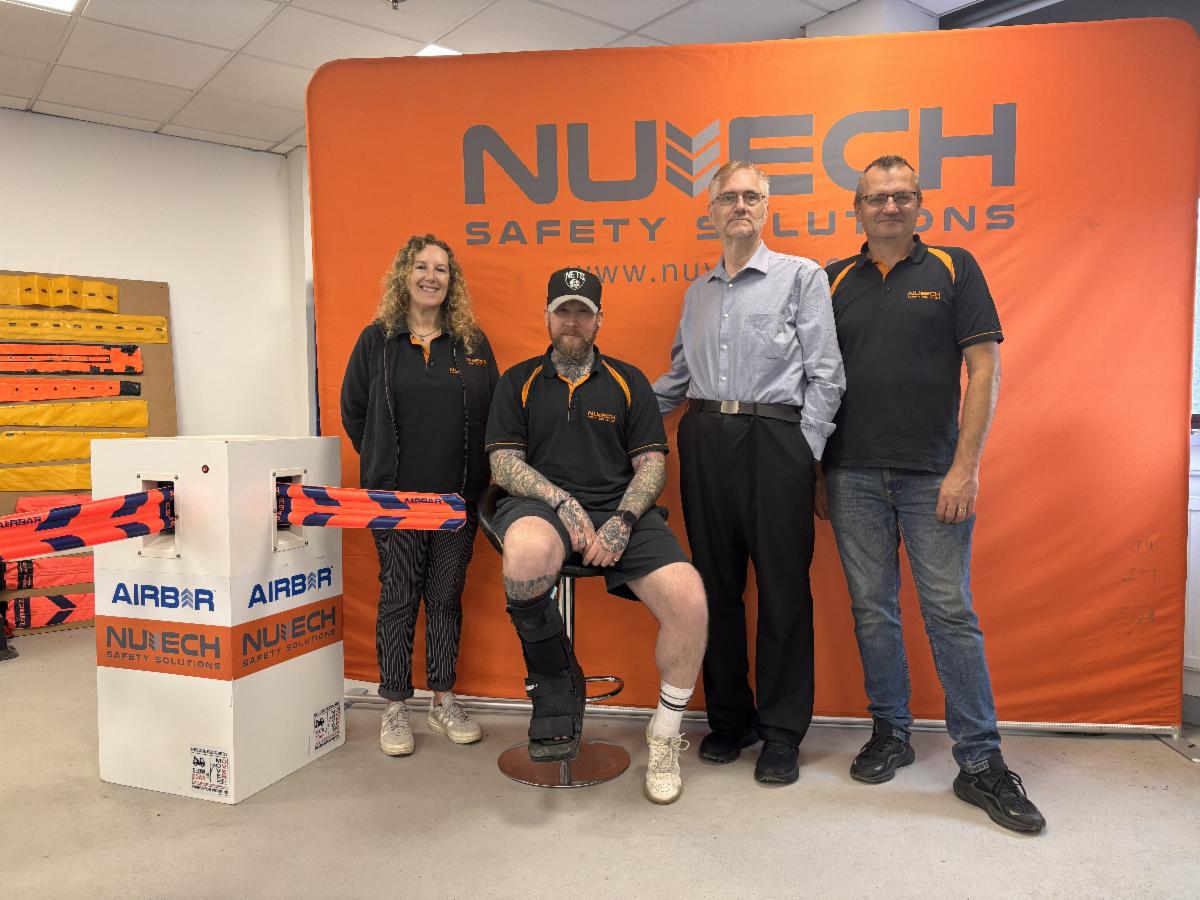
| From left to right. Sarah Scaife Operations Director of NuVech Solutions, Lee Robinson Production Manager, Eric Richardson, and Simon Scaife Director NuVech Solutions and Inventor of AirBar. | |
Tell our readers a little bit about you and how you came up with the idea for AirBar?
I have always been in the auto transportation sector and moved vehicles all around the UK. One of the dangerous parts of this work is that workers often get struck on the side of the road due to passing traffic with nothing to protect them. After getting hit one times too many, I started to develop AirBar so that people working on our roads could have a safer working area. The nice thing about AirBar is that drivers think it is solid object and we have seen almost 99% change in driver behavior when they come upon a vehicle with the AirBar deployed.
Protecting workers is important, but tell me a little about how you are working to protect vulnerable road users?
Well, we recognize that while sensors and in-cab warnings can be important there is also a chance that the warning buzzers or beeps might not be heard by a truck driver, and with new mobility devices, the technology may not sense them. But with the AirBar, it is the bicyclist or other road user who gets alerted since the AirBar deploys when a turn signal is activated and a truck is going below speeds of 15 miles an hour, it then sticks out, it flashes with the turn signal, and it warns the cyclists or the motorcyclists this vehicle is going to be turning. Once the turn is complete, AirBar just simply rolls back into place.
How will your technology help when it comes to vehicles that are moving slowly? Like a street sweeper, how would this prevent a street sweeper from getting sideswiped or hit by another vehicle?
One issue with street sweepers is that they need to often move slowly, both down the street but also from side to side. At the same time, these drivers are operating the sweeper system and vehicles are coming up behind them. Drivers are often unsure where to pass slow-moving vehicles or gauge how far they should move over. With the AirBar, we can temporarily widen the sweeper or any slow-moving truck, giving other drivers more visibility that a truck is there and a better understanding of where they should pass.
With the protections you are creating for vulnerable road users, have you seen improvements there as well?
The testing we have done with a Transport for London pilot went extremely well with 100% change in behaviors. We were even able to gather before and after video showing a cyclist going by a truck on the inside with no AirBar, legal but dangerous, but staying behind the truck with an AirBar deployed.
As you expand into the United States which fleets do you think you want to focus on?
With my background in vehicle movement logistics, we have already started with towing, and Triple A uses the AirBar on their trucks on the West Coast. We also have a couple of test cases running on a dump truck and a private waste hauling vehicle. But to be honest, AirBar can be installed on anything. We want to make sure workers in the roadway, including fuel deliveries, road crews, towing operations, and emergency services, as well as vulnerable road users are better protected on our streets.
Anything else you wish to tell our readers?
The AirBar is designed to be a simple installation, easy to use (just a switch on the dashboard or connected to a turn signal), and practically maintenance free. With the way we design the AirBar, the only part of it that ever needs replacing is the AirBar itself as it might fade or get dirty over time. But if a replacement is needed, it is simply like taking off your old work jacket that got faded over time and putting on a new one.
If you attend the Fleet Forward Conference in National Harbor, Maryland you can meet the innovators of AirBar, Simon and Sarah Scaife, on October 20 and 21 at the EBR Safety Solutions table. To find out more about AirBar click here.
| |
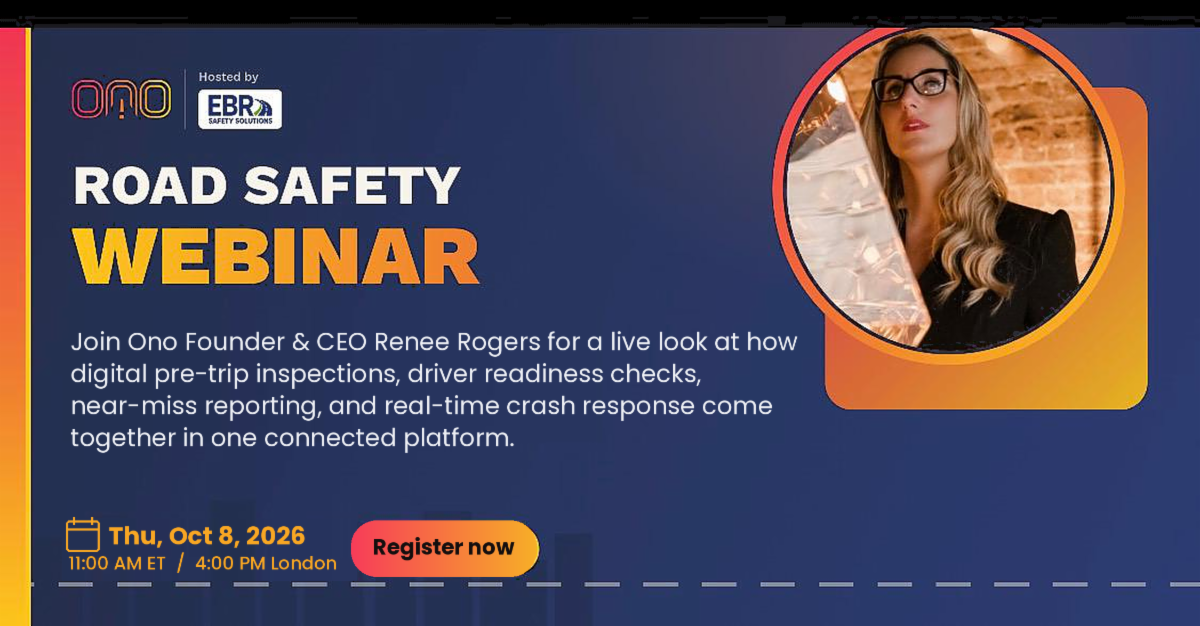
Join Renee Rogers, CEO and Founder of Ono, for an upcoming webinar on Thursday October 8 at 11AM EST where she'll walk participants through the Ono platform and how it helps fleets improve vehicle safety, streamline claims, and manage insurance costs — while ensuring crashes are properly documented and reviewed. This session is relevant for fleets of every kind: small or large, public or private, commercial or personal — including taxis and other for hire vehicle companies, bus operators, rental car companies, and non-emergency medical transportation providers. You can register here.
|
New Birmingham Cameras Switched On As Drivers Hit With £70 Fines
New cameras have been switched on in Birmingham city centre to enforce specific traffic offences. Drivers have previously been able to get away with breaking the rules but they now face fines of up to £70. Hundreds have already been punished in the first few weeks of the cameras going live.
You can read the full article here.
Croatian Police Crack Down On Powerful E-scooters
Police officers carried out increased checks on 2 and 3 September, focusing on electric scooter, moped and motorcycle users, as well as other personal transport vehicles. The operation was aimed primarily at protecting pedestrians and improving road safety in some of the city’s busiest areas. Of the 114 offences recorded, the largest number involved riders failing to wear a protective helmet, with 94 violations registered.
You can read the full article here.
Democratising vehicle safety in Africa: Global NCAP’s Forum for
Safer Mobility lands in Cape Town
Hosted in partnership with the Automobile Association of South Africa, Global NCAP’s second Forum coincided with Safety 2026, the 16th World Conference on Injury Prevention and Safety Promotion. The Cape Town session followed the official debut of Global NCAP’s Forum for Safer Mobility earlier this summer which was held alongside the UN High-Level Meeting on Global Road Safety in New York and opened the stage to the revolutionary technology that is Intelligent Speed Assistance (ISA).
You can read the full article here.
| |
September 10
Together for Safer Roads Member Reception and Vision Zero Awards
New York City
LAST CHANCE TO REGISTER
Click here for more information
September 14-17
International Association of Transportation Regulators Annual Conference
Las Vegas, Nevada
Click here for more information
October 8
Road Safety Webinar
Renee Rogers (Ono Founder and CEO)
Click here to register
October 20-22
Fleet Forward Conference
National Harbor, Maryland
Click here for more information
October 22
New York City Vision Zero Fleet Safety Forum
Queens, New York
Click here for more information
October 28-29
Transportation Alternatives Vision Zero Cities Conference
New York City
Click here for more information
November 15
World Day of Remembrance for Road Traffic Victims in the U.S.
Locations To Be Announced
Click here for more information
November 18
Public Sector Vehicle Forum
Leicester Tigers Stadium, United Kingdom
Click here for more information
| |
|
About the Safer Mobility Report
The Safer Mobility Report exists to bridge the gap between innovation and implementation. We will be sharing the technologies, policy discussions, research, and real world applications that can help companies, organizations, governments, and professional fleets make transportation safer. If one idea, technology, or shift in thinking saves one life, it will more than justify this effort.
About EBR Safety Solutions
EBR Safety Solutions is a mission-driven advisory firm focused on technology and practical solutions to reduce traffic crashes that result in serious injury or loss of life.
Founded by Eric Richardson, the firm brings a deeply practical, systems-level approach to improving road safety across both public and private sector fleets.
Our work is grounded in years of leadership at the highest levels of transportation policy and operations. As former NYC Deputy Chief Fleet Officer and a representative on the NYC Mayoral Vision Zero Task Force, Eric helped shape one of the nation’s most ambitious urban road safety initiatives.
He has also served as a road safety advisor to Together for Safer Roads, Strategic Mobility Advisor to Windels, Marx, Lane, and Mittendorf, and as the Co-Chair of the Health and Safety Committee for the International Association of Transportation Regulators (IATR), giving him a unique perspective that bridges government, industry, and technology sectors. Eric is a proud member of the Worshipful Company of Carmen one of the City of London’s oldest and largest livery companies. He is a global keynote speaker on efforts to eliminate traffic fatalities.
Eric's work advances safer vehicle design, life-saving technologies such as intelligent speed assistance, anti–distracted driving tools, systems to prevent drunk driving and best practices for seat belts and telematics. He also guides safe fleet transitions for government, trade waste, school transportation, and trucking operations. Guided by the Vision Zero Safe System approach, Eric promotes safer vehicles, speeds, and drivers as connected pillars of crash prevention.
EBR Safety Solutions turns proven safety principles into real-world impact, helping organizations meet standards and protect lives on the road.
| | | | |