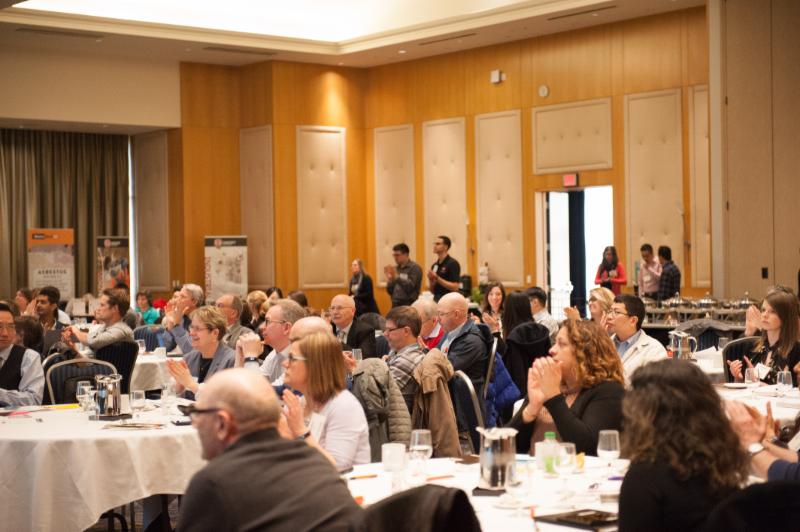
This year we had eight UBC students present the research / findings from their summer practicum following the Ignite-style presentation format. Each student had five minutes to present, followed by a short question and answer period. In addition, participants at the meeting were able to evaluate the presentations through a survey link that was shared during the meeting. Each student was also tasked with writing a short abstract / summary for their presentation for this edition of The Sampler. Thank you UBC students and the faculty at the UBC School of Population and Public Health for facilitating this event! |
Evaluation of Heat Stress Risk at Teck Trail Operations
Presented by Angelene Forbes-Salmon
The primary objectives of the summer project were to 1) Quantify the heat exposure using Wet Bulb Globe Temperature (WBGT) index; 2) Propose control measures to reduce heat exposure to workers at each workstation. Task-based environmental (area) heat exposure measurements were taken using a QuesTemp Heat Stress Monitor at workstations in one of the plants at the worksite. The WBGT values were adjusted for the clothing worn during tasks and the metabolic rates assigned based on observations at each workstation. Results showed that heat exposures exceeded the ACGIH WBGT-TLV for the respective metabolic rates. Control measures applicable to the unique workstation configurations were provided to improve the work environment.
|
Assessment of Exposures to Hazardous Gases at Howe Sound Pulp and Paper
Presented by Darryl Bannon
To address concerns at Howe Sound Pulp and Paper regarding gas exposures, gas sampling was conducted in vapor effects 1 and 2 (VE1 and VE2) and compared to WorkSafeBC limits. After preliminary sampling at 40 locations that measured 10 gases, 10 locations in VE1 and VE2 were selected for fixed monitoring of 6 gases, including hydrogen sulfide, methyl mercaptan, dimethyl sulfide, dimethyl disulfide, methanol and α-/β-pinene. All gases sampled in VE1 and VE2 were found to be well below regulatory limits. While all levels were found to be safe, almost all samples were taken under ‘routine’ conditions. The highest risk to workers is during ‘upset’ conditions, and additional sampling should be targeted for those conditions.
|
Noise Mapping of Upgrading Operations at an Oil Sands Mining Site
Presented by Dominic Galante
Noise mapping of ambient sound levels for production areas of oil sands upgrading.
|
Isocyanates Evaluation Project for Roll-on Application of
Weather-proof Membrane in Parkade
Presented by Joseph Lu
This project was to evaluate airborne isocyanates exposures on employees who roll-on apply weather-proof membrane in parkades, and to assess the effectiveness of the ventilation and respirator. Four different construction sites were sampled on seven days. The ASSET EZ4-NCO samplers were used for personal sampling. Twenty-one personal samples were obtained and isocyanates isomers detected were categorized into MDI, TDI, HMDI, and IPDI. The personal isocyanates exposures ranged from 1.175*10E-5 ppm to 5.099*10E-3 ppm. TDI exposures on Day 5 were around the WorkSafeBC Occupational Exposure Limit (OEL) of 0.005ppm. The remaining exposures were all at least 80% below the WorkSafeBC OEL. All workers were sufficiently protected against isocyanate vapours by the half-face respirator with an Assigned Protective Factor of 10 and the ventilation with an Air Change per Hour larger than 4.0.
|
Default PPE Protection Factors Used for Estimating Worker
Chemical Exposures
Presented by Malin Mao
Currently, Health Canada's Existing Substance Risk Assessment Bureau does not consider occupational exposure in their risk assessments. However, they are looking to understand risk assessment approaches used by international regulators for estimating exposures to chemicals found in the workplaces of Canadians, as this could be a new consideration as part of a future, modernized program. The aim of the project was to gather data on default protection factors of personal protective equipment (PPE) used in estimating occupational chemical exposures.
|
Qualitative Workplace Hazard Assessment of Two Natural Gas Storage Facilities
Presented by Mitchell Trickett
Oil and Gas industrial worksites present myriad hazards that have the potential to cause injury/disease to anyone who is exposed. During the Summer of 2021, I was tasked with completing a qualitative workplace hazard assessment (QWHA) for two Natural Gas Storage Facilities in Alberta, Canada. The purpose of the QWHA was to qualitatively assess potential exposures present at both sites and provide recommendations for reducing the exposure risk.
|
Exposure Assessment of Prevention Field Officers: Asbestos & Noise
Presented by Pratik Singh
This study evaluated the asbestos exposure to the WorkSafeBC’s prevention field officers by employing personal sampling as per NIOSH 7400 method Issue 2.
Noise exposure of the prevention field officers inspecting construction, manufacturing (saw mills) and oil & gas (drilling rigs) sites was also evaluated.
|
Bioaerosol Exposure Assessment at the Vancouver South Transfer Station
Presented by Ramandeep Kaur
An occupational exposure assessment for bioaerosols was conducted at the transfer station in Vancouver. Municipal waste, food waste, yard trimmings and other types of non-hazardous waste are received at the transfer station. The sampling results indicated that the employees on the tipping floor are at a high risk of exposure to endotoxins, A. fumigatus and thermo actinomycetes. These exposures are controlled by the mandatory use of half face respirators.
Minor modification in the ventilation system is proposed to ensure that exhausted air is not readmitted into the building. Effective administrative controls such as having an Exposure Control Plan for bioaerosols and a Respirator Program to train workers in the use and maintenance of respirators is recommended to further reduce the exposure.
|
|
EVENTS CALENDAR
AIHA BC-YUKON HOLIDAY SOCIAL
|
Date: December 15, 2021
Time: 6:00 pm to 7:30 pm PST
Location: Virtual on Teams
Event Fee: Free
Come join us on December 15, 2021 for a virtual Holiday trivia night!
Stay tuned for more details coming soon!
|
January 2022 Monthly Meeting |
Date: January 19, 2022
Time: 7:00 PM to 8:30 PM
Presenter: Kent Hillman
Topic: OHSR Part 5 and Workplace-centered Exposure Control Plans
Location: Virtual Meeting
Registration for this meeting will be available in the January 2022 Newsletter.
|
AIHA BC-Yukon 2022
Annual Conference & Annual General Meeting
|
Please save March 11, 2022 on your calendar for our Annual Conference / AGM for 2022.
More information will follow in future Newsletters.
|
Application Closes January 31, 2022 |
Every year the AIHA BC Yukon Local Section awards one $1000 scholarship at the Conference and Annual General Meeting in March. To be eligible for consideration, applicants must be enrolled as:
- a first year full-time student in the Master of Science Occupational and Environmental Health degree program within the UBC School of Population and Public Health, or
- a second year full-time student in the Diploma of Technology program within the BCIT Occupational Health and Safety Program.
Preference will be given to applicants who demonstrate a genuine effort to be involved in the AIHA BC Yukon Local Section via attendance at monthly meetings, participation in the Mentoring Program; as well as sincere involvement in AIHA BC Yukon Local Section activities.
|
Nomination Closes January 31, 2022 |
The AIHA BC Yukon Local Section is accepting nominations for the Elizabeth McDonald Member Recognition Award Program to be presented at the Conference and Annual General Meeting in March 2022. The award is named after the late Elizabeth McDonald, who was a prominent figure in industrial hygiene within British Columbia.
To be eligible for this award, nominees must be an AIHA BC Yukon Local Section member in good standing. Note that current Executive members are ineligible for the award.
Criteria used in the evaluation process include:
- Promotion of the AIHA mission
- Promotion of the AIHA BC Yukon Local Section goals and strategies
- Involvement and Participation in the AIHA BC Yukon Local Section
Members may either self-nominate or nominate another member.
|
|
Volunteer Opportunities
AIHA BC-Yukon Local Section Executives
Interested in taking a more active role with the local section? We are looking for a volunteer to fill the following position:
For more information, please contact the Current President (Bianca Malouf) or the Current President Elect (Taryn Toic).
|
|
Advertising
If you are interested in advertising on the AIHA BC-Yukon Monthly Newsletter, please contact our Advertising Director for more information.
|
|
Find us on Facebook or LinkedIn!
Facebook: AIHA BC-Yukon Local Section
LinkedIn: AIHA BC-Yukon Local Section
|
|
THE EXECUTIVE TEAM 2021 - 2022 |
|
Student Representatives |
|
|
|
|
|
|
|