|
Good morning, and welcome to The Ship Show!
I’ll keep this short because we have a jam-packed edition, and because I’m currently being blinded by an unfamiliar glowing orb in the sky. Sources say it’s the sun.
That’s right, folks, we’ve finally crossed the threshold. After months of 4:30pm sunsets and contemplating the fragility of human joy, the sun will stay up past 5pm on the East Coast tonight.
That may not sound like much, but it’s the first time in over two months you won’t be plunged into darkness mid-afternoon like some cursed Victorian chimney sweep.
No more 4:30 existential spirals. No more debating whether it’s too sad to eat dinner at 5:15. The next pre-5pm sunset isn’t until November, which gives us a solid 10-month trial run at being emotionally stable.
So go ahead. Touch some grass. Smile at a stranger. Let the sun hit your face and remember what it felt like to be a slightly more tolerable version of yourself.
We made it through the darkest timeline. Let’s act like it.
- Greyson Harris
| | |
State of Freight - January 2026
Not All That Glitters Is Gold...
| | |
Remember watching Looney Tunes and seeing Wile E. Coyote run off the cliff but not actually fall until he realizes there’s no ground under him? We're basically living in the freight equivalent of that.
Things look stable from a distance:
- Factories are still working.
But get closer, and the reflections warp like a funhouse mirror.
Let's dive into the new reality of American logistics in this month's freight market update, brought to you exclusively by our in-house team of transportation geniuses.
And for my next trick
The most dramatic swing in import demand since the Global Financial Crisis happened in plain sight last year, and it barely made a ripple in mainstream coverage (probably because it was too busy trying to make Odessa A'Zion famous).
- Real goods imports plunged from a year-over-year gain of 15% in Q1 to a 3% decline in Q3.
- That’s an 18-point reversal in just two quarters.
Why? A surge in non-monetary gold shipments distorted the official trade deficit, giving the appearance of improvement. But when you strip that category out, the goods deficit actually widened by 11%.
Trucks don’t haul bullion. They haul goods. And the goods market fell through the floor.
Manufacturing didn't get the memo
If manufacturing were a guy at a party, he’s still upright and holding a drink, but he’s also scanning for the exit and hasn’t said anything in 20 minutes.
December’s ISM Manufacturing PMI reading landed at 47.9, its lowest point of 2025. That would normally suggest contraction, but the details tell a more nuanced story. Production stayed in expansion territory at 51.0, and customer inventories were marked as “too low” for the fifteenth month in a row.
Meanwhile, regional sentiment is all over the place. The Philadelphia Fed’s index sits deep in the red, but six-month expectations are sky-high. Kansas City was the only district showing current expansion, but it too has cooled.
Mayday for middle mile
The freight market is no longer moving together. Local and regional freight is holding up. Long-haul is in freefall. But the map still looks the same, which makes it all the more confusing:
- Long-haul TL (LOTVI): down 26% year over year
- City/local TL (COTVI): down just 1%
Import volumes are the lifeblood of long-haul moves. When they dry up, so does the entire middle-mile cascade, from port to transload, from distribution center to regional hub. That part of the network has thinned out, and the result is a market where two lanes running through the same state can tell you completely different stories.
That’s the bifurcation. Same trucks, same highways, different realities.
Capacity confusion
At first glance, capacity looks like it’s correcting. Since January 2023, more than 20,000 fleets have exited the market. But if it feels like the exit hasn’t made a difference, that’s because much of the capacity that entered during the pandemic boom wasn’t real in the first place.
Between 2017 and 2022, fleet authorities grew by over 50%, but driver employment only increased by 10%. That mismatch tells you everything. Most of the “growth” was in single-truck operations or shell authorities with no drivers attached. The capacity was on paper, not on the road.
Today, employment has returned to 2017 levels, but the fleet count remains elevated by nearly 67,000 authorities. That’s why we’re seeing higher utilization among active carriers while the spot market still feels dry. The people actually moving freight are working harder. The ghost fleets are just sitting there, inflating the metrics.
There’s been a lot of noise about enforcement tightening the market, particularly around non-domiciled CDL holders and shell authorities. But that’s not what’s driving recent capacity shifts. If it were, we’d see driver exits and fleet revocations moving in lockstep.
Enforcement is relevant, but it’s not today’s story. It’s a 2027 problem, when demand comes back and the bar to reenter is higher.
The return to rail
When there's no need for speed, rail wins. Domestic intermodal volumes surged to multi-year highs, a clear sign that shippers are prioritizing cost over urgency. Freight is still moving. It's just moving slower, cheaper, and with fewer touches.
Shippers are consolidating what used to be split moves. Rail picks up the longer legs, and that forces a new ecosystem: fewer truckload shipments, more drayage at either end, and tighter market conditions that reflect strategic pivots instead of broad strength.
The Christmas miracle is over
One of the stranger dynamics in late 2025 was how fuel prices and rejection rates moved in opposite directions. Diesel dropped nearly 40 cents per gallon between mid-November and the end of the year. Normally, that kind of fuel price relief puts downward pressure on spot rates. Instead, linehaul pricing found unexpected tailwinds.
Tender rejections climbed past 13% by Christmas, the highest level in years, and spot rates jumped in response. But like most holiday-driven movements, the bounce didn’t stick. Rejection rates quickly fell in January, and the broader market settled into a familiar pattern.
The economy grew, but not because of what you'd think
U.S. GDP rose at an annualized 4.3% in Q3, beating expectations and helping to fuel the illusion that the economy is powering ahead. But the numbers don’t say what people think they say.
The real growth came from a swing in trade balance (caused by the earlier import collapse), a surge in service-sector spending, and increased government outlays.
What matters for freight is this: productivity rose, but employment didn’t. Manufacturing employment dropped another 8,000 in December. Trucking transportation lost 22,000. These are the jobs that lead to shipments, and they’re still missing.
We've reached the bottom, but the ground is uneven
The chaos of 2025 left a freight market that’s strangely calm on the surface but full of unresolved tension underneath. Destocking is largely complete. The tariff-fueled front-loading spree is behind us. But the next move, whether it’s a demand resurgence or another retreat, hasn’t shown up yet.
Here's what we're watching in Q1:
- First, the January PMI reading (due February 3) will help gauge whether manufacturing sentiment is turning a corner. A reading above 48.5 would suggest destocking has run its course, while anything below 46 could indicate further contraction.
- Second, import volume trends will be key. If the Import Ocean TEU Index (IOTI) begins to rebound, it may indicate shippers are rebuilding safety stock, which is a sign of confidence and forward planning. If volumes continue to fall, it means the market is still waiting, and the air pocket hasn’t closed.
- Third, the spread between long-haul and city freight volumes will offer clues about how quickly the freight economy is rebalancing. A narrower gap between LOTVI and COTVI would signal long-haul freight is stabilizing. A persistent 20+ point divergence means the bifurcated market (strong final mile, weak middle mile) is sticking around.
- Finally, watch for whether rail volume levels off or retreats. If domestic rail remains elevated, it’s a sign cost-conscious shippers are still avoiding trucking’s middle mile. If it drops, urgency may be creeping back into supply chains, and that could pull some freight back onto trucks.
Until then, the freight market isn’t in crisis, but it’s not in control either. It’s somewhere in between, and that’s often where the weirdest things happen.
| | Winter Storm Fern Could Freeze Half the Country | |
If your weekend plans involve moving, flying, or even walking in a straight line, you might want to reconsider.
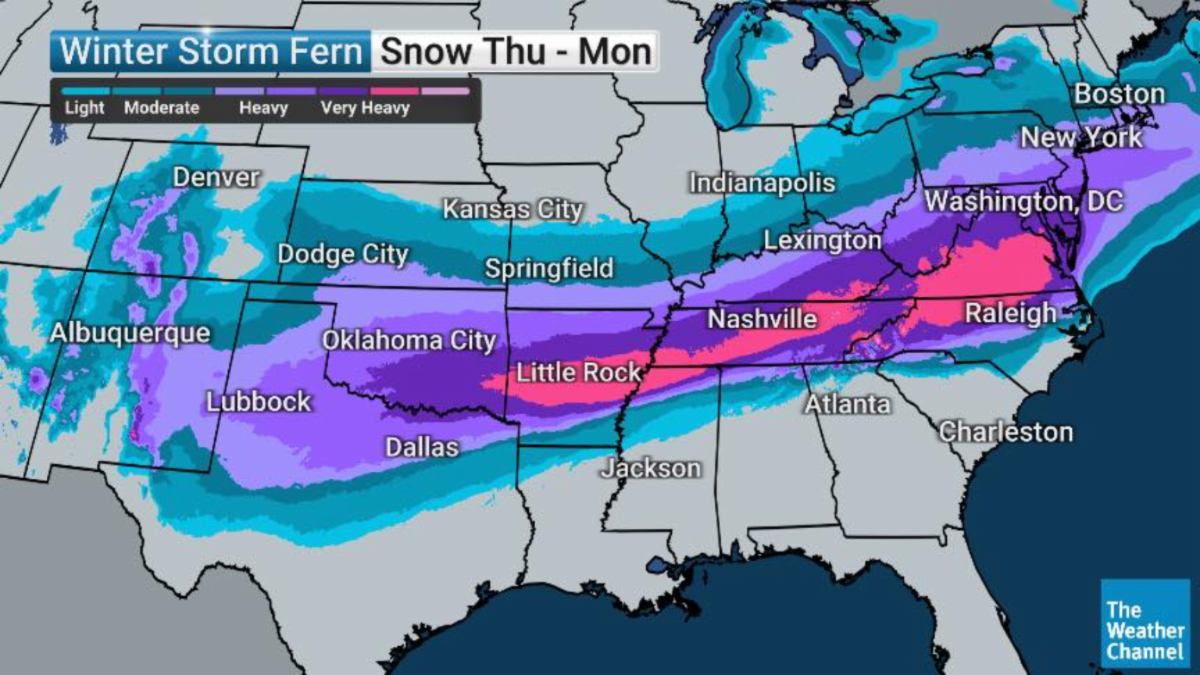
Winter Storm Fern is barreling east with a mess of snow, sleet, freezing rain, and brutal cold that's set to impact more than 180 million people from the Southern Plains to the Northeast. That’s more than half the country staring down a weather event that forecasters are already calling “potentially catastrophic.”
At its worst, Fern could bring crippling ice, widespread power outages, impassable roads, and flight delays across major U.S. regions, all while bitter arctic air locks everything in place long after the precipitation ends.
The setup
Blame Canada... or at least the arctic high pressure system camped over the Great Lakes that’s pumping bone-chilling air into the South. At the same time, a storm is brewing in the Southwest and pulling Gulf moisture north.
When that cold air meets the warm, wet stuff, winter weather explodes across the map. It's basically the atmospheric version of mixing Mentos and Diet Coke.
Timing and trouble spots
Things start going sideways Friday in parts of New Mexico, West Texas, Oklahoma, and Arkansas, where snow, sleet, and freezing rain will ramp up through the afternoon. By Friday night, that wintry cocktail spreads into the Tennessee Valley, Mississippi, and the Carolinas.
Saturday is where it really gets dicey. Fern is expected to push even farther south into places like Louisiana and central Mississippi while also intensifying in the Mid-Atlantic. Cities from Dallas to Charlotte to Richmond are all in the mix, with freezing rain and sleet turning roads into skating rinks and tree branches into potential projectiles.
By Saturday night, the storm reaches full drama. Ice is likely across southeast Texas and southern Louisiana, while snow builds from the Appalachians through the Northeast corridor.
And then comes Sunday, where the snow may finally start easing in the South, but not before blanketing major metros like D.C., Philly, New York, and Boston. The Northeast could see snow and wind persist into Monday morning.
How bad could it be?
Really bad. Some areas, especially in the South, could see ice totals approaching half an inch, or even a full inch in worst-case scenarios. That’s enough to snap tree limbs like twigs and knock out power for days.
And even after the storm passes, don’t expect a quick thaw. Temperatures will stay below freezing in many places until midweek, with lows dipping into the teens and single digits in areas more used to sweating than shivering.
Melting during the day might help a bit, but refreezing at night will make roads slick all over again, extending the chaos well into next week.
How will this affect transportation?
Travel headaches, for starters. Major airports across the South and East Coast (think Dallas, Atlanta, Charlotte, and New York) could see widespread delays and cancellations.
Highways will be a mess, especially in places not built for snow and ice. And if you lose power during the storm, it might be a while before you get it back, especially with wind chills in play and line crews trying not to slide into ditches themselves.
Fern isn’t just a snowstorm. She’s a full-blown, multi-state stress test for everything from utility grids to local patience. So maybe don’t wait until the flakes start falling to dig out the flashlight, charge your phone, and stock up on snacks that don’t require cooking.
| Trump Could Blacklist Foreign Ports Under New Trade Bill Rewrite | |
In the latest rewrite of a bill that once tried to fix international trade drama the old-fashioned way (you know, with rules), Congress has found a new way to say "don't touch our stuff."
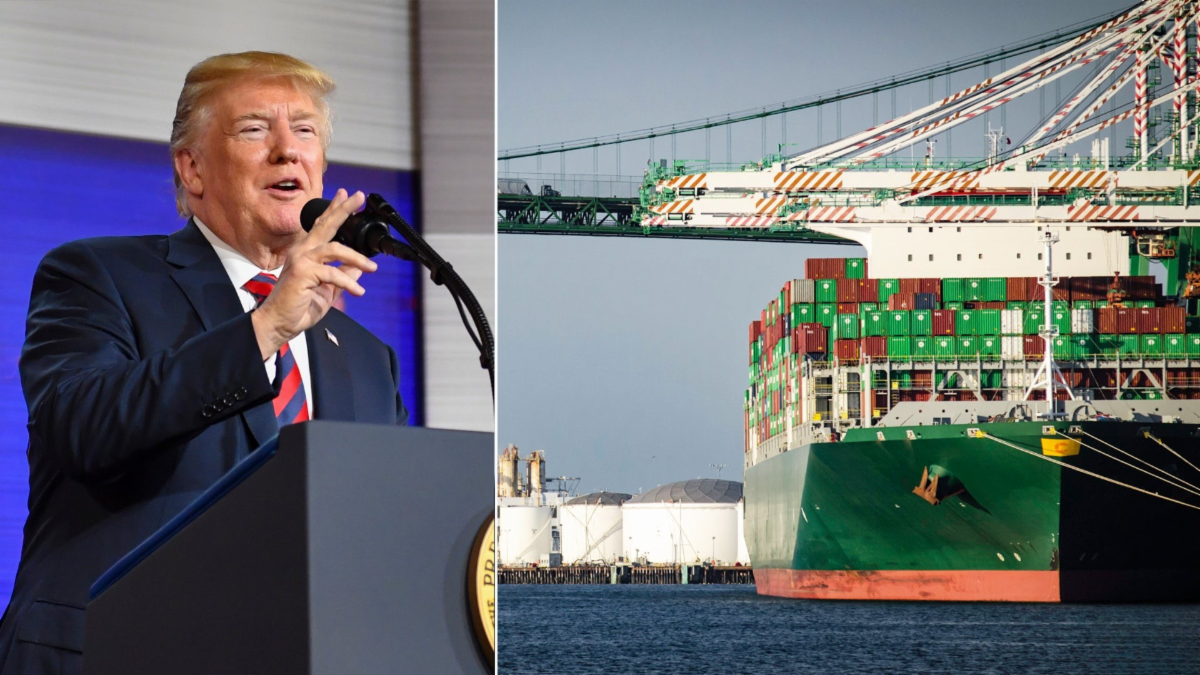
In its new 2026 form, the Defending American Property Abroad Act would hand Trump the exclusive power to declare certain foreign ports and terminals off-limits to U.S.-bound vessels.
Essentially, it's a “you can’t sit with us” list for infrastructure.
Port of no return
This all started with Mexico trying to expropriate a deepwater port owned by Alabama-based Vulcan Materials. Lawmakers didn’t love that.
The revised bill gives the president authority to ban any port, harbor, or terminal in the Western Hemisphere from U.S. access if:
- A foreign government nationalized or seized property owned by a U.S. individual or company, and
- The port is accessible through land owned or controlled by a U.S. entity
If a country grabs U.S.-owned land and starts running bulk materials through it, that port could get slapped with the “prohibited” label, and so could any vessel that stops there.
Conditions for forgiveness
The bill isn’t heartless. It lays out multiple ways a banned port can redeem itself:
- Pay up for what you took.
- End the land-grabby behavior.
- Or just reach a resolution that satisfies the president (interpret that how you will).
Once the ban is lifted, ships that previously transited through the naughty port are forgiven and allowed back into the U.S., no grudge held (officially).
The bigger picture
While framed as a defense of U.S. corporate property, this bill signals something broader: the weaponization of port access as a foreign policy tool.
Vessels and carriers moving industrial freight through Latin America will want to pay attention. In this new era of trade enforcement, just choosing the wrong port could cost you access to the world’s most valuable market.
| Trump Tariffs Eight NATO Countries Over Greenland Troop Visit, Demands “Complete and Total” Sale | |
In what might be the most expensive Zillow search of all time, President Trump is once again trying to buy Greenland.
But this time, he’s skipping the “Would you be interested in selling?” part and going straight to the trade war.
What is going on?
In a Truth Social post Saturday, Trump announced a 10% tariff on eight NATO countries, including Denmark, Norway, Sweden, Finland, Germany, France, the U.K., and the Netherlands, which are set to take effect Feb. 1.
They’ll rise to 25% on June 1 and stay there “until such time as a Deal is reached for the Complete and Total purchase of Greenland," Trump stated, apparently unaware of how capitalization works in grammar.
The nations in question had recently deployed a small, largely symbolic military force to Greenland, led by Denmark. European diplomats say this was a gesture of allied Arctic cooperation, not a covert land grab, but Trump wasn’t buying it.
On Truth Social, he claimed they had “journeyed to Greenland, for purposes unknown,” accusing them of “playing a very dangerous game.”
Europe reacts
Diplomats in Europe found out about the tariffs the same way you did: by checking social media. There was no official warning, and officials say the move risks a serious rupture in U.S.-Europe relations.
The timing adds fuel to the fire, as Trump is scheduled to appear at Davos this week, where he’s now expected to face a frosty reception from the leaders he just tariffed.
- French President Emmanuel Macron called the tariffs “unacceptable” and pledged a united European retaliation if they're enacted.
- Denmark said the troop deployment was explicitly for Arctic security and labeled the tariffs a total surprise.
- Swedish PM Ulf Kristersson warned, “We won’t let ourselves be intimidated.”
- U.K. PM Keir Starmer called the tariffs “completely wrong” and said NATO allies should be working together, not threatening each other with trade war.
Meanwhile, protesters in Greenland and Copenhagen flooded the streets. Thousands marched to the U.S. consulate in Nuuk, led by Greenlandic Prime Minister Jens-Frederik Nielsen, while others rallied outside the U.S. embassy in Denmark waving signs demanding self-determination.
But wait, there's more
Domestic response in Washington has been bipartisan, which in 2026 is rarer than a warm day in Greenland (for now, at least).
- Senate Minority Leader Chuck Schumer called the plan “foolhardy” and promised legislation to block it.
- Republican Sen. Thom Tillis blasted the move as “beyond stupid,” saying it helps adversaries and undercuts Trump’s own NATO legacy.
- Sen. Lisa Murkowski, who had just been in Greenland with a Congressional delegation, said the island “should be viewed as an ally, not as an asset.”
Adding to the tension, the White House has reportedly not ruled out the use of military force if diplomacy fails, even as Denmark warned such a move would be seen as a direct threat to the NATO alliance.
Why Greenland?
Trump’s obsession with Greenland dates back to his first term, when he floated the idea of buying the island and was laughed off by Denmark. But now he's serious (and surrounded by aides who are also serious) about turning that dream into a legacy-defining acquisition.
His argument is threefold:
- Security: The island hosts the northernmost U.S. base and offers a strategic Arctic perch for missile defense.
- Resources: Greenland holds untapped reserves of oil, gas, and minerals.
- Climate math: Melting sea ice is opening up new shipping routes, making the territory even more valuable.
What’s unclear is how Trump plans to forcibly acquire a self-governing Danish territory that, last time we checked, isn’t for sale.
So, what now?
Let's recap:
- The first round of tariffs is set to take effect on February 1, targeting eight NATO allies unless President Trump’s demand for a deal to purchase Greenland is somehow met. If no agreement is reached, the tariffs will escalate to 25% by June 1.
- Trump is expected to attend the World Economic Forum in Davos this week, where tensions with European leaders are sure to surface in both public remarks and behind-the-scenes diplomacy. Meanwhile, EU officials are already coordinating a joint response to the tariffs, signaling this could turn into a major transatlantic standoff.
- In Greenland, protests continue, with leaders and citizens alike reaffirming that the island is not for sale, no matter the price or pressure.
At this point, what began as a fringe policy idea has evolved into a real geopolitical crisis, with trade, diplomacy, and NATO unity all hanging in the balance. Whether this ends in a backroom deal, a legislative block, or just another frozen standoff remains to be seen.
| | |
🚢 Port of Long Beach Has Record Year
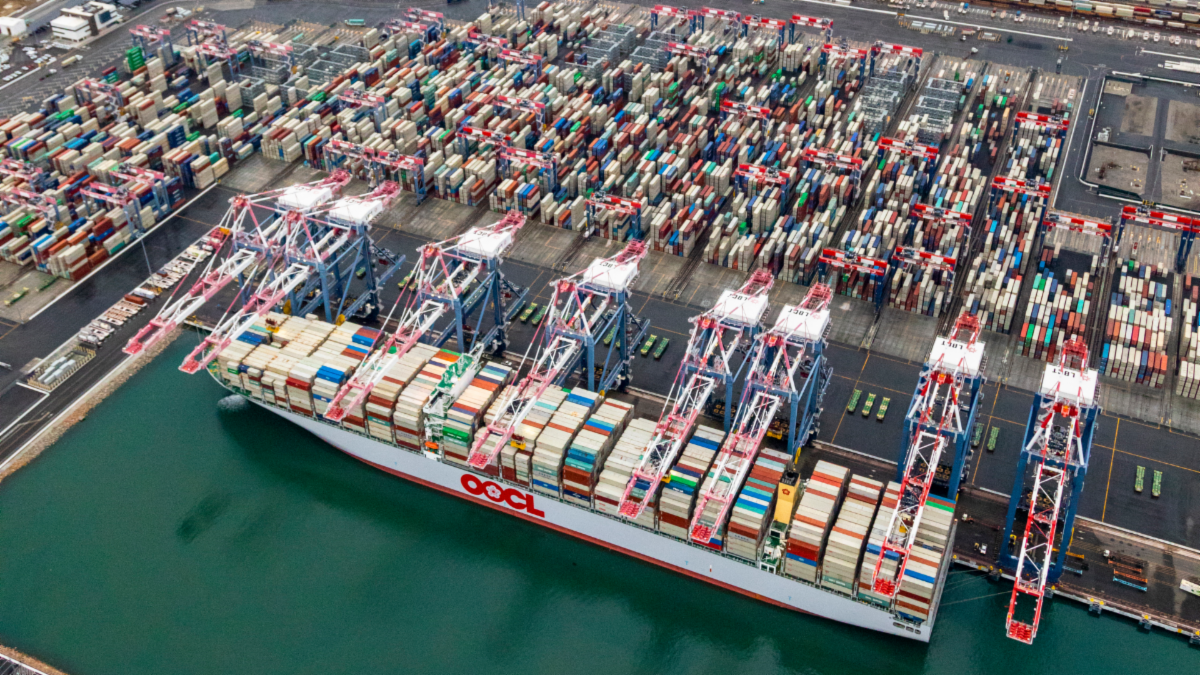
The Port of Long Beach just set a new all-time record, moving 9,881,595 TEUs in 2025, topping last year’s high-water mark of 9.6 million.
Imports led the way with 4.78 million TEUs, exports came in at 1.14 million, and empty containers jumped 6.7% to nearly 4 million.
For the first time in its history, five of the Port’s six container terminals each moved over 1 million TEUs, and two of them crossed the 2 million mark. Altogether, Long Beach handled 48.9% of all cargo moving through the San Pedro Bay complex and wrapped up its third consecutive year above 9 million TEUs.
| | |
✈️ Air Cargo Climbs to Start the Year
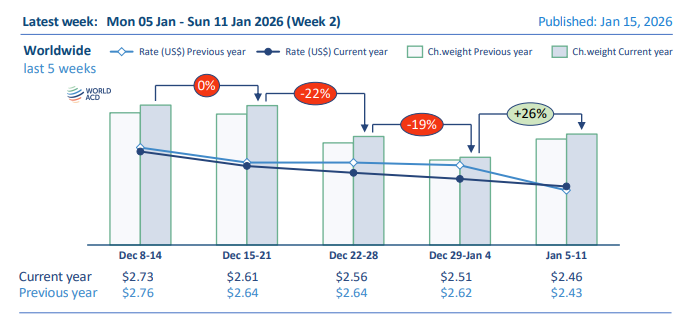
Airfreight demand kept flying high in early January, with global volumes up 5% year-over-year in the first full week of 2026, according to WorldACD. But the data firm cautioned that 2025 started off slow, so this year’s early momentum should be taken with a grain of salt.
- Week 2 (ending Jan. 11) volumes rose 26% over Week 1
- Year-over-year demand was strongest in:
- Middle East & South Asia: +16%
- Global air cargo capacity is recovering but still 7% below the mid-December peak
Not everything’s trending up, however. Average rates slipped 2% week-over-week to $2.46/kg, about 10% lower than December highs, but still 1% higher than this time last year.
Looking ahead, container ships returning (cautiously) to the Red Sea could siphon off some air cargo demand from the Middle East.
| | |
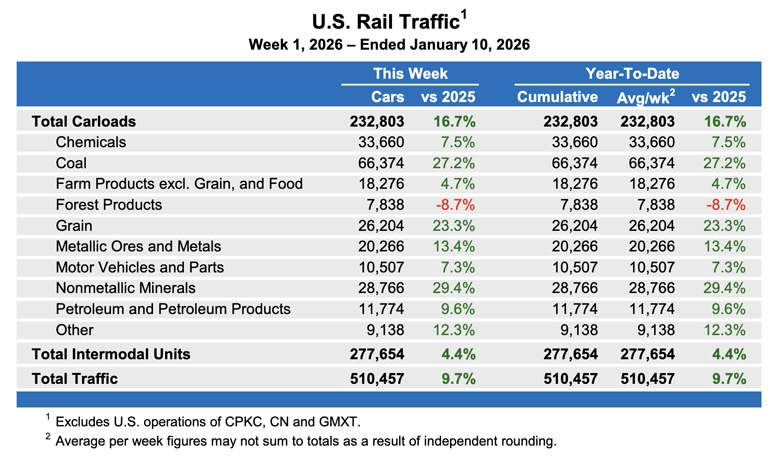
🚂 Rail Traffic Starts 2026 with a Bang
U.S. railroads kicked off the year with a burst of momentum, logging a 9.7% year-over-year increase in total traffic during the first full week of 2026.
According to AAR, the week ending Jan. 10 saw 510,457 carloads and intermodal units move through the system, thanks in large part to double-digit gains in carload volume.
- Carloads rose 16.7% year-over-year, led by surges in:
- Nonmetallic minerals: +29.4%
- Intermodal units climbed 4.4%
- Forest products were the only major commodity to slip, down 8.7%
Across all of North America, total traffic was up 7.7% for the week. Mexico led the charge with a 53% increase in volume, while Canada lagged slightly behind last year’s totals.
Since this was the first full week of 2026, these stats also double as the year-to-date scoreboard, and so far, the rails are off to a strong start.
| |
|
Turns out one glowing eyeball of a venue wasn’t enough. Sphere Entertainment just announced plans to bring a second version of its iconic Las Vegas Sphere to National Harbor, a glitzy tourist zone just outside Washington, D.C.
The so-called “mini-Sphere” will land along the Potomac, near the MGM Grand and The Capital Wheel. So if you’ve ever wanted to ride a Ferris wheel, lose a paycheck at the blackjack table, and stare into the LED soul of a building, all in one afternoon, your time is coming (also, get help).
Fun-sized sphere
This version will be smaller (6,000 seats versus Vegas’ 18,600) but promises the same sensory overload: high-res LED screen, haptic seats, immersive sound, 4D effects, and an exterior that could terrify small children and possibly double as an alien distress signal.
And unlike the Vegas version, which feels like it was dropped onto the Strip by an omnipotent being, this one is getting a public-private welcome package:
- $200 million in combined state, local, and private incentives
- $1+ billion total project cost
- 2,500 construction jobs and 4,750 permanent jobs once open
- Projected $1 billion+ annual economic impact
Some of that public funding will need voter approval, so stay tuned for the political equivalent of debating whether it's worth it to buy a really, really cool lamp.
What happens in Vegas doesn't stay in Vegas
This will be the third Sphere project, following the Vegas original and a full-size version currently under construction in Abu Dhabi. CEO James Dolan says it’s all part of the plan to build a “global network of Spheres,” because apparently Earth doesn’t have enough glowing orbs.
Programming will likely follow the Vegas model: concerts, residencies, and trippy documentaries that make you question time itself. The Vegas Sphere already runs daily shows including Postcard From Earth, a surreal visual buffet presented in more pixels than the average human brain can process.
| | Book Our Loads on Highway's TFX | |
We’re now posting freight on the Trusted Freight Exchange (TFX), a secure, Highway-powered network made for verified carriers like you.
It’s built right into Highway, free to use, and designed to connect you with quality freight fast.
Every KCH load on TFX is:
- Verified: posted by trusted shippers and brokers.
- Ready to roll: book it instantly and get moving.
With TFX, you skip the back-and-forth and get straight to hauling.
| | |
Truck parking sucks. Let's fix that.
The U.S. has 23 million truck parking spots. You should be able to find one without feeling like you're on a wild goose chase.
We’re teaming up with Truck Parking Club to make that happen.
Use code KCH25 for $25 off your next reservation.
Less wandering. More rest.
| |
| |
The Frog
Comfort Colors Garment-Dyed Heavyweight T-Shirt
$39.95
| | | | | | |