|
The Spirit of Black Philanthropy
Issue 2 | November 2021
| |
|
Many seem to rush to Christmas after Halloween and skip right over the many blessings in November. (That being said, if your Christmas tree was up before this week, we’re not judging!) The month of November is a wonderful month of celebrations, not only Thanksgiving but also National Philanthropy Day on November 15 and Giving Tuesday on November 30.
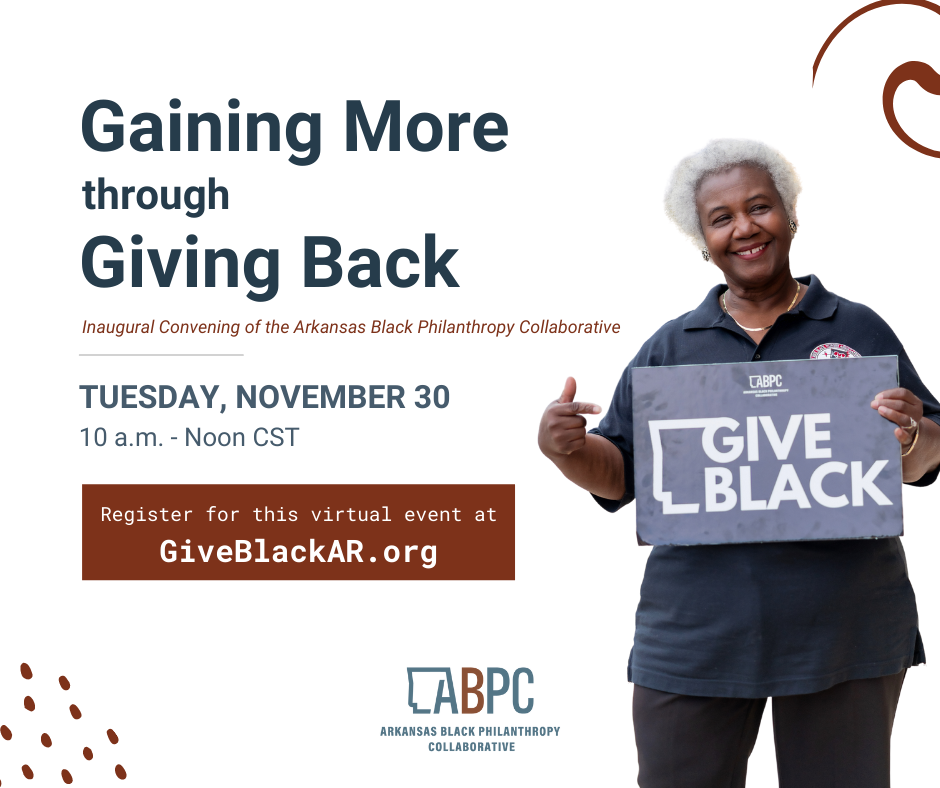
Giving Tuesday is the biggest giving day of the year and takes place annually on the Tuesday following Thanksgiving, Black Friday, and Cyber Monday. The Inaugural Convening of the Arkansas Black Philanthropy Collaborative is happening on Giving Tuesday from 10 a.m. until noon. You can register for the virtual Convening here. Keep reading for more information about the program and the dynamic panelists who will share with us about “Gaining More through Giving Back.”
In addition to attending the virtual Convening on Tuesday, November 30, we invite you to make a tax-deductible contribution to the Give Black Arkansas Fund, powered by the Arkansas Black Philanthropy Collaborative. Your gift will support general charitable purposes with a focus on organizations and programs supporting Black communities in Arkansas.
When it comes to giving, no act or amount is too small, especially when it’s done in the spirit of gratitude. Our giving is extremely important because it provides opportunities, support, and encouragement to those who are in the trenches every day trying to make a difference in the lives of others. We encourage you to consider giving with a purpose to a purpose on Giving Tuesday.
You can make your gift of $25 or more online at arcf.org/GiveBlackAR or by mailing a check of any amount to the Arkansas Community Foundation (5 Allied Drive, Suite 51110, Little Rock, AR 72202). Non-traditional gifts – such as gifts of stock, life insurance, IRA rollovers, etc. – are also accepted.
November provides an opportunity to be grateful and what better way to practice gratitude than to give (Thanks + Giving). In a spirit of gratitude and thanksgiving, we wish you and yours a happy holiday.
Derek Lewis II
President, Derek Lewis Foundation
Chair, Arkansas Black Philanthropy Collaborative
| |
Inaugural ABPC Convening
Gaining More Through Giving Back
Tuesday, November 30
10 a.m. - Noon
| |
|
Join the Arkansas Black Philanthropy Collaborative on Giving Tuesday for our Inaugural Convening. The theme for this year’s virtual event is “Gaining More Through Giving Back.”
Panelists will explore the legacy of giving in Black communities and examine how giving can build pathways toward economic mobility for Black entrepreneurs and Black-led organizations. The event will also address how giving can assist in tackling systemic issues facing communities of color, such as the racial wealth gap and health disparities.
Gaining More Panel
Our first panel will look at historical perspectives and the legacy of the impact of Black philanthropy both in Arkansas and throughout the country. Panelists will also discuss shifting the narrative surrounding giving in Black communities and how we can help individuals begin to see themselves as philanthropists in their community. You'll hear from these distinguished panelists:
-
Susan Taylor Batten, ABFE: A Philanthropic Partnership for Black Communities
-
Janine Lee, Southeastern Council of Foundations
-
Dr. Charlotte Lewellen-Williams, The Center on Community Philanthropy at the University of Arkansas Clinton School of Public Service
-
Quantia “Key” Fletcher, Mosaic Templars Cultural Center (Moderator)
Giving Back Panel
Our second panel will take a look at the current landscape of Black philanthropy to ask what the future of giving looks like for and in Black communities. How can strategic investments help Black-led or Black-serving organizations eliminate health disparities, reduce the racial wealth gap, build pathways toward economic mobility for Black entrepreneurs and communities, and tackle other systemic issues facing communities of color? You'll hear from these distinguished panelists:
-
Dr. Joyvin Benton, University of Arkansas at Pine Bluff
-
Tyrone Spann, Indiana Blacks in Philanthropy
-
Erika Wright, JP Morgan Chase & Co.
-
Dr. Joseph Jones, Medgar and Myrlie Evers Institute (Moderator)
| |
PIONEERS IN ARKANSAS BLACK PHILANTHROPY | |
In each issue of The Spirit of Black Philanthropy, the Mosaic Templars Cultural Center brings attention to the history of giving in our community by spotlighting a Black philanthropic pioneer in Arkansas history. | |
|
Where would we be without the women in our community?
While much of the work of community philanthropy is done by women, women’s contributions have been underreported and underrepresented in our history books.
I have a special admiration for those who give in the areas of education and learning. Once a seed is planted in education – even the tiniest seed – a world of possibilities is unlocked. What is learned can never be unlearned or denied, no matter what. This month we learn about the power, freedom, and limitless opportunities created by one seed of a sower.
Quantia “Key” M. Fletcher
Director, Mosaic Templars Cultural Center
| | |
|
Carrie Lena Fambro Still Shepperson
Carrie Lena Fambro Still Shepperson was born a freedwoman in 1872, near Milledgeville Georgia. She was promoted by her mother to seek out education as a profession and she became a teacher. She graduated from Atlanta University in 1886. In 1893, while teaching at Alabama State Agricultural and Mechanical College, Carrie met William Grant Still, a colleague who taught instrumental music and vocal music. The couple married and settled in Woodville, Mississippi, in 1894. On May 11, 1895, their son, William Grant Still Jr. was born at Piney Woods. William Grant Still died on September 26 of that same year – just a few months following the birth of his son – at the age of 24.
After her husband’s death, Carrie moved to Little Rock where her mother lived and began teaching at Union School, Little Rock’s Black school. When the decision was made to replace Union School with Capitol Hill in 1902, the new school lacked a library. To supplement the school’s inadequate funding, Carrie organized and staged a school-sponsored and student-performed public program in 1916. The proceeds were donated to the school to establish a library at the new site. The benefit production was so successful that Carrie inaugurated a series of annual productions at Capitol Hill and later at Gibbs High School.
In 1924, Carrie was elected as secretary of the Little Rock branch of the NAACP. In her first year, fundraising increased by almost 1,000%. She supervised several successful events, including increasing membership and organizing a junior division. As a result of her work, the chapter was nationally recognized, and she won the inaugural Madame C. J. Walker award for service to the national NAACP. Carrie Shepperson’s death in 1927 created such a decline in fundraising for the Little Rock chapter that the national organization questioned if the Little Rock chapter was still a functioning chapter.
For more information about Carrie Lena Fambro Still Shepperson and other historical African American leaders in Arkansas, stop by and visit Mosaic Templars Cultural Center. Admission is free, and its hours of operation are Tuesday through Saturday from 9 a.m. until 5 p.m. To schedule a tour, visit mosaictemplarscenter.com.
| | |
GET TO KNOW THE ABPC ADVISORY COMMITTEE | |
In each issue of The Spirit of Black Philanthropy, we introduce you to a member of the ABPC advisory committee. Get to know the people behind the scenes who help make our work possible. | |
Lena Hayes
Lena Hayes is Chief Development Officer for Baptist Health Foundation. A native of Malvern, Arkansas, Lena earned a Bachelor of Arts degree in Communications with an emphasis in Business Administration from Henderson State University in Arkadelphia.
| |
|
|
What does Black philanthropy mean to you?
A sense of shared ownership in strategically creating and supporting solutions to empower ourselves to build a better and stronger Black community.
What excites you most about the future of Black philanthropy in Arkansas?
Black people are not only recipients of philanthropy; we have a rich, long history of being accountable and engaged philanthropists. I’m excited about this opportunity to help shine more light on our resilient Black humanitarians. I’m equally excited to be a part of these collective, collaborative efforts to make Black people even more effective in meeting the needs of our Black community.
What causes are you passionate about and in what ways do you support those causes?
I am passionate about health and education. I support these causes in a personal and professional capacity, and it’s my pleasure to invest my heart, time, and money in both.
What do you love most about living in Arkansas?
The people.
What do you love most about what you do?
The opportunity to connect philanthropy to purpose.
Tell us a little more about yourself.
I honestly prefer talking more about others, so I will take the liberty to share that I have a son, Luke, who is kind, analytical, and a student-athlete at the historical Central High. And I recently married Kenneth Hayes, who is a loving, intelligent, and strong Black man and entrepreneur in our community. I am so blessed to have these two amazing men accompany me on my ever-evolving journey to seek wisdom, meaning, and purpose.
What attracted you to your career?
My career is not easy but I love the challenge and opportunity to help transform the health and lives of Arkansans.
What quality do you admire most in others?
Authenticity.
What talent do you wish you had?
A photographic memory.
Favorite quote to live by:
“With men this is impossible, but with God all things are possible.” –Jesus
| |
ABPC is proud to work in partnership with the Arkansas Community Foundation to provide grants to 40 Black-led and Black-serving nonprofit organizations in central Arkansas through the Building Black Communities Fund. In each issue, we shine a light on one of the grantees and the amazing work these organizations are doing in our state. | |
Center for Racial Justice and Criminal Justice Reform, University of Arkansas at Little Rock William H. Bowen School of Law
Founded in 2021, the Center for Racial Justice and Criminal Justice Reform at the University of Arkansas at Little Rock William H. Bowen School of Law was one of the Building Black Communities Fund grantees. The Center’s mission is to advance racial equity, access to justice, and fairness in Arkansas and the region through academic legal research and legal education. We spoke with Professor of Law Anastasia M. Boles about the newly opened Center’s research programs and projects.
| |
|
|
What’s your role at the Center for Racial Justice and Criminal Justice Reform and how long have you been there?
I am a co-director and co-founder, along with Associate Dean andré douglas pond cummings, of the Center for Racial Justice and Criminal Justice Reform at Bowen Law. I have been teaching at the law school since 2012 and teach Civil Procedure, Evidence, Employment Discrimination, and Race and the Law at Bowen. My research examines racial justice, employment law, criminal justice policy, and legal education.
Describe your background. What did you do before working for Bowen Law School?
I moved a great deal growing up, and I call myself a “corporate brat.” We moved around the east coast, Midwest, and then Scottsdale, Arizona, where I went to junior high and high school. I graduated from Stanford University and dual majored in political science (with honors) and sociology. I attended Columbia Law School, then served as a judicial clerk for the late Honorable Napoleon A. Jones Jr., of the United States District Court, Southern District of California. I have practiced corporate litigation with three law firms in New York and Los Angeles; my practice focused on employment litigation, labor litigation, white-collar criminal defense, securities litigation, and general civil litigation.
What are some exciting projects you’re working on or have recently completed?
We are brand new, having just launched in August 2021, but already have a number of exciting research projects and programs. The Building Black Communities Fund has generously supported the Center’s law student pipeline program. The pipeline program aims to help students from underrepresented communities succeed on the Law School Admission Test (LSAT). We partner with HBCUs in Arkansas to provide an LSAT prep course, mentoring, assistance with applications, and professional development opportunities. We are finishing with our first cohort of students and it has been a great semester.
What people, books, and/or life factors have influenced and impacted you?
I have always cared deeply about racial justice and access to justice. That value has guided my life decisions, and I am exceedingly grateful that God blessed my family with the opportunity to be part of the Arkansas community.
Describe your training, your interests, and/or your hobbies. What do you do when you’re not at the office and why?
When I am not teaching, I am cherishing time with my amazing husband and two sons. We are part of a powerful church community at Mosaic Church of Central Arkansas. I really love gardening, although I am not very good at it!
| |
Do you have good news to share? Send an email to hello@theabpc.org with “Boss Moves” in the subject line, and we may feature you in our next issue! | |
|
MEN ON A MISSION
Little Rock Soirée recently recognized 23 men who are changing the way people do business and do life together in central Arkansas. We are proud that two ABPC Advisory Committee members were named to the inaugural class of Men on a Mission.
| |
Rev. Cory Anderson
Chief Innovation Officer
Winthrop Rockefeller Foundation
| |
Scott Hamilton
CEO
The Urban League of the State of Arkansas
| Congratulations, Cory and Scott, on this well-deserved recognition! | |
|
NEW JOBS AND PROMOTIONS
ABPC Advisory Committee Member Christopher L. Harvey has joined the Chris Jones for Governor gubernatorial campaign as Senior Advisor & Political Director. Congratulations, Christopher!
| |
WHAT CAUGHT OUR ATTENTION | | | | |