| |
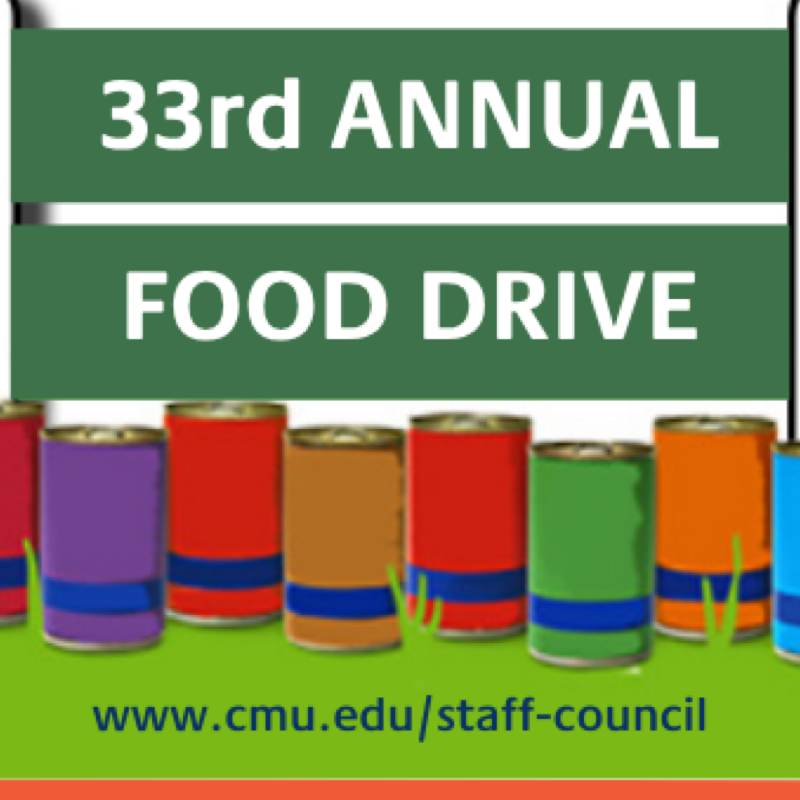
Carnegie Mellon University’s 33rd Annual Food Drive Starts Next Week!
Mark your calendars for Oct.1 – Nov. 6, and be sure to participate in our 33rd annual food drive! Our goals for this year are – once again – to collect $100,000+ in nonperishables for Greater Pittsburgh Community Food Bank, as well as 250 can openers for CMU’s Food Pantry, directly benefiting our students.
For more details, including special event dates, please visit: https://www.cmu.edu/staff-council/what-we-do/food-drive/index.html.
| | | |
A Call for Volunteers: The 2026 Andy Awards
The 2026 Andy Awards ceremony is happening Wednesday, Oct. 14, from noon to 1 p.m. EDT in Rangos Ballroom, Cohon University Center. Join us as we celebrate the CMU staff whose hard work, creativity and teamwork embody Andrew Carnegie's motto, "My heart is in the work."
Please reach out to Jen Weidenhof if you would like to volunteer at the event (showing attendees to their seats, handing out certificates, etc.)
| |
Staff Feedback on
New Workplace Flexibility Guidelines
| | |
When Carnegie Mellon announced its plans to shift to a 4:1 standard hybrid work posture starting January 4, 2027, Staff Council wanted to understand how this change would affect staff across campus. The response was impressive: 1,088 staff members (about 28% of staff) shared their thoughts, providing over 700 detailed comments about what's working, what's not and where we go from here.
The data shows that staff are not necessarily opposed to coming to campus; rather, strict mandates fail to align with how current operational workflows are executed. Less than 2% of staff supported the new 4:1 work arrangement, while most people advocated for flexibility tailored to their specific roles.
What the Numbers Show
-
Work-Life Balance Matters Most: 88% of respondents pointed to work-life balance as their primary concern, overshadowing issues like daily parking fees (62%) and commuting costs (61%).
-
Reality of Daily Roles: 68% of respondents said they rarely or never interact directly with students. For staff who spend their days in virtual Zoom meetings, mandating physical presence feels counterproductive.
-
The Workspace Gap: Among the 137 staff members who don't currently have a dedicated desk on campus, 94% were unaware of any plans to provide them with a workspace ahead of the January 2027 rollout.
-
Flexibility is Already Essential: About one-third of respondents (33%) already work under approved flexible arrangements, proving that flexibility is core to the university's operational infrastructure.
What Staff Asked For
-
Trust Department Autonomy: Let individual units set schedules based on functional job duties rather than top-down mandates.
-
Provide Early Exception Clarity: Release transparent criteria and timelines to ease staff anxiety around application processes.
-
Ease Commute Friction: Introduce flexible daily parking rates and transit support for days staff commute to campus.
-
Fix Logistics First: Lock in concrete office space plans for employees currently without desks.
What HR Shared With Us
At the September 17 Staff Council meeting, HR presented and answered the questions we submitted, along with follow-ups from the floor. HR emphasized that senior leadership has made the decision on the 4:1 posture, and that HR's role is to help staff and teams through the transition. Here is what we learned.
Exceptions
-
Management drives them. Employees must work with their supervisors to apply for a Tier 1 or 2 exception, unless a medical or religious accommodation is needed. Supervisors evaluate roles, while deans and vice presidents build the business case. The Flexible Work Committee, which includes the Provost and Chief Human Resources Officer, makes the final decision. There is no appeal process, and individual supervisors cannot grant exceptions to 4:1.
-
Three tiers apply. Tier 1 covers fully remote or out-of-state roles that are geographically bound or highly specialized. Tier 2 allows 2–3 days on site for highly digital, independent roles with minimal stakeholder contact. Tier 3 is the standard 4:1 posture. Supervisors of staff are expected to model 4:1, and new hires spend their first 90 days on site before an exception can be considered.
-
Timeline: The committee is reviewing exceptions at the end of September or early October, and everyone affected will be notified in October. Existing exceptions may continue, be modified or end. All current exceptions are time-bound and run no later than December 31, 2027. Roles without an exception are expected on site January 4.
- Space alone is not enough to justify a long-term exception.
Day-to-day flexibility
- Supervisors decide which four days you're on site, and some units may set "anchor days." HR noted that Mondays and Fridays are the most popular remote days, but leadership would like to see people on campus all five days.
-
Supervisors can approve day-to-day flexibility without the exception process: shifting your hours (core hours are 8:30–5, with flexibility from 7:30 to 6:30), swapping remote days, or adjusting for something like a home repair or bad weather. HR also said a four-day compressed schedule is an option to discuss with your supervisor, though the written guidelines route compressed schedules through the VP or dean.
- In addition to the one remote day per week, you may work remotely up to 30 calendar days per year with supervisor approval, but not as a way to reduce your regular on-site days.
- Meetings can stay hybrid or on Zoom when space or group size makes in-person impractical.
- For event-heavy roles, such as weekend or Carnival-week work, arrangements are made within your unit and with your HR business partner. Supervisors cannot offer comp time under federal law.
- HR is not aware of plans to track individual on-campus attendance beyond existing building badge access.
- Faculty are also expected on site four days per week, per the Provost's communication.
Accommodations
Medical and religious needs go through Disability Services on a separate, case-by-case basis, so timing varies.
Costs and support
-
Transit and family support: Full-time, benefits-eligible staff ride PRT for free with their CMU ID and the Ready2Ride app. Carpool matching is available through Commute PA, and parking options have been updated. Family Care offers a concierge service for child care, aftercare and summer care. Cyert Center enrollment depends on availability, and EAP offers financial planning resources.
-
Compensation: HR said salaries are based on market value, role and performance rather than commuting costs. There are no plans to adjust merit for the added expense. HR noted that the university funded a merit pool this year and has offered one-time payments in the past but cannot speak to the future.
-
Delay: HR is not aware of plans to postpone implementation and encouraged staff to prepare now, even those hoping for an exception.
Space and facilities
HR acknowledged that some groups gave up space during the pandemic and said leadership is aware. Campus Design and Facility Development is preparing guidance for units, and Facilities Management Services will monitor building use so maintenance and cleaning keep pace. Departments continue to manage their own equipment, with IT guides available. HR said its business partners haven't heard many space concerns, which tells us we should keep making sure yours are heard. Questions about meeting room availability and the room-booking system were noted but not answered.
Success measures, benchmarking and HR survey data
- Success will be judged by whether teams meet objectives, keep operations running and support the campus experience. Leadership will review performance and operational outcomes, and HR will report what it hears, including from exit interviews. No specific metrics were shared.
- HR said it reviewed peer institutions, found a lot of variation, and noted that top-tier peers emphasize physical presence. No comparison data was shared.
- HR said its own survey feedback shaped the guidelines and resources, but it doesn't plan to publish a summary report.
Where We Go From Here
The meeting gave us clearer criteria, a timeline and a set of resources to share, and HR asked us to pass them along to colleagues. Some of the biggest questions, including cost, workspace and how much input individual units have, are still on the table, and Staff Council will keep bringing them to leadership. In the meantime, start with your supervisor, connect with your HR business partner if you need support, and let us know what you're experiencing.
Resources
| |
| | |
…you're just a five-minute walk from a live orchestra rehearsal-turned-concert — and nobody's charging Broadway prices.
The School of Music has something on the calendar most weeks. Check out what's coming up and add a little culture to your calendar!
School of Music Schedule of Events
| | | | |
|
The Staff Support and Guidance Committee (SSGC) offers staff a confidential, peer-led resource for guidance or listening. Formerly known as RGAC, this committee includes Staff Council members from across Carnegie Mellon. If you need someone to talk to who understands what you might be going through or if you want help navigating official processes, members of SSGC are willing to help.
To learn more about who we are and what we do, visit our website. To find someone to speak to, reach out to co-chairs Kirsten Heuring or Tendai Ushendibaba, or fill out the SSGC Intake Form.
|
| Staff Council General Body Meeting | |
September Highlights
- Members of Human Resources came to Staff Council to share information on the upcoming FWA changes.
- All FWA exemptions will be processed by a committee, with no appeal process currently in place.
- Staff will all have 30 flexible days per year, contingent on supervisor approval. These days can be used for inclement weather, childcare, doctors' appointments, etc.
- FWA exemptions related to neurodivergence or disability should be requested through the disability accommodations process.
| | | | | |
Family Weekend
Friday-Saturday, Oct. 2-3, in various locations
Family Weekend brings together Carnegie Mellon undergraduate and graduate students and their families and friends for a weekend of events that showcase the vibrancy of the campus experience. Highlights include academic welcomes, campus tours, student performances, Scotty Saturday and more!
Hosted by Family Engagement
| | | |
Scotty Saturday
Saturday, Oct. 3, noon to 6 p.m. in various locations
Scotty Saturday celebrates Carnegie Mellon spirit and pride, uplifting our incredible students and highlighting the vibrancy of our campus! Join us for a fun-filled afternoon of activities, traditions, student talent showcases, free snacks and more!
Hosted by the Office of Student Involvement & Traditions
| | | |
UPLift Challenge: Apply for Project Funding
Application period: Sept. 14-Oct. 4 | Virtual office hours: Sept. 28, 4-5 p.m.; Sept. 29, 10-11 a.m.; Oct. 1, 11:30 a.m.-12:30 p.m.
The UPLift Challenge empowers CMU students, faculty and staff to reimagine and improve the shared campus spaces where we gather, study and connect. Use the interactive campus map to identify potential projects and connect with others around shared ideas, then apply for up to $25,000 in project funding before the Oct. 4 deadline. Attend a virtual office hour session to talk through your idea with architecture, design and facility experts.
Learn more and apply: cmu.edu/leadership/president/uplift-challenge
| | | |
32nd Andy Awards Ceremony
Wednesday, Oct. 14, noon to 1 p.m., reception to follow, in Rangos Ballroom, second floor, Cohon University Center
President Farnam Jahanian invites you to join colleagues from across the university as we recognize 53 staff members and 19 teams for their exceptional contributions to Carnegie Mellon University. No registration required. A lunch reception will immediately follow the ceremony in Wiegand Gymnasium.
Questions? Contact AndyAwards@andrew.cmu.edu.
Hosted by University Events
| |
The Staff Voice is a monthly newsletter distributed by the Staff Council Communications Committee. You are receiving this email because of your status as a staff member of the university.
| | | | |