Volume 5 | Issue 10 | October 2025

Cosmology of Light Newsletter


Hello Friends,


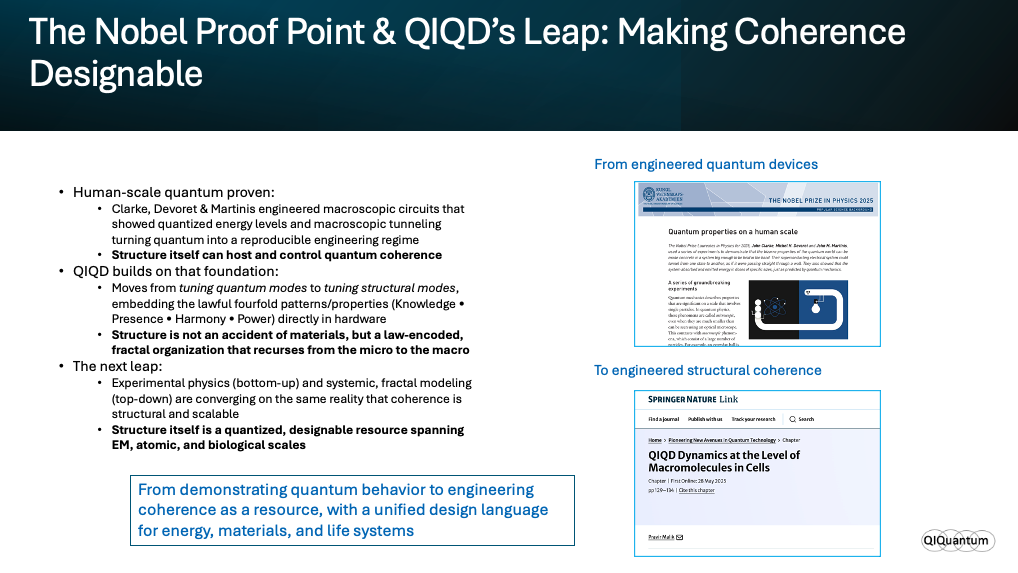
Quantum computing stands at a threshold moment. For the past few decades, progress has been measured managing probability. Yet just two weeks ago, the Nobel Committee recognized John Clarke, Michel Devoret, and John Martinis for engineering macroscopic circuits that sustain quantized energy levels and tunneling, an achievement that quietly redefines what coherence means.


It signals a turning point. For decades, we’ve measured progress in qubit counts and error rates. But this Nobel moment reminds us that structure itself can embody quantum behavior. Coherence, in other words, can be designed.


This evolution points toward a future where resilience is embedded at the level of law, not layered afterward in software, and on October 21 I hosted a Forbes Technology Council Quantum Computing session, Pioneering New Avenues in Quantum Technology: QIQD to Applications, where I emphasized that quantum’s next leap won’t come from colder systems, but from warmer structures: engineered, coherent, and human-scale.


The Structural Era of Quantum has begun.


Warmly,

Pravir

Some Highlights from the Forbes Session


In the recent October 21 session, we bridged:

  • Foundational theory → practical engineering, guided by my new Springer Nature volume Pioneering New Avenues in Quantum Technology
  • QIQD patterns → next-generation devices, algorithms, and measurement systems
  • Today’s probabilistic limits → tomorrow’s coherent, structure-first architectures


We also mapped an application pipeline, from near-term innovations like quantum energy detection and QIQD-inspired nano-devices, to the long-term pursuit of room-temperature superconductors.


For leaders navigating the convergence of AI, HPC, and quantum computing, this conversation offered a new strategic lens to assess risk, coherence, and opportunity in the quantum decade ahead.


🎥 Watch the recorded session to see where quantum technology is heading and how structure may become the next great substrate of innovation.


The State of Quantum

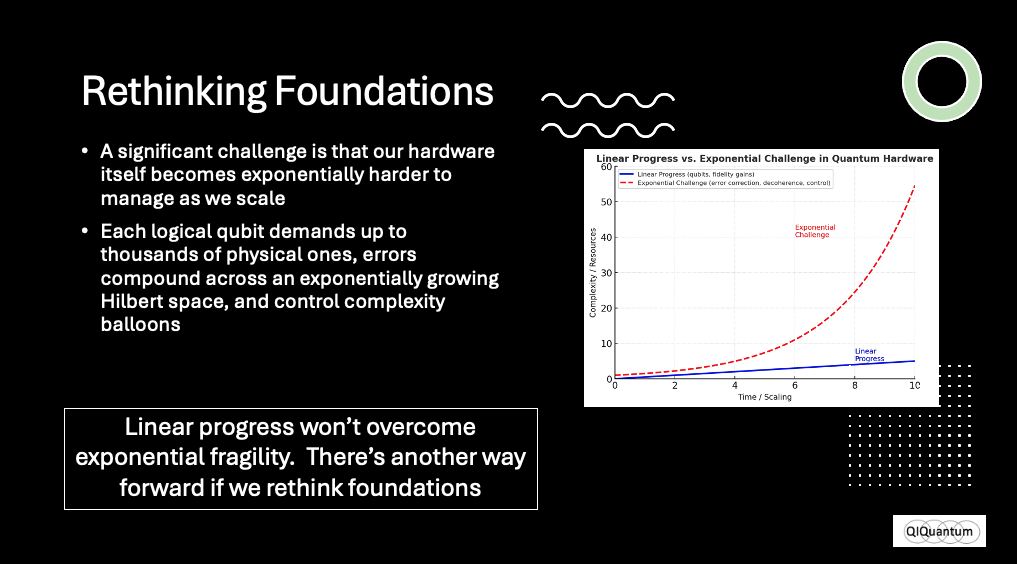
The promise of quantum remains extraordinary: exponential computational power that could reshape energy, security, and AI. But as of today, we remain far from stability.


Using IBM’s roadmap as a reference point, in the Forbes session I highlighted that the company’s current 433-qubit system aims to reach 1,000 physical qubits soon and 10,000 by 2030. Yet these are physical, not logical, qubits. Once error correction is factored in, the effective qubit count drops sharply.


The error rates tell the deeper story:

  • Single-qubit errors (governing superposition): ~10⁻³ to 10⁻⁴
  • Two-qubit errors (governing entanglement): ~10⁻² to 10⁻³
  • What we truly need for scalability: ~10⁻⁶


At these margins, hardware becomes exponentially harder to manage. Each logical qubit demands thousands of physical ones, while coherence times remain around 100 microseconds—too short for meaningful computation. Every additional layer of complexity fights the same underlying issue: noise.


This led to the central question of the session: Can we build something stable on foundations that are inherently probabilistic?


QIQD: A Structure-First Model of Quantum Dynamics

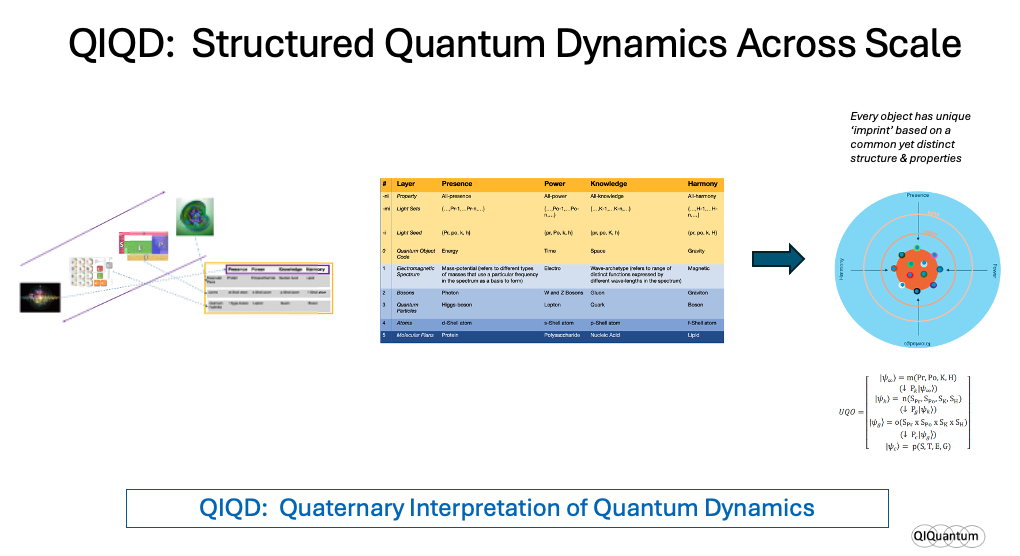
Over the years, my work on the Quaternary Interpretation of Quantum Dynamics (QIQD) has been guided by a simple question: What if coherence isn’t an accident of probability, but the natural consequence of structure?


QIQD suggests that beneath the apparent randomness of quantum behavior lies a repeating geometric order, a fourfold rhythm that surfaces across scales. Life, matter, and energy each seem to organize themselves through this quiet symmetry. Cells draw stability from four molecular patterns that sustain them. Atoms shape themselves through four recurring orbital forms. Even the particles of physics, in all their diversity, assemble within four primary families.


These echoes across domains point to something deeper. A structural logic woven into nature’s design. If coherence arises from such order, then it is not something to be preserved through correction, but something that can be cultivated through design.


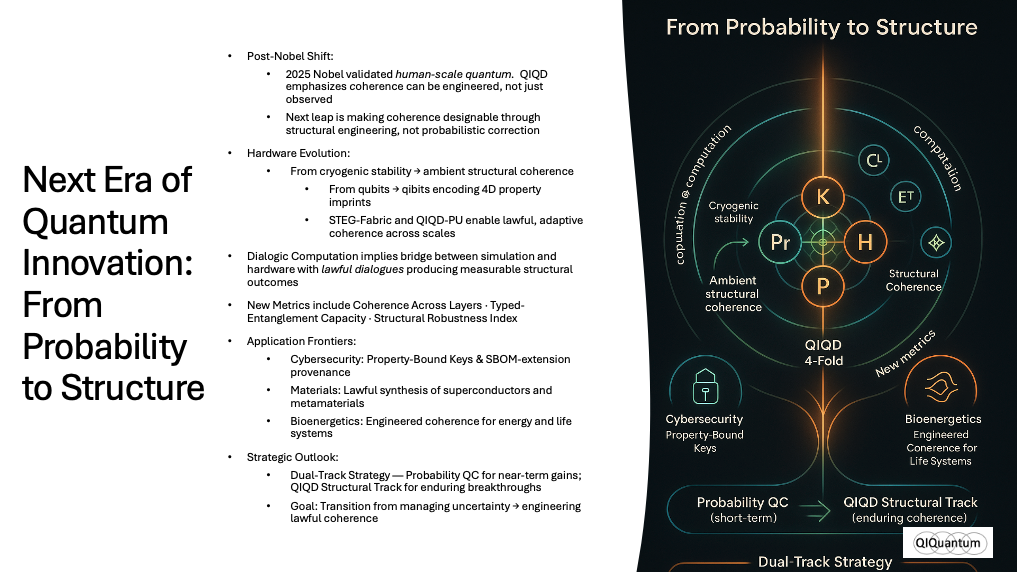
In this view, quantum computation evolves as well. Instead of manipulating probabilities, we begin shaping structured states. This subtle shift, from computing uncertainty to composing structure, marks the heart of QIQD’s vision. It’s where engineering meets cosmology, and where coherence becomes a creative act.

The Post-Nobel Shift: Engineering Coherence Across Scales

The 2025 Nobel Prize in Physics effectively proves that structure itself can host quantum coherence.


The coming decade invites a dual-track quantum strategy:

  • Continue advancing probabilistic architectures for short-term proof-of-concepts and global quantum literacy.
  • Parallelly invest in structural regimes—QIQD-like frameworks that engineer coherence natively rather than patching it through correction.


This shift transforms risk into design. It de-risks quantum innovation by embedding resilience at the level of law, not software. Investors, governments, and labs that recognize this will position themselves at the forefront of law-embedded, coherence-driven computation.


quantuSelected Links

  1. Cosmology of Light & Related Books
  2. ORCID Page
  3. Index to Cosmology of Light Links
  4. QIQuantum Page
  5. Previous Newsletters
  6. PravirMalik.com