|
Immigrants Are Welcome Here: Bearing Witness as Spiritual Practice
“When an alien resides with you in your land, you shall not oppress the alien. The alien who resides with you shall be to you as the citizen among you; you shall love the alien as yourself, for you were aliens in the land of Egypt.” -Leviticus 19:33–34 (NRSV)
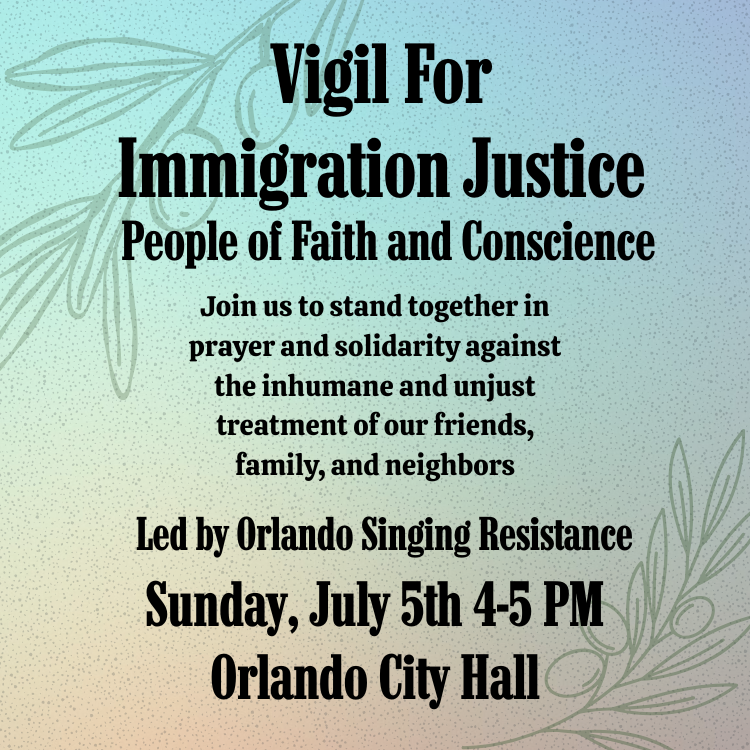
Not long ago, I was talking with a friend about an upcoming vigil. She used the phrase “bearing witness” a few times. While I’m familiar with the term, it landed differently in our conversation. I left the conversation pondering: When we say that, what are we doing within ourselves? What does it mean spiritually to bear witness to that truth?
That question has stayed with me. I carry it as I visit congregations, speak with pastors, and listen to the quiet anxieties and deep hopes of our communities. It is one thing to have a statement about welcome; it is another to let that welcome become a way of seeing, praying, and being—what our tradition might call a spiritual practice.
Remembering as an act of witness
Leviticus 19 does something remarkable. It grounds the command to love the immigrant not in abstract virtue but in the people’s own wound: “for you were aliens in the land of Egypt.” Memory becomes theology. The people’s history of displacement, terror, and deliverance is not to be forgotten; it is to be carried in the community’s body as a permanent tenderness toward anyone who now stands where they once stood.
To “bear witness” in this sense is to refuse amnesia. It is to let memory do its work on us. We remember the stories in Scripture—Abraham and Sarah on the move, Israel in exile, Jesus as a child refugee, and the early church as a scattered people. We remember our families’ migrations, whether across borders or between states, whether dramatic or quiet. We remember that even when we have been socially secure, we have, spiritually, known what it means to be estranged, lost, and hungry for a home.
When we say, “Immigrants are welcome here,” we are not primarily announcing our generosity. We are confessing our identity. We are saying: We are the people who remember that our lives are bound up with those who cross borders. We are the people who remember that we have been carried by a God who makes a home for those without permanent residency and a way for the wanderer. That remembering is not nostalgia; it is a discipline, a practice of placing ourselves again and again among the displaced.
Seeing Christ in the stranger
Jesus deepens this memory in a way that is both beautiful and unsettling. In Matthew 25, he tells a story in which he is not recognized in the temple or in the halls of power, but among the vulnerable: “I was a stranger, and you welcomed me.” The shocking claim is not merely that God cares for strangers, but that God chooses to be found there.
To bear witness that “immigrants are welcome here” is, then, to cultivate a particular way of seeing. It is to train the eyes of the heart to look for Christ precisely where prevailing narratives might lead us to see threat, burden, or problem. It is to adopt a Eucharistic gaze: to look at a life the world has deemed ordinary or expendable and to say, “This is my body…this is the presence of Christ among us.”
As a spiritual practice, this kind of seeing does not happen by accident. It is born of prayer, confession, and contemplation. It asks us to notice where our fear distorts our neighbor’s face into something less than human—and to let the Spirit correct our sight. It invites us to imagine that every border crossing, every migration story, every unfamiliar accent might be a visitation, an epiphany, a doorway through which Christ comes to us again.
Allowing the neighbor to disturb us
Spiritual practices are rarely comfortable. They stretch us, sometimes against our will, toward the God who is always larger than we imagined. If welcoming immigrants is a spiritual practice, it will not simply console us; it will disturb us.
Leviticus does not say, “Tolerate the alien at the margins.” It says, “The alien…shall be to you as the citizen among you.” That is a radical leveling of status, a reordering of who counts, and a theological demolition of the distance we like to keep between “us” and “them.” Similarly, Jesus does not say, “Think kind thoughts about strangers.” He says, in effect, “Your encounter with the stranger is a site of judgment and grace, a place where your life is measured by love.”
To bear witness in this sense is to allow the immigrant neighbor to become a teacher of our own souls. Their presence calls into question our assumptions about safety, belonging, and scarcity. Their courage, grief, resilience, and hope lay bare the smallness of our imaginations about what community can be. Welcome, then, is not a project we direct from a position of power; it is a conversion we undergo. It is a willingness to be changed by those we claim to welcome.
Holding tension as prayer
Living in Florida intensifies all of this. We know the rhetoric. We know the legislation. We know the fear—both the fear directed at immigrants and the fear immigrants carry as they navigate daily life. To say “Immigrants are welcome here” in this environment is not a neutral statement. It places us in tension with powerful currents in our political and cultural life.
But perhaps this tension is not something to be quickly resolved. Perhaps it is a place for prayer. To bear witness as a spiritual practice is to stand in that tension with God: to lament the cruelty of our public life, to grieve the wounds inflicted on our communities, to confess our own complicity and silence, and to intercede for those whose lives are more precarious than our own.
This is not about cultivating a vague sadness. It is about letting our hearts be broken open in a way that aligns us more closely with God's heart. It is about allowing the dissonance between the gospel and our reality to become the very space where the Spirit groans within us, sighing too deeply for words. That, too, is bearing witness: refusing to numb ourselves and choosing instead to keep watch with those who suffer.
Welcome as a way of belonging to God
In the end, welcoming immigrants is not only about what we offer others; it is about who we become before God. When we say “Immigrants are welcome here,” we articulate a theology of belonging: that every person belongs first and finally to God, and that the church is called to mirror that belonging in its own life.
We do not welcome out of moral superiority, but out of kinship. We do not welcome as hosts who own the house, but as guests who have realized that the table at which we sit is not ours. The One who presides at that table has always made room for the least, the last, and the lost. Our welcome is true when it reflects that divine hospitality.
So, I wonder whether the question beneath my question is this: What kind of people are we becoming when we dare to say “Immigrants are welcome here” and mean it as prayer, confession, and spiritual practice?
My hope for our Florida Conference is that we will become a people whose memory is tender, whose sight is Christ-shaped, whose hearts are willing to be unsettled, and whose prayer life is deep enough to hold the tension of this moment. That in our worship, our conversations, and our quiet decisions, we will bear witness to a God whose welcome is wider than our fear and stronger than our borders.
May this be our practice. May this be our witness. And may the God who welcomed us when we were strangers teach us, day by day, to welcome Christ among us in the lives of immigrants and all who seek a home.
|