|
Annual Earth Week Edition (April 2026)
| | |
"Optimism is a strategy for making a better future. Because unless you believe that the future can be better, you are unlikely to step up and take responsibility for making it so." — Noam Chomsky (American philosopher and linguist)
For our Earth Week 2026, we had so much to share that we realized it called for TWO issues, not one. This is the first issue.The second one will be sent in the near future.
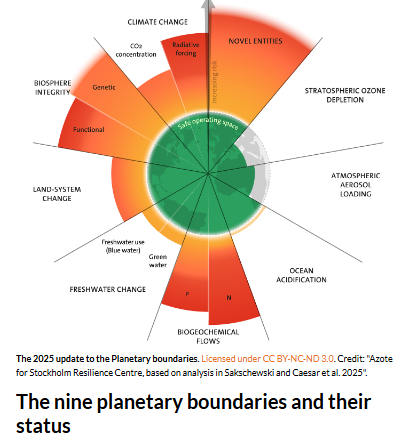
In this issue, we’re looking at the reality that humanity has exceeded seven out of nine planetary boundaries beyond its safe operating system limits, per research by Johan Rockström and his colleagues at the Stockholm Resilience Centre. It's a polycrisis requiring polysolutions.
A core part of this polycrisis is our unsustainable planetary food system – the key driver pushing five of the seven boundaries over the top. The EAT-Lancet Commission Report (10/25) provides full illumination on this, its impact on human and environmental health, what is needed for planetary recovery – and a global roadmap for the sustainable, equitable production of food - enough to feed the planet and bring us back from the brink.
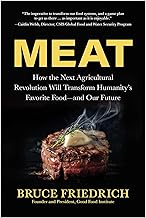
We’re also taking a look at the new book MEAT: How the Next Agricultural Revolution Will Transform Humanity's Favorite Food – And Our Future. It speaks to the popularity of plant-based “meats” and the innovation of lab-grown meat, and how they can help reduce animal agriculture's environmental footprint.
This Earth Day invites us to reflect on a defining reality of our time. We are living beyond the planet’s safe operating boundaries—yet still within a window of possibility to chart a better course. Change begins with personal awareness and education. In the face of a polycrisis, we each have a role to play through the choices we make, the conversations we engage in, and our individual – and collective – actions to achieve polysolutions together.
In our upcoming second issue, we’ll be looking at AI – its upsides, downsides and grave risks – as told in The AI Doc: Or How I Became an Apocaloptimist. This, along with the impact of AI and data centers on energy and the environment. Plus, initiatives in Australia and Virginia to incentivize the use of small solar and battery systems for residential homes and apartments.
Organizations like Leaders in Energy are working in their own way to foster dialogue, share solutions, and help empower individuals to become leaders for the change—to a healthy, green and just world.
* * * * * * * * * * * * * * * *
At the end of the newsletter is a link to
Louis Armstrong's What a Wonderful World.
This is a song we all need to listen to now and again (and again).
| | Sustainable Pathways: How to Get Within a Safe Operating Space for the Planet | | |
We have exceeded seven out of the nine planetary boundaries.
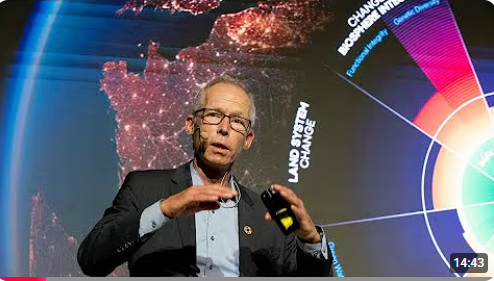
In his presentation at the Frontiers Planet Prize (June 2025), Johan Rockström | Breaking boundaries:science responsibility to restore the planet, Rockström presents the latest scientific evidence regarding Earth's stability – and human impact – and identifies strategies for technological and collective action to enable the planet to stay within a safe operating space.
This compelling and eye-opening presentation is 15 powerful minutes long. We highly encourage you to watch. Rockstrom says that over the past 50 years, advances in Earth system science have revealed that:
-
Earth is a self-regulating, complex adaptive system
-
It maintains stability through interconnected feedback loops
-
But when pushed beyond limits, it can shift rapidly and irreversibly
Today, with satellites and real-time data, we can measure planetary health with remarkable precision—down to ecosystems and even individual trees.
| | |
The Planetary Boundaries Framework
At the center of this work is the Planetary Boundaries Framework. It identifies nine interdependent, critical Earth systems that regulate planetary stability: climate change; biodiversity loss; excess nitrogen and phosphorus production; stratospheric ozone depletion; ocean acidification; freshwater consumption; land-use change; air pollution; and chemical pollution.
Each has a quantifiable boundary, from safe conditions to uncertainty to high-risk. Today, humanity has already breached seven of these nine boundaries, placing us outside the safe operating space and increasing the likelihood of destabilizing Earth systems.
We Have a Narrow—but Real—Window for Action
-
we are outside the safe zone, but not irreversibly so
-
we remain in a “danger zone” with a window for recovery
-
the next decade is critical in determining direction
The Rise of “Polycrisis”
Rockström warns that we may be entering a polycrisis – a situation where multiple global risks interact and amplify one another. For example: climate change can lead to water scarcity, which in turn can cause other impacts such as food insecurity, migration and conflict, economic instability, conflct such as war, leading to reduced investment and capacity for climate action. These cascading effects create self-reinforcing cycles, making challenges harder to manage in isolation.
Moving From Incremental Change to Transformation.
One of his clearest messages is that incremental change is no longer sufficient.
Staying within planetary boundaries requires:
-
rapid, large-scale transformation
-
action at speed and scale
-
fundamental shifts across systems—not gradual adjustments
For climate alone, this includes:
- halving emissions each decade to reach net zero by ~2050
- transforming food systems from a major emitter to a carbon sink
- scaling carbon removal technologies
- protecting natural systems (forests, oceans) that absorb ~50% of emissions
This is not a single transition—it is a whole-system transformation. The Path Forward calls for: integrated, collective action with alignment across science, policy, finance, and culture; integration of human and planetary health; acceleration of interdisciplinary solutions; and a shift from national to planetary-scale stewardship.
Phasing out fossil fuels alone is not enough to keep global warming below 1.5°C. It accounts for about 70% of the problem. We must also address the "crisis in nature." The transformation of the global food system is critical, as it is the largest cause of biodiversity loss, freshwater consumption, and land-use change, representing about 30% of human-driven greenhouse gas emissions.
LEARN MUCH MORE THIS BY VISITING The Stockholm Resilience Centre
| | Food Systems Now Exceed 5 Planetary Boundaries | | |
|
Our current food system is the dominating cause for exceeding 5 of the 9 planetary boundaries on earth. These boundaries are critical processes that regulate life on Earth and are essential for maintaining a stable environment.
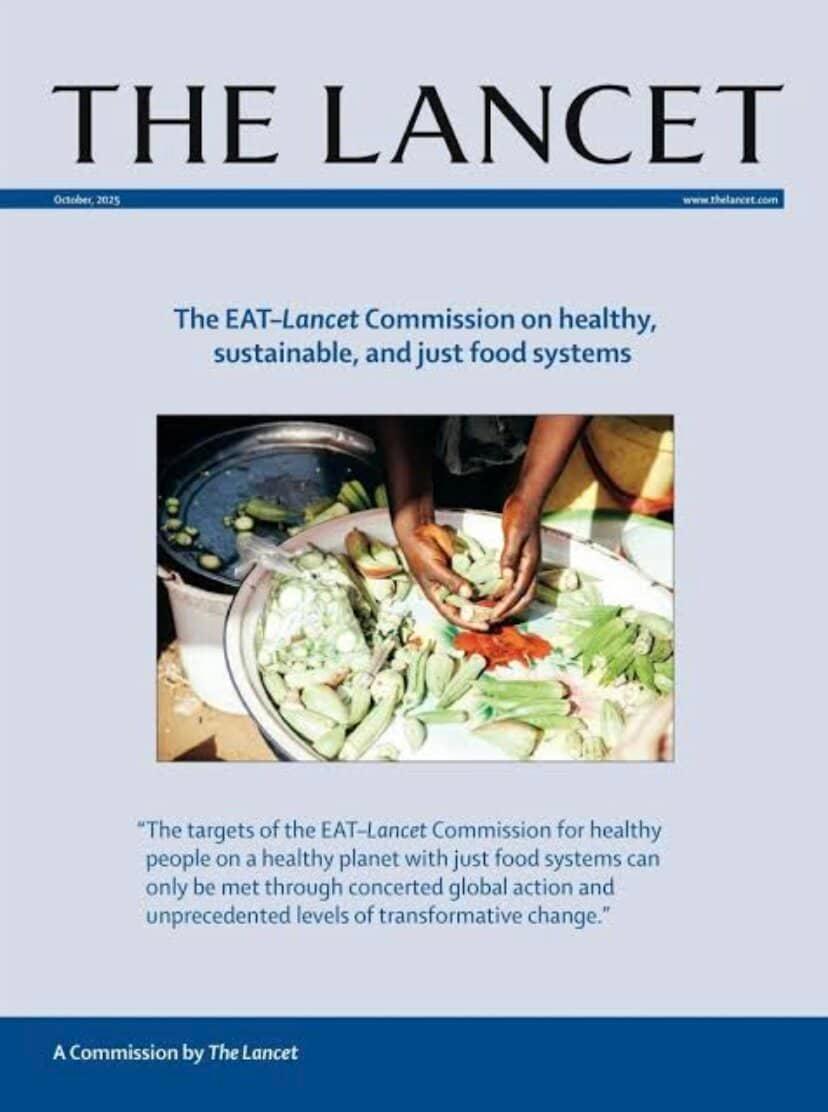
“The most important scientific study ever done to guide humanity’s future for a healthy people on a healthy planet. It’s nothing less than that.” That's how Johan Rockstrom describes The EAT-Lancet Commission on healthy, sustainable, and just food systems, which offers a bold pathway for transforming our global food systems to benefit the health of people, animals and our planet. Currently, more than half of the world's population struggles to access healthy diets, leading to devastating consequences for public health, social equity, and the environment.
We’ve all heard that for our own health we should eat plants, not animals. Or at least, mostly plants and little meat. It's clear now that this is also true for planetary health.
The new EAT – Lancet Report shows that it is our current global food system and diet, especially meat production, is responsible approximately 30% of the greenhouse gas emissions driving climate change.
The five boundaries that food production impacts are: Climate Change; Biodiversity Loss; Land Use Change; Nitrogen and Phosphorus Pollution; and Freshwater Use.
No safe solution to climate and biodiversity crises is possible without a global food systems transformation. How and where food is produced, which foods are produced and consumed, and how much is lost and wasted, all contribute to planetary boundary transgressions.
The EAT-Lancet Commission report is a roadmap to a healthier, more sustainable, and equitable food system. It sets out fully-considered plans for equitably feeding nearly 10 billion people by 2050, and bringing our food system back inside of planetary boundaries, while providing increased human well-being through more secure and healthier food. It presents the solution space – and how we can scale practices that are sustainably intensified and ecologically aligned.
The Planetary Health Diet (PHD) is a cornerstone of the recommendations. The PHD is rich in plants: whole grains, fruits, vegetables, nuts, and legumes comprise a large proportion of foods consumed, with only moderate or small amounts of fish, dairy, and meat recommended.
The PHD is based entirely on the direct effects of different diets on human health, not on environmental criteria.
It targets the best life outcomes for humans including large reductions in all-cause mortality and a substantial decline in the incidence of major diet-related chronic diseases – and offers a framework within which diverse and culturally appropriate diets can exist.
The planetary cost of food has been revealed. This is ultimately good news, because it is correctable. We can change our current food systems to healthfully feed the world while, simultaneously, reducing global warming, restoring ecosystems and planetary health, including the carbon sinks that earth is designed to provide, and more.
A global shift in the food system will take much and many to achieve. For today, we have personal power and choice in this. We can ourselves “be the change we wish to see in the world” through what we eat. Knowledge is power and it is motivational.
It may feel like a dream to accomplish all this, but as Carl Sandburg tells us,
“Nothing happens unless first we dream.”
For more information click the link below for the complete EAT-Lancet Report livestream video with Johan Rockström and other leaders. You can also visit the UN page called Food and Climate Change: healthy diets for a healthier planet for and overview of the food issue.
| | |
How much land?
Animal agriculture occupies a massive portion of the Earth's land, utilizing approximately 75% of all agricultural land and nearly 26% to 30% of the world's total ice-free land surface. When considering only habitable land, animal agriculture (including grazing and feed crops) accounts for more than one-third of the total.
| |  | |
How much water?
A single one-third pound hamburger takes approximately 660 gallons (roughly 2,500 liters) of water to produce. This "water footprint" includes irrigating feed crops, drinking water for the cow, and processing, with some estimates ranging between 450 to over 1,000 gallons depending on the beef source
| | Meat, Climate, and the Next Agricultural Revolution | | |
What about meat? Does it have to be taken off the table? In his recent book Meat: How the Next Agricultural Revolution Will Transform Humanity’s Favorite Food – and Our Future. Bruce Friedrich, founder of the Good Food Institute, argues that the way we currently produce meat is fundamentally unsustainable for the planet, public health, and global food security. Rather than relying solely on changes in personal diet, he proposes a different path: transforming how meat itself is made itself.
His core insight is both pragmatic and ambitious. Global demand for meat continues to rise—and is expected to keep growing for decades. If that demand is met through conventional livestock systems, the environmental consequences—from emissions and deforestation to water use and biodiversity loss—will intensify. The alternative, he argues, is a new agricultural model built on plant-based proteins and cultivated (lab-grown) meat.
Scientific and industrial innovation can deliver the same experience—taste, cost, and accessibility—with far lower impact. This is why Friedrich describes the shift as “the next agricultural revolution.” From lab-grown meat to plant-based alternatives, Friedrich says a food revolution is already underway. The landscape has shifted in just one decade with the Beyond Burger and Impossible Burger. Today, there are over 100 cultivated meat companies worldwide and more than 1,000 patents have been granted.
Friedrich makes the case that industry can work together to meet the world’s soaring demand for meat, while reducing the environmental damages caused by animal agriculture. The Lancet EAT Report (see previous section) also references plant-based meats and lab-grown meats as potential alternatives in the transition to a more plant-based diet.
Importantly, Friedrich's approach mirrors the transition underway in energy: not asking people to change behavior overnight, but creating better, scalable alternatives—much like renewable energy or electric vehicles. If successful, these innovations could: reduce greenhouse gas emissions, lower pressure on land and water systems, improve food security and resilience and decrease risks related to pandemics and antimicrobial resistance.
For more info, check out these videos of interviews with Bruce Friedrich:
| | |
The first Earth Day was in 1970 and we're remembering early plant-based leaders
In 1971 Frances Moore Lappe wrote the groundbreaking book, Diet for A Small Planet, that links personal food choices to global issues like hunger, ecology and democracy, arguing that a meat-centered diet is wasteful and inefficient. Inspired by this book, John Robbins built upon it with his own, Diet for a New America, in 1987. It connects American food choices, particularly meat, to personal health, animal welfare and environmental crises, advocating for a plant-based diet.
| | |
We are dedicated to building a network of intergenerational changemakers to accelerate clean energy and sustainability solutions. Our focus includes green economy and jobs, green practices, products, and services, including the circular economy. We also facilitate global collaboration to help connect people working on projects and innovations in these areas. We invite you to join our network to engage with others working for a greener world!
Executive Director: Janine Finnell
Creative Director/Editor: Carol Lampman McCaffrey
Subscribe to our Newsletter
Join our 4,100+ member LinkedIn Group
Get involved as a Volunteer or Ambassador
The LE Ambassador Program is focused on building an effective global action network that aligns and connects at district local and regional levels a diverse set of participants that have a shared but direct stake in the sustainable development of their community.
We are looking for these desired attributes in new ambassadors
- Willing to make a 2-year commitment towards the ambassadors program.
- Available for allocating 3-5 hours a month to communication & meetings.
- Orchestrator of an in-region team (city or country).
- Experience in a field of clean energy and/or sustainability (academic, working experience, etc.) is highly encouraged.
- Demonstrates deep and vested connections to their community/locality.
- Effective leader & communicator.
Share your information with us here if interested.
| | Leaders in Energy is a 501(c)(3) nonprofit organization. Your support enables us to conduct our mission and programs. If you find our materials and programs useful, please consider making a tax-deductible contribution. | | | | |