|
The TCCPI Newsletter
Issue #83: July-August 2024
| |
TCCPI is a multisector collaboration seeking to leverage the climate action commitments made by Cornell University, Ithaca College, Tompkins Cortland Community College, Tompkins County, the City of Ithaca, and the Town of Ithaca to mobilize a countywide energy efficiency effort and accelerate the transition to a clean energy economy. Launched in June 2008 and generously supported by the Park Foundation, TCCPI is a project of the Sustainable Markets Foundation.
We are committed to helping Tompkins County achieve a dynamic economy, healthy environment, and resilient community through a focus on energy efficiency and renewable energy.
| |
New York Unlikely to Hit 2030 Climate Goals
by Samantha Maldonado, The City, 7/8/24
| |
|
New York is not on track to achieve one of its chief, legally mandated climate goals, according to a new state report.
The state Climate Leadership and Community Protection Act, passed in 2019 and hailed then as a nation-leading law, requires New York to source 70% of its electricity from renewables like solar and wind by 2030. But the state will likely not achieve that benchmark by the deadline.
Instead, the report acknowledged, New York could hit that 70% mark by 2033. A new draft report from the New York State Energy Research and Development Authority (NYSERDA) and the Public Service Commission indicates New York will have to delay its 2030 climate goals.
| |
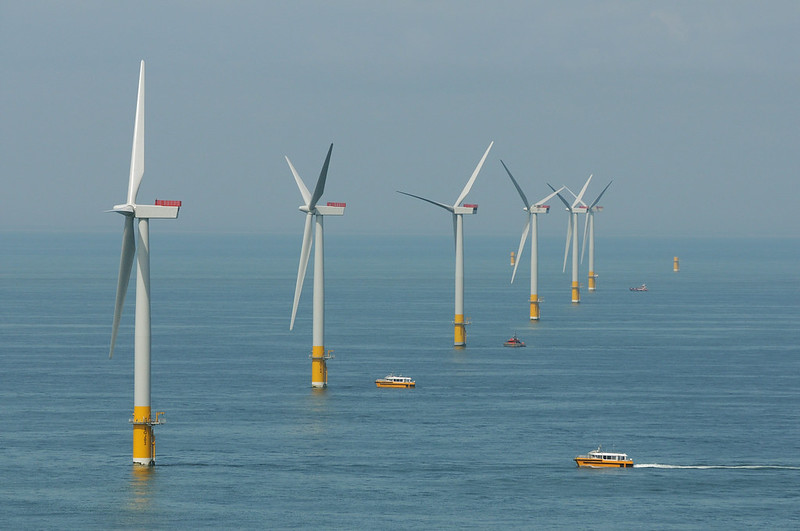
Offshore wind farms such as this one in the UK are expected to play a big part in how NYS secures 70% of its electricity from renewable sources. Photo by CHPV licensed under CC BY-ND 2.0. | |
|
Why the delay? The report pointed to the global market and economic conditions, notably logistics and supply chains affected by “geopolitical tensions.” The report also cited inflation and high interest rates as factors that undermined the financial viability of renewable projects.
“It’s still worthwhile to push as aggressively as fast as we can for these goals. With fighting climate change… every little bit counts,” said Patrick McClellan, state policy director for the New York League of Conservation Voters.
“We hope that this is kind of a wake-up call for the state — not that I think that they weren’t aware, obviously, there were these problems — but they probably need to be pushing harder,” he added.
While the lack of timely progress does not come as a complete surprise for those tracking the state’s progress, it brings a finer point to the challenges involved with moving away from burning fossil fuels, the major contributor to climate change.
Key Deadlines Missed
The Climate Leadership and Community Protection Act’s interim 2030 target was supposed to put the state on a path to have zero-emissions electricity by 2040, a deadline also mandated by the law. A failure to green the grid in time could jeopardize slashing planet-warming greenhouse gas emissions, which must fall 40% below 1990 levels by 2030 — and 85% by 2050 — as the climate law stipulates.
As of 2023, just seven years away from the 70% target deadline, renewables generated under 30% of New York’s electricity, according to the state grid operator. Including nuclear power, a zero-emissions energy source, that total hits about 50%.
The delayed transition to a greener grid makes other climate efforts harder to realize. For instance, large New York City buildings face caps on their emissions under Local Law 97. The concept of emissions, in the law, counts not only direct exhaust from any fuels used by occupants’ stoves, heaters, or boilers, but also the emissions connected to the electricity the building uses, wherever it was generated. A dirtier grid means those buildings will have a harder time complying with those caps.
For months, the state has failed to meet key benchmarks under the climate law, with recent developments further imperiling those 2030 goals.
In October, the state rejected developer requests for increased funding for a series of solar and wind projects that together represented about a quarter of the projected 2030 electric needs. The developers said they needed the boost to make up for increased costs, mostly from inflation, but the state Public Service Commission denied the requests in order to protect ratepayers.
Many developers backed out of their contracts, including for two major offshore wind projects. Offshore wind projects were poised to significantly move the needle toward the clean energy goals.
Marguerite Wells, executive director of the Alliance for Clean Energy New York, a renewable energy industry group, said the projects, even with canceled contracts, are still moving forward and just need to be rebid for new contracts with the state.
“Certainly the contract cancellation was a challenge, but happily, it’s a paperwork challenge. It’s not a three-dimensional, real world challenge, if you will,” she said. “In all cases, the projects are doing fine. They’re still out there in the real world doing permits and contracts and all the studies they have to do.”
NYSERDA has solicitations out for additional offshore wind projects (and other renewables) and is also investing $700 million in offshore wind ports, infrastructure, and manufacturing to help boost the sector.
Spokespersons for NYSERDA and the PSC indicated the state would consider several other possible actions to advance progress.
Higher Energy Demand
Another challenge for rapidly scaling up renewables is simply keeping pace with growing demand.
Energy-guzzling projects like data centers and microchip plants (and to a lesser extent, electric cars and electric heat pumps) increase how much electricity is needed overall in the state. As the electric need grows, so too does the amount of renewables necessary to hit that 70% goal.
New York’s grid operator predicted a gap in available power by the summer of 2025, due to higher energy demand and fossil fuel-powered plants coming offline but not being replaced fast enough with new generation.
McClellan pointed out the state must accelerate renewables in order to retire fossil fuel plants, like the highly polluting peakers which fire in times of high energy need and are located overwhelmingly in and around low-income, non-white communities that already bear higher pollution burdens.
| |
|
Next TCCPI Meeting
Friday, September 27, 2024
9 to 11 am
TCCPI meetings have moved online. Contact Peter Bardaglio, the TCCPI coordinator, for further details at pbardaglio@gmail.com.
| |
Rally to Oppose Artificial Turf Set for Sept. 3rd at City Hall
By Vivian Rose, The Ithacan, 8/28/24
| |
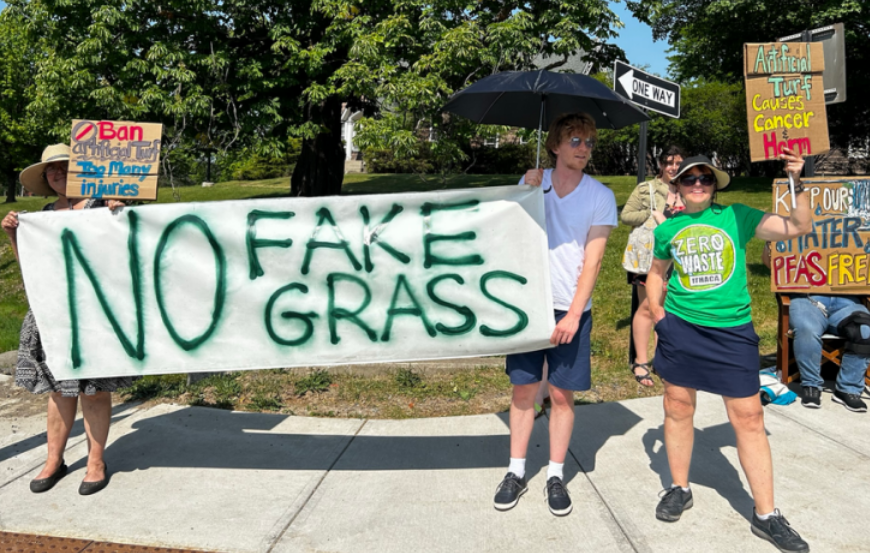
An earlier protest against artifical turf at Ithaca College. Photo courtesy of Zero Waste Ithaca. | |
|
In 2023, Ithaca College faced objections from the local community while constructing a synthetic turf field approved by the Town of Ithaca’s Planning & Development Board.
Now in 2024, the City of Ithaca’s planning board will meet Sept. 3 to determine the next steps of Cornell University’s proposal to construct two synthetic turf fields on its campus.
Zero Waste Ithaca (ZWI) and other local environmental groups plan to rally outside the Ithaca City Hall during the Sept. 3 planning board meeting
| |
|
Planning Board Will Consider Risk
If the board finds that the turf fields might cause a high environmental risk to the surrounding area, Cornell will be required to research these impacts, according to Yayoi Koizumi, founder of Zero Waste Ithaca, a local environmental organization that is vocal about resisting synthetic turf projects. However, the turf fields will be constructed if the board finds little to no evidence regarding its impact on the environment.
Organizations like ZWI have been protesting synthetic turf since Ithaca College converted Bertino Field at Butterfield Stadium from natural grass to artificial turf. The college upgraded the field after receiving a $3 million donation.
Koizumi said the protests have been necessary to fight for the local community’s health.
“At what expense are we going to pollute our community and other communities … for this?” Koizumi said. “Why can’t we have natural, organically managed grass fields that have better drainage and players have a reasonable playtime? What more do you want at the expense of your own health, your students’ health and at the expense of all these communities that are suffering from the plastic manufacturing and disposal?”
The plan calls for the construction of a fieldhouse on Tower Road that will have artificial turf. In addition, it includes a 91,950-square-foot outdoor multipurpose synthetic turf field located between the proposed Meinig Fieldhouse and Weill Hall, and a field hockey pitch on Game Farm Road.
Fred Wilcox, chair of the Town of Ithaca’s planning board, said because about 83% of Cornell’s land is located in the city and about 17% is located in the town, both the City of Ithaca and the Town of Ithaca decided that the city should do the environmental review. The review determines the environmental impact of the proposed fields and Meinig Fieldhouse.
Wilcox said that Ithaca College experienced a similar controversy when synthetic turf was installed on its campus, but that he has noticed more outcry regarding Cornell’s Meinig Fieldhouse proposal. He also said the planning boards of each municipality are unsure if the environmental impact is low enough to approve the project.
Koizumi said the group has been collecting signatures for a petition against the Meinig Fieldhouse proposal, with a goal of reaching 1,600 signatures, which they will provide to the planning board as evidence for lack of community support.
In 2023, when Ithaca College was preparing to install its second turf field, ZWI held similar protests and sent out a petition to the local Ithaca community with a goal of reaching 1,000 signatures. The group reached 966 signatures.
Koizumi said ZWI began protests too late in the college’s approval process. However, she said the group learned of Cornell’s plans earlier and were able to protest more frequently and attend more planning board meetings.
“It was the first time we were involved in this sort of fight and we were not paying any attention to movements in the town planning board,” Koizumi said. “For Cornell, we’ve been attending the board meetings … and sending in comments and organizing … and working with allies around the country such as Beyond Plastics, Plastic Pollution Coalition and Safe Healthy Playing Fields.”
Other Groups Supporting Rally
Koizumi said other environmental organizations have been fighting the turf proposal like Mothers Out Front New York, Cayuga Lake Environmental Action Now! (CLEAN), Sustainable Finger Lakes, Seneca Lake Guardian, Sunrise Ithaca, Extinction Rebellion Ithaca and Cornell on Fire. They take issue with chemicals involved in turf manufacturing as well as chemicals, like polyfluoroalkyl substances (PFAs), microplastics, and crumb rubber that can leech from the fields into the environment. A test done on a sample of a synthetic turf blade from 2017 showed the presence of PFOS, a type of PFA, in a study done by the New Jersey Department of Environmental Protection.
Susan Allen, professor and chair of the Department of the Environment, said crumb rubber can negatively affect the environment if it gets into local waterways because of the chemicals in each piece.
“The real issue is trying to make sure that the tire wear particles stay put by the engineering techniques that are hopefully being applied [on turf fields], because we know that those can be directly toxic,” Allen said. “We want them to stay put. We don’t want there to be a lot of tire wear leachate.”
Turf fields are made of plastic fibers to resemble grass, with backing material and an infill — typically of crumb rubber — to provide strength and stability to the grass. Each fiber is made of nylon, polypropylene, or polyethylene, and can cause potential health risks like heat stress, infection, and chemical exposure, according to the New York State Department of Health.
The chemicals in synthetic turf include PFAs in the dye that make each blade green. Allen said when crumb rubber is used as an infill for synthetic turf fields, they can get washed away from stormwater and can also be brought off the field on people’s shoes. She will be conducting research on crumb rubber during fall 2024 with the ecotoxicology lab to determine their impact on water systems.
“We are testing leachate from tire wear particles … on young fish to see if it affects them, and it does, it affects their survival and it affects their behavior,” Allen said. “We’ve also found that the tire wear particles affect other aquatic organisms like daphnia, which are small critters. We find that when we put tire wear particles in with daphnia, their behavior is also modified.”
Drainage systems are one way of decreasing the amount of crumb rubber that can enter the environment. The Bertino Field at Butterfield Stadium has several drainage points surrounding the field, according to Allen. The synthetic fields proposed by Cornell will also deploy a stormwater strategy, collecting runoff in six major points along and within the fields to catch as much crumb rubber as possible.
The fields will be equipped with filters and detention chambers for stormwater flow, according to Cornell’s proposal that was submitted to the planning board. However, these drains will only be able to filter out the large crumb rubber particles, not PFAs.
The City of Ithaca’s planning board members have six members who are or who have been affiliated with Cornell. Koizumi worries that the board may decide in Cornell’s favor. Although Cornell has already received approval for other turf fields in the past, Koizumi said that she will continue protesting against synthetic turf fields.
“Plastic is toxic,” Koizumi said. “So why are we letting it into our environment?”
| |
Ithaca 2030 District Hits Energy & Water 2025 Targets
By Brian Crandall Ithaca Voice, 7/10/24
| |
|
As the effects of climate change seem poised to worse in central New York, it’s become all the more important that communities like Ithaca become environmentally sustainable if the most destructive impacts are to be prevented.
As part of that effort, there has been plenty of attention given to applying strict environmental standards on new construction at the local and state level. But both Tompkins County and New York State don’t have much new construction underway — it makes up a small fraction compared to the existing built environment, making the standards’ impact significantly smaller.
| |
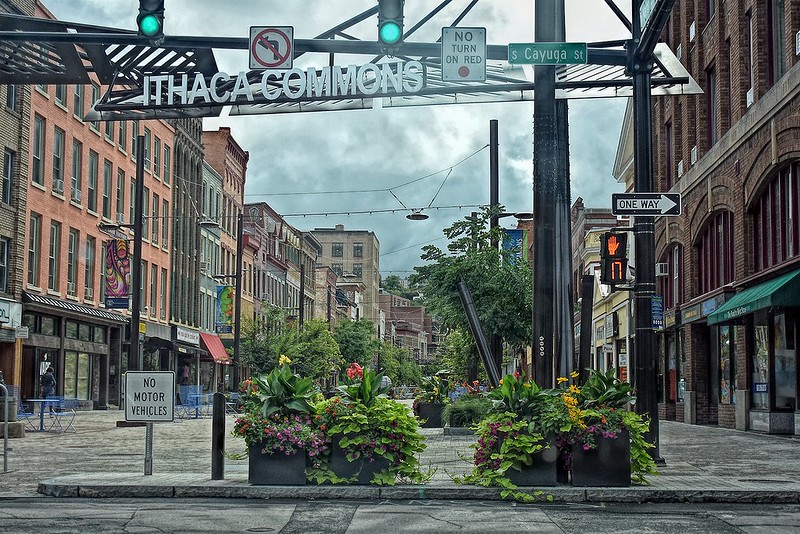
Many of the 2030 District buildings are around the Ithaca Commons. Photo by Jo Zimny Photos licensed under CC BY-NC-ND 2.0. | |
|
Retrofits Key to Progress
The City of Ithaca’s greenhouse gas inventory shows that buildings in the city make up about 58% of total greenhouse gas emissions. Most of that comes from the commercial sector, such as stores, hotels, and offices, which contributes 38% of Ithaca’s total emissions.
The vast majority of these buildings are older with obsolete utility systems, in some cases dating back 100 years. Ithaca’s goal to achieve carbon neutrality, particularly by the city’s stated deadline of 2030, will depend on the community’s ability to retrofit these older buildings and improve its infrastructure overall.
In an effort to rise to the occasion, some cities have turned to public-private coalitions of environmentally-minded business and property owners working with local officials to create more sustainable communities. A good example is the Ithaca 2030 District, a voluntary effort by local government, property owners, and tenants to improve the energy and water performance of their buildings as well as bring about cuts in commuter transportation emissions.
Since its launch in June 2016, the district has expanded considerably as more building owners have opted in. In 2021, the district comprised 33 buildings and about 417,089 square feet, comparable to 250 typically-sized houses.
By the end of 2023, there were 43 building owners with 41 buildings and 583,269 square feet, and at present, it’s 55 buildings with over 922,000 square feet of space, meaning the district grew by more than double in three years.
Peter Bardaglio, the executive director of the Ithaca 2030 District, offered the example of one of its members, Purity Ice Cream, which joined the district back when Bruce and Heather Lane still owned the business.
“They installed wells for the geothermal heat pumps in the parking lot, perfect place to put them, and they replaced the lighting with LEDs, they put new windows in, basically just did everything they could to tighten up the envelope,” Bardaglio said. “That’s why they’ve already hit their 2030 target.”
The approach is straight-forward: members who joined after the 2016 launch committed to a 20% reduction by 2020 in energy use, water consumption, and transportation-induced emissions. That figure increased to a minimum 35% reduction in all three categories from the baseline “starting point” by 2025, and a 50% decrease by 2030.
Members may still use natural gas, but need to take steps to reduce their natural gas use, whether that be more efficient heating systems, electrification, or other means. Properties that join late can scale up to meet the goals on similar timeframes.
To ensure accountability, each member building’s energy and water data are collected, analyzed, and aggregated to determine the overall district-level results. The results for each individual building are made available to the owners using a software “dashboard” designed by Cornell students.
Owners can choose to keep their individual data confidential from the public, but it still has to be shared and validated by the 2030 District staff. Meanwhile, the district-wide results are publicly distributed to demonstrate whether benchmarks are being met.
Progress so far has been somewhat mixed, but there are positives to be seen. As a collective whole, the district has already met the 35% reductions in energy and water use that its members aimed for by 2025. Of the 43 properties in the 2023 Annual Report, 17 have already achieved their 2030 goals.
Bardaglio attributes that to a state-mandated incentive put in place when NYSEG found its gas service capacity constrained in Ithaca in 2023. The “gas kicker” grant program allowed several commercial buildings in the city, including several in the 2030 District, to switch to electric heat pumps and more efficient gas equipment.
“They [NYSEG] were told to do this by the Public Service Commission, the idea was to get people off of gas as much as possible,” Bardaglio said. “Those buildings converting over made a difference.”
The program is no longer open, but some projects are finishing up this year, so additional reductions will likely be seen in 2024.
Transportation Still a Struggle
However, there are some points of weakness as well, particularly on the transportation side. Following the pandemic, mass transit, biking, and walking dropped, while vehicle travel grew, so greenhouse gas emissions by vehicles increased locally.
It has been a struggle to restore the previous levels of local emissions, and they remain elevated above 2020 levels, according to the report. Last year saw a modest decrease, which the report attributes to more commuters shifting from gasoline to hybrid and plug-in electric vehicles.
Bardaglio said he thinks that facilitating both public transportation and low- or zero-emission vehicles will be crucial to achieve the desired reductions.
“We definitely want to encourage people to move to [electric vehicles], that’s really important, especially as the infrastructure continues to develop,” Bardaglio said. “At the same time, you want to pay attention to non-car travel. We’re so caught in the web of automobiles, it’s hard to extricate ourselves from it, but we've got to figure out a way to move towards other, multimodal transportation options.”
A million square feet of space is notable, but in the grand scheme of Ithaca’s built environment, it’s not more than a few drops in the bucket. Bardaglio pointed out the way they monitor building performance and analyze the quantitative energy and water savings of improvements helps establish what gets the most ecological bang for the buck, and establishes a model that can be followed on a larger scale.
“I think we have a pretty good sample that is fairly representative of the commercial sector, and it’s data nobody else has,” said Bardaglio when posed the question. “The community can see the progress that building owners are committed to reducing their carbon footprint, and it sends a message to customers when they take action.”
Bardaglio added that there has been talk at City Hall that building performance standards could be considered for older buildings in Ithaca in the future, and that the 2030 District has established a model that could scale to that if it comes to fruition.
Most of the headlines about the environment and climate change can be somewhat dire, creating a sense of futility. But Bardaglio holds a more encouraging view.
“Here’s where I make a distinction between hope and optimism. Being optimistic at this point is somewhat suspect. But hope is absolutely essential,” he said. “If you have hope, it’s because people are rolling their sleeves up, and taking concrete steps to strengthen the community and mitigate climate change.”
| |
Take a step to save money and energy! | |
One Last Thing: How Serious is NY about Its Climate Goals? | |
|
There’s something seriously unnerving about the casual way in which Gov. Hochul has acknowledged that New York will probably not meet its 2030 climate targets. The pathbreaking Climate Leadership and Community Protection Act (CLCPA) calls for the state to obtain 70 percent of its electricity from renewable energy by 2030.
As recounted in the lead article above, a joint draft report issued in July by the New York State Energy Research and Development Authority (NYSERDA) and the Public Service Commission (PSC) indicated that the 70 percent renewables target will not be achieved before 2033.
| |
State ComptrollerThomas DiNapoli and Senate Majority Leader Andrea Stewart-Cousins. NY Senate Photo licensed under CC BY 2.0. | |
|
Audit Reveals Flaws
A few weeks after this report, State Comptroller Thomas DiNapoli released a detailed audit criticizing the PSC and NYSERDA for inadequate planning and the use of outdated data. In particular, it said that the PSC had failed to address “all current and emerging issues that could significantly increase electricity demand and lower projected generation.”
Perhaps most disturbing was the audit’s finding that the PSC had overlooked the need to calculate the costs of the transition to renewables or to identify how to cover those costs beyond the tried and true method of dumping them on ratepayers.
| |
|
How Committed is the State?
Together these two reports raise major questions about the actual commitment of the state to implementing the 2019 CLCPA. The governor’s reaction to these findings? Oh well, it won’t hurt if we let things slide for a few years. Not surprisingly, state Republican leaders and the business community have taken advantage of the leadership vacuum to attack the climate law and press Hochul to abandon it.
How is it possible for this failure of leadership to take hold during the same summer that global temperatures have been setting new records month after month? In fact, not only was this past July the warmest on record, but it was also the 14th consecutive month of record-high global temperatures. Does anyone see a pattern here?
Cornell professor Robert Howarth, a member of the state’s Climate Action Council, certainly does. The council passed a plan to implement the CLCPA in December 2022, and Howarth is on the front line defending it. “I am appalled at this pushback against the CLCPA by business interests pushing their short-sighted agenda,” Howarth said in an interview with WaterFront. “Climate change is very real. The consequences of climate disruption (floods, droughts, fires, crop failures) are becoming increasing obvious to all.”
Eddie Bautista, executive director of the New York City Environmental Justice Alliance, strongly agrees that stronger leadership is necessary. “In just five short years, we’ve gone from being visionary leaders to not being able to implement our own laws. It’s just insane,” he said recently.
The governor’s reversal on congestion pricing in New York City has environmentalists wondering whether this is part of a larger plan to back away from other elements of the state climate action agenda such as the cap-and-invest plan that would price greenhouse gas emissions. At the very least, it looks likely that the administration will blow past its self-imposed deadline to launch the program in early 2025.
A Simple Step
One step that Hochul could take to restore some degree of confidence in her commitment to climate action would be to sign the Climate Change Superfund Act that is currently sitting on her desk after being passed in June by both the General Assembly and State Senate. This legislation would require oil and gas companies to pay a total of $3 billion a year for 25 years to cover the cost of the climate damage they have inflicted on the state.
The governor has not yet signaled her intention, which leaves a lot of climate activists worried, although some think she might just be waiting until after the election to do so. The pressure on her has been growing throughout the summer and will only continue to increase this fall.
Fossil Free Media, together with the Sunrise Movement, has launched a national billboard campaign in California, New York, Arizona, and Philadelphia, with plans to expand to Florida and Louisiana in September. as part of the effort to build support for the principle that polluters should pay for the mess they have made.
The Make Polluters Pay campaign seeks to hold the fossil fuel industry accountable through legislation, lawsuits, and public pressure. This is exactly the kind of national attention that Hochul wants to avoid, but she better get used to it. Sen. Chris Van Hollen (D-MD) and Rep. Jerry Nadler (D-NY) just announced their intention to introduce federal Polluter Pays bills in Congress. Things are definitely heating up – stay tuned.
Peter Bardaglio
TCCPI Coordinator
| |
Be sure to visit the website for TCCPI's latest project, the Ithaca 2030 District, an interdisciplinary public-private collaboration working to create a groundbreaking high-performance building district in Downtown Ithaca.
| |
309 N. Aurora St.,
Ithaca, NY 14850
607-229-6183
| | | | | |