|
Exercising the Power of Co-Creating Emotional Growth
By Lois Holzman, East Side Institute
“We create a space for everyone. We say to everyone, bring us your trauma and pain. You all saved me.”
| | |
The East Side Institute has been involved in an ongoing exploration of how people, particularly those in poor communities, understand and relate to individualized, medical model conceptions and practices of “mental health” and “mental illness.” The first phase consisted of creating conversations with people on the streets of New York City, followed by an online survey designed from these conversations. We published a qualitative report on these activities in 2018 in one of The Humanistic Psychologist’s special issues on diagnostic alternatives (Holzman and Genn, “Diagnosis: A Thousand People Speak Out”). The Creating our Mental Health (COMH) workshops—the focus of Phase 2—grew directly out of that exploration.
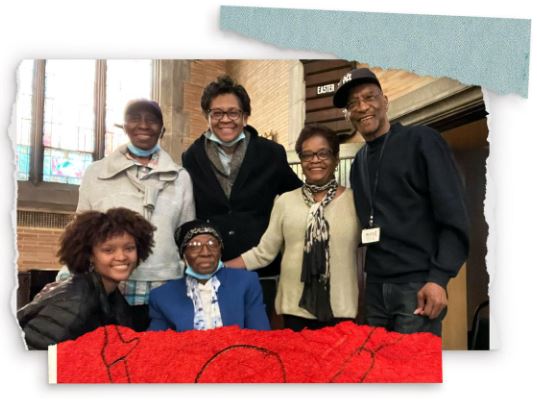
For ten years, the COMH workshops have been transforming. Currently conducted both online and in-person at food banks and shelters in New York's poor neighborhoods, these workshops focus on the process of building group environments that allow people to have new kinds of conversations on the broad topic of emotionality/mental health—with the aim of unleashing collective and creative meaning making, and finding new ways of understanding and relating to “mental health,” “mental illness,” psychiatric diagnoses, and emotionality. The environments created are social therapeutic, and utilize performance, improvisation, play, and poetry. The facilitation team includes a primary care physician/poet, Jessie Fields, social worker, Rachel Mickenberg, psychiatrist, Hugh Polk, and professional improvisor and coach, Marian Rich.
A Taos Associate Grant led us to create and conduct interviews of participants in COMH group workshops about their experiences of the groups and the impact on their lives. We wanted COMH facilitators and participants to explore together what is meaningful and developmental about the group activity. We wanted to involve them in a slow and deep reflection on how their involvement has impacted their understandings of mental health in general and personally, and in what ways the collective meaning making of these creative and improvisational conversations might be emotionally and socially helpful to them.
The interviews were designed, conducted and analyzed by 3 participant researchers—Allen Cox, Denise Kaalund, and Spencer Washington. Participants spoke often of how participating in COMH impacts their emotionality and how they thought this happens. Here’s some of what they shared:
- “Emotional struggles are made normal; they’re not treated like this shameful thing.”
- “As others share, we all become more open.”
- “Each time, I discover emotional feelings I didn’t even know I was feeling.”
- “We help each other find ways to deal with impossible things.”
- “Men [in the group] opened up, that broke a stereotype for me.”
- "You'll be surprised... Creating Our Mental Health is a place where you can discover, in a light and no-judgment atmosphere, a depth in yourself."
All is sparked by poetry, music and improv which allows a new activistic and playful way into the emotional pain and the need for emotional growth. Because the members of the group, including the facilitators, create the group, participants experience that they can create something positive with all the negative and painful experiences of their lives, that they can together create new emotional experiences from this way of being emotional together. This is the exercise of power going on in COMH sessions.
And development continues. People referenced concrete changes in how they were living their lives, including: more willingness to try new things; increased social engagement outside of the group; putting themselves “more out there” meaning being more of who they are becoming and more honest with themselves and others about how they feel; and using the creative tools they encountered in the group like humor, poetry and improvisation in daily life.
| | |
Self-Paced Course, Start Anytime
Provocative, unsettling, liberating, inspiring…all have been applied to the dialogues on the social construction of knowledge. The ideas have swept across the academic world and into personal and professional life. For many, they contain the ingredients for a promising life together on this planet.
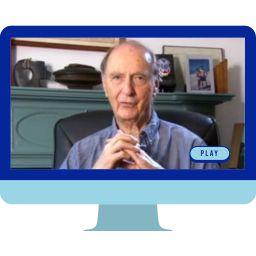
We are pleased to introduce the Taos Institute's first online self-paced course! In six modules, each with 3 short videos and questions for reflection, Ken Gergen introduces basic premises of social constructionist theory and how they apply to professional practices in all domains as well as everyday life. More details here.
| |
Includes six modules with videos by Taos Institute Co-founder & President Ken Gergen! | | |
August 19, 1:00-1:30pm EST
Whether you are new to the Taos Institute Commons online community or already a member (it's free and easy to join!), you are invited to this informal gathering to meet others in our global network to share stories of how you are applying (or hoping to apply) social constructionist, relational and appreciative approaches in your work and life. Stop by to say hello, we would love to meet you.
| | | |
With Sandra Kensen, The Netherlands
September 17, 11:00am-12:30pm EST
Join Sandra Kensen for an inspiring conversation exploring the practice of co-creation between governments and their communities—grounded in appreciative approaches, social construction, and dialogue. Drawing from her work with several local governments in the Netherlands, Sandra will share compelling real-life examples, including both inspiring collaborations and challenging power dynamics. She will reflect on key interventions, the dynamics they provoked, and the growing challenges of authoritarian tendencies, ongoing protest movements, and post-process tensions. This session invites participants to reflect on their own experiences with democratic practice and offers insight into how we can move forward—together. More details.
| |
| *You will be prompted to join, or sign in to, the free Taos Institute Commons online community to access these events. | | | |
Join with over 2600 members from around the world in the Taos Institute Commons online community (free) as we explore social constructionist, relational, and appreciative theory and practices. You will instantly get access to free webinars, free books, event replays, announcements, workshops and courses, special interest and language groups, and meaningful connections with others interested in creating more promising futures, one conversation at a time.
Join in the Taos Institute Commons — it's free, quick and easy, to become a part of our global family!
| | | |
TIE is a center of gravity for researchers, practitioners and other like-minded people in Europe, who challenge the known and frozen paradigms of understanding, to build a better world for tomorrow. Join the TIE group in the Taos Institute Commons online community (free) to meet other relational practitioners in Europe.
| | |
TILAC serves as a regional and language hub to strengthen networks of cooperation and support among Spanish- and Portuguese-speakers; share and validate the unique knowledge and practices emerging from these regions; and contribute to the promotion of social constructionist thought. Join the Spanish or Portuguese group in the Commons (free), follow TILAC on Facebook or email tilac@taosinstitute.net.
| | |
The mission of TIJ is to build a network of collaboration and support led by Taos Institute Associates in Japan; to create a forum for dialogue centered on theory, to gather interesting cultural practices in Japan, and to disseminate them both domestically and internationally; and to contribute to the dissemination of social constructionist theory by translating foreign literature and organizing seminars. In addition to their Facebook page, you are invited to join the new Taos Institute Japan group in the Commons, and the TIJ Festival, October 25-26, 2025!
| | |
The RRN is a global initiative to explore, share, learn, and create practices and processes for doing research from a relational perspective. Online presentations featuring relational research projects will continue through the spring. Visit the Relational Research Network group in the Commons (free) for announcements. You may also explore their video series.
| | |
Taos Associates represent a network of more than 850 scholars and practitioners around the world, who have demonstrated exceptional talents, research, practices, and dedication relevant to the Taos Institute’s mission. You can find Taos Associates in your area on our website.
| | |
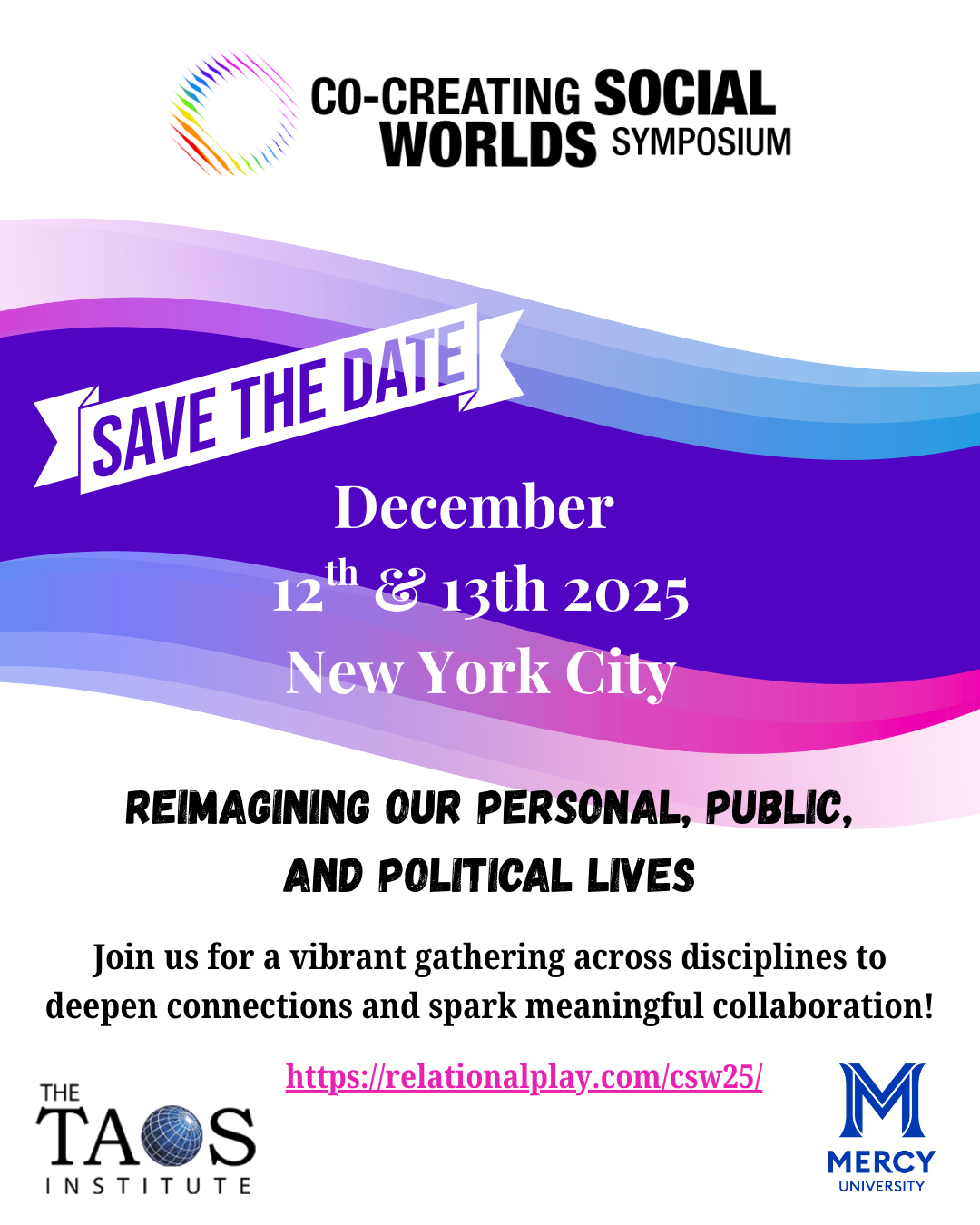
The ICCP Network, co-hosted by The Houston Galveston Institute and The Taos Institute, is an interdisciplinary program that provides an intensive, in-depth study of postmodern-social construction-relational theory and the possibilities for personal, organizational, and social transformation. ICCP partners with organizations in 15 countries and regularly host multilingual workshops. SAVE THE DATE for the International Conference on Collaborative-Dialogic Practices, June 24-27, 2026, Bratislava, Slovakia. Visit the ICCP website for details.
| |
FREE Spanish-English Bilingual Symposium
August 23, 12:00-2:00pm EST
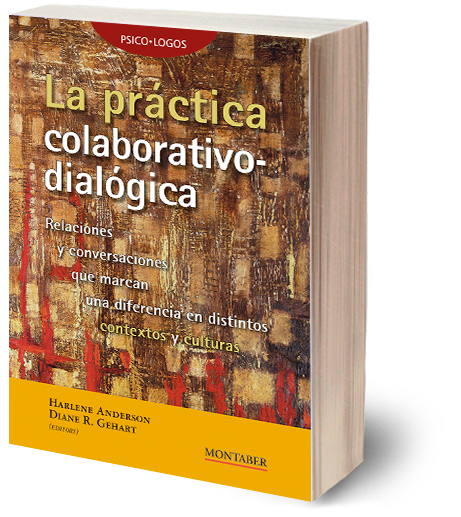
We are pleased to announce the online book presentation of the Spanish edition of Collaborative-Dialogic Practice: Relationships and Conversations that Make a Difference Across Contexts and Cultures, by Harlene Anderson and Diane Gehart. This event will highlight the significance of the Spanish edition and share resources with the academic and professional communities in Spain and Latin America. Special offers for participants: Free digital copy of the book using coupon and 10% student discount for print editions. More details.
| |
| |
September 9, 11, 16 & 18, 9:00-11:30am EST
It remains the top issue for organizations, teams, and relationships. Almost everyone struggles with how to effectively communicate when they are frustrated or facing conflict. The effects of poor communication are costly. "They show up in organizations through symptoms such as employee disengagement, malaise, turnover, dysfunctional teams, poor performance, an inability to give and receive feedback, and negative attitudes, including cliques and gossip: a culture of “me”. If you’re dealing with any of these outcomes, the Conversations Worth Having Bootcamp will give you the skills and tools to turn them around. This program is grounded in Appreciative Inquiry, one of the most widely used positive change approaches. Two simple Appreciative Inquiry practices can turn your entire culture around, creating a culture of conversations worth having. Details.
| | One way the Taos Institute carries out its mission to create brighter futures through social construction is by creating and disseminating a wide variety of resources for scholars, practitioners, and students interested in dialogic and relational approaches. These free resources span many disciplines and languages. To suggest a resource, email info@taosinstitute.net. | | | | |
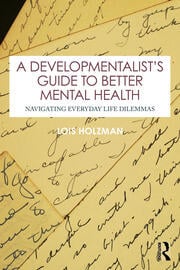
This month's feature: A Developmentalist's Guide to Better Mental Health, Navigating Everyday Life Dilemmas
The book centers around dozens of letters from writers asking “the developmentalist” (and author, Lois Holzman) for help with a wide range of issues. Organized by topics and themes—including trauma, family and relationship issues, living with uncertainty, workplace problems, and more—the letters and the developmentalist's thoughtful, thought-provoking responses lay out a wide variety of strategies for inviting clients into developmental journeys. More details.
| | | | The Taos Institute is a non-profit educational organization. We strive to keep our offerings free or at low cost to make social constructionist, relational, and appreciative ideas available to as many people as possible around the globe. Please consider supporting our mission of creating brighter futures through social construction by making a donation. For small, convenient monthly contributions, consider becoming a sustaining donor. | | | | |