Changemakers, How Might we Engage
our Discursive Power?
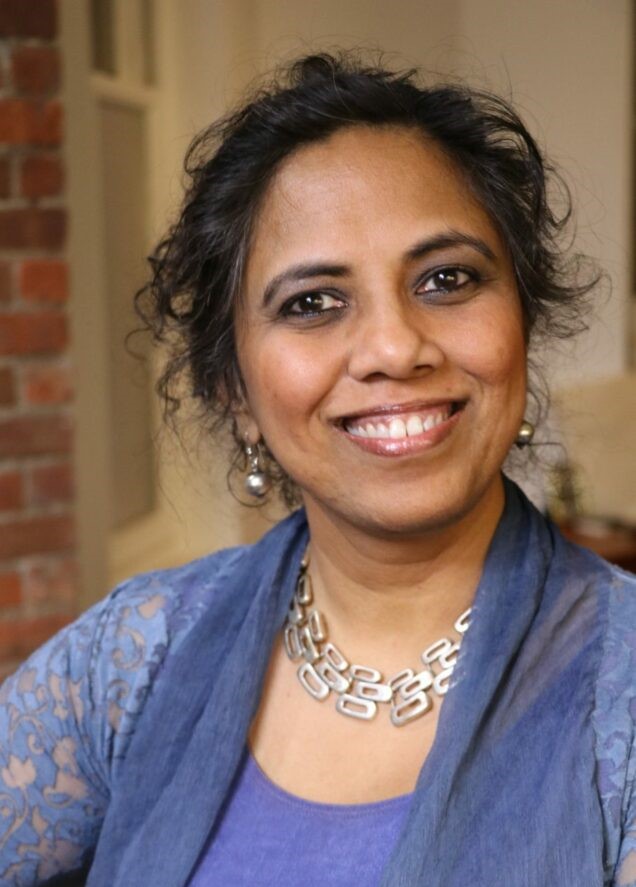
By Saliha Bava, Ph.D., Taos Institute Board Member
| |
|
Hello! I’m an incoming Taos Board member and a practitioner-scholar of Collaborative Dialogic Practices (CDP). For the longest time, I have been intrigued by the critique that CDP is not critical, especially since it originates from the critique of grand narratives, shedding light on our knowledge-making practices with an invitation to understand how language is a social process. That’s pretty political! However, in everyday speech we have surrendered the meaning of political and politics (often related to power though not limited to governance) to electoral politics. Drawing on McNamee’s words, I believe political is “what people do together and what their "doing" makes” in the world. And, I’m committed to reclaiming political from electoral politics by exploring the power of the discursive.
| |
At the Taos Institute, as a collective, we engage in discursive power—shaping our worlds through language, interactions, and meanings. In a chapter in Anderson & Gehart’s book Collaborative Dialogic Practice, I explore how engaging our discursive power is a political activity. While discursive power is a vital means for understanding and challenging structural power relations, it can also be used to encourage violence, as demonstrated by the January 6th US Capitol attack. Thus, co-author Mark Greene and I elaborate in our book The Relational Workplace, how social and organizational change must consider discursive and structural dimensions, recognizing their interplay and mutual influence.
As social justice voices call for equity, we see the rise of voices that seek to reinforce possessory power, obscuring discursive formations and the resulting power. So, how might we engage? I believe an answer lies in Shotter’s ethical view of relational responsiveness, adopting a discursive orientation. Following are some of the ways I do so:
-
Playing with power. By hosting play workshops for organizational teams we explore discourses of “power-over” and “power-with” to expand notions of power for relational engagement.
-
Participating in the dialogue. I engage with family, clients, students, consultees, and many others about power, politics, and identity, as a way to not abdicate the discursive formations of what is politics and power to electoral politics. Instead, we generate a diverse conversational net challenging the status quo.
-
Engaging in the relational play of social identity formation. Noticing the interpretive repertoire in identity formation by engaging in relational play. I view relational play as social repertoires of relationality, which gain intelligence from within the interactive moment in time and place.
-
Naming it! Visibilize it! Naming is an activity of liberation. I seek to create space and conditions by which people, especially those who have been socially marginalized, can name their experiences and ways of being seen. In my sex therapy class, students ask me why there are so many named sexualities. I say, “it is a way to be noticed and be in the game.” It is one answer among many. By naming, we create a presence for that which wasn’t seen or invisibilized.
-
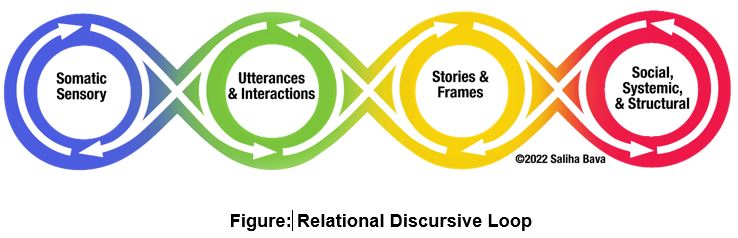
Mapping the socio-relational arrangements. I created the relational discursive loop to help us visualize the interplay of the relational and social. The double infinite loop brings forth the recursive process of meaning-making between the interactional and the social wherein they define and are defined by each other. And, I leave us with this image as an invitation to engage our curiosities and uncertainties in a conversation on the Taos Commons.
|  | Inspired by Gandhi, let us recognize our collective agency in shaping societal processes even as they shape us. As constructionists, let us be the discursive formations we envision. | | |
|
"This course made me think of possible futures, on how to focus on my language and the power it has in creating new realities and relationships."
| |
Starting Soon: March 27-May 1, 2024
Introduction to Social Construction
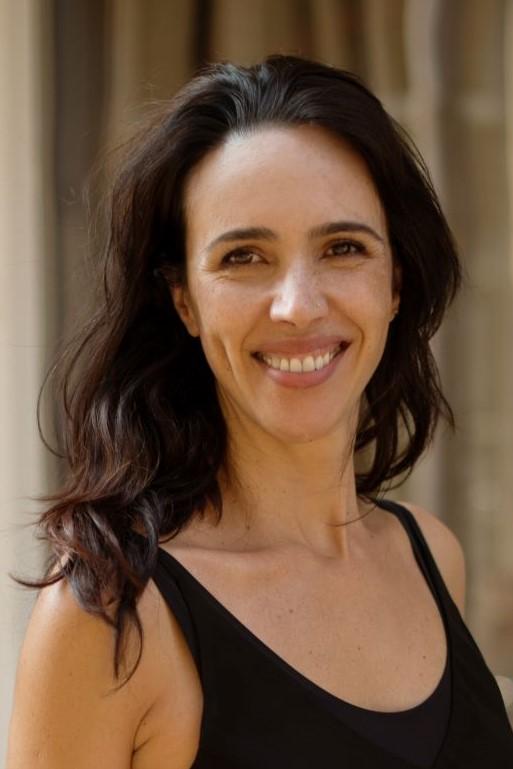
A 6-week online course with Taos Institute Board Member Celiane Camargo-Borges
| |
This course is for students and practitioners who wish to explore how aspects of the world that are taken for granted are socially constructed, thereby opening space for alternative ways to engage in practice and with people. Whether you work in Education, Organizational Design and Leadership, Governance, Healthcare, Therapy, Community Development or you are simply looking for new ways to cope with today's complexity and fast pace of change, you will never see the world the same way.
By joining a Taos educational program, you will experience a constructionist way of being first hand! Unlike conventional content delivery and lectures, a small and diverse group comes together to co-create knowledge in an interactive, collaborative, and dialogical way so that each participant may bring social construction into their own work and life and discover the positive impact this paradigm shift has on society at large. Click here for details.
| |
What's Happening in the Commons | |
Join with almost 1500 members from around the world in the Taos Institute Commons online community as we explore social constructionist, relational, and appreciative theory and practices. We invite you to attend the free events in the Commons to engage in rich dialogue, share valuable resources, watch event replays, and make meaningful connections with others interested in creating more promising futures, one conversation at a time. More details here. | |
|
|
|
|
Community Meet & Greet
Informal gatherings in the Taos Commons
March 13, 12:00-1:00pm & April 1, 1:00-2:00pm EDT
Whether you are new to the Taos Institute Commons online community or already a member, we invite you to join this informal gathering to meet other Taos Institute Commons members and share stories of how you are applying (or hoping to apply) social constructionist, relational and appreciative approaches in your work and life. Stop by to say hello, even if you can't stay for the whole time.
| | | |
|
|
|
Taos Conversation:
Experimenting in Dialogue
March 22, 12:00-1:00pm EDT
During this Taos Conversation, Celiane Camargo-Borges, Naoko Ellis, Derek Gladwin & Sheila McNamee will experiment with a co-creation process in real time. Embracing aspects of experimentation and improvisation, they will respond to a series of questions and engage in dialogue about their responses, while also co-creating potential meanings within the contexts of the questions. Details and meeting link available here.
| | | |
|
|
|
Taos Conversation: Placing People in Time
April 10, 10:00-11:00am EDT
David Kenkel invites an exploration of the uses and dangers of hope following his doctoral research on how the nature of people might be different in a more resource constrained future world. Hope can either maintain allegiance to a dangerous business-as-usual; or face painful predicaments and find new ways of being. Critical take-aways from the research suggest a future shift from self-interest to relational care of the other in community and a move away from independence as an influential discourse toward interdependence as virtuous norm. Details available here.
| | | |
|
March 14, 2024, 12:00-1:00pm EST
Join the guest editors, Dr. David Cooperrider and Dr. Lindsey Godwin, for the February 2024 issue of The AI Practitioner Journal which focuses on Appreciative Inquiry as an approach to “future forming” research. This issue is a homecoming to the original vision of Appreciative Inquiry as a research methodology that creates future-forming, generative and prospective theory. After briefly highlighting the 9 articles in the special issue, we will explore how AI can help eclipse the theory or practice divide. For more details, click here.
| | | |
|
"Normalizing ourselves for the clients. Freeing Ourselves and Finding Freedom"
April 7, 2024, 11:00am-1:00pm PST
When dignity, dialogue, and humanity are foremost in the clinician’s thoughts, we find that those with severe psychiatric histories are able to shift and overcome mental barriers. A panel of clinicians and recovery consultants discuss how therapeutic relationships and conversations foster a cure from mental illness narratives. Free. Donations accepted. $15 for 2 CEUs. For details and access link, email admin@nowiseeaperson.com.
| | | |
|
April 25 & 26, 2024, Boston, MA, USA
This 2-day, in-person conference is an opportunity to connect with other people around narrative ideas, form relationships, and further develop your narrative therapy skills. The event includes keynote speaker Vikki Reynolds, small-group storytelling sessions, and outsider witnessing. On April 23 & 24, join a hybrid training with Ncazelo Ncube about COURRAGE: A Narrative Approach to Responding to People Who Have Suffered Severe Hardships and Trauma. CEs available. Details here.
| | | |
|
Playful & Philosophical; Developmental & Demanding; Mundane & Magical
The East Side Institute 9-month online immersion program in Social Therapeutics is for performance activists, other social change leaders, practitioners and academics with a range of educational and life experiences, and a passion for innovation. "The International Class taught me that we human beings are who we are and are who we are becoming, at the same time. I have learned to embrace uncertainty and accept growth opportunities — not as tasks to be solved, but as ways to explore." –María José Castrillo, psychologist and performance activist, Aguascalientes, Mexico. Details available here.
| | | |
One way the Taos Institute carries out its mission to create brighter futures through social construction is by creating and disseminating a wide variety of resources for scholars, practitioners, and students interested in dialogic and relational approaches. These free resources span many disciplines and languages. To suggest a resource, email info@taosinstitute.net. | | |
|
This month's feature:
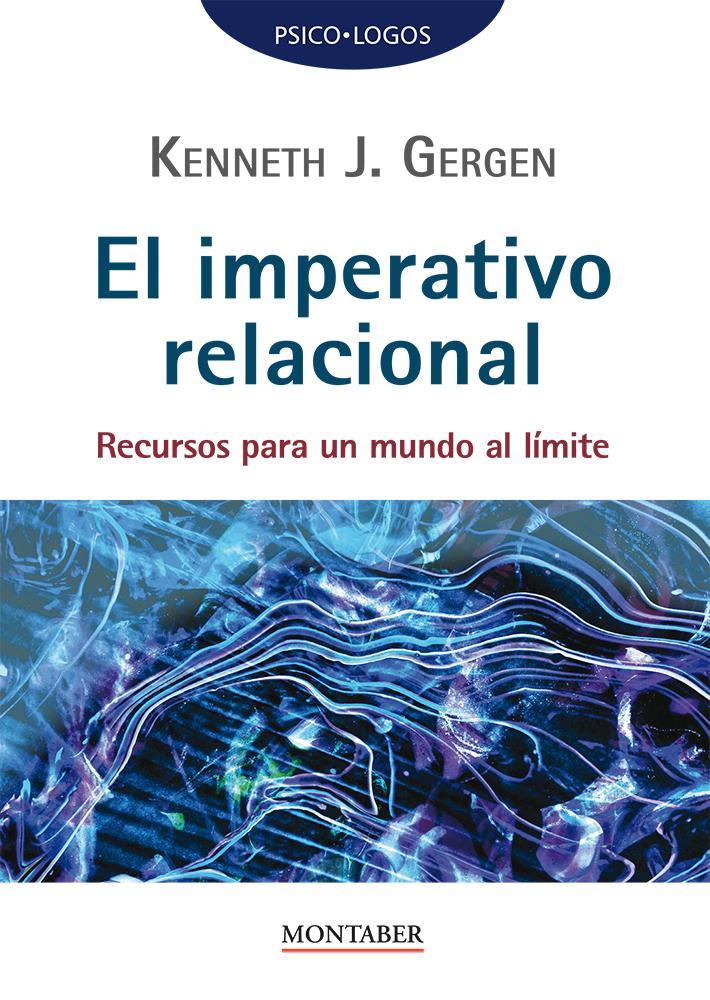
In 2023, Taos Associate Adria Gibernau, from Montaber publications, created a new collection of books focused on discursive and relational psychology. The book that opened this collection was El imperativo relacional, written by Kenneth Gergen (original in English, The Relational Imperative) and translated by Adrià himself.
| | |
|
The Taos Institute is a non-profit educational organization. We strive to keep our offerings free or at low cost to make social constructionist, relational, and appreciative ideas available to as many people as possible around the globe. Financial contributions from you are vital to support our activities. Please consider making a donation. | | | | |