|
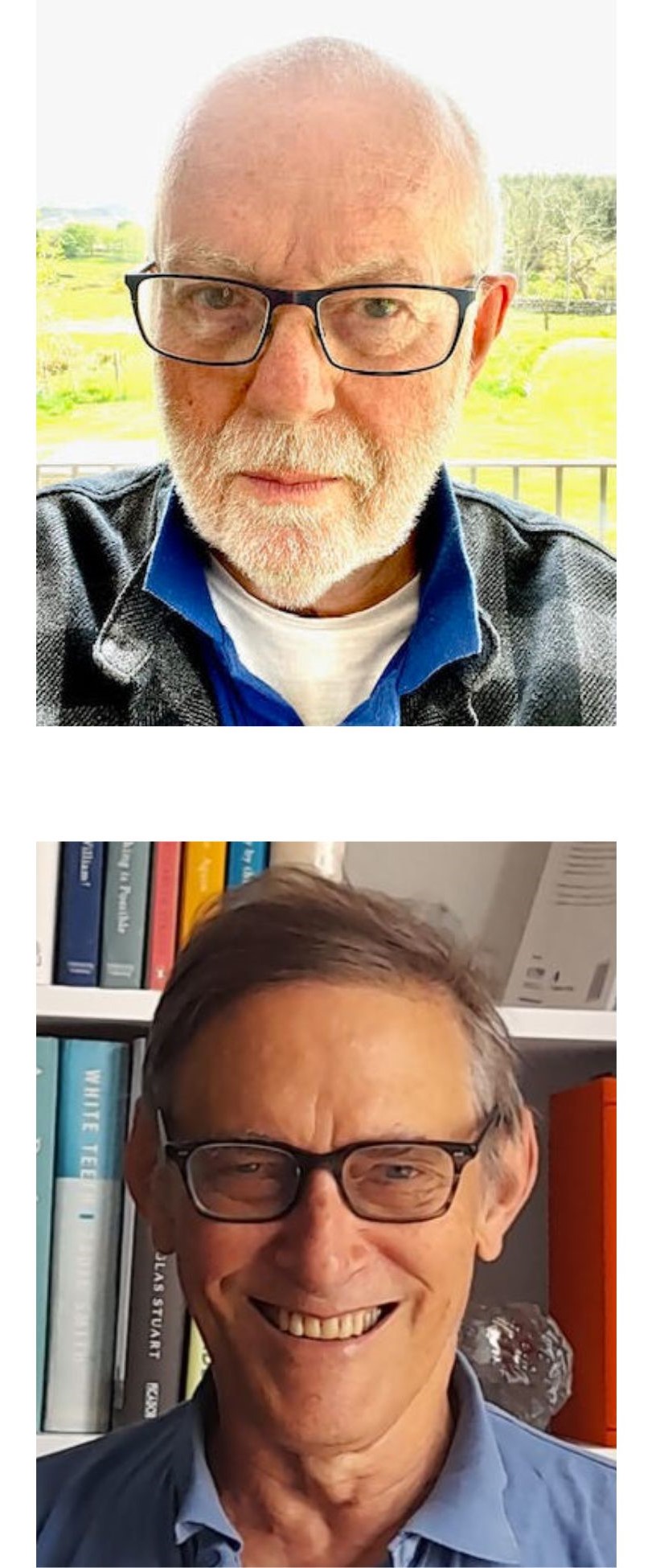
The Relational Manager development project supported by a Taos Associate Grant (TAG), has been aimed at providing managers with alternatives to the taken-for-granted disciplinarian approaches of authoritarian managerialism by offering ways of managing that arise from a more relational, empathic sensibility.
The project began as a seed idea for a book but we recognized that delivering our message and suggestions about more relational practices in book form, however down to earth, would have limited impact. Managers, even if inclined to, have little time to read – especially when they are involved in moment-by-moment interaction in the workplace. We were aware, too, of the long-standing challenge of the transfer of learning from traditional off-the-job, programmatic training to daily, contextual practice. We came to the view that situating the accessibility of more relational management practices as close as possible to daily interaction was likely to be much more effective. This is congruent with an understanding of relational practice as constitutive of knowledge, identity and, ultimately, agency and wellbeing.
We intended to make use of AI video to show relational management practices in action rather than being limited to describing them. We wanted to take advantage of the burgeoning development of AI to produce easily accessible ‘trigger’ conversational scenarios offering more productive positions and modes of interaction of which managers might otherwise be unaware. This approach offers far greater richness than text alone and, significantly, gets closer to contextual workplace action.
We began by developing a website at http://relationalmanager.org (contact us if you would like access). We had envisaged this as a repository of short articles on different aspects of relational management, the content of which could then be used to generate dialogue scripts for AI video production. We placed several such articles on the website for illustrative purposes and sought, through a Taos Commons Conversation (recording available here), to foster interest in collaborating with us in taking the project forward, through generating further material.
Almost a year later, we have now adjusted our approach and have developed a sample short film using AI (click here to watch), demonstrating what is possible. This video, though based on a real situation, is meant as a simulated example with the aim of stimulating further possibilities. It shows a contrast between 2 styles of managing – ‘command and control’ (reflecting a top-down, unilateral approach typical of many hierarchical organisations) and a ‘collaborative’ approach (representative of a more dialogical outlook).
We see this project as offering a resource to those who are interested in finding new ways of communicating and encouraging relational practices principally in the field of organization and management though it might just as easily apply to educational, social work and psychotherapeutic contexts. AI videos can be produced quickly and with minimum cost so, if you have practices that you would like to illuminate, we would love to hear from you. Please contact us at chris.blantern@me.com or messentphilip2@gmail.com.
| |
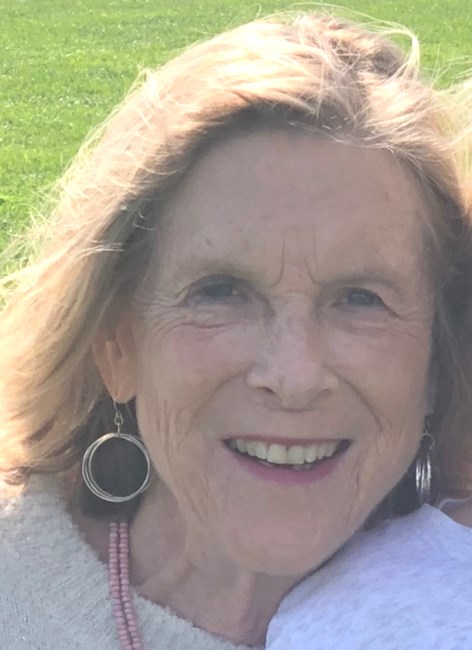
Marjorie (Marty) Roberts
It is with deep sadness that we announce the death of Taos Associate and close collaborator, Marjorie (Marty) Roberts. Marty was a dedicated supporter of the Taos Institute, attending workshops, conferences, and online events. She was a founder of the Salem Center for Therapy Training and Research in Salem, Massachusetts which has trained hundreds of therapists in relational, collaborative, and reflective practices. Marty also organized conferences sponsored by The Salem Center, drawing Taos associates and practitioners interested in postmodern forms of therapeutic practice, including a conference honoring the work of Tom Anderson. As a psychologist Marty has helped countless individuals and families find constructive ways to move forward with their lives. We will miss Marty and her gracious and enthusiastic presence. You can read her obituary here.
| | |
Interdisciplinary Call for Papers
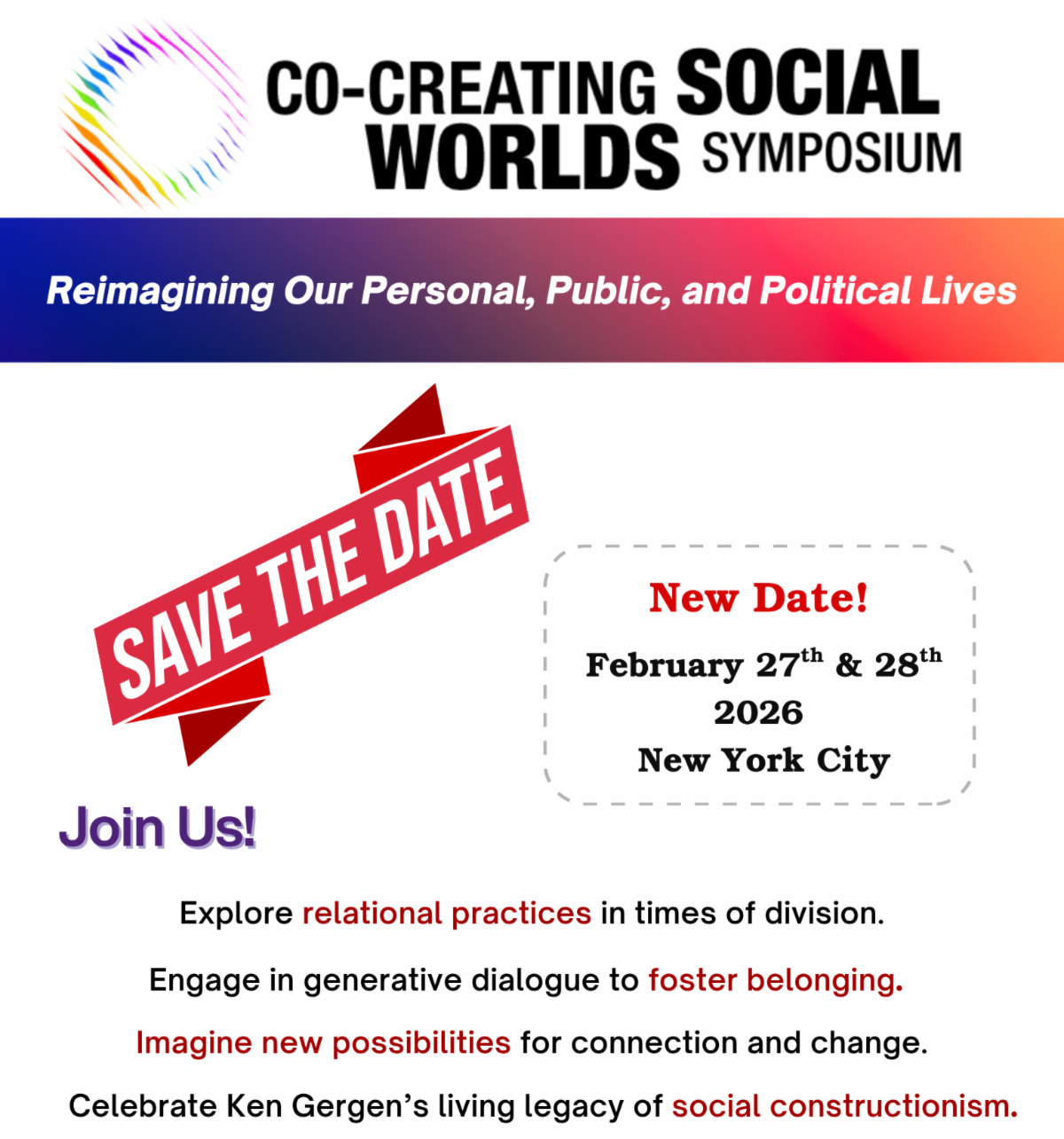
We invite practice-, art-, inquiry-, or philosophical papers that explore the symposium theme and invite exploration of the making of our social worlds through everyday practices for engagement and/or social transformation. We seek relational practices embedded in social construction, viewing language, knowing, and sense-making as a socially dynamic process. Submit a 50-word abstract by November 15, 2025. Details.
| | |
Self-Paced Course, Start Anytime
Provocative, unsettling, liberating, inspiring…all have been applied to the dialogues on the social construction of knowledge. The ideas have swept across the academic world and into personal and professional life. For many, they contain the ingredients for a promising life together on this planet.
We are pleased to introduce the Taos Institute's first online self-paced course! In six modules, each with 3 short videos and questions for reflection, Ken Gergen introduces basic premises of social constructionist theory and how they apply to professional practices in all domains as well as everyday life. More details here.
| |
Includes six modules with videos by Taos Institute Co-founder & President Ken Gergen! | | |
With Susan Riva, Switzerland
October 24, 12:00-1:30pm EST
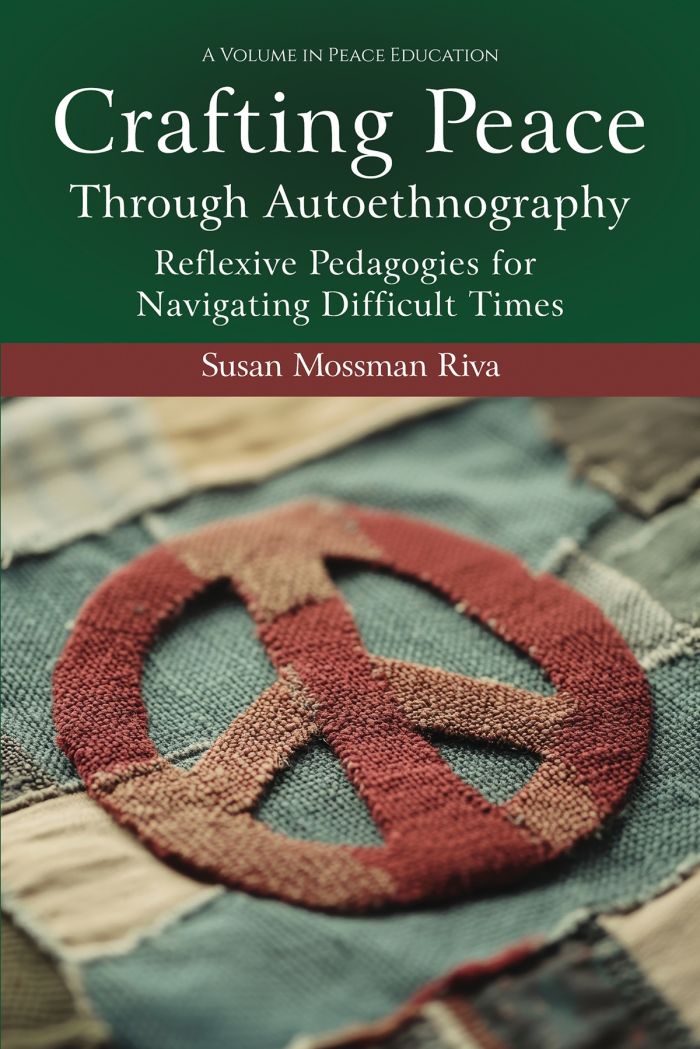
In this book, the author offers a reflective framework for navigating complexity in higher education. She introduces the Transformational Learning Model and features students’ Transformagram Portfolios—creative, personal expressions of their transformative learning journeys. She also shares how her conflict resolution course uses personal conflict narratives to connect lived experience with theoretical frameworks. Students craft story mandalas and engage with autoethnography as a social science method, deepening their understanding of conflict, identity, and personal transformation. In another one of her courses on complementary and alternative medicine, Susan explores traditional healing practices through illness narratives. Students’ artistic representations of conflict and illness showcase the power of story in healing and transformation. By viewing personal and societal challenges through an interconnected, holistic lens, students discover how storytelling can serve as a bridge between peacemaking, healing, and constructive social change. More details.
| |
| |
With Sara Cobb, USA
November 5, 1:00-2:30pm EST
Persistent conflicts, such as wars, the rise of fascism, political and social conflicts over colonialism, marginalization, climate change, race, etc., depend on “master narratives” that keep the parties prisoner to their own logics, their descriptions of histories, and their vision of possible futures. We see master narratives at work, constructing the world, from the local to the global level, in personal conflicts where families fracture over their ideological differences, in communities divided by race, in professional settings where “merit” seems to challenge “diversity” and vice versa, in political settings where “science” is in opposition to “belief,” and of course, in violent conflicts. This webinar offers a strategy for evolving master narratives via the development of new logics, or “proximate narratives,” to open new pathways for conflict transformation. More details.
| |
| If you can't join us live, all session recordings are available in the Taos Commons! | | |
Join with over 2700 members from around the world in the Taos Institute Commons online community (free) as we explore social constructionist, relational, and appreciative theory and practices. You will instantly get access to free webinars, free books, event replays, announcements, workshops and courses, special interest and language groups, and meaningful connections with others interested in creating more promising futures, one conversation at a time.
Join in the Taos Institute Commons — it's free, quick and easy, to become a part of our global family!
| | | |
TIE is a center of gravity for researchers, practitioners and other like-minded people in Europe, who challenge the known and frozen paradigms of understanding, to build a better world for tomorrow. You are invited to contribute to its new Embodied Constructionist Anecdotes blog. What anecdote would you like to share about a lived, embodied, and meaningful constructionist experience? Visit the TIE group in the Taos Institute Commons online community (free) to learn more.
| | |
TILAC serves as a regional and language hub to strengthen networks of cooperation and support among Spanish- and Portuguese-speakers; share and validate the unique knowledge and practices emerging from these regions; and contribute to the promotion of social constructionist thought. Join the Spanish or Portuguese group in the Commons (free), follow TILAC on Facebook or email tilac@taosinstitute.net.
| | |
The mission of TIJ is to build a network of collaboration and support led by Taos Institute Associates in Japan; to create a forum for dialogue centered on theory, to gather interesting cultural practices in Japan, and to disseminate them both domestically and internationally; and to contribute to the dissemination of social constructionist theory by translating foreign literature and organizing seminars. In addition to their Facebook page, you are invited to join the new Taos Institute Japan group in the Commons, and the TIJ Festival, October 25-26, 2025!
| | |
The RRN is a global initiative to explore, share, learn, and create practices and processes for doing research from a relational perspective. Online presentations featuring relational research projects will continue through the spring. Visit the Relational Research Network group in the Commons (free) for announcements. You may also explore their video series.
| | |
Taos Associates represent a network of more than 850 scholars and practitioners around the world, who have demonstrated exceptional talents, research, practices, and dedication relevant to the Taos Institute’s mission. You can find Taos Associates in your area on our website.
| | |
The ICCP Network, co-hosted by The Houston Galveston Institute and The Taos Institute, is an interdisciplinary program that provides an intensive, in-depth study of postmodern-social construction-relational theory and the possibilities for personal, organizational, and social transformation. ICCP partners with organizations in 15 countries and regularly host multilingual workshops. SAVE THE DATE for the International Conference on Collaborative-Dialogic Practices, June 24-27, 2026, Bratislava, Slovakia. Visit the ICCP website for details.
| | |
Performing The World 2025
November 13-16, 2025
What does creating and organizing power look like? Sound like? How is it created? How does it move? How does it dance? How does it sing? What ideas, emotions, relationships does it generate? How is the mess impacting the nature and tone of our creativity? How is our creativity and power impacting on the mess? These are some of the questions we want to explore together, not abstractly, but with those from far-flung communities of activists, artists, educators, therapists and play revolutionaries. Performing The World 2025 is starting to take shape. In this short video, co-convener Dan Friedman shares the names and stories of presenters already confirmed— from Kenya to Nigeria, Greece to Israel-Palestine. Watch now and see the beginnings of this global gathering come alive. Details.
| | |
November 21, 10:00am-1:30pm EST
This workshop addresses the real effects of working with distraught, suffering, and traumatized individuals. Explore new understandings and practices to sustain yourself while protecting the integrity and hope within your work. This 3.5-hour workshop will explore burnout, compassion fatigue, empathic strain, secondary stress, and moral injury, with a focus on their unique effects in high-stakes helping environments. Drawing on examples from advanced illness care and other emotionally intense practice settings, we will explore how these challenges impact clinicians’ sense of purpose, connection, and hope. Participants will examine practical, ethical, and organizational strategies to protect empathy and rebuild a sense of professional meaning for themselves and their clients. Details.
| | One way the Taos Institute carries out its mission to create brighter futures through social construction is by creating and disseminating a wide variety of resources for scholars, practitioners, and students interested in dialogic and relational approaches. These free resources span many disciplines and languages. To suggest a resource, email info@taosinstitute.net. | | | | The Taos Institute is a non-profit educational organization. We strive to keep our offerings free or at low cost to make social constructionist, relational, and appreciative ideas available to as many people as possible around the globe. Please consider supporting our mission of creating brighter futures through social construction by making a donation. For small, convenient monthly contributions, consider becoming a sustaining donor. | | | | |