|
Being a Relational Practitioner
in a Complex and Challenging World
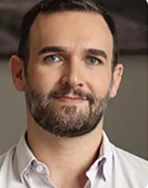
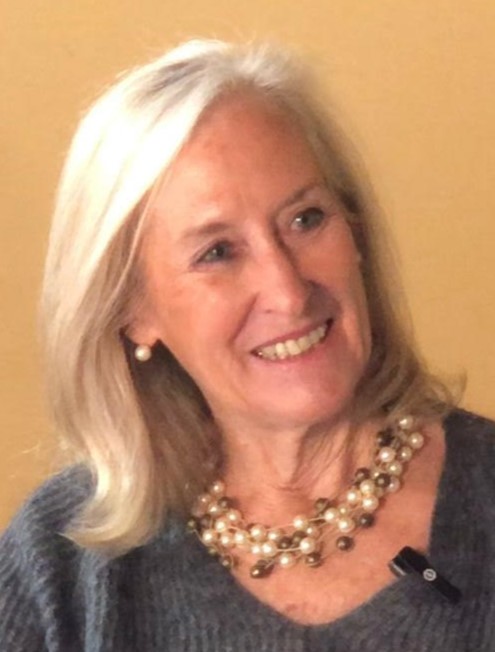
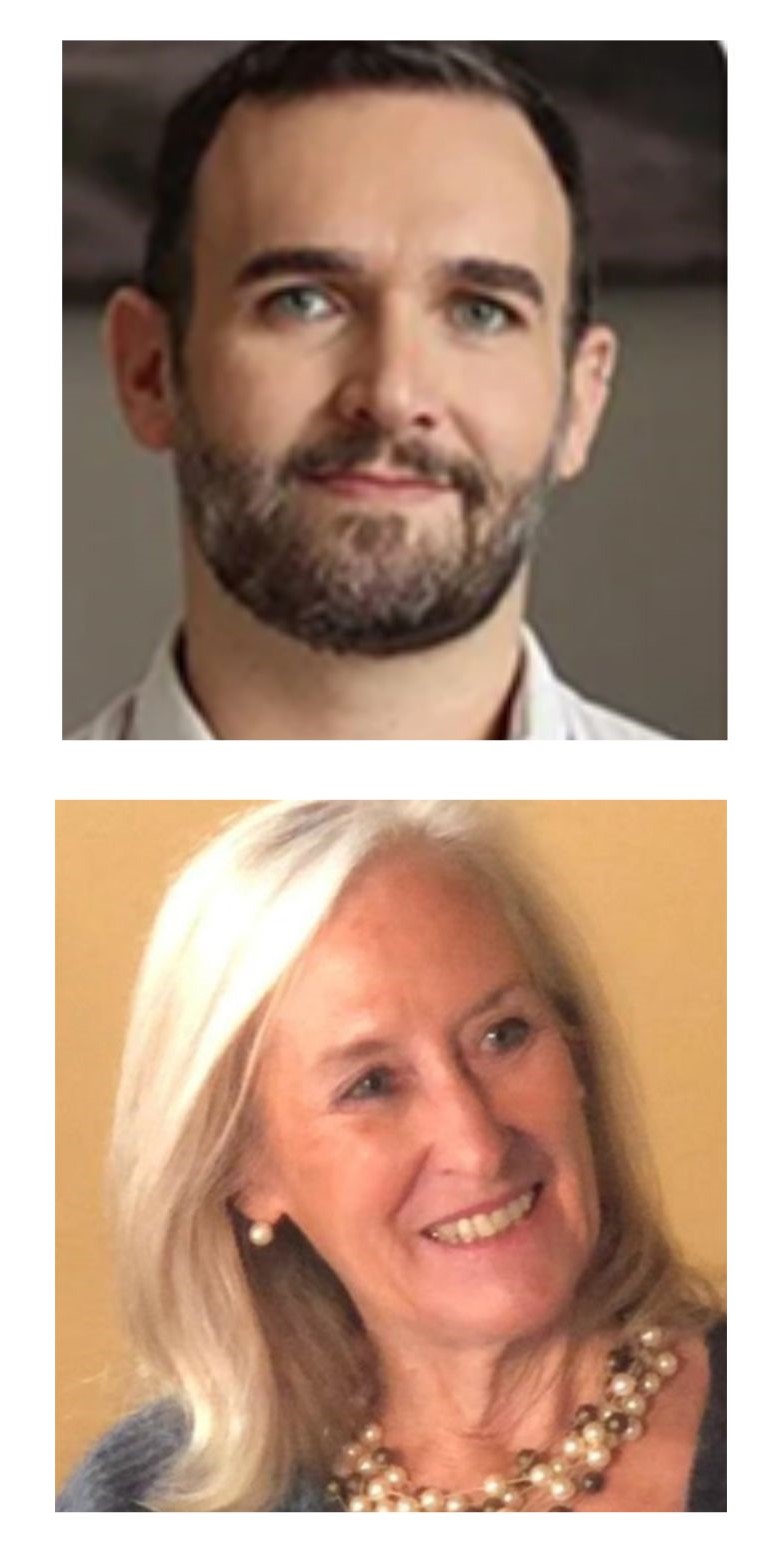
By Pedro Martins & Sheila McNamee
| | |
|
|
These are hard times for us as relational practitioners. Regardless of your professional identity, we are confronted with the challenges of ethical, political, environmental, economic, and educational issues. Amid these challenges, it is useful that the relational sensibility that we share as constructionists keeps us open to multiple views and orientations, eschewing dogma and instead opting to give voice to competing ideas.
Our constructionist orientation positions us favorably to navigate complexity. But despite our embrace of complexity, sometimes simplicity is appealing. We find ourselves frequently thinking how much easier it would be to inhabit a worldview where the taken-for-granted ideas about what is true and what is false are simply and unquestioningly accepted. It is in these desperate moments that we might contemplate the promised wonders of relational ignorance (e.g., a non-relational stance); a black and white world where we do not have to critically reflect on every step we take, or every move we make.
However, if understanding processes of social construction encourages us to think critically about the world – our practices included – returning to a place of simplicity is not the way forward. What will move us forward is finding empowering resources. We all experience these moments of uncertainty, moments of clinging to our own beliefs. There are ways of putting the constructionist ideas of multiplicity and collaboration into action, and to find hope in the midst of uncertainty and desperation. Here are some ideas on how to move forward in these complex times:
1) Keeping curiosity alive. A stance of curiosity is perhaps the most powerful resource we, as relational practitioners, have at our disposal. Not only curiosity about our clients’ beliefs and values but about our own. When we question our own certainty, we find ourselves more able to listen generously to others. Curiosity invites us to find novelty in the known and to be creative in the face of old solutions that are no longer useful for new challenges.
2) Building bridges with people who think differently. People inhabit multiple social worlds. However, we also share a physical world where we meet each other and where our actions systemically affect the lives of many. Seeking connections with those who hold opposing views is not only desirable, but necessary if we are going to do something about the world we share. What if, instead of placing our focus on differences, we begin by inquiring into what might be similar amongst us?
3) Finding our own way of contributing. Looking at all the challenges in the world at one glance might be overwhelming. Sometimes it can be useful to break down these challenges into smaller pieces. Diverse difficulties demand diverse types of action. What is your own and best way to contribute to any one of these challenges? Social construction reminds us that micro social processes (our everyday interactions) and macro social realities (larger cultural discourses) are intricately interconnected. While confronting macro level change may often seem out of reach,
there are resources for inviting change in our micro interactions. Let’s start there.
How might we find new ways to coordinate ourselves with others and with our ever-evolving environment? Join us in our Taos Conversation on September 20 to dive deeper into the challenges we face as relational practitioners (see details below).
| |
December 6, 2024
Pathways to Relational Resilience
An online workshop with Deb Nathan & Sheila McNamee
Whether it is between nations, within families, between partners, or with colleagues, it is challenging to find ways to move beyond conflict towards greater understanding and an appreciation of difference. However, it is not impossible, and hope can be found even amid the deepest of divides. How do we hold on to our beliefs while making room for other perspectives? As the political and social aspects of the world in which we live become more polarized, how do we learn to tolerate difference and listen to viewpoints that differ dramatically from our own? How do we work together and learn to value difference?
This online workshop features relational alternatives to more traditional approaches to conflict resolution. Participants will learn how the utilization of art and reflecting dialogue can work together to encourage the development of relational resilience and to shift from conflict to appreciating the value of difference. More details.
Certificates of Completion available upon request.
| |
Sheila McNamee, Ph.D. is Professor Emerita of Communication at the University of New Hampshire and co-founder and Vice President of the Taos Institute. Her work is focused on dialogic transformation within a variety of social and institutional contexts. | |  |
Deborah Nathan, Ph.D., LMHC, ATR is a psychotherapist specializing in art therapy, conflict mitigation and trauma. In 2008, Deb founded Artsbridge, Inc. – an organization that utilizes a unique methodology to bring together teens from communities in conflict. | | |
What's Happening in the Commons | |
Join with over 1600 members from around the world in the Taos Institute Commons online community as we explore social constructionist, relational, and appreciative theory and practices. We invite you to attend the free events in the Commons to engage in rich dialogue, share valuable resources, watch event replays, and make meaningful connections with others interested in creating more promising futures, one conversation at a time. More details here. | |
|
|
|
|
Taos Conversation
The Role of Therapy in Challenging Times
September 20, 2:00-3:00pm EDT
Therapy is situated in a world that is rapidly changing and where both local and global challenges affect all of our lives, our relationships and the societies in which we live. Along with these different contexts, a variety of expectations and goals are placed upon therapists. Sheila McNamee and Pedro Martins invite you to join them to explore the question: what is the role of therapy in today’s world? We will also have some exciting news to share! More details here.
| | | |
|
|
|
Community Meet & Greet
Informal gatherings in the Taos Commons
October 2, 9:00-9:30am & October 21, 2:00-2:30pm EDT
Whether you are new to the Taos Institute Commons online community or already a member, we invite you to join this informal gathering to meet other Taos Institute Commons members and share stories of how you are applying (or hoping to apply) social constructionist, relational and appreciative approaches in your work and life. Stop by to say hello, we would love to meet you.
| | | |
|
|
|
Dialogue with the Authors
Appreciating Health and Care
October 11, 10:00-11:00am EDT
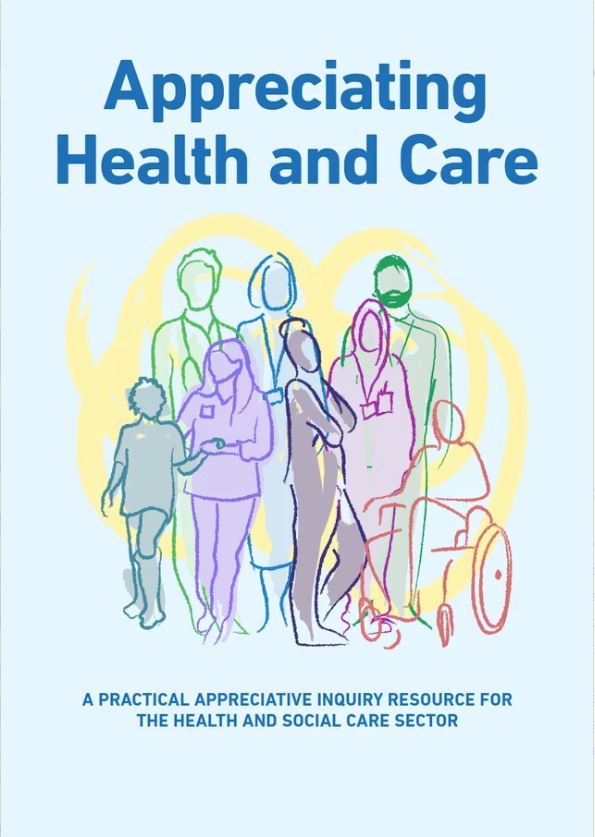
Suzanne Quinney and co-authors Daniel Hodgkiss, Tim Slack, Kayleigh Barnett & Brook Howells invite you to join them in dialogue about their new book, Appreciating Health and Care. The book features learning from a myriad of examples of Appreciative Inquiry projects and practice over the last decade across the health and care sector. The stories demonstrate the rich response from health and social care practitioners across the UK. Register here.
| | | |
|
The Narrativ Institute is launching their 10th 170-hour training program in collaborative-dialogic practices in September, with accreditation by the Ministry of the Interior and part of the International Network of Collaborative-Dialogic Practices certification. The program focuses on applying the philosophy of collaborative-dialogical practices in different areas of the helping professions. They also take inspiration from narrative therapy, solution-focused therapy, and open dialogue. Details.
| | | |
|
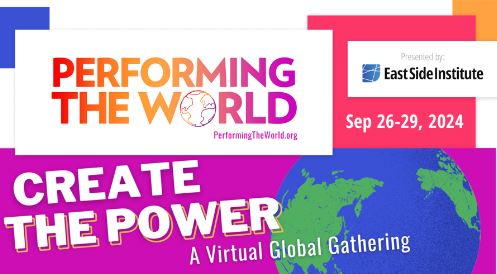
A question facing those of us who want to make a more humane and sustainable world is, “What happens after the demonstration (or occupation or strike or uprising)?” How do we maintain social motion, pass our values on to new generations and continue to build power at the grassroots? Much of the struggle for social justice and human development around the world has been focused on what we’re against. For decades Public Enemy’s rap classic, “Fight the Power,” has been an anthem for millions. But what can it mean and how does it shape us if we are defined primarily by our opposition, our resistance, our against-ism? What if instead of simply fighting the power, we focused on creating the power? Details of Performing the World 2024 event are available here.
| | | |
 | |
Collaborative Supervision and Peer Consultation
Critically reflective practices for transformative possibilities
October 19, 2024
In this interactive workshop Caroline Tremblay and Jim Duvall will invite participants to journey through the post-structuralist assumptions that inform critically reflective practices. These practices can be applied to a wide range of environments including but not limited to non-profit, social service organizations, independent practices, coaching practices, corporate environments, health care, and educational environments and will be of interest to both experienced and hardworking beginner supervisors and consultants. More details.
Novel Practices for Breaking Free from Panic and Anxiety: A Somatic meets Narrative training event
November 16, 2024
Panic and anxiety are amongst the most frequent problems that people present when seeking therapy. Their personal stories often reflect the impoverishing and debilitating effects that it has on their ability to appreciate and participate in the mundane details of everyday life. In this one-of-a-kind workshop, Jim Duvall and Bob Schwartz will present a range of valuable assumptions and practices for addressing panic and anxiety that are not normally presented together. They are all non-normative time-sensitive approaches to therapy. Jim will be focusing on brief narrative practices and Bob will be focusing on somatic approaches including energy psychology and Ericksonian hypnosis. Together they will present empowering alternative short-term approaches for overcoming panic and anxiety. More details.
| | | |
One way the Taos Institute carries out its mission to create brighter futures through social construction is by creating and disseminating a wide variety of resources for scholars, practitioners, and students interested in dialogic and relational approaches. These free resources span many disciplines and languages. To suggest a resource, email info@taosinstitute.net. | | |
|
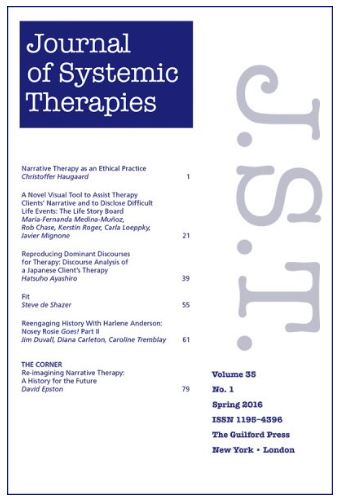
This month's feature: Journal of Systemic Therapies The Journal of Systemic Therapies explores the latest concepts in such areas as brief therapies, solution-focused brief therapy, relational approaches, collaborative dialogical therapy and narrative therapy. This journal is a solid teaching tool – reader friendly – with a major focus on practices. The journal offers clinically relevant, practice oriented articles, as well as interviews with leading practitioners and theorist in the field. Special issues focus on important topics, such as Process Ethics, Reflecting Teams and Cross-Cultural Narratives. Note: the journal has an open Call for Papers and Reviewers. | | |
|
The Taos Institute is a non-profit educational organization. We strive to keep our offerings free or at low cost to make social constructionist, relational, and appreciative ideas available to as many people as possible around the globe. Please consider supporting our mission of creating brighter futures through social construction by making a donation. | | | | |