Spring 2023    The Teaching Inquirer    Issue 2

JOIN US

May Teaching Retreat


May 17, 8:00—4:30


free @ Carnegie Hotel


Meals • Workshops • Work Time • Support


Click to learn more & register 

Updates from Dr. Scott Jenkinson, CEL Fellow

ETSU’s QEP, Go Beyond the Classroom - focused on Community Engaged Learning (CEL) -, is quickly gearing up! We have a committed group of instructors working to try out some of the assessment measures for CEL experiences already happening in their courses. Various departments across campus are discussing where in their programs CEL experiences will best fit. And we are actively moving forward with a process by which we can designate courses as “CEL” and offer supports to instructors who are interested in bringing this high-impact practice to their students! 


Be on the lookout for upcoming announcements about available mini-grants for CEL idea-development, summer intensives, and more opportunities to discuss this meaningful teaching practice.  

Summer Book Club

Thursday, June 15

2:30—4:00 pm

Registration limited to 25

Free book with registration

Register


Upcoming Events

3/23  |  2:00-3:30        

Turn Students into their Own Teachers


3/24  |  12:00-1:00      

TED Talk Lunch & Learn: Lunch!


3/27  |  10:30-11:00     

Flash Mentoring: Active Learning in Large

Classrooms (ONLINE)


3/28   | 2:30-4:00         

Authentic Assessments


4/4    | 2:30-4:00         

Taxonomies of Learning


4/11 |  2:30-4:00         

Active & Collaborative Learning (ONLINE)


4/12 | 10:00-11:30

Campus-as-Text


4/14 | 1:00-2:30

Turn Students into their Own Teachers


4/21 | 12:00-1:00

TED Talk Lunch & Learn: Lunch!


5/4 | 11:30—1:00

Purely Social “End-of-Semesta Fiesta”:

Lunch!


All on-ground workshops, unless otherwise noted, held in Room 433 Sherrod Library


Learn more, register, and see additional Spring events at our CTE website.

Come unwind with us at our

End-of-Semesta Fiesta!

Barberitos & Good Company

May 4, 11:30 - 1:00


Register

Student Voices

by Patrick Brown

Do students value the time they spend in our classes?


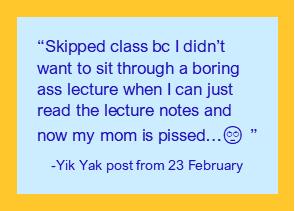
The answer to that question depends on how that time is spent. In-state students pay $37 in tuition for every hour they spend in our class, but do we provide $37 of value?

I’m not trying to commoditize higher education, but the sad reality is that more of the cost to educate our students is coming from the students themselves (or their parents, in the case of our anonymous Yik Yak poster).


Gone are the days when instructors were the sole source of information. Our students carry around the collective knowledge of all humanity in their pockets or backpacks. Information is everywhere and access to it is universal in the United States.

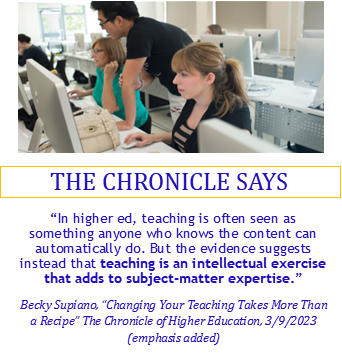
Our role in the classroom needs to shift from deliverer of information to one of facilitating learning. We should be working to help our students use the information they have access to, applying our course content to appropriate situations, and thinking deeply not memorizing facts.


If a student can learn everything they need to know without coming to class, what’s the point of coming to class? 

What We're Reading

Patrick Brown, CTE Fellow


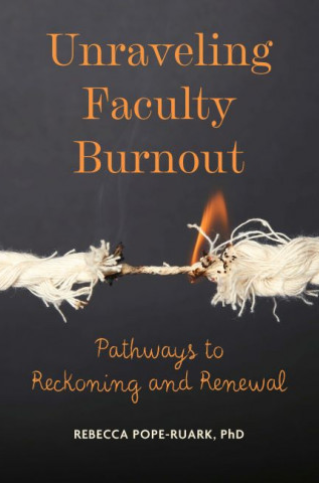
I currently have my nose in Student Engagement Techniques – Second Edition by Elizabeth Barkley and Claire Major. This is an update (from 2020) of the original published in 2010, which I have used extensively over the last decade. This is a fantastic guidebook for instructors who are interested in engaging their students and introducing more active learning strategies in their classroom. What makes this book particularly useful is its arrangement. The book begins with a brief (fewer than 50 page) introduction to the conceptual framework underlying the tools outlined in later chapters. This is followed by a section containing general tips and strategies for improving student engagement in a course, and finally in part 3 the authors review dozens of specific techniques. Part three is also arranged in a very convenient manner, with the techniques organized by the type of learning an instructor is trying to elicit (simple recall, analysis, critical thinking, creative thinking and more). If you are looking for a creative way to help your students learn at any level, this is a wonderful book to have on hand.


Scott Jenkinson, CEL/QEP Fellow


I am currently reading Education in Black and White: Myles Horton and the Highlander Center’s Vision for Social Justice by Stephen Preskill. This text is part biography of the Highlander Center founder and adult educator Myles Horton and part ethnography of the wide array of influences that characterizes the Highlander Center’s legacy.


Given this blend between biography and ethnography this text does a wonderful job of showing how Horton’s early experiences seeing first-hand the disrespectful and disenfranchising environments that persisted among racially, economically, and intellectually marginalized folx across Appalachia influenced his humble, intentional, and subtle methodology of empowering people to become advocates for challenging oppressive systems. 


Phil Smith, CTE Assistant Director


How does all the buzz about AI generated content make you feel? Worried? Concerned? Excited? See how educators across the globe are responding by experimenting with various ways to use AI tools like ChatGPT and DALL-E in the classroom for critical learning. This is a work-in-progress Open Educational Resource (OER), so you can also share ideas you may be trying out!


Alison Barton, CTE Director


For Valentine’s Day, my husband gave me a bookmark (inside a fiction book) that says, “I have no shelf control.” How well he knows me! One of the many books I’m picking up to read bits of these days is a unique approach - a memoir entitled, better: A Teacher’s Journey: Project 180, Book One, by Monte Syrie. This reflective collection of blog posts describes one high school teacher’s experiences on the way to helping students focus more on learning, less on grades. A surprising element are the reflective prompts he inserts for readers as they reflect on their own teaching. A great find!


Find all kinds of teaching books for check-out in our CTE Teaching Collection - Room 441 Sherrod Library!

Our academic year is nearly at an end…

How are we doing?

Please share your input about CTE offerings:


What’s gone well, what we could work on, topics of interest, and more -


We want to be sure we are responsive to the needs of our teaching community, so your input matters. Thank you for taking the time to give us your feedback!

CTE Feedback Form

Changing the Conversation:

What Chat GPT is Inspiring Us to Do

by Alison Barton

Four months ago, just about nobody had heard of ChatGPT. Now we find that nearly everyone has heard about it, and mostly it has been with alarm bells going off in the background. As we have done for decades, we worry about students cheating - this time, using the most sophisticated application to date that generates unique, written content (as well as art images and more).


The CTE got emails, Anthony Kiech (director of ETSU’s Academic Technology Services) got emails, administration got emails. Worried emails: Will we adapt our academic integrity statements to include this new wrinkle? Is there a way to address this in the syllabus? Solicitous emails: Would you like to explore our new software that will catch ChatGPT users? But also curious emails: What can we do with this new technology in our classrooms? And confident emails: I’m not worried about ChatGPT - I don’t think it will impact what I’m doing all that much.


Anthony and I put together a workshop to address the what’s and what-to-do’s about ChatGPT. True to form for myself, I tried to get too much into my part of the workshop, which meant I glossed over the last bit about what this new development means for higher education. So let me take a few moments here to share what I believe is the ultimate upshot of what we are learning from ChatGPT and the other artificial intelligence content generators coming over the horizon. I believe there are two major takeaways we should pay attention to:


  • Universities, including ETSU, should emphasize that our purpose is about learning, not job attainment.


When we become “the next step to getting a job,” we become a box to check for students—an obstacle on the way to “real life.” Obstacles will be overcome by any means possible, including cheating. Yes, we hope our graduates go on to successful careers, but the way they’ll be most successful for any life path is to deeply learn a breadth of information. Let’s give a consistent message, from recruitment to graduation, about the value of learning here at ETSU. And let’s make the learning experience a fabulous one for each and every class our students take.


  • It’s time to trust our students.


Our main concern with A.I. is students abusing this new tech to get away with something in our classes. But let’s remember that many of our students don’t cheat. Those that do might pull one over on us, but they are really only cheating themselves and will discover their folly later. Let’s trust that most will do the right thing.

How do we trust a group of learners who are often stressed, pulled in multiple directions, and perhaps unmotivated - in other words, tempted to cheat? Well, there’s a bunch of ways to answer that, but let me say that it has to begin with relationship. When we connect with our students, when we show we care about their learning, when we have conversations about the purpose of learning in higher education - they are more likely to work with us and for us than try to game us. [Eliminating busy work and high-stakes assignments, and adding in authentic assessments,1 are also excellent ideas.]


Thanks to Dr. Susan Epps’ encouragement, I’m engaging in a Grand Experiment this semester, testing out the strategy of “ungrading” in my graduate class. My students receive a steady stream of feedback, but no grades; instead, they will propose their own grade at the end of the semester, with evidence to support it. This is the ultimate trust fall. And so far, the writing seems authentic, students regularly attend class, and our relationship is stronger than any I’ve had before with a class ... because I’m no longer their judge, I’m their coach.


I have to say - I’m not worried about ChatGPT. In fact, I’ve shown my students how to use it to begin brainstorming ideas. We collaborate, we reflect, we apply what we learn to authentic situations. We talk a lot about the value of what we are learning and why it’s important.


Letting go of control and learning to trust students are major steps for me - but I’m having such a rewarding experience. I feel sure there will be some rocks strewn in the path, but doesn’t every semester? Ungrading is not for everyone, but connecting with students can be. We are here to help you learn how - watch for our offerings, or just reach out!


 1See our offering on 3/28, as well as other related workshops!


Follow Us!

Facebook  Twitter