|
Just Three Weeks Away!
The Promise and Reality of Health IT in
Improving the Patient Journey
February 23 - 24, 2026, in person and virtual!
Join the nation’s leading health care policymakers, payers, providers, technology vendors, and patient advocates to explore how health IT policy, data-centric technology, and digital innovation are reshaping the patient experience.
This year’s forum will spotlight the tools, standards, and strategies that are enabling a more patient-centered health care ecosystem.
Individual & group registration available for onsite AND virtual
| | |
Partial Government Shutdown:
Update as of Monday Morning 2/2/26
A partial federal government shutdown, including the Department of Health and Human Services (HHS), began at 12:01 am on Saturday, January 31, 2026, due to the lack of passage of the remaining Fiscal Year 2026 appropriations bills. While this partial shutdown is expected to be short, HHS, and the other affected departments and agencies, are implementing shutdown contingency plans. HHS’ contingency plans can be reviewed here.
The six departments and agencies affected by the partial shutdown are Labor, HHS, and Education; Defense; Financial Services and General Government; Homeland Security; State and Foreign Operations; and Transportation, Housing and Urban Development. The House passed these remaining funding bills on January 22, 2026, and they were sent to the Senate. There was a holdup in the Senate with debate over the funding bill for Homeland Security. On Friday afternoon, the Senate passed five of the six bills, with Homeland Security extended for two weeks to allow for continued debate.
Because the Senate-passed package differs from what the House passed, the funding bills must go back to the House for passage. The House was on recess Friday and is set to return to session today, February 2, resulting in the expiration of funding and partial government shutdown that began Saturday morning at midnight. According to reports, the House is scheduled to mark up the Senate-passed bill today at 4 pm. It is unclear at this time what the House support will be for the Senate bill, timing of a vote, and ending of the partial shutdown. Actions by Congress to pass this funding will be closely watched.
| | |
WEDI Survey:
Industry Implementation of the CMS 0057-F Final Rule
Share Your Perspectives!
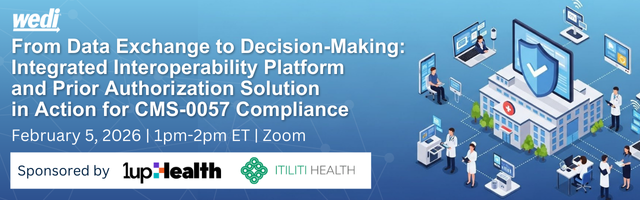
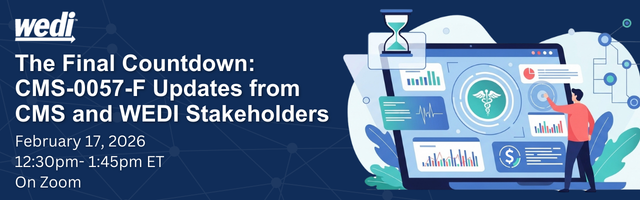
WEDI is conducting a follow up survey on the progress the industry has made implementing the Centers for Medicare & Medicaid Services (CMS) Interoperability and Prior Authorization Final Rule (CMS-0057-F), and we need your help.
This short survey will gauge how the payers, providers, clearinghouses, and vendors are implementing this landmark regulation. Don’t miss this opportunity to share your insights on this important industry mandate. The survey will be open until February 13.
| | |
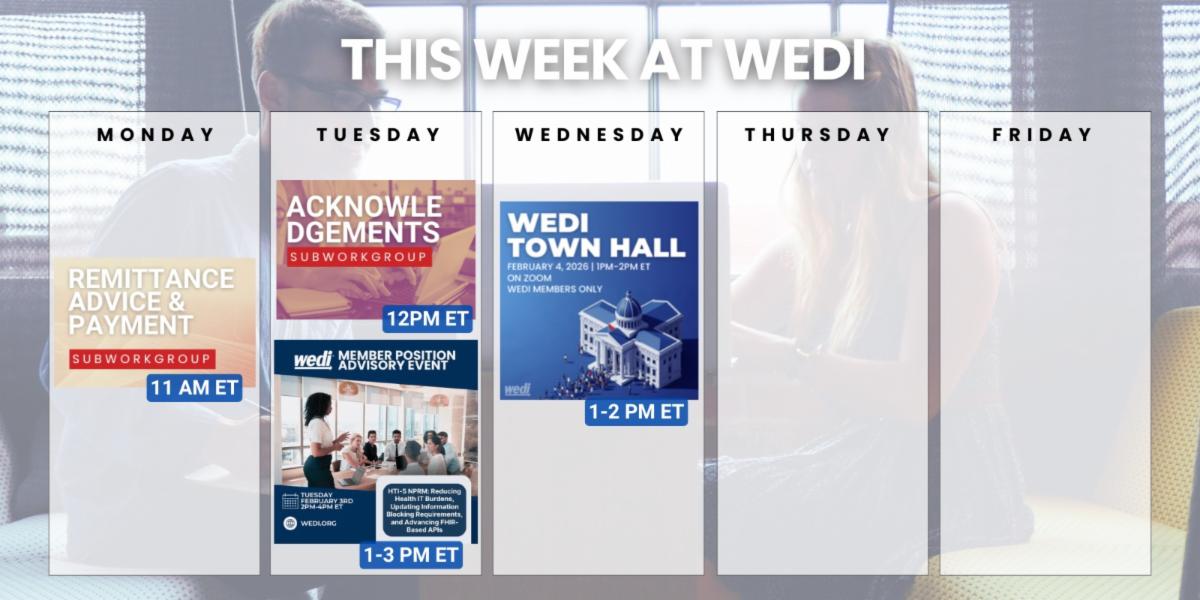
TODAY: Monday, Feb 2nd at 11AM ET
The workgroup will review CMS potential 8060 survey questions and continue review of CARC/RARC usage documentation.
| |
Tuesday, Feb 3rd at 12PM ET
The Acknowledgements SWG will be discussing key issues facing the industry related to these transactions.
| | |
WEDI Members:
Participate in a Workgroup or Subworkgroup
As a reminder, everyone in your organization is eligible to participate in WEDI’s 17 Workgroups.
Email Ariana Poole at apoole@wedi.org for details.
| | |
Save the Date!
Upcoming Workgroup Spotlight and Event
| | |
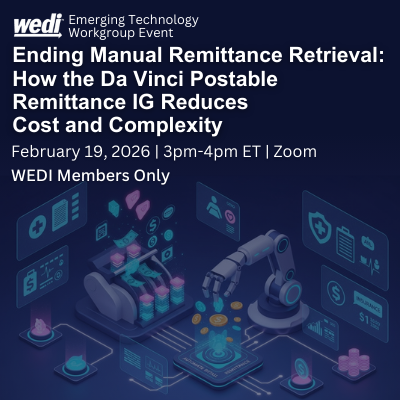
Emerging Technology
Workgroup Event
How the Da Vinci Postable Remittance IG
Reduces Cost and Complexity
February 19 | 3PM - 4PM ET
Remittances often contain claims for multiple destination systems but 835 ERAs only go to one, leading to manual remittance retrieval via portals, phone calls, and faxes.
This manual intervention drives administrative costs for providers, payers, and RCM service providers. The Da Vinci Postable Remittance IG enables the retrieval of a copy of a previously issued remittance via API.
Learn more about this HL7 FHIR standard that will allow providers to request and download missing remittances in real-time via a standardized API.
| |  | |
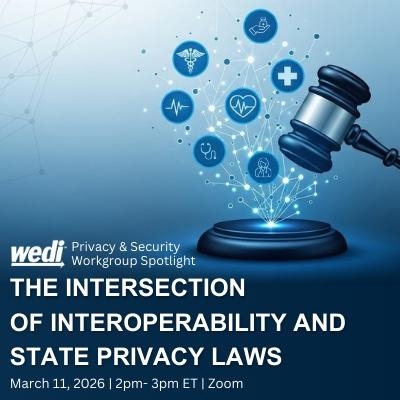
Privacy and Security Workgroup Spotlight
Balancing Health Data Interoperability and Privacy
March 11 | 2PM- 3PM ET
Recently, The Sequoia Project released “Guidance to States: Legislating Technical Standard Definitions for Existing State Sensitive Health Data Laws.”
The document recognizes that as our health care industry moves toward greater interoperability—where health data should flow seamlessly and securely without special effort on the part of the user—there is an urgent need to ensure that privacy protections, particularly for sensitive health data, can keep pace and that the need for compliance with those privacy protections.
Chantal Worzala, PhD, Vice President, Strategy and Engagement from The Sequoia Project, will walk us through this important document and answers questions.
| | | The Privacy and Security workgroup identifies and works toward resolution on all implementation issues related to securing, and protecting health information across the industry. Facilitate the review of privacy and security beyond HIPAA/HITECH in the growing areas of EHR, HIEs, HIX’s and interoperability. | | |
Lesley Berkeyheiser
Direct Trust
| | | |
WEDI, a national membership association since 1991, advises on health IT policy and implementation, focusing on enhancing health care through efficient data sharing and education across all stakeholders. Learn more about becoming a member here!
Connect, collaborate & communicate for a better health system
| | | | | |
Was this email shared with you?
Subscribe today and stay a step ahead of the competition with the latest news, regulatory information, free resources and more!
| | | | |