|
Dear Brothers & Sisters,
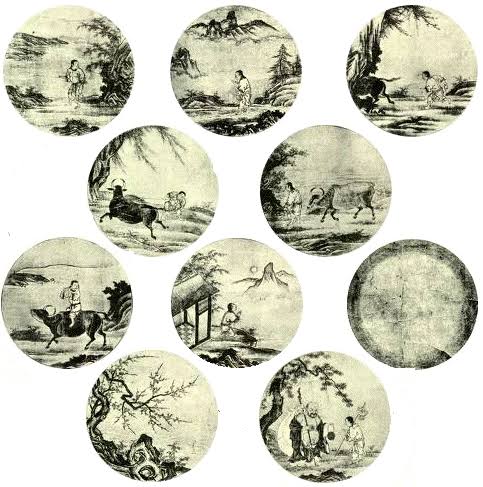
The Ten Oxherding Pictures describe the spiritual journey from the first longing for truth to realization—and finally to returning to ordinary life as an expression of compassion. They originated in Zen Buddhism, but their mystical symbolism can speak across traditions.
In this interpretation:
- The ox represents our true nature—the Divine presence within and beneath the separate self.
- The herder represents the human soul seeking its source.
- The rope and whip represent spiritual discipline.
- The empty circle represents nondual realization.
- The marketplace represents awakened life expressed through love and service.
1. Searching for the Ox
The Picture-The seeker wanders through the wilderness looking for an ox that cannot be found.
This is the beginning of the spiritual path. A person senses that something essential is missing, even if outward life appears complete, it’s not fulfilling.
The soul begins to cry out for something more, the searching through religion, philosophy, relationships, achievement, or spiritual practices begin.
The paradox is that the ox was never truly lost. Our Divine nature is already present, there is nowhere to go. But it is hidden beneath distraction, attachment, willfulness, fear, and identification with the small self, the separate ego.
Mystically, this is the soul’s longing for reunion with its source. The longing itself is already evidence of the Divine calling us home.
2. Discovering the Footprints
The Picture-The herder sees the tracks of the ox.
The seeker begins to recognize signs and awareness of a deeper reality. These footprints may appear in sacred scripture, prayer, silent meditation, beauty of nature, suffering, loss, addiction, love, or the example of spiritually awakened people.
At this stage, the seeker does not yet directly know the Divine, but begins to recognize its traces. Spiritual teachings and practices provide language and direction. The great traditions become maps left by the saints, sages, avatars who have traveled before us.
The footprints are not the ox. But teachings, doctrines, and rituals point toward truth, but they are not the experience of truth itself.
3. Glimpsing the Ox
The Picture-The herder catches sight of part of the ox.
This is the first direct spiritual awakening—a moment in which the seeker briefly experiences the reality, a spiritual experience that had previously been known only through belief.
It may arise as profound stillness, unity, unconditional love, freedom from fear, or the unmistakable awareness of a sacred presence. For a moment, the boundary between the individual and the Divine becomes transparent.
But this is only a glimpse. Then the ego tries to possess the experience, reproduce it, or experiences spiritual greed.
The glimpse is an invitation, not a final attainment.
4. Catching the Ox
The Picture-The herder catches the ox with a rope, but the animal fiercely resists.
Once we recognize our deeper nature, we discover how difficult it is to live from it consistently. Old habits, attachments, willfulness, fears, desires, resentments, and compulsions, the need to be in control or right resist spiritual transformation.
The ox’s resistance represents the undisciplined mind and the force of conditioning. The rope represents attention, prayer, silent meditation, sacred scriptures, ethical living, self-examination, and surrender.
This stage can be painful because the seeker now clearly sees the difference between spiritual truth and the way the ego ordinarily lives.
Awakening has begun, but the personality has not yet been transformed.
5. Taming the Ox
The Picture-The ox gradually becomes peaceful and follows the herder.
Through sustained spiritual practices, the mind and heart become less rebellious. Desire, willfulness and fear no longer control every decision. The seeker develops discernment and learns to recognize thoughts and emotions without automatically obeying them.
Taming does not mean destroying the human personality. It means bringing the body-mind unit into harmony with the soul’s deepest purpose. To make One out of two.
The rope is still present because vigilance remains necessary. Spiritual progress does not make a person incapable of wandering from the path. Humility, compassion, remembrance, and spiritual practices continue to be needed.
6. Riding the Ox Home
The Picture-The herder rides peacefully on the ox’s back, often playing a flute.
Struggle gives way to harmony. The seeker is no longer fighting the mind or trying to force spiritual awakening. Human nature and spiritual nature begin moving together as One.
The flute represents spontaneous joy. Spiritual practice is no longer primarily an obligation; it has become a natural expression of life. The seeker begins to trust the movement of the Divine rather than trying to control every outcome.
This is surrender without passivity.
One still acts, loves, serves, and accepts responsibility—but without the same attachment to results.
7. The Ox Is Forgotten
The Picture-The herder sits alone; the ox has disappeared.
The distinction between seeker and sought begins to dissolve. The ox was a symbol of true nature, but once that nature is directly realized, the symbol is no longer necessary.
The seeker understands that the Divine was never an external object to be captured. What we were seeking is the deepest reality of what we are.
In Christian mystical language, this is the realization of Two becoming One, when humanity and divinity act as One.
In Hindu language, it recalls the recognition of the Self as inseparable from ultimate reality.
Zen cautions, however, against turning even these formulations into something to possess.
8. Both Ox and Self Are Forgotten
The Picture-The picture becomes an empty circle.
This is the most radical stage of the journey. Not only has the object of the search disappeared—the identity of the seeker has also dissolved.
There is no longer “I am experiencing God,” because that statement still contains a division between “I” and “God.” There is simply reality as it is: undivided, ungraspable, and beyond all concepts.
This emptiness is not meaninglessness or nonexistence. It is freedom from the boundaries through which the ego divides reality into self and other, sacred and ordinary, seeker and sought.
Mystically, this is where the human spirit and Divine Spirit are known in unity—not as two things forced together, but as a unity that had always been present beneath the experience of separation.
9. Returning to the Source
The Picture-Mountains, rivers, flowers, or trees appear—but no person is present.
After the experience of emptiness, the world returns. Yet it is no longer perceived through the same divided consciousness.
The mountains are again mountains. The rivers are again rivers. Ordinary life is revealed as sacred precisely as it is. Nothing needs to be rejected or made supernatural.
The seeker discovers that the Divine is not found by escaping creation. The source is present within every leaf, every person, every sorrow, and every moment.
This is a return to simplicity. Reality is no longer valued only when it produces an extraordinary spiritual experience.
10. Entering the Marketplace with Helping Hands
The Picture-The awakened person returns to the marketplace, often depicted as a joyful, ordinary figure mingling with other people.
This is the completion of the mystical path. The seeker does not remain isolated in contemplation or become absorbed in private enlightenment. Realization naturally becomes compassion.
The marketplace represents family, work, relationships, conflict, suffering, and the needs of the world. The awakened person returns without spiritual pretension. There may be no outward indication that anything remarkable has occurred.
The “helping hands” symbolize love expressed in action. Wisdom becomes patience, mercy, humor, generosity, forgiveness, justice, and service.
The final evidence of spiritual awakening is not the visions one has experienced, the doctrines one can explain, or the disciplines one has mastered. It is the presence one brings into the lives of others.
The entire journey may be summarized this way:
We search for the Divine, discover signs of it, briefly experience it, struggle to live from it, surrender into it, lose the distinction between ourselves and it—and then return to ordinary life to embody it through love.
Or as The Sufi’s say:
The perfect mystic is not an ecstatic devotee lost in contemplation of Oneness, nor a saintly recluse shunning all commerce with mankind, but the true saint goes in and out amongst the people and eats and sleeps with them and buys and sells in the market and marries and takes part in social intercourse, and never forgets God for a single moment.
Only Love,
Michael John
|