PHILANTHROPY
The perk that gives back
What is VTO, and why is it trending?
| |
|
BUSINESSES OF ALL stripes are frequently looking for ways to give back ― donations, fundraising campaigns, partnerships and other strategies. But many are starting to turn to a different strategy: giving their employees time off to be used for volunteering, often called “VTO”, or volunteer time off.
“If one in 10 companies shared a business practice in common, would you sit up and take note? If the number moved to one in five, would you think seriously about following suit? What about one in four?” asked Atlassian’s Sarah Goff-Dupont. “That’s exactly the trajectory of one of the hottest employer trends: paid time off to volunteer.”
Goff-Dupont credits some of it to Millennials coming to dominate the workforce in the years leading up to Covid. “When coupled with a compelling, bullshit-free mission, VTO is one of the best ways to speak their language,” she said.
One advantage of simply granting VTO ― as opposed to a more structured program ― is that it diversifies where an organization’s charity efforts go, wrote Jessica Rodell at HBR. “Too often, executives focus their corporation’s volunteer programs around their own personal charitable-giving preferences,” she said.
As part of her research, she quoted one employee who echoed this, saying: “I would rather choose volunteer opportunities that I’m interested in and that I feel really need the extra help, not the ones that [my employer] has some association with.”
Some employers are even taking it a step further by making volunteering efforts part of employees’ annual performance markers.
“One organization I had worked at previously decided to ditch the annual volunteer day,” explained Tonya Lagastra, head of ESG for Colliers Real Estate Management Services, in The Globe and Mail. “In its place, everyone was given the flexibility and tools they needed to contribute to their community, with one catch ― community goals would be included in annual goal setting and performance.
“Employees worked with their performance manager to set their philanthropic goals and agree to the flexibility needed to meet them,” she continued. “Then at the end of the year, the performance manager sat down with each employee to talk about what they did in the community and how these philanthropic activities contributed to their personal and professional development.” Kieran Delamont
| |
ENTREPRENEURSHIP
The eight-day workweek
Making up for labour shortages, small business owners are clocking in the equivalent of an eight-day workweek
| |
|
THE NEW NORMAL of a tight labour market seems to be putting a great number of small business owners in a tough ― and labourious ― position, with a new study from the Canadian Federation of Independent Business (CFIB) suggesting that owners are effectively clocking eight-day work weeks to make up the difference.
“The average small business owner works 54 hours a week, the equivalent of an eight-day workweek for most salaried workers,” the CFIB said. “Those who say they work more hours because of labour shortages clock in even more, about 59 hours a week, 20 of which are spent compensating for staffing challenges.”
The CFIB is pitching this report as a call on government to do what they can to ease the labour shortage.
“Owners have to work more hours, or they have to choose to have their employees work more hours,” CFIB economist Laure-Anna Bomal told the Canadian Press. “They have to turn down sales contracts, decrease service offerings. They are diverted from developing and implementing strategies to their business to improve, to grow their business, so that’s really an issue.”
So, problem to be solved or just the price of entrepreneurship?
For the CFIB, it’s a problem that they want to see addressed with a streamlined temporary foreign workers program and boosted immigration ― and easier access to tax credits and other government subsidy programs.
Others, naturally, disagree, and say that the wage increases that small businesses plan to offer this year ― 3.3 per cent on average according to another CFIB report released a few days later ― are still too uncompetitive in an inflationary environment like we’ve been in.
But you see it, the news is resonating with weary business owners. “That eight-day workweek seems pretty accurate,” said one moving company owner, in an interview with the Toronto Star. “You’re never shutting your brain off. I’m always thinking about what’s going on, [and] lately, it’s just keeping things afloat.” Kieran Delamont
| |
|
|
Terry Talks: How to choose the right HR partner
| Selecting an HR outsourcing company is an important decision that you want to get right first time. But no two HR companies are the same, and sadly, some may be of less repute than other. With such a lot of choice out there, businesses need to know what to look for in a good HR partner, and to gauge the appropriate level of support for you business. | | | |
RESEARCH
A little less happy?
Feel like you’re stuck in a rut at work? You’re not alone
| |
|
IF SMALL BUSINESS owners are tired, it seems their employees are feeling it, too. ADP Canada released its latest iteration of their Happiness@Work index for April 2023, finding that workers in Canada got a little more unhappy last month ― dropping from seven on a scale from one to 10 to 6.8 overall, according to ADP’s scoring system.
What’s also interesting, however, is the stark differences in regional and generational breakdowns. In terms of age, it might be no surprise to know that boomers are the most pleased with their work, with Gen Z, Millennials and Gen X workers lagging behind.
But there is also interesting regional differences, suggesting that the west coast really might be the best coast, at least as far as work is concerned.
Workers in BC and Alberta were a few points ahead of workers in the rest of the country: while every other province registered slight declines in happiness, those scores went up in Alberta and stayed steady in BC. The report didn’t really offer much insight or theories on why this is the case but did note that the sharpest drop in happiness was among workers in Manitoba and Saskatchewan, whose happiness scores slid by nearly 10 per cent over the past month.
(One might also wonder whether Canada is in a happiness recession of sorts, though. Earlier this year, Canada got its lowest-ever score in the United Nations World Happiness Report, ranking us only 13th in the world.)
ADP suggests that employers might be able to improve overall happiness with more flexible, responsive approaches to their employees.
“Although the National Work Happiness Score for April only falls slightly below the benchmark and the score for March, it's important for employers to acknowledge external factors can impact Canadians' happiness at work,” said Holger Kormann, president of ADP Canada.
“Given that workers were less satisfied with compensation and benefits, amidst a backdrop of inflation, companies may need to re-evaluate compensation structure on a more regular basis, instead of reviewing or adjusting annually.” Kieran Delamont
| |
CULTURE
Stall tactics
As many teams transition back into the office, now is the perfect time to rethink the intersection of human biology and work
| | |
|
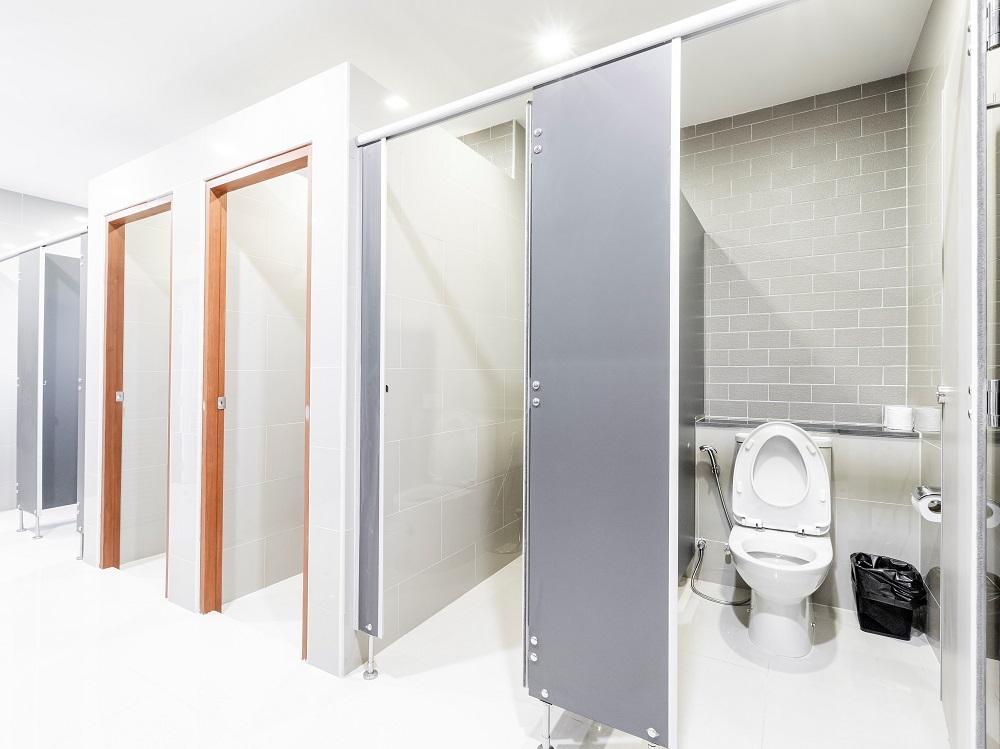
TALK FRANKLY TO some office workers, and at least one of them will likely be pretty protective of their leisurely – and sometimes lengthy – bathroom breaks. After all, as the old saying goes: “Boss makes a dollar, I make a dime ― that’s why I poop on company time.”
Managers have never been thrilled about this, naturally, and have even made attempts to make the bathroom break more unpleasant. A couple years ago, the StandardToilet hit the market – it was a toilet that was angled 13 degrees forward, adding strain to your legs and (hypothetically) limiting the bathroom break to about five minutes, before your legs start cramping. Its inventor claimed that extended bathroom breaks cost the UK economy “£4 billion per annum.”
“The fight to clampdown on toilet time has begun, it seems,” reads a Wired article about the anti-loitering latrine. “But, is policing your pooing a step too far?”
Experts say yes, it probably is the case that targeting an employee’s bathroom breaks in an effort to boost productivity is the wrong approach.
“A steady stream of news articles suggests that employers around the world are indeed clamping down on toilet breaks in a bid to improve productivity,” writes Madeleine Gabriel, head of inclusive innovation at Nesta. “Instead of trying to optimize every minute of their workforce’s time, employers might be better off improving working life.”
Two management researchers, Michael Matthews and Dr. Thomas Kelemen, surveyed hundreds of workers about their “bio breaks” recently.
“Our data reveals that many people are comfortable with their bodies at work,” the pair wrote. “However, some engage in worrying behavior: dehydrating themselves, leaving work to use a restroom at home and mentally scheduling how often they use the facilities. Others used toilets that were not proximally close to their workspace to avoid being seen by coworkers. Indeed, there are a whole array of reasons that people feel uncomfortable.”
They argue that – within some reason – employers should give up the fight and build in bathroom break time into their expectations of employees.
“Establish an environment in which everyone is conscientious of others. As a leader, set the standard and avoid having work-related conversations in the bathroom. Even if some employees are completely fine with conversations in the restroom, some are not. Rely on social cues to ensure employees feel respected.” Kieran Delamont
|
| | | | |