The Tri-State Development Regional Report
news & updates
| | |
Contribute
We help ensure that ideas make an impact! By supporting projects and programs that contribute to our local communities and regional goals, we help drive outcomes!
|
Connecting the Tri-State Region Through River Commerce
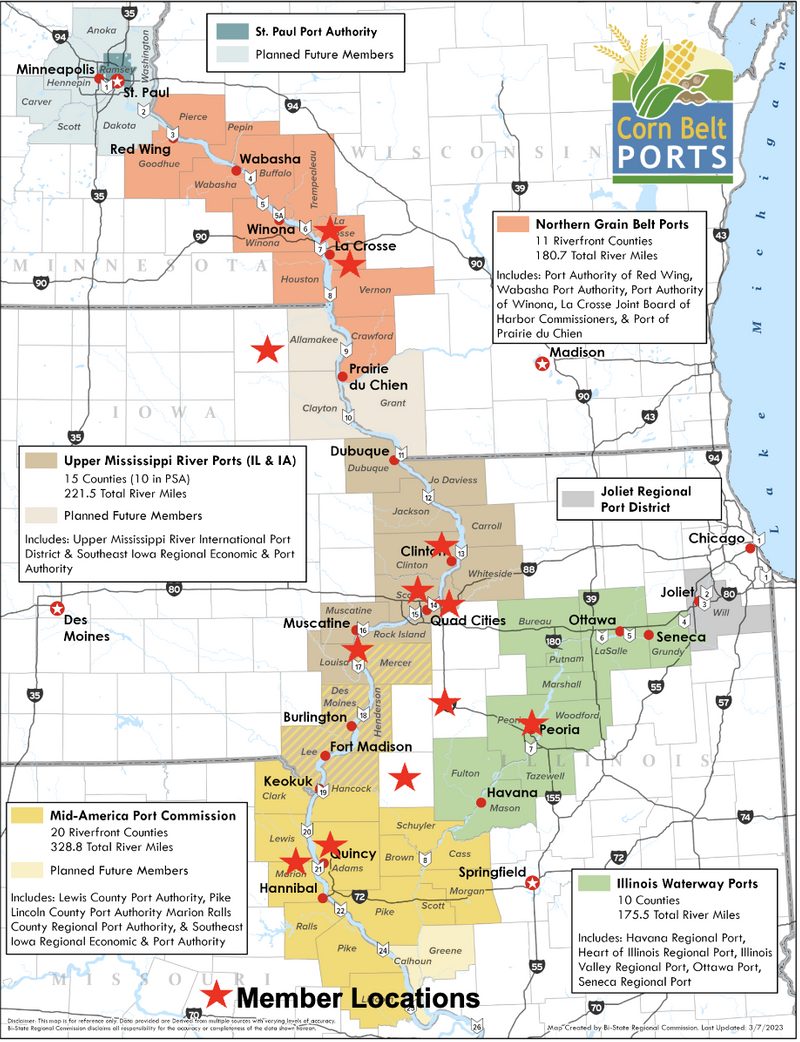
The Mid-America Port Commission (MAPC) and Corn Belt Ports are regional partners working to strengthen economic opportunity along the Upper Mississippi River and Illinois Waterway.
Established in 1999 through an interstate compact among Illinois, Iowa, and Missouri, the Mid-America Port Commission is the nation’s only three-state port compact. It includes 26 counties—11 in Illinois, six in Iowa, and nine in Missouri—and was formed to help create an efficient, connected transportation system that links waterways, rail, highways, and air service. Its central goal is to help regional businesses compete in domestic and global markets while advancing economic development in rural communities.
Corn Belt Ports builds on that regional approach by bringing together federally recognized inland port districts in the Upper Mississippi River and Illinois Waterway system. The organization promotes a shared vision for modern, sustainable, rural, regional, and multi-modal ports, places where transportation infrastructure, business development, workforce opportunity, and environmental stewardship intersect.
For communities in the Tri-State region, this work is about more than moving cargo. Port development can support new business investment, stronger supply chains, transportation options for manufacturers and agricultural producers, and jobs in logistics, trucking, rail, marine operations, construction, and related industries.
Together, MAPC and Corn Belt Ports give local and regional partners a stronger voice in conversations about infrastructure investment, freight mobility, navigation reliability, and the long-term economic value of the Mississippi River system.
| |
Leveraging Port Investment to Grow Regional Opportunity
Regional leaders, transportation officials, port representatives, economic-development professionals, and federal partners gathered at Culver-Stockton College in Canton on July 30 for the 2026 Corn Belt Ports & Mid-America Port Commission Annual Meeting.
The meeting’s topics reflected a larger conversation about the Mississippi River’s role in the Tri-State economy. Participants explored how ports, navigation infrastructure, freight systems, and regional collaboration can support rural communities, strengthen supply chains, and create new economic opportunity across Illinois, Iowa, and Missouri.
A central message from the gathering was that it is time to expand the public’s understanding of the river. The Mississippi is often associated with flooding and the movement of agricultural commodities such as corn and soybeans. While those functions remain essential, regional leaders emphasized that the river also offers significant potential for diversified waterborne commerce, industrial development, freight logistics, and new investment in rural communities.
The program brought together representatives from regional port districts to discuss how ports can serve as economic-development engines. Participants heard perspectives from the Northeast Missouri Regional Port Authority, Hendricks River Logistics Port, Lewis County Port Authority, Marion-Ralls Regional Port Authority, and the Mid-America Intermodal Authority Port District.
State transportation officials from Illinois, Iowa, and Missouri provided updates on water and freight priorities, followed by a discussion on the rural regional economic-development outlook.
The value of attending the annual meeting was clear: it gave local and regional stakeholders direct access to people and information shaping the future of freight, navigation, port infrastructure, and economic development. Conversations among port leaders, transportation agencies, the U.S. Army Corps of Engineers, and economic-development organizations can help communities identify opportunities, coordinate projects, and advocate more effectively for investment.
Attendees also participated in a tour of Lock and Dam 20 in Canton, providing a firsthand look at the navigation infrastructure that keeps barge traffic moving on the Mississippi River. The visit connected the day’s policy and economic-development discussions to the physical systems that support commerce throughout the region.
The meeting demonstrated why regional collaboration matters. No single community, port authority, or state can fully address the transportation, infrastructure, environmental, and economic-development opportunities connected to the river. By working across state and county lines, the Mid-America Port Commission, Corn Belt Ports, and their partners are helping position the Tri-State region to pursue investments that benefit businesses, workers, communities, and the river system itself.
| |
Corn Belt Ports harvesting new ideas to grow waterborne commerce - Muddy River News | Public perception can sometimes inaccurately limit the Mississippi River's potential CANTON, Mo.-It's time to shake those old ways of thinking when it comes to the Mississippi River, and that it's just about floods and moving corn and soybeans. That was the message of a special panel of experts assembled to speak about leveraging port districts... | | | |
Corn Belt Ports Maritime Consortium Launches to Fill Regional Gap | Exciting news! The Corn Belt Ports Maritime Consortium has launched to boost the Midwest maritime workforce and economy. #Maritime #MidwestGrowth #Education | | | | |
Collaborate
TSD is a collection of big thinkers, energetic doers, and motivated partners who help move ideas, create jobs, and propel the regional economy forward.
| | |
Tri-State Development’s recent Policy & Advocacy Action Committee session highlighted the power of collaboration in strengthening the regional workforce across Iowa, Missouri, and Illinois. We got to hear from Teli Van Rycke, Regional Director of Workforce Innovation, Greater Burlington Partnership / Lee County Economic Development Group, Coley Haycraft, Workforce Development Coordinator, Hannibal Regional Economic Development Council, and Gina Hayes, Owner/General Manager, Home Instead. We discussed everything from early career exploration and work-based learning to soft-skills development and addressing barriers such as childcare, transportation, and housing.
The discussion created valuable opportunities for peers to compare ideas, learn from approaches tested in neighboring communities, and identify ways to better connect existing programs. A clear takeaway was that no single organization can solve workforce challenges alone: the strongest results come when employers, schools, workforce agencies, community colleges, nonprofits, chambers, and economic development organizations work together to build a more visible, navigable talent pipeline.
| | |
Connect
TSD was formed as a collaboration to get things done! Recognizing then and now that we accomplish more when we work together. We work hard to connect ideas and the people who have them to each other so that our goals resonate more effectively.
| |
1 Million Cups
August 19, 2026
9:00 a.m.
Quincy Public Library
526 Jersey Street,
Quincy, Illinois 62301
August 26, 2026
9:00 a.m.
Mark Twain Boyhood Home and Museum Auditorium (Upstairs)
120 N. Main Street,
Hannibal, Missouri 63401
September 2, 2026
9:00 a.m.
Quincy Public Library
526 Jersey Street,
Quincy, Illinois 62301
September 9, 2026
9:00 a.m.
Mark Twain Boyhood Home and Museum Auditorium (Upstairs)
120 N. Main Street,
Hannibal, Missouri 63401
September 16, 2026
9:00 a.m.
Quincy Public Library
526 Jersey Street,
Quincy, Illinois 62301
| |
Action Committees
All action committees meet via Zoom. To receive the link, contact Sue Goulder at sgoulder@culver.edu.
Policy & Advocacy
Thursday, September 3, 2026
3:00p.m.
River, Road, & Rail
Wednesday, December 9, 2026 3:00p.m.
Rural Retention & Attraction
Tuesday, September 15, 2026
3:00p.m.
| | |
Resourses
TSD works to compile resources to support our region.
| | | | |
Grant Funding Opportunities
We've gathered the latest grant funding opportunities available to stakeholders in our region, and we're excited to share them with you. Click the link below to access the the comprehensive list and find the support you need for your projects.
| | |
Please join us in thanking all of the community partners who support
Tri-State Development and the economic prosperity of our region.
Presenting sponsor:
| | |
IMPACT PARTNERS
Adams Fiber
Blessing Health Systems
Greater Burlington Partnership
| | |
COMMUNITY PARTNERS
HREDC
Klingner and Associates
Tigerhawk Technologies
| | |
SUSTAINING PARTNERS
Great River Economic Development Foundation
Pike County Chamber and Economic Development Corp.
Pike-Scott Farm Bureau
Poole Communications
| | | |
Tri-State Development at Culver-Stockton College supports the region by cultivating collaborative relationships, promoting interdisciplinary problem-solving, fostering the expansion of academic-organization-industry initiatives, and developing an environment for collective impact to address the current and emerging economic, and social challenges in the region.
| | | | |