The Tri-State Development Regional Report
news & updates

JUNE 2026 | Issue 40

 
Upcoming Events

1 Million Cups


June 17, 2026

9:00 a.m.

Mark Twain Boyhood Home and Museum Auditorium (Upstairs)

120 N. Main Street,

Hannibal, Missouri 63401


June 24, 2026

9:00 a.m.

Quincy Public Library

526 Jersey Street,

Quincy, Illinois 62301


July 1, 2026

9:00 a.m.

Mark Twain Boyhood Home and Museum Auditorium (Upstairs)

120 N. Main Street,

Hannibal, Missouri 63401


July 8, 2026

9:00 a.m.

Quincy Public Library

526 Jersey Street,

Quincy, Illinois 62301


July 15, 2026

9:00 a.m.

Mark Twain Boyhood Home and Museum Auditorium (Upstairs)

120 N. Main Street,

Hannibal, Missouri 63401


Action Committees

All action committees meet via Zoom. To receive the link, contact Sue Goulder at sgoulder@culver.edu.

​

Policy & Advocacy

Topic: Workforce Development

Thursday, August 6, 2026

3:00p.m.


River, Road, & Rail

Wednesday, September 9, 2026 3:00p.m.


Rural Retention & Attraction

Tuesday, June 23, 2026

3:00p.m.


A Word from

Tri-State Development


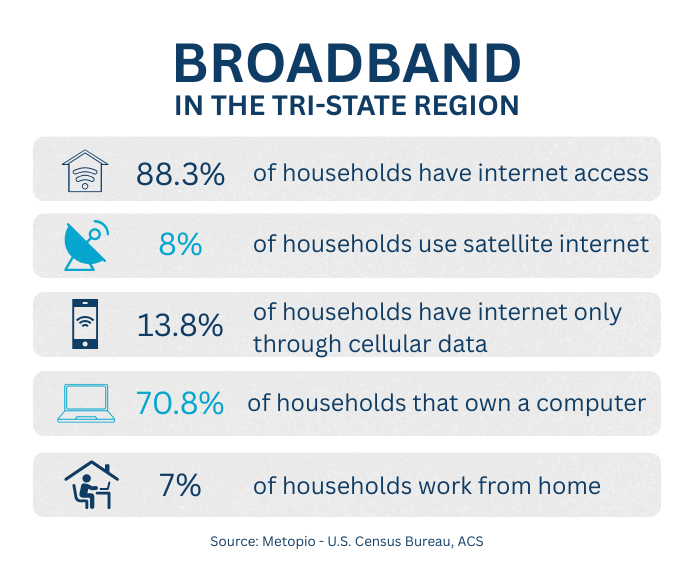
Our Policy and Advocacy Action Committee met in April to discuss broadband. Broadband affects almost everything. It touches business growth, workforce competitiveness, education, health care, and the ability of rural communities to keep up with changing expectations around work and daily life.


One of the strongest takeaways was that rural broadband deployment is still hard, expensive, and highly dependent on local conditions. Fiber remains the long-term goal in many places. Satellite and other technologies may help in specific situations, but they are not a simple fix for every challenge.


The discussion lead to the conclusion that broadband should be viewed as a core infrastructure for community vitality. If we want stronger communities, better job access, more flexible education options, and healthier local economies, broadband has to stay near the center of the conversation.

Broadband Across the Tri-State Region


The region’s broadband discussion highlighted several shared challenges. Rural deployment is the most expensive and difficult part of the work, permitting varies across jurisdictions, workforce and supply chain issues can slow projects, and mapping accuracy still matters for grant funding and eligibility.


Illinois has organized its broadband work around access, adoption, and meaningful use. They are offering support through grants, mapping, permitting guidance, and digital equity efforts. Committee materials noted more than $386 million has been invested through Connect Illinois to connect more than 45,000 locations. They are expecting nearly $1 billion in BEAD funding and more than $1.6 billion in total investment when provider match is included.


Iowa’s discussion focused on the realities of deployment on the ground, including active fiber expansion in Southeast Iowa and the Burlington area. Providers also noted the high cost of rural builds, the complexity of railroad crossings and permitting, workforce limitations, and the need to keep improving mapping accuracy.


Missouri’s broadband strategy continues to focus on closing rural and underserved gaps while supporting provider sustainability. Committee materials indicate a preliminary BEAD allocation of $1.72 billion, with construction in the region anticipated to begin in late 2026 after required reviews are completed.


As broadband deployment continues, opportunities remain to strengthen coordination between providers and communities and improve understanding of permitting and regulatory differences across state lines. Participants also expressed interest in reconnecting around regional broadband convenings that would provide opportunities to share practical solutions, lessons learned, and emerging needs.


RESOURCES

FCC National Broadband Map


Missouri Broadband Map

Illinois Office of Broadband


Iowa Broadband Map


Grant Funding Opportunities


We've gathered the latest grant funding opportunities available to stakeholders in our region, and we're excited to share them with you. Click the link below to access the the comprehensive list and find the support you need for your projects.


Please join us in thanking all of the community partners who support
Tri-State Development and the economic prosperity of our region.

Presenting sponsor:
and supported by:


IMPACT PARTNERS

Blessing Health Systems

Greater Burlington Partnership

COMMUNITY PARTNERS

Lewis County Industrial Development Authority

Moberly Area Community College

Tigerhawk Technologies


SUSTAINING PARTNERS

Great River Economic Development Foundation

Klingner & Associates

Michelmann Steel Construction Co.

Pike County Chamber & Economic Development Corporation

Pike-Scott Farm Bureau

Two River Regional Council of Public Officials

Tri-State Development at Culver-Stockton College supports the region by cultivating collaborative relationships, promoting interdisciplinary problem-solving, fostering the expansion of academic-organization-industry initiatives, and developing an environment for collective impact to address the current and emerging economic, and social challenges in the region.
 
 
Facebook  X  Linkedin