The Tri-State Development Regional Report
news & updates

MARCH 2026 | Issue 37

 
Upcoming Events

1 Million Cups


March 18, 2026

9:00 a.m.

Quincy Public Library

526 Jersey Street,

Quincy, Illinois 62301


March 25, 2026

9:00 a.m.

Mark Twain Boyhood Home and Museum Auditorium (Upstairs)

120 N. Main Street,

Hannibal, Missouri 63401


April 1, 2026

9:00 a.m.

Quincy Public Library

526 Jersey Street,

Quincy, Illinois 62301


April 8, 2026

9:00 a.m.

Mark Twain Boyhood Home and Museum Auditorium (Upstairs)

120 N. Main Street,

Hannibal, Missouri 63401


April 15, 2026

9:00 a.m.

Quincy Public Library

526 Jersey Street,

Quincy, Illinois 62301


Action Committees

All action committees meet via Zoom. To receive the link, contact Sue Goulder at sgoulder@culver.edu.

​

Policy & Advocacy

Thursday, April 2, 2026 3:00p.m.


River, Road, & Rail

Wednesday, April 8, 2026 3:00p.m.


Rural Retention & Attraction

Tuesday, March 17, 2026 3:00p.m.

Tuesday, April 21, 2026

3:00p.m.

Workforce Realities: A 3-2-1 Look at Our Regional Labor Market

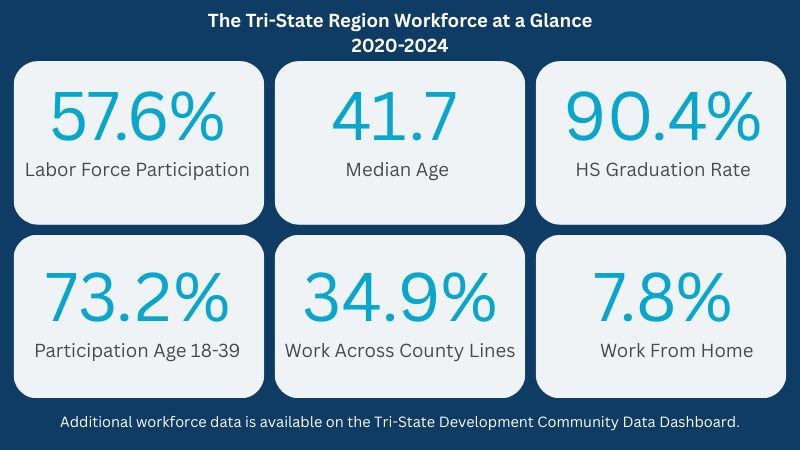
With updated 2020–2024 data now available, we took a fresh look at labor force participation, demographics, education, and commuting patterns shaping the Tri-State region's workforce.

3 Realities


Reality #1: Participation is Steady, but Tight


Labor force participation in the Tri-State region sits at 57.6%, essentially flat from the previous benchmark of 58%. That stability is encouraging, but it also means we are operating with a structurally constrained labor pool. This mirrors a broader rural pattern: national data show rural labor force participation has hovered around 57% for years, even as employment has grown. Growth in our region won't come from squeezing more out of who's already here, it will require expanding who's here.

​

Reality #2: Our Workforce is Mature


The region's median age is 41.7, with 226,740 residents between the ages of 40–64, compared to 195,354 residents aged 18–39. Workers in the younger cohort participate at a strong rate (73.2%), but the pipeline behind them is smaller. Rural Midwest research warns that Baby Boomers are currently propping up regional labor force participation rates, and without replacement, rural areas face a structural cliff within the next 5–7 years. Retention and attraction of working-age adults isn't a long-term concern, it's an immediate one.

​

Reality #3: We Already Operate as a Regional Labor Market


Nearly 35% of workers cross county lines, and 6% cross state lines for employment. This isn't unusual, cross-county commuting has grown steadily since the 1990s, and Federal Reserve research confirms that commuting flows create meaningful economic linkages between county labor markets, spreading both opportunity and challenge across jurisdictional lines. Our workforce does not stop at borders, and neither should our strategy.

2 Signals to Watch


Signal #1: Education Remains a Strength


High school completion improved slightly to 90.4%, edging above the national average of 89.9%. That's a real asset. However, with 30.7% holding a higher degree, our education attainment profile shapes the types of industries we can realistically attract and retain. Workforce development investments that bridge the gap between a high school diploma and industry-recognized credentials are likely our highest-leverage opportunity.


Signal #2: Remote Work Expands Our Workforce Options


Only 7.8% of Tri-State residents currently work from home, well below what remote-friendly regions are capturing. That gap is actually an opportunity. Research shows rural mid-career workers are highly motivated to reskill for remote roles, 75% express willingness to pursue training for remote work, yet employers continue to pull back on remote job postings. Proactively connecting remote-friendly employers with our region's residents and recruits could expand the effective labor pool without requiring a single new commuter.

1 Big Question


How do we strengthen workforce participation by attracting and retaining working-age residents in a multi-county, multi-state labor market?


This question sits at the center of everything we do at Tri-State Development. The data confirms what many of us already sense: our labor market is regional by nature, our workforce is aging, and the window to build a stronger pipeline is narrowing. The answer won't come from any single county or any single sector, it will require the kind of collaboration that defines this region at its best.


All of the above statistics can be found here.


The newest ACS data is now available on the Tri-State Development Community Data Dashboard. Instead of digging through multiple Census tables and reports, communities can explore updated housing, workforce, population, and income data in one place, ready to use for planning, grant applications, and local decision-making. 

INTERESTING READING

Iowa Ends 2025 with Higher Labor Force Participation, 32,400 More Workers

Iowa's seasonally adjusted unemployment rate was 3.5 percent in December, level with November and up slightly from 3.3 percent one year ago.

Missouri Ends 2025 with Steady Job Growth

Missouri added 800 jobs in December 2025 as unemployment fell to 3.9 percent. Explore key employment trends impacting Missouri workers and employers.

Illinois Job Openings and Labor Turnover - December 2025

Illinois had 219,000 job openings in December 2025, compared to 231,000 openings in November, the U.S. Bureau of Labor Statistics reported today.

Grant Funding Opportunities


We've gathered the latest grant funding opportunities available to stakeholders in our region, and we're excited to share them with you. Click the link below to access the the comprehensive list and find the support you need for your projects.


Get Involved: Tri-State Development Action Committees

Policy & Advocacy Committee

Next Meeting: April 2, 2026 - 3:00pm

Meeting Remotely


The Policy & Advocacy Committee looks at big issues that shape daily life in the Tri-State region, things like childcare, workforce, broadband, healthcare, and education. This month, the group will focus on broadband. Participants help surface real on-the-ground challenges and identify practical ideas communities can act on.


To attend, email Sue Goulder at sgoulder@culver.edu to get the zoom link.


River, Road, & Rail Committee

Next Meeting: April 8, 2026 - 3:00pm

Meeting Remotely


The River, Road, & Rail Committee focuses on how our transportation network, highways, local roads, rail lines, and the river, supports growth across the 42-county region. The committee helps translate local insights into clear regional priorities and messages that resonate with partners and decision-makers.


To attend, email Sue Goulder at sgoulder@culver.edu to get the zoom link.


Rural Retention & Attraction Committee

Next Meeting: March 17, 2026 - 3:00pm

Following Meeting: April 18, 2026 - 3:00pm

Meeting Remotely


The Rural Retention & Attraction Committee works on one core question: how do we help people see the Tri-State region as a place to stay, return, and build a life? Current work is centered on the Culver-Stockton College career fair and gathering baseline data on what students think about living and working here after graduation. The group explores strategies to keep young talent, support entrepreneurship, and tell a compelling regional story.


To attend, email Sue Goulder at sgoulder@culver.edu to get the zoom link.

Please join us in thanking all of the community partners who support
Tri-State Development and the economic prosperity of our region.

Presenting sponsor:
and supported by:


IMPACT PARTNERS

Blessing Health Systems

Greater Burlington Partnership

COMMUNITY PARTNERS

Lewis County Industrial Development Authority

Moberly Area Community College

Tigerhawk Technologies


SUSTAINING PARTNERS

Great River Economic Development Foundation

Klingner & Associates

Michelmann Steel Construction Co.

Pike County Chamber & Economic Development Corporation

Pike-Scott Farm Bureau

Two River Regional Council of Public Officials

Tri-State Development at Culver-Stockton College supports the region by cultivating collaborative relationships, promoting interdisciplinary problem-solving, fostering the expansion of academic-organization-industry initiatives, and developing an environment for collective impact to address the current and emerging economic, and social challenges in the region.
 
 
Facebook  X  Linkedin