|
United States Commission
on Civil Rights
January 2026 Newsletter
| | Antisemitism on America's College and University Campuses: Current Conditions and the Federal Response | | |
The U.S Commission on Civil Rights will hold a briefing on Thursday, February 19, 2026, titled, “Antisemitism on America’s College and University Campuses: Current Conditions and the Federal Response.” The briefing will be followed by a Public Comment Session scheduled for Friday, February 20, 2026.
The bipartisan investigation, led by Commissioners Peter Kirsanow (R) and Mondaire Jones (D), will examine how institutions of higher education and the federal government responded to allegations of antisemitism on U.S. college and university campuses in violation of federal civil rights protections. This study will primarily examine four subjects:
- How the Office for Civil Rights in the U.S. Department of Education has responded to allegations of antisemitic incidents on college and university campuses since October 7, 2023.
- How the U.S. Department of Justice has responded to allegations of antisemitic incidents on college and university campuses since October 7, 2023.
- How the U.S. Department of Health and Human Services has responded to allegations of antisemitic incidents on college and university campuses since October 7, 2023.
- How a sample of colleges and universities has responded to allegations of antisemitic incidents on their campuses since October 7, 2023.
At this public briefing, the Commission will hear from subject matter experts such as current and former federal employees, impacted students and university officials, advocacy organizations, and legal and policy experts.
The Commission will also accept written materials from the public for consideration as we prepare our report. Written materials may be submitted to asbriefing@usccr.gov no later than March 19, 2026.
| | USCCR Wants to Hear from You | | |
The U.S Commission on Civil Rights will hold a hybrid, virtual and in-person, Public Comment Session on Friday, February 20, 2026, starting at 12:00pm to hear directly from the public about the increase in antisemitism on America’s college and university campuses. This session will build on the testimony that will be given at the Commission’s Briefing on February 19, 2026.
The Commission wants to hear from impacted students, educators, university officials, and community members about their experiences with antisemitism on college campuses. This public comment session is a chance for the public to share their own experiences and thoughts to help the Commission continue its work on this important issue.
For more information and to participate as a speaker for this event, please visit: Public Comment Session Registration
| | STATE ADVISORY COMMITTEES | | |
District of Columbia Advisory Committee
Announces Addendum to its Report
| | |
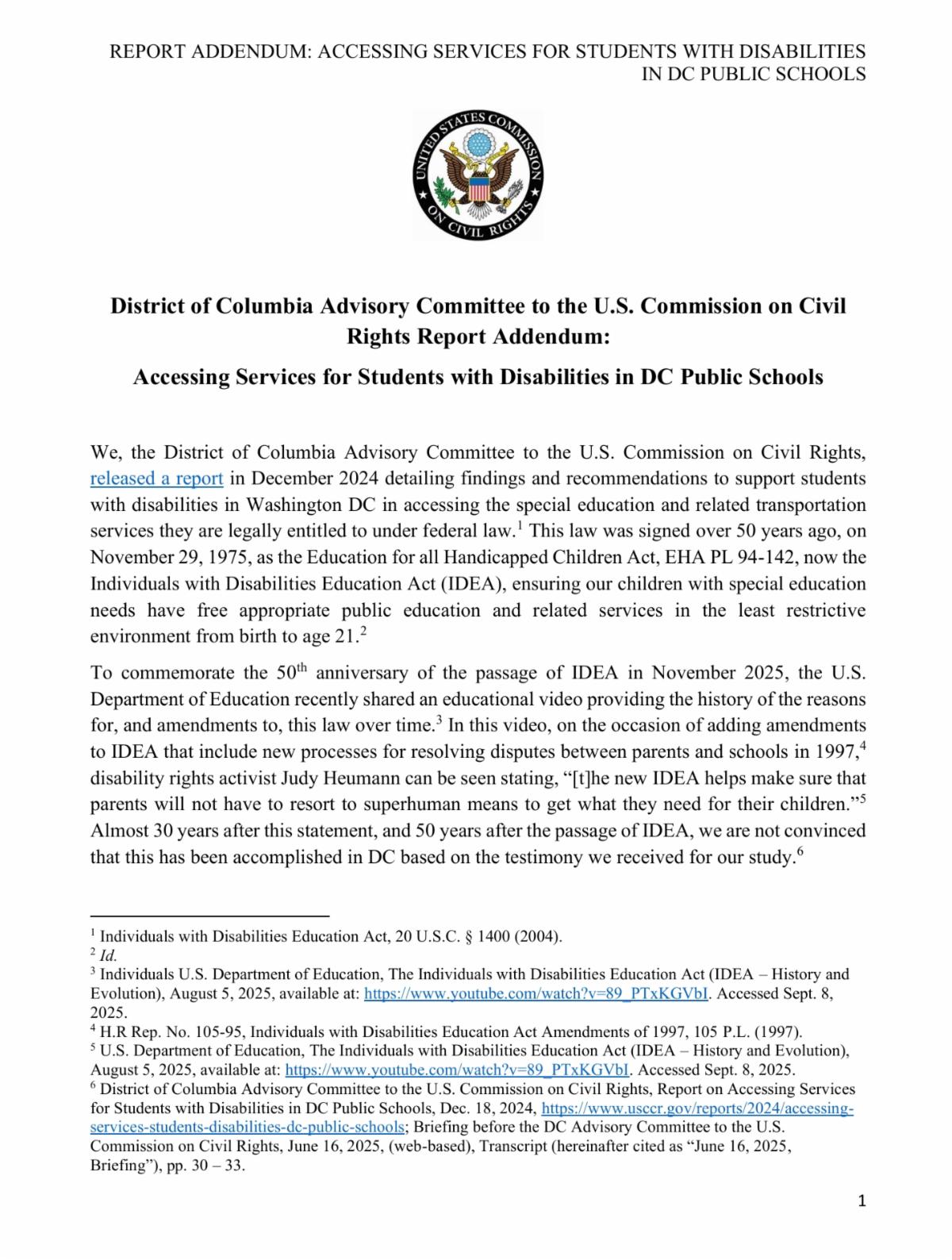
The District of Columbia Advisory Committee (Committee) to the U.S. Commission on Civil Rights (Commission) released a report in December 2024 regarding access to special education and transportation services in D.C. for students with disabilities. In recognition of the 50th anniversary of the passage of the Individuals with Disabilities Education Act (IDEA), the Committee developed this addendum to examine the public response to its 2024 report and also assess potential impacts of updates to the U.S. Department of Education and its oversight of special education initiatives on the recommendations and strategies outlined in its report.
Through testimony gathered in developing the report addendum, the Committee learned that the DC Council shares many concerns regarding the need for early identification and adequate funding for special education related staffing and services. The Committee also learned that research around innovative supports and funding may be helpful in supporting students with special education needs.
As updates to the U.S. Department of Education’s oversight of IDEA are ongoing, the Committee encourages policymakers to consider supporting a strong federal role in ensuring students across states have access to the services and supports they are entitled to under IDEA. The Committee hopes its efforts will support forward progress in supporting children with special education needs.
Chair Wayne Heard said, “Since 1975, the full promise and intent of the IDEA has at times gone unrealized in education across the United States. Here in our nation’s capital, this is evidenced by the District of Columbia Public School system historically receiving more due process complaints than any other state or jurisdiction. The current practices effectively place the burden of accessing special education services guaranteed under the law on students and their families. Thank you to the stakeholders that contributed to our initial report and this subsequent addendum. We are optimistic that local government, the U.S. Commission on Civil Rights, and Congress will accept this baton and apply their power and resources to finish this race in a manner that realizes a sustainable solution for students, parents, caregivers, and teachers.”
| | Louisiana Advisory Committee Releases Report on the Role of Coroners in Involuntary Commitments in Louisiana | | |
The Louisiana Advisory Committee (Committee) to the U.S. Commission on Civil Rights (Commission) has released a report on the role of coroners in involuntary commitments in Louisiana. Louisiana is currently the only state in the country that allows a medical examiner or coroner to issue an emergency certificate to involuntarily commit a person alleged to be suffering from mental illness.
The Committee received testimony that a majority of Louisiana’s parishes have coroners with qualified medical professional backgrounds, but there are instances where there is no qualified medical professional in the role of coroner, potentially leading to inappropriate medical determinations in the coroner’s emergency certificate process. Additionally, the Committee is concerned that there is a lack of accountability for decisions made, lack of ability to question or counter decisions made, lack of diligence in assessing mental illness concerns, and a lack of an ability to void or expunge a determination that may have been made in error. These issues have potentially lifelong impacts on the individual who was involuntarily committed.
Among their recommendations, the Committee recommends that Louisiana ensure that a physician, preferably a psychiatrist, is involved in the Coroner’s Emergency Certificate process, and also ensure there are appropriate checks and balances that will provide for a qualified individual to assess a potential involuntary commitment case if a local qualified coroner is not immediately available.
Acting Chair Tia Mills said, “We are concerned that involuntary commitments can occur without appropriately qualified medical personnel making the determination that such a deprivation of liberty is warranted. We hope our recommendations help ensure the Coroner’s Emergency Certificate is used appropriately and as a tool to help support, and not punish, individuals alleged to be suffering from mental illness.”
| | The Puerto Rico Advisory Committee Publishes its Fourth and Final Memorandum on its Study on the Insular Cases and the Civil Rights of Residents of Puerto Rico | | |
The Puerto Rico Advisory Committee (Advisory Committee) to the U.S. Commission on Civil Rights (the Commission) announces the publication of its fourth and final memorandum as part of its study on the effects of the Insular Cases and the Non-Incorporation Doctrine on the civil rights of the residents of Puerto Rico. This memorandum focuses on two key issues: the lack of parity in the allocation of federal benefits, and the role that race and ethnicity has played over time in the relationship between the island and the federal government. The Committee highlights several findings and recommendations identified in the testimony it has received from experts on these subjects.
For the focus on federal benefits, the memorandum specifically analyzes Medicaid, Supplemental Security Income, Veterans’ benefits, and nutrition assistance, which are programs under the expertise of panelists who testified before the Committee. The Committee learned about program structures and how their appropriations and service delivery differ between Puerto Rico and the states. Based on this information, the Committee found that there is an urgency in the lack of program equity and the impact this has on vulnerable residents.
In learning about the categorizations of race and ethnicity over time in Puerto Rico, the Committee found that racial formation in Puerto Rico has been complex and has faced challenges in accuracy through data collection. In addition to Puerto Rico being excluded from various critical statistical population surveys, the cultural understanding of race, ethnicity, and identity differs from the standardization applied through survey tools developed by the federal government and are not fully captured in official data.
The Committee Chair, Andrés Córdova Phelps, said: "We thank the panelists for shedding light on these topics which directly impact the lives of every Puerto Rican. We aim to use our platform to highlight the information they shared as a way to encourage equal treatment and inclusivity of the residents of Puerto Rico."
| | |
UPCOMING COMMISSION MEETINGS
The Commission meets to conduct agency business on civil rights matters. Pursuant to the Sunshine Act, meetings of official business of the U.S. Commission on Civil Rights are open to the public, with the exception of executive sessions, which may be closed pursuant to the exemptions of the Sunshine Act.
Click the link for more information and view documents under heading Commission News:
View Commission Events
| |  | |
UPCOMING STATE ADVISORY COMMITTEE MEETINGS
The Commission establishes Advisory Committees in every state, the District of Columbia, and the five U.S. territories. These committees serve as the Commission’s eyes and ears on the ground and advise the Commission regarding civil rights matters in their locales. All Advisory Committee meetings are open for public attendance.
Interested in attending an Advisory Committee meeting?
View Meeting Notices
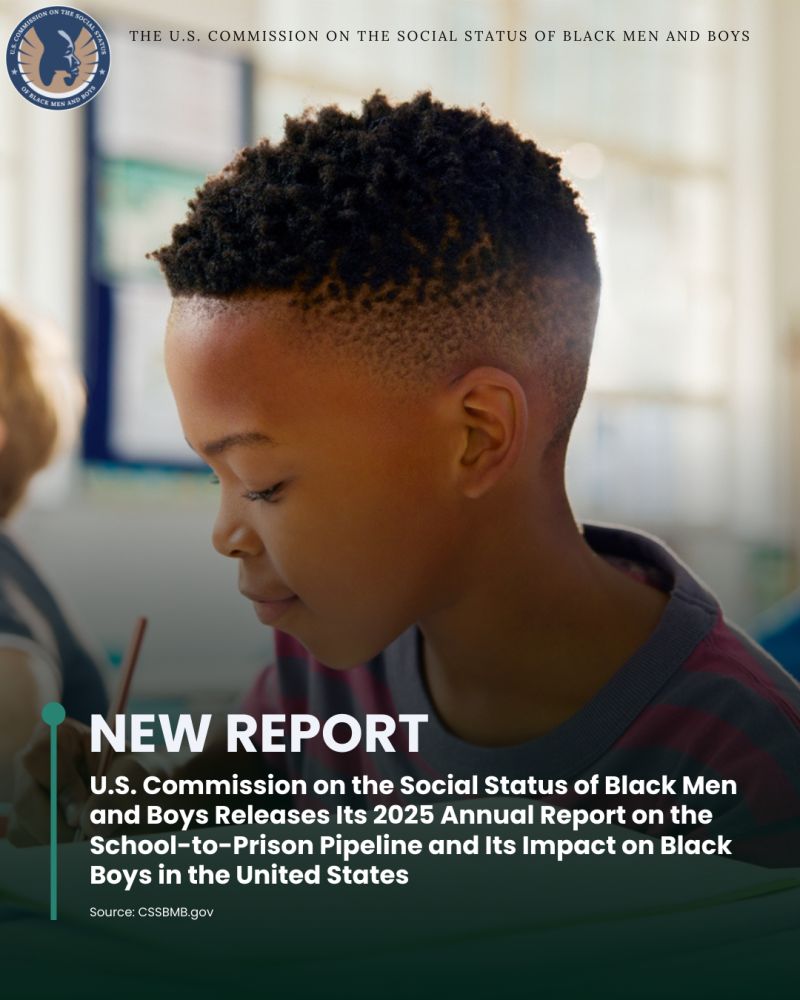
| | U.S. COMMISSION ON THE SOCIAL STATUS OF BLACK MEN AND BOYS | | School-to-Prison Pipeline and Its Impact on Black Boys in the United States | | U.S. Commission on the Social Status of Black Men and Boys (CSSBMB) Links to Know: | | ADVISORY COMMITTEES IN THE NEWS | | |
The Civil Rights Act of 1957 created the U.S. Commission on Civil Rights. Established as an independent, bipartisan, fact-finding federal agency, our mission is to inform the development of national civil rights policy and enhance enforcement of federal civil rights laws. We pursue this mission by studying alleged deprivations of voting rights and alleged discrimination based on race, color, religion, sex, age, disability, or national origin, or in the administration of justice. We play a vital role in advancing civil rights through objective and comprehensive investigation, research, and analysis on issues of fundamental concern to the federal government and the public.
| | | | |