|
|
Dear Reader,
This month's issue is a special one, focusing on the launch of our CCDR stories series.
Country Climate and Development Reports (CCDRs) are the World Bank Group's core diagnostic tool for helping countries identify the most effective actions to achieve low-carbon, resilient growth while also advancing broader development goals. Building on CCDRs' insights, the series will explore how the sovereign ESG data portal can complement and operationalize CCDRs' recommendations, showcasing relevant ESG indicators for progress tracking and informing frameworks, as well as identifying key policy priorities and strategies. Each story will illustrate how countries are putting recommendations into practice and how the ESG Portal’s tools and data are supporting the translation of climate and development goals into tangible results.
In this edition of the "ESG Data Portal – Tips & Tricks" and "ESG Indicator Spotlight," we introduce the Quadrant Analysis Tool - a simple way to compare countries across two dimensions - and share insights into two ways of measuring the contribution of agriculture to a country's wealth. We hope these two new installments enhance your familiarity with the Sovereign ESG Data Portal and the tools it makes available.
Last but not least, we are excited to share a publication in the Policy Research Working Paper Series on "Protecting Forests in the Congo Basin". The paper provides an empirical basis for performance-linked financing to incentivize the protection of the Republic of Congo's rich tropical rainforests. It extensively utilizes the feasibility and ambitiousness framework to evaluate various scenarios and targets.
As always, we hope this content supports your work and sparks new ideas.
Sincerely yours,
Sovereign ESG Data Portal team
|
| Introducing the Country Climate and Development Report (CCDR) Series on the Sovereign ESG Data Portal | | The Country Climate and Development Reports integrate climate change and development priorities and have been published for more than 72 countries. In this new series, we focus on operationalizing CCDR recommendations through the lens of sustainable finance. We highlight key policy priorities, relevant ESG indicators to track progress and success stories. To start, we discuss how Brazil can emerge as a leader in climate action and how Viet Nam balances growth, adaptation and mitigation. | | |
Brazil stands at a pivotal moment to align climate action with economic transformation
| |
This data story examines progress on sustainable land use, transport decarbonization, and social equity—three CCDR priorities that are shaping a more inclusive, competitive, and climate-resilient future.
|
|  | How Viet Nam can unlock a more resilient and sustainable future through three urgent policy priorities | |
This data story delves into the Mekong Delta’s regional program, the country’s clean energy transition, and air pollution reduction in Hanoi, drawing on ESG indicators to reveal where targeted investments have the greatest impact.
| | | Côte d’Ivoire launches its first Sustainability-Linked Loan with WBG Guarantee Platform | | |
Côte d'Ivoire has secured its €433 million (approximately $505 million) inaugural sustainability-linked loan, secured by Standard Chartered Bank and uniquely backed by the World Bank Group's Guarantee Platform, with its first joint IBRD–MIGA guarantee. The operation, issued under the country's inaugural Sustainability-Linked Finance Framework, ties financing to climate and development targets, including renewable energy expansion and forest protection, which the ESG Data Portal helped identify through its feasibility and ambitiousness (FAB) framework.
| | ESG DATA PORTAL TIPS & TRICKS | | |
Quadrant Analysis tool
Revealing country patterns at a glance
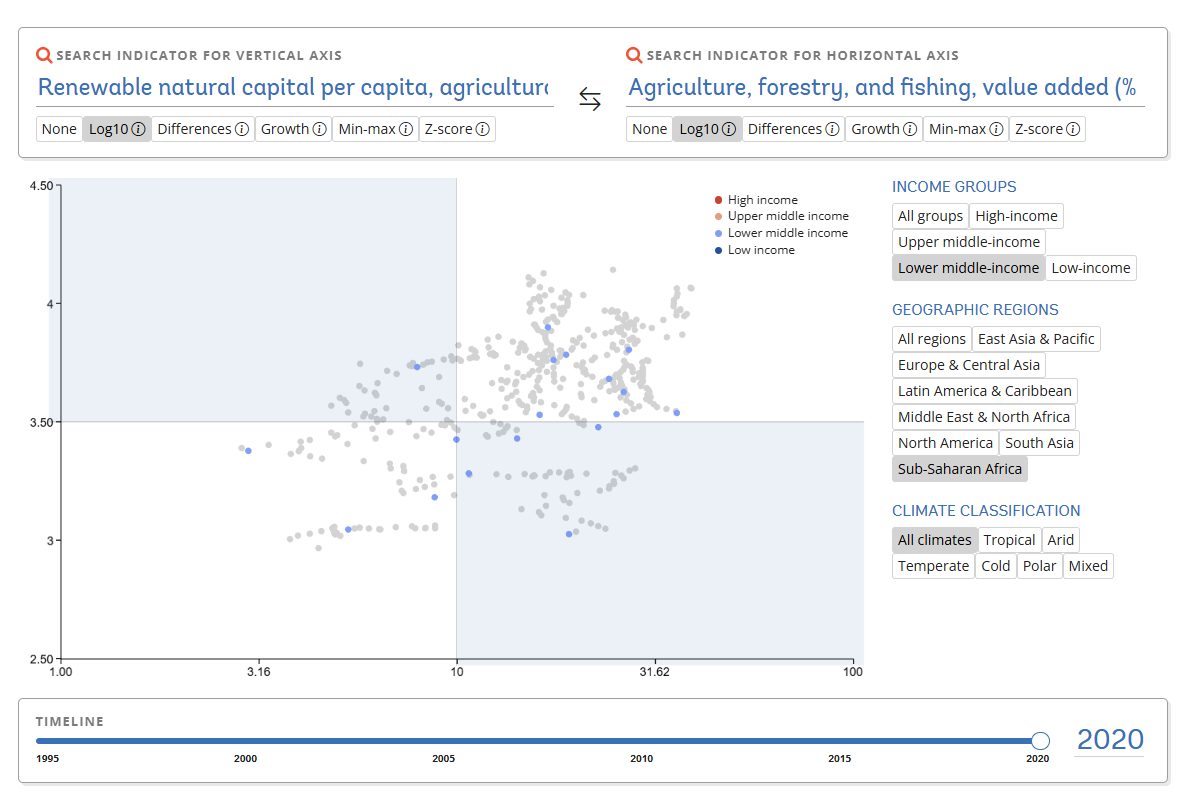
The Quadrant analysis tool makes it easy to identify which countries share similar structural characteristics—and which stand out or are lagging. By plotting two indicators against each other, the tool places countries into one of four quadrants, offering a clear visual representation of their relative positioning. This makes it a powerful way to uncover clusters, outliers, and patterns that may not be obvious when looking at indicators in isolation.
Take, for example, the relationship between Renewable Natural Capital Per Capita, Agricultural Land and Agriculture, Forestry, and Fishing, Value Added (% of GDP). The Quadrant tool highlights how some countries with high dependence on agriculture as a share of GDP may actually hold relatively low agricultural wealth per capita—signaling potential risks to sustainability and resilience. Others, meanwhile, manage to maintain both higher agricultural wealth and a balanced economic reliance on the sector. Exploring these quadrants helps spot countries with unusual profiles—those that could be particularly vulnerable, or conversely, those that are performing above expectations.
| | |
Agriculture, Forestry, and Fishing, Value Added (% of GDP)
This month, we zoom in on the share of agriculture, forestry, and fishing in GDP—a classic indicator that tells a powerful story about economic structure and sustainability.
In many developing countries, a high share signals the sector’s critical role in livelihoods, food security, and employment, while also highlighting vulnerability to climate change and natural resource pressures. In more advanced economies, a lower share often reflects diversification and industrialization while, at the same time, raising questions about the resilience of food systems and rural development.
Another lens is provided by the Changing Wealth of Nations (CWON) dataset, which measures the underlying value of agricultural wealth itself (indicator: “Renewable Natural Capital”). While GDP share highlights the sector’s relative contribution to current economic output, CWON data captures the longer-term sustainability of the asset base that underpins it.
Looking at both together provides a richer picture: countries with a large GDP share but declining agricultural wealth may face risks to sustainability, while those with modest GDP shares but robust agricultural assets may have greater long-term resilience. Taken side by side, these two approaches help identify where policies and investments—such as sustainable land management, forestry governance, or climate-smart innovation—can have the greatest impact on strengthening both economic performance and natural wealth.
| | |
Focus box: Agriculture and Sustainable Food Systems
The centrality of agriculture-related indicators to sustainable development is reflected in the World Bank Group’s broader strategic priorities. Sustainable food systems are a dedicated outcome area in the WBG Scorecard that captures agriculture as an integral component. The Scorecard tracks how World Bank Group operations contribute to reducing hunger, strengthening food systems, and expanding access to safe and affordable nutrition, underscoring their importance for resilience, food and nutrition security, and broad-based prosperity.
This focus is further reinforced by the launch of Agriconnect, a World Bank Group initiative that doubles financing commitments to agribusiness and redefines strategies to support sustainable food systems. The initiative responds to four powerful trends reshaping the sector—climate change, innovations in finance, digitalization, and solutions to fragmentation—while preparing countries to meet rising food demand and address the urgent need for jobs in emerging markets, making agriculture a cornerstone of climate action and inclusive growth.
In this context, the Sovereign ESG Data Portal can provide data, analytical tools, and cross-country comparisons that help the World Bank and its partner countries identify risks, track progress, and inform strategic choices, thereby supporting the design of policies and investments that maximize impact in agriculture and food security.
| |
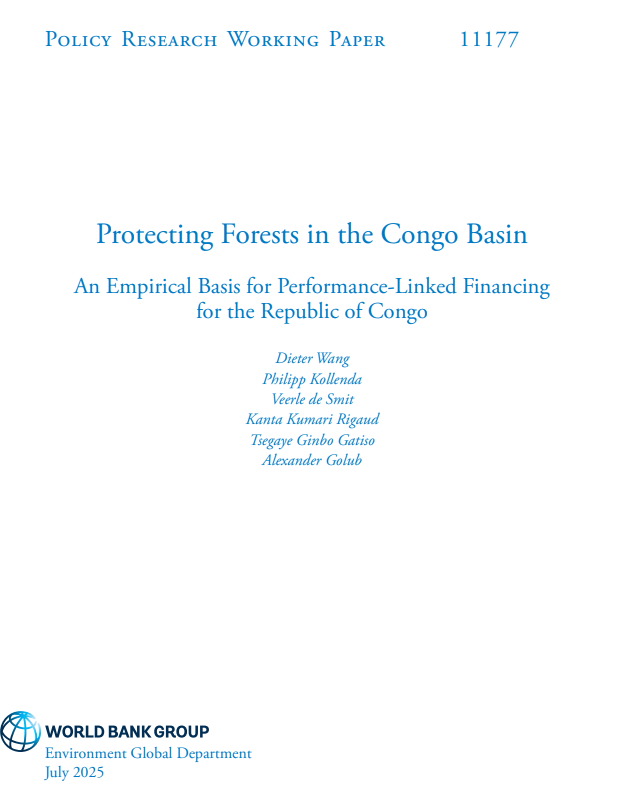
PRWP: Protecting Forests in the Congo Basin - Empirical insights for linking forest protection to finance in the Congo basin area
Wang, Dieter; Kollenda, Philipp; de Smit, Veerle; Rigaud, Kanta Kumari; Gatiso, Tsegaye Ginbo; Golub, Alexander. 2025. Protecting Forests in the Congo Basin: An Empirical Basis for Performance-Linked Financing for the Republic of Congo. Policy Research Working Paper; 11177. © World Bank.
| |
| |  | The Congo Basin has vast tropical rainforests that are crucial hotspots of biodiversity and are home to the world’s largest known peatland complex – storing approximately 10 billion tons of carbon, the equivalent of almost three times the World’s CO2 emissions. The Republic of Congo is a typical high forest, low deforestation (HFLD) country, but here, the pressure on forests is rising. However, traditional forest finance typically only rewards decreasing historical deforestation rates. For HFLD countries, these frameworks offer little reward and may unintentionally create an incentive structure where to qualify for funding, a country must first start deforesting to then reduce deforestation. The new World Bank Policy Research Working Paper “Protecting forests in the Congo Basin” provides the empirical basis for performance-linked financing for HFLD countries like the Republic of Congo. It analyzes climatological, demographic, and economic factors that historically contributed to deforestation to estimate a forward-looking business-as-usual scenario. It then utilizes the feasibility and ambitiousness framework to evaluate potential scenarios and credible targets.
| | | | | |