|
Gates Mills Land Conservancy
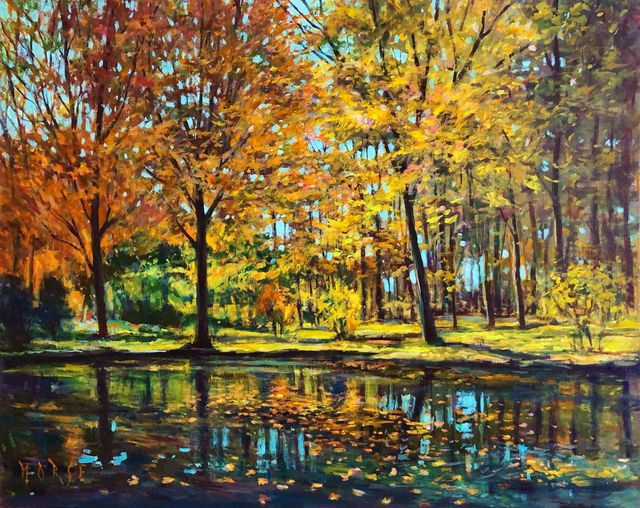
| | September 9, 2025 | Newsletter Issue #11 | | "Autumn Pond Revisited" by Jamie Morse | | Journey of the Lake-Run Smallmouth Bass | | |
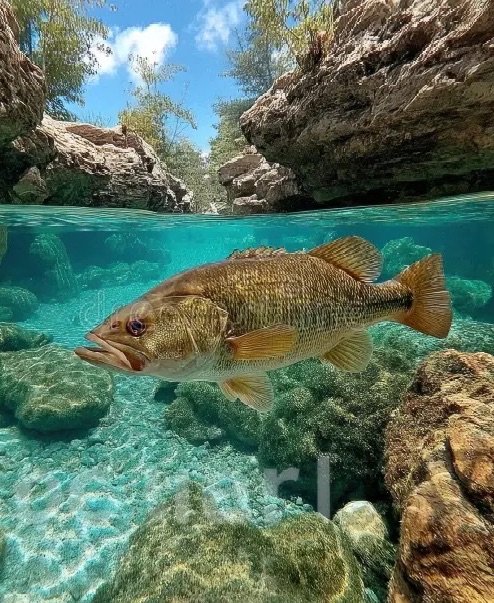
For generations, anglers have known that Smallmouth Bass gather in tributary rivers during the spawning season, but until recently, little was understood about their larger movements across Lake Erie and its rivers. These “lake-run” bass may be more than just seasonal visitors—they could represent distinct populations with their own ecological role, separate from resident river bass. Understanding how often they move between rivers and the lake, and whether they are genetically unique, is key to managing and protecting this important fishery.
In 2023, the Ohio Division of Wildlife (ODW) launched a groundbreaking study in partnership with Wisconsin researchers to learn more about these fish. Working closely with local anglers, ODW tagged 65 Smallmouth Bass in the Grand River and Conneaut Creek. Each fish was fitted with a tiny acoustic transmitter that allows scientists to follow its movements year-round throughout Lake Erie using the expansive Great Lakes Acoustic Telemetry Observation System. After just 18 months of tracking, the findings are already eye-opening: 75% of tagged fish spent the winter back in the main lake, and by spring 2024, about half had returned to their home tributaries. These early results confirm that a significant number of Smallmouth Bass migrate between rivers and the lake, creating a truly dynamic fishery.
This exciting project, funded by the Great Lakes Fishery Commission, will continue collecting data through 2026—and its insights will shape how Ohio manages its fisheries for years to come. We are delighted to share that Zak Slagle, Fisheries Biologist at the Sandusky Fisheries Research Station for the Ohio Division of Wildlife, will be the featured speaker at the Gates Mills Land Conservancy Annual Meeting this October, where he will present more about the "Tributary Smallmouth Bass Project" and what it means for our region.
| | |
Please remember to support the environmental work GMLC
does on behalf of the Gates Mills Community.
| | Highlights & Happenings in This Issue | | |
This issue of the GMLC Newsletter celebrates the symbiotic relationship between land, plants, insects, and wildlife that together create a balanced ecosystem. What makes this issue especially meaningful is that every article highlights species and habitats native to our area, revealing the intricate web of life that defines Gates Mills and the Chagrin River Valley.
Each story focuses on a unique part of a particular living system, illustrating how all are interdependent for resilience and balance. Building on our 'Lead-In' story of the “The Lake-Run Smallmouth Bass Project”, an ongoing study of one of the river’s most remarkable native fish, is also a larger view of native fish of the Chagrin River and the diversity of aquatic life that has thrived here for centuries.
We spotlight the people driving conservation forward. Longtime community leader and GMLC Board Director John Kozak is recognized for his dedication to land preservation, reflecting the same interconnectedness we see in nature. We are equally pleased to welcome new contributor Josh Philipps, Natural Resources Area Manager with Cleveland Metroparks, whose article “Bringing Our Forests Back to Life”, underscores the vital role healthy forests play in sustaining balance. Complementing Josh’s work is the restoration work going on at GMLC’s LoConti property, a local example of protecting and nurturing native resources.
Turning to important connected stories are individual species: the Catalpa Tree, the Caterpillar Sphinx Moth, and the Great Blue Heron - all reminders that even the most familiar plants and animals are essential threads in the ecosystem. Together, these stories illustrate a simple truth: when one part of the ecosystem thrives, all parts thrive. GMLC is proud to protect and restore the natural balance of our community so that fish, forests, birds, and people alike can flourish for generations to come.
Hope to see you at our October Annual Meeting!
The GMLC Board
| | |
A 2023 report by NatureServe, finds that 34% of U.S. plant species and 40% of U.S. animal species are currently at risk of extinction. It also warns that 41% of ecosystems in the country face the threat of range-wide collapse.
(from Biodiversity in Focus: United States Edition)
| | "I have had the privilege to serve on the GMLC Board for the past 20 years, and I work with the most dedicated, hard working people. They have added to the nature of the Village which has helped to make it a wonderful place to live and raise a family."
~ John Kozak | |
John Kozak
Land Conservation Advocate
For 22 years, John R. Kozak has been a dedicated member of the Gates Mills Land Conservancy Board of Directors, blending his professional expertise in real estate appraisal with his lifelong passion for land conservation.
John’s ties to Gates Mills go back to childhood, when he attended St. Francis of Assisi School before graduating from Cathedral Latin. He later earned a Bachelor of Arts degree in Political Science from the University of Dayton in 1975. Following his marriage to Louann, the couple returned to Gates Mills to raise their family, strengthening John’s enduring connection to the village.
Professionally, John is a certified Residential Appraiser in Ohio. His career includes work with both the public and private sectors, the Cuyahoga County Auditor’s Office—where he served as chief residential appraiser—and a family-owned firm in New Jersey. In 1985, he launched his own business, and today remains an active member of the National Association of Real Estate Appraisers. His knowledge of land values, paired with his appreciation for the natural character of Gates Mills, has been an invaluable asset to the Conservancy.
Outside of work, John enjoys golf, tennis, skiing, and jogging through the village he helps to protect. His guiding motivation has always been simple and heartfelt: “to help maintain the beauty of this rare place.” John’s service and spirit exemplify the best of Gates Mills—a true neighbor and steward of the land.
| | | |
Joshua Philipps is the Cleveland Metroparks Natural Resources Area Manager, for North Chagrin, South Chagrin, Euclid Creek, Acacia Reservations. | | |
An Ecosystem Approach by Josh Philipps
Healthy deciduous forests of Eastern North America contain overstory trees, understory trees and shrubs, and an herbaceous plant layer underneath. Unfortunately, virtually all of our forests in Ohio have been invaded by aggressive non-native invasive plants which can occupy these various niches in the forest layers.
When invasive plants form the dominant cover in the forest understory and herbaceous layer, they can limit forest regeneration by reducing or eliminating the next generation of trees.
You can probably see where this is eventually headed: unhealthy forests that lack biodiversity which are not very beneficial to wildlife. All the more reason to be proactive in the current time with forest management!
At Cleveland Metroparks, "Our management philosophy is based on an ecosystem approach to natural resource management. An “ecosystem” is an interconnected community of living things, including humans, and the physical environment in which they all interact.
The ecosystem approach is a strategy for managing the land, water and living resources that promotes conservation and sustainable use in an equitable way, based on appropriate scientific methods that consider the interactions among organisms and their environment. Humans, with their cultural diversity, are an integral component of many ecosystems."
Read More
"Bringing Our Forests Back to Life"
by Josh Philipps
| | | |
|
The Smallmouth Bass -
A true native of the Chagrin River.
| | |
Native Fish of the Chagrin River
Long before Gates Mills was settled, the Chagrin River was already alive with native fish uniquely adapted to its clear, cool waters. Smallmouth Bass, Rock Bass, Northern Pike, and several species of darters and minnows evolved alongside this river system, thriving in its gravel riffles, shaded pools, and oxygen-rich currents. Unlike non-native or stocked fish, such as Steelhead Trout, these species truly belong here and carry forward the story of the Chagrin itself.
The river’s success as a fishery lies in its natural character. Flowing cold and clean from its forested headwaters, the Chagrin carries oxygen-rich water over gravel and cobble beds that provide excellent spawning grounds. Shaded banks of hemlock, maple, and beech keep summer temperatures cool, while wetlands and backwaters offer refuge during floods and droughts. This remarkable variety of habitats in such close proximity has long made the Chagrin an ideal home for fish—and one of the most important tributaries to Lake Erie for sustaining native populations.
Many of these species are still present in Gates Mills today, though not always in the abundance they once were. Smallmouth Bass remain strong in the river, Rock Bass and darters still dart through riffles, and minnows continue to shimmer along the shallows. But dams have blocked upstream migration, invasive species such as the Round Goby compete for food and space, and warming waters threaten the delicate balance these fish depend upon.
Even so, habitat restoration, improved water quality, and the protection of riparian land are helping the Chagrin River remain a stronghold for native species. Their survival depends on all of us. Through thoughtful stewardship, community involvement, and a shared commitment we can play a vital role in protecting our native fishery. Each leaping bass or flashing school of minnows is a reminder of the richness still present here.
| | | |
|
While the native North American Catalpa Tree is common in our area,
it is also a unique treasure of seasonal beauty.
| |
The Catalpa Tree
A Perfect Ecosystem
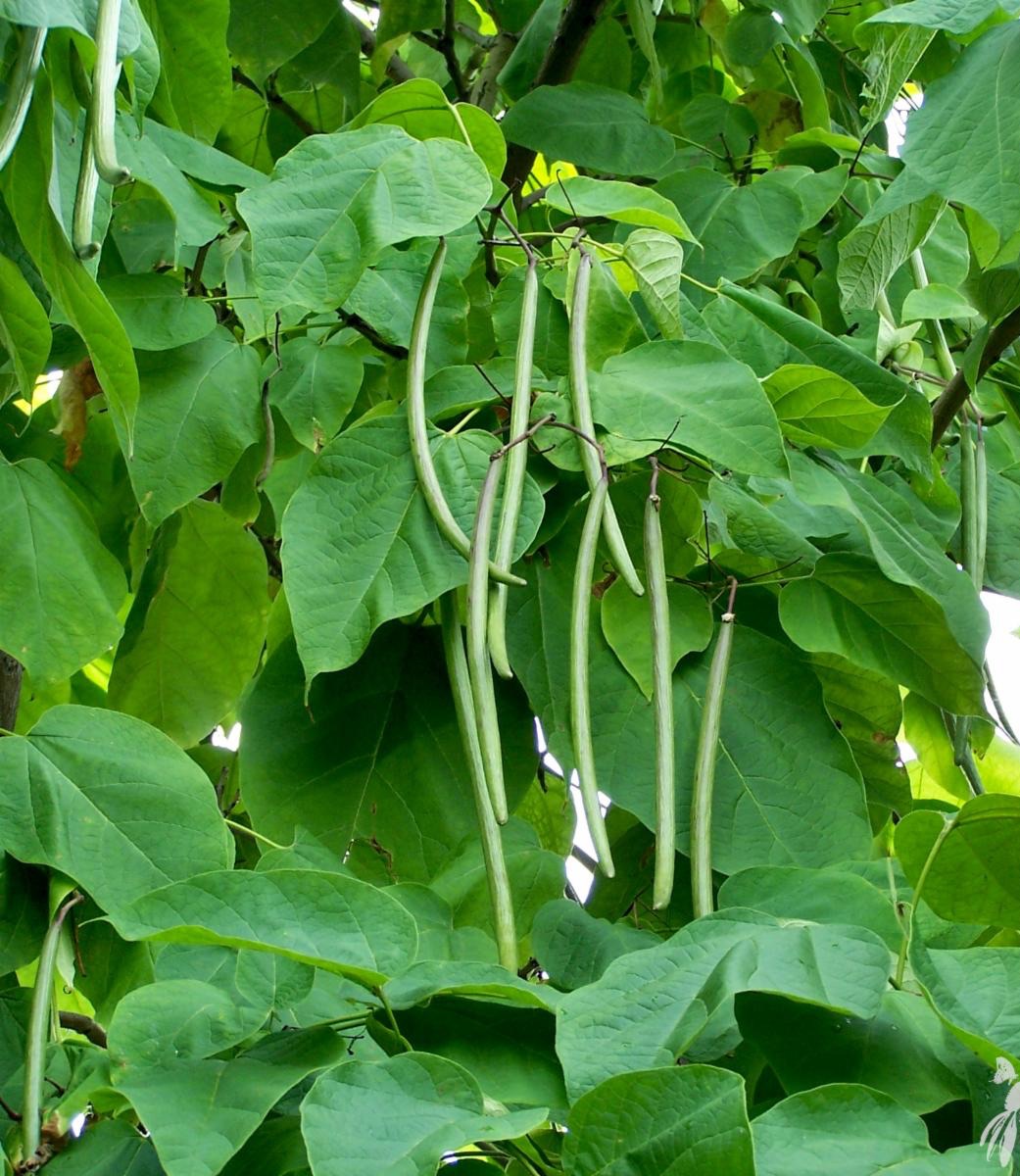
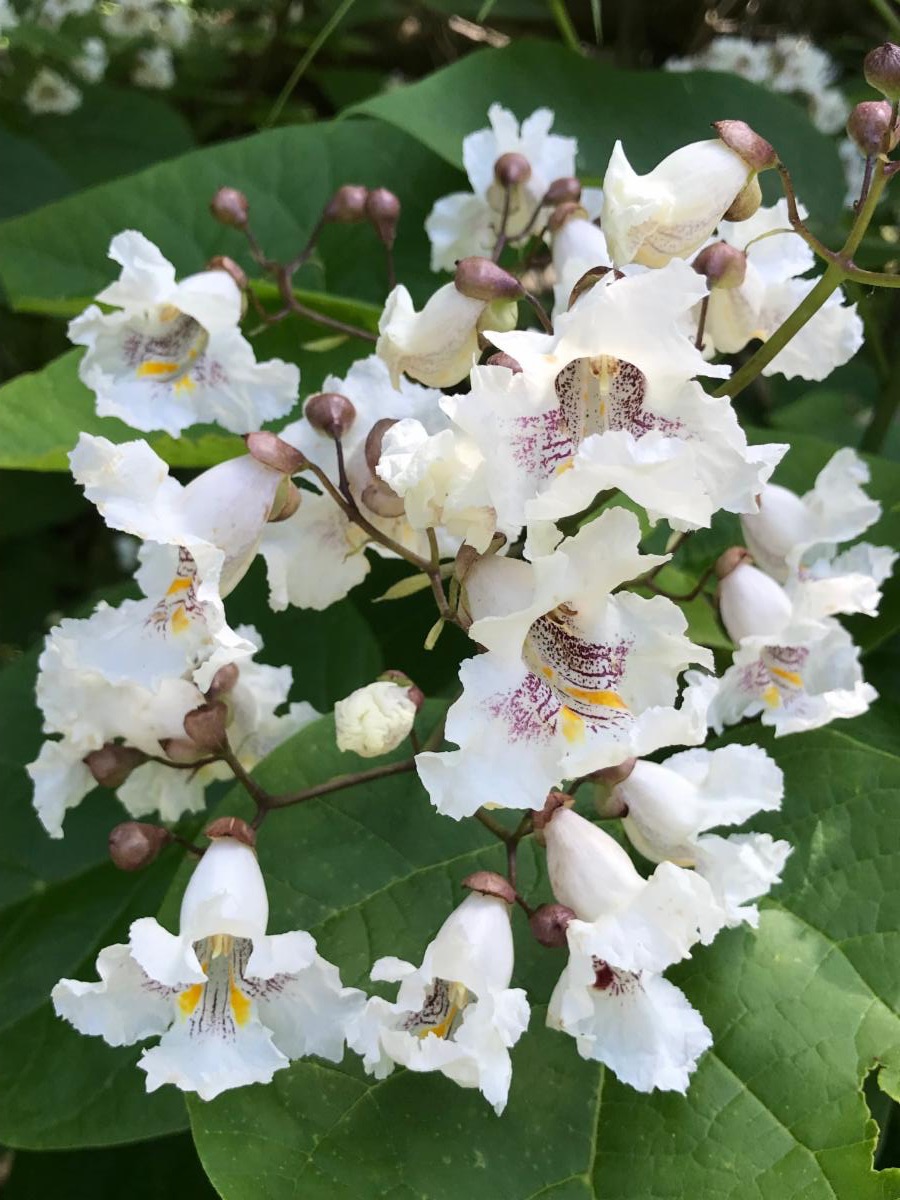
The Western Reserve is home to the native catalpa tree (Catalpa speciosa), a tall species with giant heart-shaped leaves, orchid-like white flowers in spring, and long, bean-like seed pods that dangle in fall. Northern and Southern Catalpa trees originally grew in small pockets of the Midwest and Southeast, but people fell in love with them long ago, planting them throughout the eastern United States for their beauty, shade, and usefulness.
The word catalpa comes from the Muscogee (Creek) language—kutuhlpa, meaning “winged head,” inspired by the tree’s showy blooms and winged seed pods. In late spring, catalpa leaves grow to the size of dinner plates, while clusters of white blossoms marked with purple and yellow resemble exotic orchids. Their wood, naturally rot-resistant, was once prized for fence posts and railroad ties. Yet beyond their practical uses, catalpas are part of a much larger story—an ancient partnership between plant, insect, people, and even river bass, woven into a natural rhythm that has been happening for centuries.
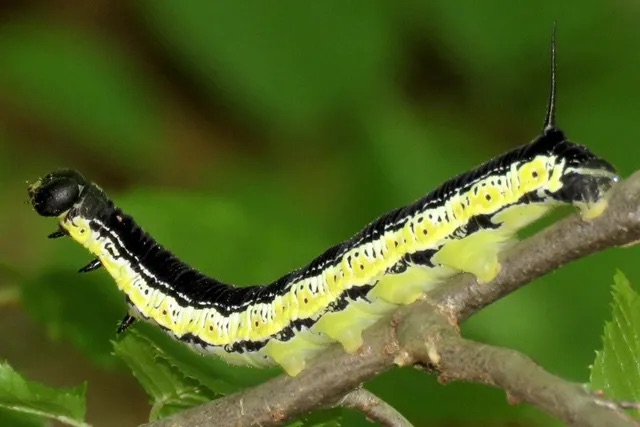
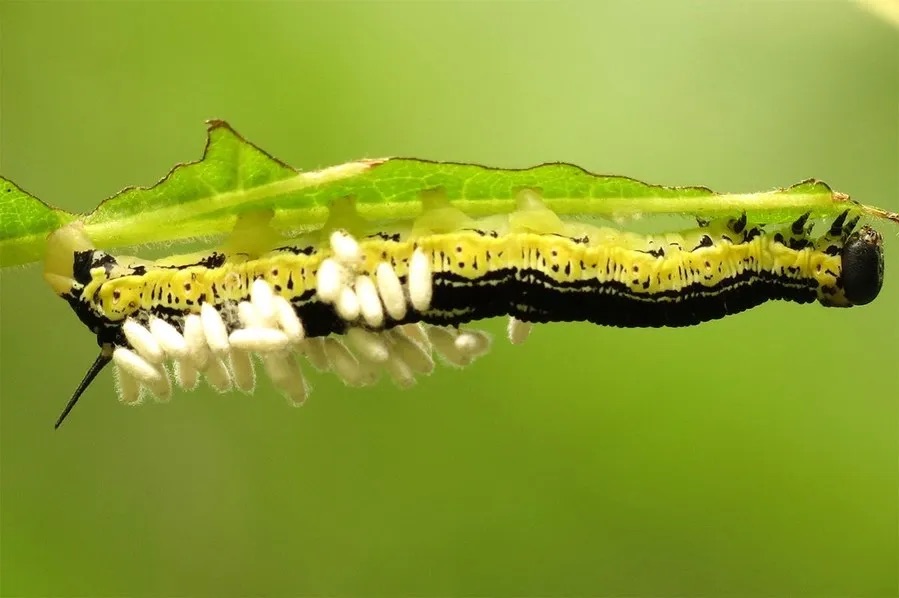
Catalpas often grow near water and serve as the exclusive host for the caterpillars of the catalpa sphinx moth. These large, bold yellow-and-black “worms” sometimes munch through every single leaf on a tree. But the catalpa is resilient—after complete defoliation, it quickly bounces back, producing new leaves within weeks. The tree even secretes a sweet, sticky nectar that attracts ants, which in turn attack the caterpillars, while parasitic braconid wasp preys on the “worms” during their larval stage.
This life cycle extends beyond the tree. Caterpillars often fall into rivers, where they become food for bass. For fishermen, catalpa worms are pure gold. With tough skins that stay firmly on a hook and irresistible wriggling action, they’re legendary bait for bass and catfish. From tree to caterpillar to insects to river fish, the beautiful and generous catalpa tree remains a vital contributor to the native ecosystem within our river valley.
| | | |
The horned Catalpa caterpillar. | Wasp larvae parasites on the Catalpa caterpillar. | |
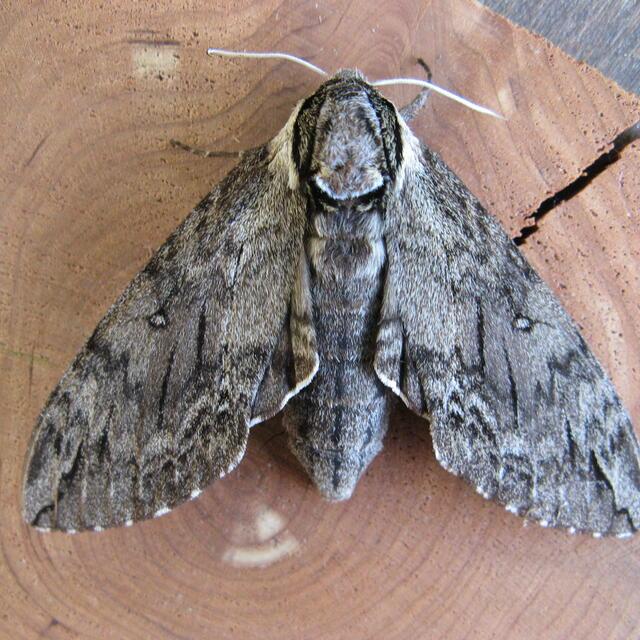
The Sphinx Moth
Closing a Loop
If you grew up near a catalpa tree, you might remember summer days when its leaves were crawling with big, striped caterpillars. These are the famous catalpa caterpillar—the larval stage of the catalpa sphinx moth. They may not look glamorous, but they’re the star of a fascinating natural cycle—and a fisherman’s secret weapon.
Catalpa caterpillars grow up to 3 inches long, with bold black stripes on yellow sides and a little black “horn” at their tail end. They feed on only one thing: catalpa leaves. No other caterpillar uses this host, and in return, these catalpa "worms" never stray to another tree. It’s a perfect example of coevolution, where plant and insect are made for each other.
Their life cycle is just as interesting. From late spring to fall, female moths lay eggs in clusters on catalpa leaves. The caterpillars hatch, eat like crazy, and sometimes strip every leaf off the tree. Then they wriggle into the soil, pupate, and emerge the following year as plain brown moths—ready to start the cycle all over again.
But here’s the twist: catalpa caterpillars go through boom-and-bust cycles. Some years, a tree can be crawling with hundreds. Other years, you’ll hardly find a single one. Nature keeps the balance with help from predators, especially a tiny parasitic wasp called Cotesia congregata. This wasp lays eggs inside the caterpillar, and the larvae eventually emerge, spinning tiny white cocoons right on the worm’s back. Sometimes the poor caterpillar even defends the wasp cocoons instead of itself—a true “zombie” moment in the insect world.
For anglers, though, catalpa "worms" are simply the best live bait around. Their tough skins stay on the hook, and fish can’t resist them. Bass, bluegill, and catfish strike readily, which is why some people freeze them for use all year long.
So the next time you see a catalpa tree full of striped caterpillars, look closer—you’re seeing a natural partnership in action. The tree feeds the worm, the worm feeds the ecosystem (and the fishermen!), and the cycle begins again. Not bad for a humble little “worm” that only shows up when it’s good and ready.
| | | |
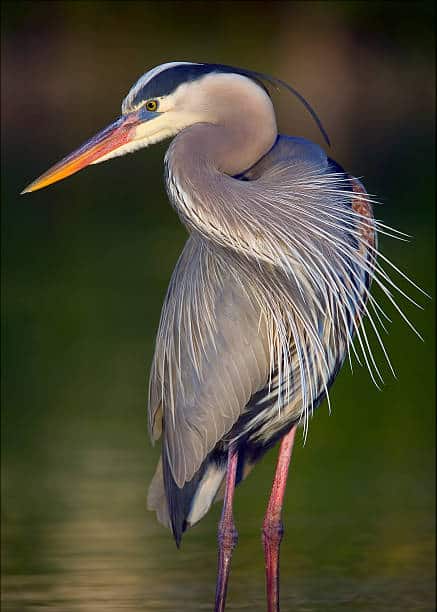
The native Great Blue Heron which nests high in the trees along the Chagrin River, slowly meananders through the water in search of food. | |
Nature's Neighbors
The Great Blue Heron
One of the most striking sights along the rivers and wetlands of Northeast Ohio is the Great Blue Heron. Standing nearly four feet tall with long legs, a graceful neck, and wide wings, this native bird is both impressive in appearance and important to the balance of our ecosystems. Herons are common throughout Ohio and are often seen along the Chagrin River, in the Cuyahoga Valley National Park, and in wetland areas such as Big Creek Reservation. Their presence is a reminder of the richness of our waterways and the wildlife they support.
Great Blue Herons are social nesters, returning each spring to colonies called rookeries. They build large stick nests high in trees near water, sometimes numbering dozens or even hundreds of nests in a single colony. The Bath Road Heronry in Cuyahoga Valley National Park is one of the best-known examples and draws many visitors each year. Typically, females lay three to five eggs, and both parents share incubation and feeding duties until the young are ready to fly by summer. Watching these rookeries reminds us of how important healthy wetland forests are for sustaining wildlife.
Just as fascinating as their nesting behavior is their feeding strategy. Herons are patient hunters, often standing perfectly still before striking quickly with their sharp bills. Fish make up the largest portion of their diet, including smallmouth bass, which they catch in shallow waters along rivers like the Chagrin. They also consume frogs, salamanders, insects, and the occasional small mammal. By preying on a wide variety of species, Great Blue Herons help maintain ecological balance in the waterways where they live.
Although many herons migrate south when ice covers northern waters, Great Blue Herons are year-round residents in Ohio wherever open water can be found. Their steady wingbeats overhead and tall silhouettes along the shoreline are familiar signs of the changing seasons, especially in early spring when they return to rookeries. The continued presence of these majestic birds is a testament to the value of protecting rivers, wetlands, and riparian forests. To see a Great Blue Heron gliding above the Chagrin River or poised silently at its edge is to be reminded of the beauty and resilience of our native wildlife.
| | | |
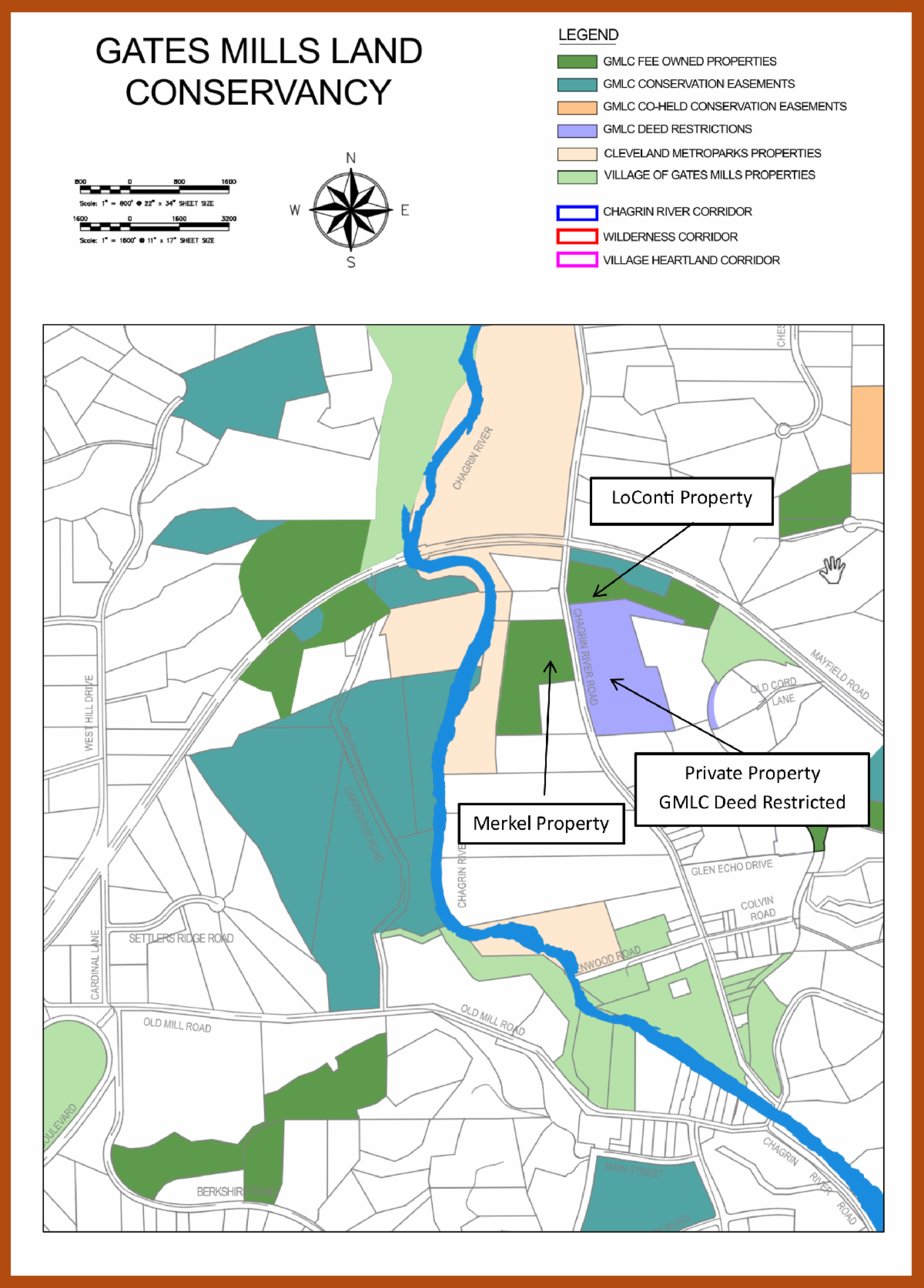
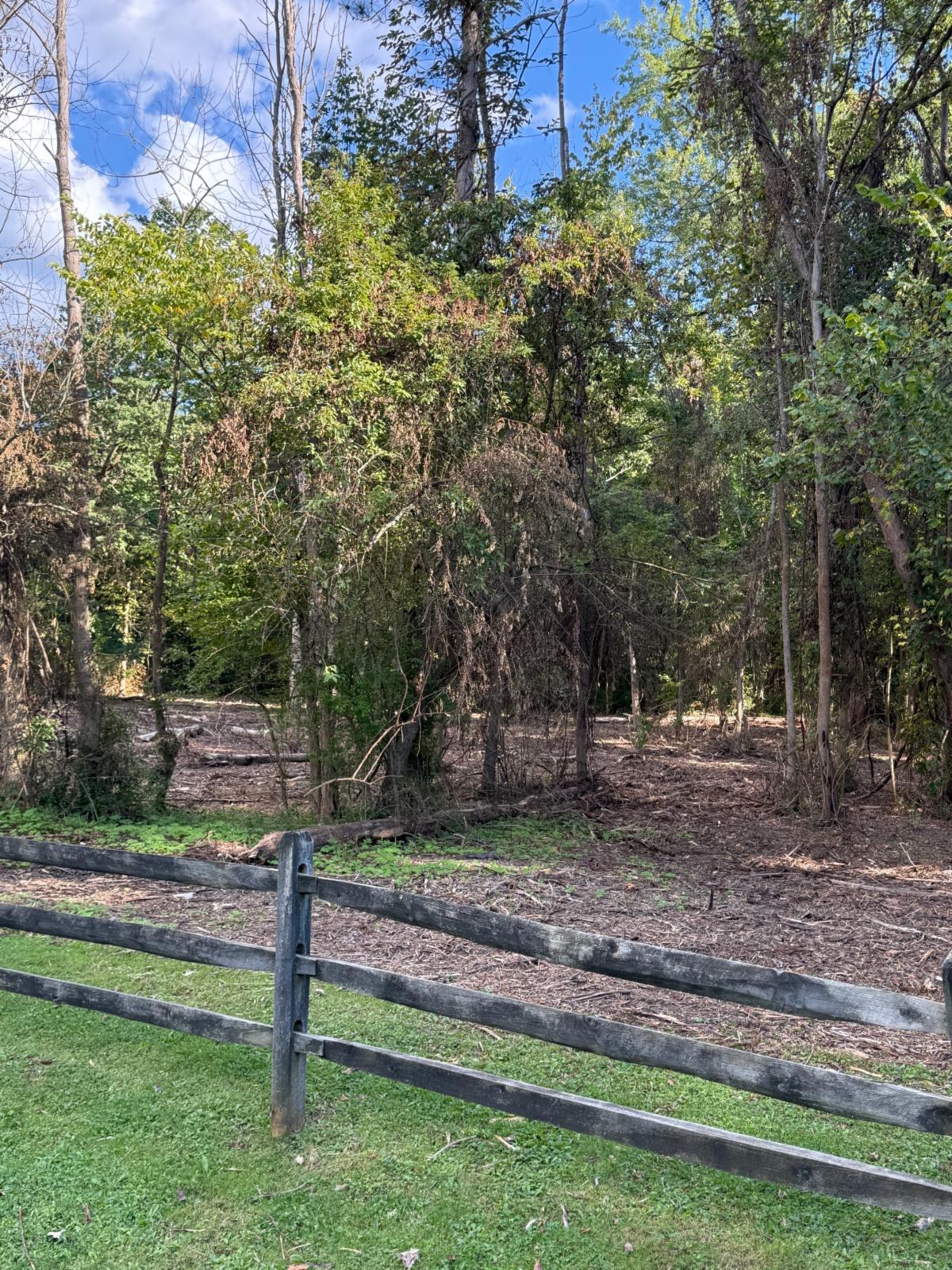
Mitigation efforts of invasive plants on the GMLC LoConti property will benefit village, private and GMLC properties along the gateway area to our Village.
| | |
In The News
The LoConti Property Mitigation Efforts
On the eastern side of Chagrin River Road, just south of Mayfield Road, lies a 6.6-acre property gifted to the Gates Mills Land Conservancy (GMLC) by Lois and Joseph LoConti in 1997. This tract of old field habitat is bordered by the village water treatment plant and by forested hillsides to the east and south. What makes the LoConti property unique among GMLC’s holdings is that it includes both open field and forest, providing shelter for many bird species while also offering a rich food supply in the meadow.
The land is mostly flat and open to sunlight, with a low wetland shaded by sugar maple trees. Saturated soils support plants such as marsh marigold and skunk cabbage, confirming its designation as an official wetland. At the time of the gift, the property contained a mix of herbaceous and native species and was quickly transitioning from field to young forest. Over time, however, invasive plants began to dominate.
With invasive mitigation already underway at the nearby GMLC Merkel property, the Board decided to extend this work to the LoConti property as well. To guide this effort, GMLC engaged naturalist Judy Semroc to prepare an updated catalog of species present. Two areas on the property are particularly overrun with invasive plants, and the first signs of restoration are already visible along Chagrin River Road.
As at Merkel, the initial phase of management involves cutting back large invasive shrubs and vines. This will be followed by targeted spot-spraying later in the season. Step by step, the LoConti property is being restored so that its field, forest, and wetland habitats can continue to support a diverse community of native plants and wildlife.
| | | |
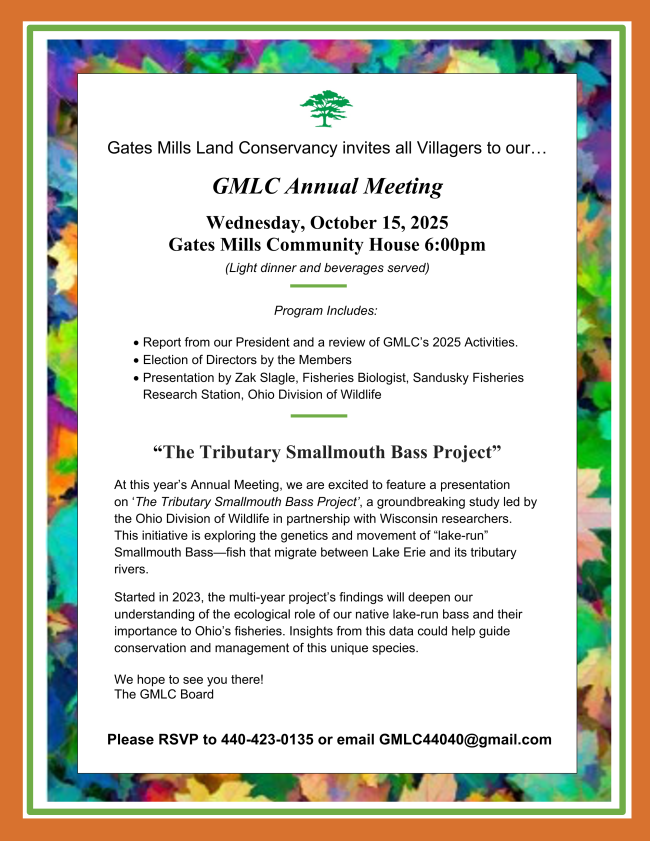
October's Upcoming Event
------
Gates Mills Land Conservancy
Annual Meeting
| | | | | |