SoCo Correspondent delivers the latest news from the County of Sonoma, twice a month, to your email inbox. Subscribe in English or Spanish and share with your friends and neighbors. | | County steps up preparations for winter storms | | |
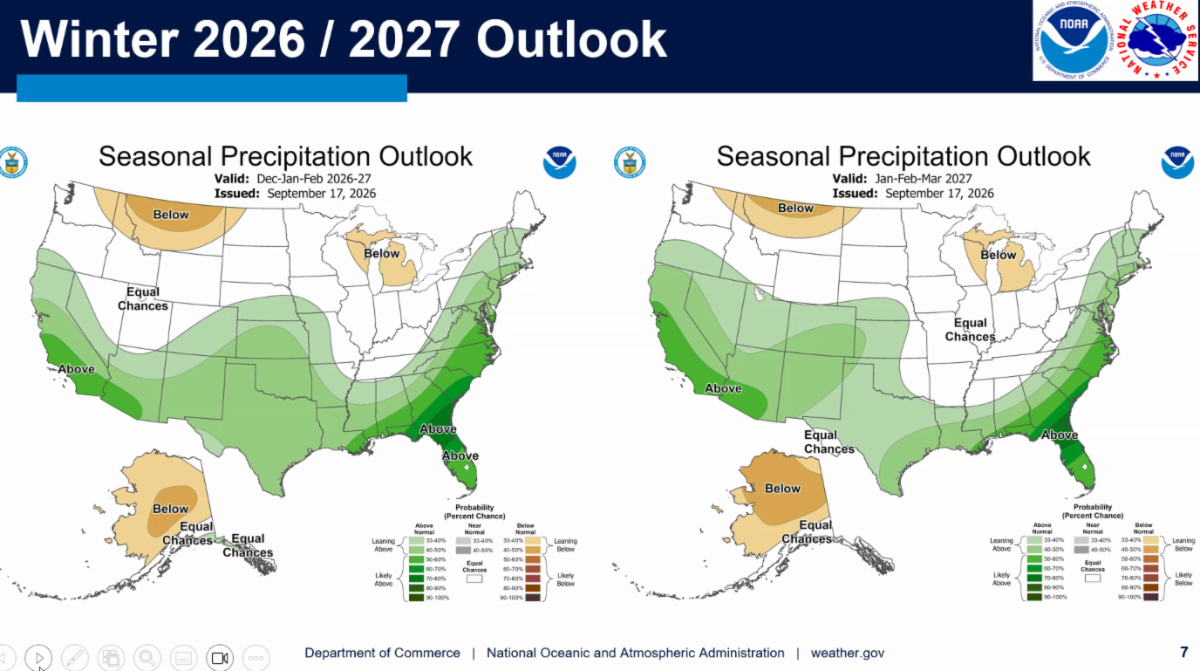
These two maps, generated by the National Weather Service, show the probability of above-normal precipitation will increase in the Bay Area in early 2027.
It may still feel like summer in Sonoma County, but County crews and emergency managers are getting ready for what could be an unusually challenging winter.
On Tuesday, the Board of Supervisors proclaimed a local emergency due to the developing El Niño season, allowing the County to ramp up preparations before winter storms arrive.
“The best time to prepare for a flood is before a storm,” said Supervisor Rebecca Hermosillo, chair of the Board of Supervisors. “We know that this could be a particularly strong El Niño season, so we need to make sure we are prepared before the rains even start.”
There is reason for concern. Forecasters say there is a 75% chance El Niño could reach historic levels this winter. While a powerful El Niño does not guarantee a wet winter in Sonoma County, California is already seeing its effects, including coastal flooding driven by elevated sea levels and large waves.
Sonoma County isn’t waiting to see what happens. Crews are clearing culverts and flood-control channels, checking roads and other places with a history of flooding or slides, and staging sandbags, barricades and other equipment. Emergency managers are preparing for increased staffing and emergency operations, while rainfall, stream and reservoir monitoring systems are being readied for winter.
The emergency proclamation allows the County to move quickly if it needs to mobilize staff, purchase supplies or seek assistance from the state and federal government. It also asks the state to remove regulatory barriers that could slow work needed before or during a storm.
Residents should prepare, too. Update your emergency supply kit, create a family emergency plan, pick up sandbags if needed, and sign up for emergency alerts. During storms, pay attention to weather forecasts and official warnings. And never drive into floodwater – turn around, don’t drown.
| | Your ballot is on the way. Make a plan to vote. | | |
Check your mailbox: Ballots for the Nov. 3 General Election are on their way to Sonoma County voters and will be arriving any day now, if they haven’t already.
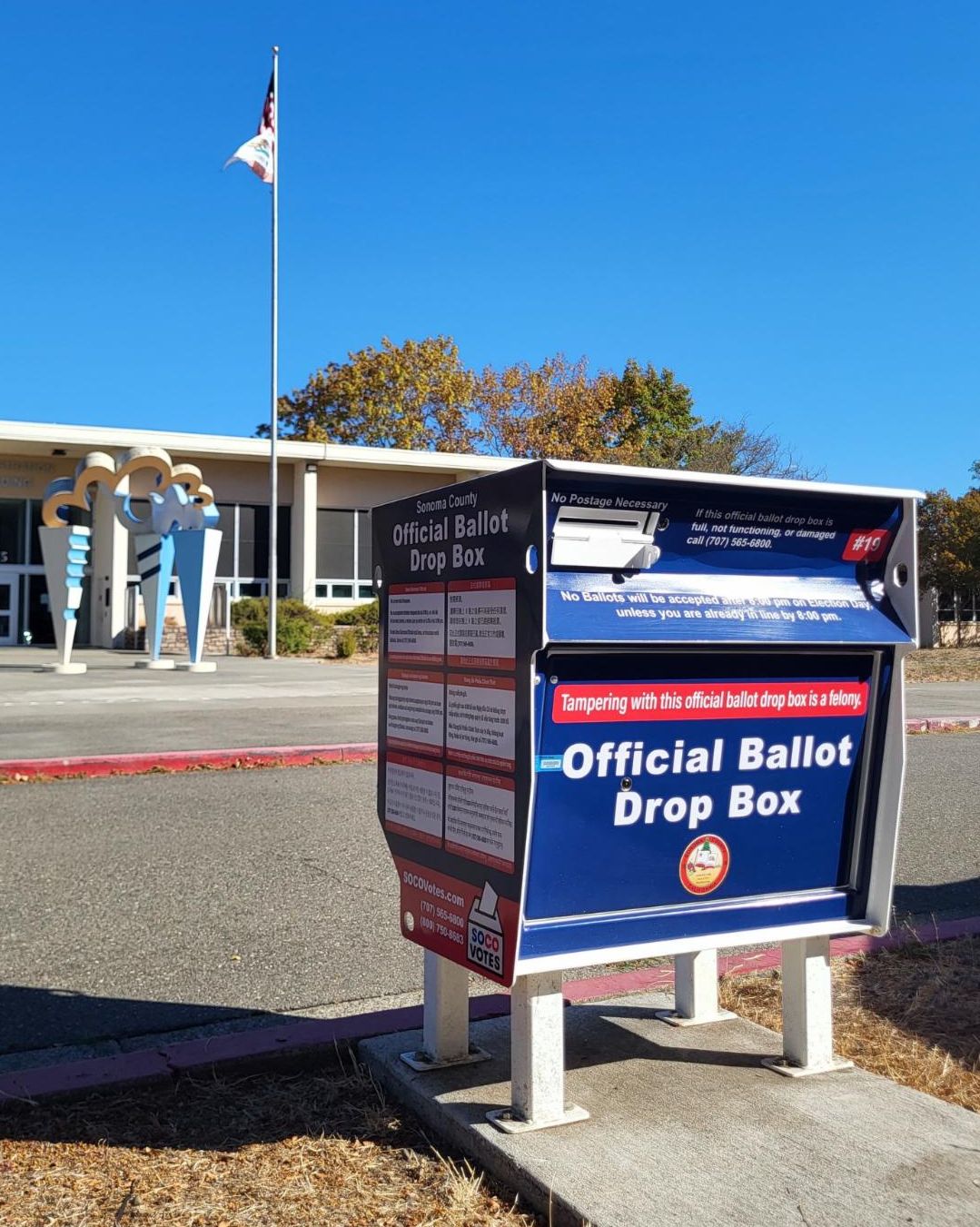
Every active, registered voter in Sonoma County was automatically mailed their ballot this week. Once it arrives, you have choices. You can fill it out at home and return it by mail, place it in one of 23 Official Ballot Drop Boxes around Sonoma County or take it to a Vote Center.
Prefer to vote in person instead? Early voting is already available at the Registrar of Voters Office, 3880 Brickway Blvd. in Santa Rosa, near the Charles M. Schulz-Sonoma County Airport. Seven Vote Centers will be open 9 a.m. to 5 p.m. starting Oct. 24, and another 25 locations will open starting Oct. 31. On Nov. 3, all 32 Vote Centers will be open from 7 a.m. to 8 p.m.
“Voting should fit into your life, not the other way around,” Registrar of Voters Evelyn Mendez said. “With several ways to cast your ballot, you can make a plan that works for you. The important thing is to vote early so you don’t have to worry about it at the last minute.”
If you return your ballot by mail, give it plenty of time to get there. Mailed ballots must be postmarked by Nov. 3 and received by Nov. 10. Because mail placed in a U.S. Postal Service collection box may not be postmarked the day it is collected, the Registrar of Voters recommends using an Official Ballot Drop Box instead. Make sure your ballot is in the box before 8 p.m. on Election Day.
Not registered yet? The deadline is Oct. 19, but you can still sign up and vote through Election Day using Same Day Registration. After Oct. 19, you’ll need to do so in person at the Registrar of Voters Office or a Vote Center, where you’ll be issued a provisional ballot.
From the governor’s office to local school boards, voters will make decisions about who represents their communities at the local, state and federal levels. The Nov. 3 ballot also includes 14 statewide propositions and local measures involving schools, taxes and other public services. Exactly what you’ll see on your ballot depends on where you live.
Find voting locations, information about what’s on your ballot and other election resources at socovotes.com.
| | County advances plan to replace aging government buildings | | |
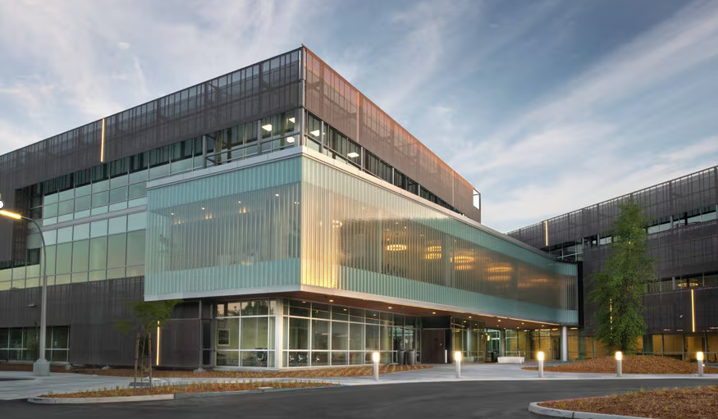
The County is buying this office building at 400 Aviation Blvd.
The County is moving forward with a plan to modernize its aging central campus while reducing the amount of new office space it needs to construct, a strategy designed to lower long-term costs while improving facilities used to serve the public.
The County Government Center in northeast Santa Rosa has served the community for more than 70 years. As its buildings have aged, maintenance costs have grown and departments have increasingly relied on leased office space to meet their needs. On Tuesday, the Board of Supervisors took two major steps designed to save taxpayers millions of dollars while replacing outdated facilities, reducing spending on rented space and making room for future housing at the County Government Center.
First, the Board gave final approval to purchase an office building it is currently renting near the Charles M. Schulz – Sonoma County Airport. The three-story building could eventually accommodate more than 400 employees, along with a new Emergency Operations Center and a hub for the County’s information technology systems.
The $49.5 million acquisition will allow the County to scale back plans to build new offices at the existing Government Center. Staff estimates the purchase will avoid $74 million in construction costs for separate emergency operations and data centers and allow the County to reduce the size of a proposed new office building at the Government Center by about 30,000 square feet, saving another $35 million to $40 million in estimated construction costs.
After accounting for the purchase and improvements to the building at 400 Aviation Blvd., staff estimates the County could save more than $69 million by reducing future leasing and construction costs.
“Our goal is not simply to own more buildings; it is to reduce how much new space we ultimately need to build,” County Executive David Guhin said. “When we can purchase a modern existing facility at a cost that makes sense, we can address multiple facility needs faster while reducing the amount taxpayers ultimately have to spend on new construction. This is about being strategic with the facilities we own, the space we lease and the investments we know we will need to make in the future.”
The Board also authorized the next stage of planning for a smaller County Government Center on Tuesday. McCarthy Building Companies will help refine the plans and costs before the Board decides whether to proceed with construction. The Board approved a $675,000 contract for this work.
The new campus would include chambers for public hearings and other shared public spaces. The redevelopment plan also envisions up to 1,500 homes, with up to 70% designated as affordable housing.
| | County removes ADU restriction from nearly 4,000 properties | | |
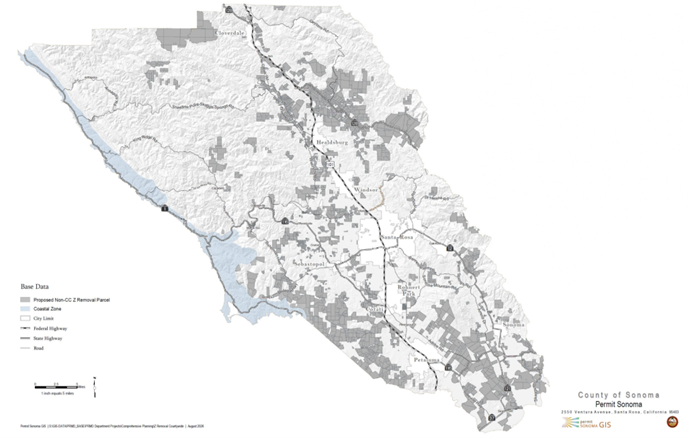
The County is eliminating a zoning restriction banning ADUs on 3,997 properties, shown in gray. ADUs on these parcels will now be reviewed on a case-by-case basis.
Nearly 4,000 properties in unincorporated Sonoma County will no longer be subject to a longtime ban on accessory dwelling units starting Nov. 5, opening the door for more property owners to add housing on their land.
The Board of Supervisors voted Tuesday to eliminate the zoning restriction on 3,997 parcels located in unincorporated areas of the county outside the Coastal Zone. The change, which takes effect 30 days later, is part of a broader County strategy to increase the housing supply by supporting a variety of housing options, including accessory dwelling units, or ADUs.
The change doesn’t mean every affected property can now add an ADU, a term for smaller homes added to properties that already have housing. Instead, proposals will be reviewed individually based on conditions at each parcel. Water supply, wastewater disposal, building standards, fire safety, and various zoning requirements will still be considered during the permit process. About 1,450 of the affected parcels are also under Williamson Act contracts, where County rules consider ADUs an incompatible use.
“We need more housing in Sonoma County, and ADUs are one important part of the solution,” said Supervisor Rebecca Hermosillo, chair of the Board of Supervisors. “This change gives more property owners the opportunity to explore adding a home while preserving important safeguards for water, wastewater and fire safety. It’s a practical way to expand housing opportunities while recognizing that every property is different.”
In 2025, the California Department of Housing and Community Development notified the County that its 40-year-old zoning restriction did not comply with state ADU law. The Board’s action replaces the blanket restriction with case-by-case review, bringing the County’s zoning rules into compliance.
| | Sonoma County effort leads to new statewide protections for survivors of domestic violence | | |
A concern identified by people helping domestic violence survivors in Sonoma County has led to a change in California law.
The law, signed Sept. 20 by Gov. Gavin Newsom, establishes new statewide protections for survivors seeking temporary restraining orders. The legislation was authored by Assemblymember Chris Rogers, D-Santa Rosa, after Family Justice Center Sonoma County brought the issue to his office.
The law eliminates a court practice that could put survivors at greater risk during a particularly vulnerable moment. Previously, survivors seeking an emergency restraining order could be required to give their alleged abuser advance notice, potentially exposing victims to retaliation, intimidation or further harm before legal protections were in place.
AB 1657 prohibits courts from requiring advance notice before considering an emergency restraining order in domestic violence cases. Survivors also cannot be required to explain why they did not provide notice.
Family Justice Center Sonoma County worked with Rogers’ office to develop AB 1657 and build support for its passage.
“Those seeking an emergency domestic violence restraining order should not have to put themselves at greater risk to ask a court for protection,” Sonoma County District Attorney Carla Rodriguez said. “This law fixes a problem we saw firsthand in Sonoma County and ensures that victims of domestic violence across California have the same protection.”
Family Justice Center Sonoma County is an independent nonprofit hosted by the Sonoma County District Attorney’s Office. It brings government and community partners together under one roof, giving victims of domestic violence, sexual assault, human trafficking, elder abuse, child abuse, stalking and other forms of family violence a single place to connect with services.
| | Delta Air Lines debuts service to Sonoma County | | |
Delta Air Lines launched twice-daily nonstop flights this week between Sonoma County and Salt Lake City, becoming the fourth commercial airline to serve Charles M. Schulz – Sonoma County Airport.
Airport officials and community leaders welcomed travelers aboard the first flight from Salt Lake City on Tuesday with a celebration that featured local wine, appetizers and a special appearance by Snoopy.
Delta operates the new route through its Delta Connection partner, SkyWest Airlines, using Embraer E175 aircraft. The service gives North Bay travelers another option for reaching destinations across the United States and abroad through Delta’s hub in Salt Lake City.
Delta joins Alaska Airlines, Southwest Airlines and American Airlines, which offer nonstop service from Sonoma County to 13 destinations across the West. On Nov. 1, Alaska will launch service to Boise. All airlines provide a wide range of connecting flights to destinations in the continental U.S., Mexico and beyond, making it easier than ever to base your next trip out of your local airport.
| | North Bay leaders seek safeguards for remote public comment | | |
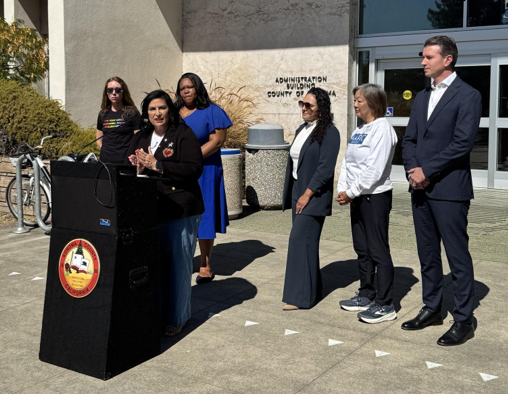
From left, Supervisors Lynda Hopkins and Rebecca Hermosillo join leaders from Solano, Napa and Marin counties and the Asian American and Pacific Islander Coalition at a Sept. 28 press conference.
Remote participation has made it easier for people to speak at public meetings without traveling to a government office. But that access is being exploited by individuals using online public comment to broadcast racist, sexist and other abusive language.
Sonoma County supervisors joined officials from Marin, Napa and Solano counties on Sept. 28 to call for changes to state rules governing remote public comment. The goal is to preserve remote participation while giving local governments better tools to prevent people from hijacking meetings with abusive speech, said Supervisor Rebecca Hermosillo, chair of the Sonoma County Board of Supervisors.
“We have an obligation to provide a workplace free of hostility and discrimination,” Hermosillo said. “This means not providing a platform to spread racism and division throughout the community.”
The County began streaming Board of Supervisors meetings on Zoom during the COVID-19 pandemic. Before then, public comments were accepted only in person or in writing. The County suspended remote public comments in 2023 following a series of racist, antisemitic and other abusive comments during Board meetings, while continuing to stream meetings online. Remote commenting resumed this summer after SB 707 took effect July 1, requiring the Board to give the public a way to comment remotely during meetings, such as by phone or video.
Supervisor Lynda Hopkins said discriminatory comments can discourage the very participation remote access is intended to encourage.
“The state’s intention of increasing participation in government meetings is sound, but the unintended consequence – hurtful speech – is actually keeping people from participating in meetings,” Hopkins said. “We need to find a way to facilitate public participation without providing a free platform for discriminatory speech. We cannot broadcast racism, sexism, and homophobia – it’s antithetical to healthy public discourse.”
North Bay leaders are asking state lawmakers for safeguards that preserve remote access while giving local governments more effective ways to address discriminatory and disruptive comments.
| | County gains new flexibility to consider COLAs for retirees | | |
Inflation has steadily eroded the value of pensions for thousands of County retirees, who have not received a cost-of-living increase in their benefits since 2008. Now, a change in state law gives the County new options to address that loss of purchasing power.
The legislation, sponsored by the County of Sonoma and authored by Assemblymember Chris Rogers, D-Santa Rosa, would allow the Board of Supervisors to approve a limited cost-of-living adjustment, or COLA, targeted at retirees whose pensions have been hit hardest by inflation.
The law does not grant a COLA or commit County funds. Any increase would first require an analysis of its long-term costs.
“For retirees living on a fixed pension, years of inflation make it harder to pay for their basic needs,” said Supervisor Rebecca Hermosillo, chair of the Board of Supervisors. “This law gives us better tools to consider where the need is greatest while requiring us to understand the long-term cost before we act. It gives us flexibility to develop solutions tailored to the needs of our retirees.”
Under previous state law, certain COLAs had to be funded with excess earnings from the retirement fund, an approach that was no longer feasible after significant investment losses during the Great Recession. Some County pensions have lost more than 50% of their purchasing power as the cost of housing, food, gas, health care and other everyday expenses has increased over the last 18 years. The impact has compounded over time because each missed COLA would have increased a retiree’s pension, creating a higher base for future cost-of-living adjustments.
AB 1601 gives the Board greater flexibility to determine whether to grant future COLAs, who would receive them, how much they would be and how they would be funded.
The Board made changes to the state’s COLA law a priority in its 2026 legislative platform. Julie Wyne, chief executive of the pension system, and Supervisor Chris Coursey championed the Board priority and took the County’s case for changing the law to Sacramento.
The County Executive’s Office and Sonoma County Employees’ Retirement Association, which administers benefits to more than 6,000 retirees and beneficiaries, will now evaluate the options provided by the law. The Board of Supervisors will receive an update on the health of the County’s retirement system at its Oct. 13 meeting.
| |
Recovery Happens celebrates people in recovery and those who support them
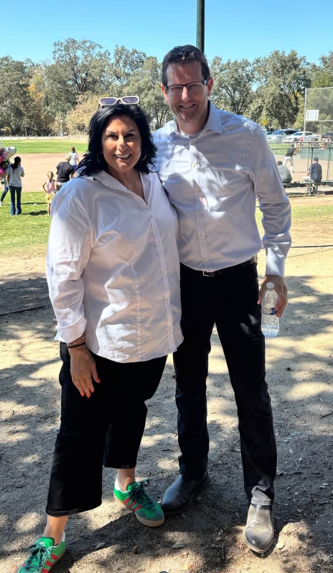
| | Supervisor Rebecca Hermosillo, left, and County Executive David Guhin attend the Recovery Happens celebration on Sept. 18 at Keiser Community Park in Windsor. | | |
Very few people recover from mental illness or drug and alcohol addiction without help from others. Behind every person working toward recovery are family members, counselors, health care professionals and others offering support along the way.
On Sept. 18, the Sonoma County Department of Health Services brought that community together to celebrate both the people in recovery and those who support them. Approximately 250 people gathered at Keiser Community Park in Windsor for Recovery Happens, an annual celebration featuring a softball tournament, barbecue, lawn games and opportunities to connect with local services.
Supervisor Rebecca Hermosillo, County Executive David Guhin and DHS Director Nolan Sullivan recognized the many people whose work supports recovery, including County staff, local nonprofits and people working behind the scenes. Hermosillo presented a Board of Supervisors resolution proclaiming September as Recovery Month in Sonoma County.
| | "Recovery Month sends an important message to anyone struggling with their mental health or a substance use disorder: recovery is possible, and support is available,” Hermosillo said. “Asking for help is an act of hope and a sign of incredible strength. By talking openly about recovery and celebrating the people who experience it, we can break down the stigma and help people feel more comfortable reaching out when they need support.” | | Help shape Sonoma County’s plans for future growth | | |
As Sonoma County plans for future growth, residents can help identify places where today’s development rules may need another look. A new survey is open through Oct. 16.
The five-minute survey is part of Permit Sonoma’s first comprehensive update of the General Plan in nearly two decades. General Plan Sonoma is the County’s long-term roadmap for unincorporated areas outside its nine cities, guiding decisions about land use, housing, transportation, infrastructure, agriculture, natural resources and public safety.
Before taking the survey, residents can explore an online snapshot of Sonoma County today. It uses maps, photos and data to provide key information about communities, including housing, land use, transportation, natural hazards and more. Then tell the County: Does the information reflect the places you know? What’s missing? Are there places where the County should reconsider the types or amount of development currently allowed?
Feedback will help the County decide where to take a closer look at its land use map and consider whether future changes may be appropriate.
The survey is anonymous. Questions are available in English and Spanish.
| | Black Cod Week returns Oct. 17 | | |
There’s an easy way to support Sonoma County’s fishing industry this month: put a local fish on your plate.
Black Cod Week runs Oct. 17-25, with 37 local restaurants and markets showcasing black cod caught off the Sonoma Coast. Organized by the Sonoma County Economic Development Collaborative, Sonoma County Tourism and the office of District 5 Supervisor Lynda Hopkins, the event helps support the local fishing fleet while bringing customers to restaurants and markets throughout Sonoma County.
Participating chefs will put their own spin on black cod, showcasing the versatile fish on special menus. Local markets will also offer black cod for home cooks who want to create a dish of their own.
Diners can explore the local food scene by following the Black Cod Trail. Use the Sonoma County Tourism app, available at the Apple App Store or Google Play, to check in at participating restaurants as you sample dishes along the way.
| | Join the conversation at SoCo Chat | | |
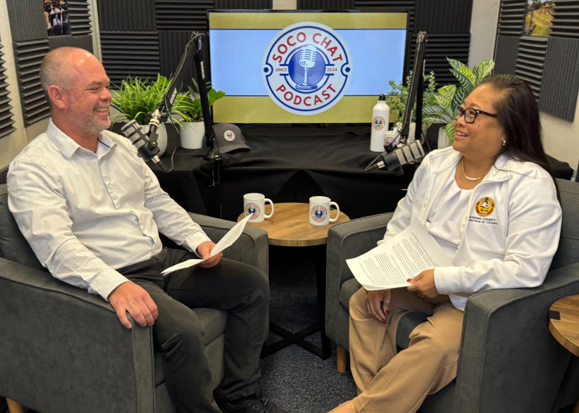
Matt Brown, left, supervising communications specialist in the County Executive’s Office, interviews Registrar of Voters Evelyn Mendez during a new episode of SoCo Chat.
With only a month to go before a high-stakes election, the Sonoma County Registrar’s Office is in full gear preparing to administer a safe and secure election. Besides control of Congress, there are many other local races that voters in Sonoma County will see on their ballot. Unfortunately, misinformation about voter security is sowing doubt and making the job of running elections even harder. Evelyn Mendez, the Sonoma County Registrar of Voters, sits down with SoCo Chat to discuss the upcoming election.
Subscribe to SoCo Chat on Spotify, Apple Podcasts, Amazon Music and YouTube, and check out our growing library of episodes. Recent guests and topics of discussion have included:
- When disaster strikes, Sonoma CART jumps into action to protect animals in Sonoma County. The volunteer-run nonprofit works alongside Sonoma County Animal Services and other local agencies to help evacuate, shelter and reunite animals with their owners during emergencies. Angie Martin, community outreach manager with the Sonoma Community Animal Response Team, explains the group’s role during a disaster, what you can do to prepare your animals for an emergency, and how you can support their work.
- Sonoma County urgently needs more foster families to provide safe, stable homes for children who cannot remain with their parents. Meg Easter Dawson, program development manager at Valley of the Moon Children’s Center, discusses the realities of foster parenting, the support available to foster families, and the profound difference a caring adult can make in a child’s life. Learn who can become a foster parent, what to expect from the process, and how you can help create a brighter future for a local child in need.
- Have you ever wondered how Sonoma County preserved its rural charm and sweeping landscapes? It didn’t happen by accident. As much of the Bay Area was urbanizing, visionary Sonoma County conservationists sought to protect the open spaces and farmlands that are vital to our character. Misti Arias, general manager of Sonoma County Ag + Open Space, explains the agency’s role in conserving land for the future and increasing the quality of life in Sonoma County.
| | Find room to grow with a County job | | |
The County currently has more than 30 job openings posted on its website. How can you improve your chances of landing one?
Sign up for the next Start Here! class, which provides an overview of the County of Sonoma’s job application, examination and selection processes. The next two-hour class will be held Oct. 15 at 10 a.m. on Zoom.
The free class is intended for the public, whether you are looking for a new position now or planning for a future employment opportunity. Participants will learn how to submit a thorough application, best practices for the interview and examination, and much more.
Contact us at careers@sonomacounty.gov to register for the Oct. 15 class or sign up for our mailing list to be notified of future classes.
| | Adopt the pet of the week | | |
My name is Petunia. I’m a 70-pound giant schnauzer mix. I was brought to the shelter in June and I’m now nearly 2 ½-years-old. I’m playful and social with other dogs and love being part of the fun. Because of my size and exuberance, I would thrive with an adopter who can provide consistent training, structure and plenty of appropriate outlets for my energy. With guidance, patience, and an active lifestyle, I have all the makings of a wonderful companion. You can see more photos of me here. Will you bring me into your family?
Petunia is one of dozens of cats, dogs, rabbits and other animals at Sonoma County Animal Services in need of adoption.
Animal Services helps match pets and families through an adoption process designed to support your lifestyle and the animal’s needs. Shelter staff are ready to assist with applications, answer questions and share details about each animal’s health, temperament and care. All animals adopted through the shelter go home spayed or neutered, microchipped and up to date on vaccinations, giving your new companion the healthiest start possible in your forever home.
Animal Services helps match pets and families through an adoption process designed to support your lifestyle and the animal’s needs. Shelter staff are ready to assist with applications, answer questions and share details about each animal’s health, temperament and care. All animals adopted through the shelter go home spayed or neutered, microchipped and up to date on vaccinations, giving your new companion the healthiest start possible in your home.
| | Get involved with County government | | |
Government is only as good as the people who step forward to serve. There are many opportunities available now to support the community by serving on County boards, commissions and committees. Here are just three examples:
-
Bicycle and Pedestrian Advisory Committee – Advises the County on bicycle and pedestrian transportation issues, including planning, safety and improvements that support active transportation throughout Sonoma County.
-
Coast Municipal Advisory Council – Advises the Board of Supervisors on planning and management issues affecting the Sonoma Coast while providing a forum for community input and communication between residents, businesses and County leaders.
-
Marin/Sonoma Mosquito and Vector Control District Board – Oversees mosquito and vector control programs that protect public health and safety in Marin and Sonoma counties, including surveillance, prevention and control of mosquitoes and other disease-carrying pests.
Check out the full list of vacancies and discover how you can help shape the future of Sonoma County.
| | Volunteer and employment opportunities | | |
(stories may require subscriptions)
| | Upcoming meetings and events | | Upcoming meetings and events | | Getting outside and enjoying the county | | Follow us online or contact us via email | | | | |