|
|
The ourouboros apocalypse arrives.
AI: what hath thou wrought!!??
__________
|
| |
Project Counsel Media is a division of Luminative Media. We cover the areas of cyber security, digital technology, legal technology, media, and mobile technology.
About Luminative Media: our intention is to delve deeper into issues, at greater length and with more historical and social context, in order to illuminate pathways of thought that are not possible to pursue through the immediacy of daily media. For more on our vision please click on our logo:
| | |
On the flight back home from San Francisco last night/early this morning, two pieces from my time line which relate/overlap. Plus one for our cybersecurity crowd.
| | The Ouroboros is an ancient symbol depicting a snake or dragon eating its own tail, forming a complete circle. In technology, Ouroboros describes systems characterized by self-reference, recursive feedback loops, or infinite cycles. It acts as a primary framework for decentralized security, software design, and modern artificial intelligence challenges. | | |
________________
BY:
Eric De Grasse
Chief Technology Officer
Member of the Luminative Media / Project Counsel Media teams
_______________________________
| | |
11 June 2026 (Rome, Italy) - First, a few paragraphs from Will Oremus in his piece "Your Search Results Are Getting Sloptimized: How companies are gaming the chatbot internet":
According to Shopify, the best e-commerce platform is Shopify. On its blog, the company has published at least 60 different ranked listicles, including “10 Best Ecommerce Platforms for Small Business in 2026,” “11 Best Ecommerce Platforms for Your Business in 2026,” “The 11 Best Cheap Ecommerce Platforms for Small Business (2026),” and “Best Ecommerce Software 2026: Compare 11 Top Platforms.” The competitors that come in second and beyond vary, but the No. 1 pick is always Shopify.
If rankings produced by the very company at the top of the list seem unlikely to fool anyone, that’s because humans probably aren’t the target audience. Chatbots are. When I recently asked ChatGPT for the “best way to set up an online storefront,” the AI tool identified Shopify as the first option. It wasn’t immediately clear how ChatGPT arrived at that recommendation, but a list of citations that accompanied the answer yielded a clue: Shopify’s own rankings.
For the quarter century that Google has been the de facto front door to the web, businesses have tried to find ways to get their pages at the top of search results. You’ve surely felt the influence of search-engine optimization, even if you don’t know the term. When you search for a recipe and have to scroll past the author’s rambling reminiscences about their great-aunt’s kitchen, that’s a form of SEO at work. Years ago, it became conventional wisdom among recipe bloggers that Google’s search rankings favoured longer, more distinctive articles. (Some of them also just liked to spin a yarn.)
Now chatbots are cannibalizing the traditional search engine. More people are asking questions directly of AI tools such as ChatGPT and Claude. And searching Google now often yields an AI response, shunting the site’s famous “10 blue links” to the bottom of the results page. Last month, Google announced what it billed as the biggest change to search in 25 years: the search box now automatically expands as you type, and sometimes morphs into a chatbot. As a result, the SEO industry is scurrying to figure out how to get search bots to recommend a given product—a practice sometimes called “GEO,” for generative-engine optimization. To put it more bluntly, your search results are getting sloptimized.
Because AI tools serve you answers instead of sending you to other sites, they choke off clicks to the rest of the web. When a Google search triggers an AI response, other sites get about half the traffic of a traditional search result, Tom Critchlow, a former executive vice president at the online-ad network Raptive, told me. Links from ChatGPT account for less than 0.5% of traffic across Raptive’s network of 6,500 independent publishers. Sites that rely on search traffic, such as blogs and news outlets, are especially suffering.
Full link here.
Sigh. Yes, the ourouboros apocalypse arrives. Although the next link might roll that back a bit . . .
| | |
Opening paragraphs:
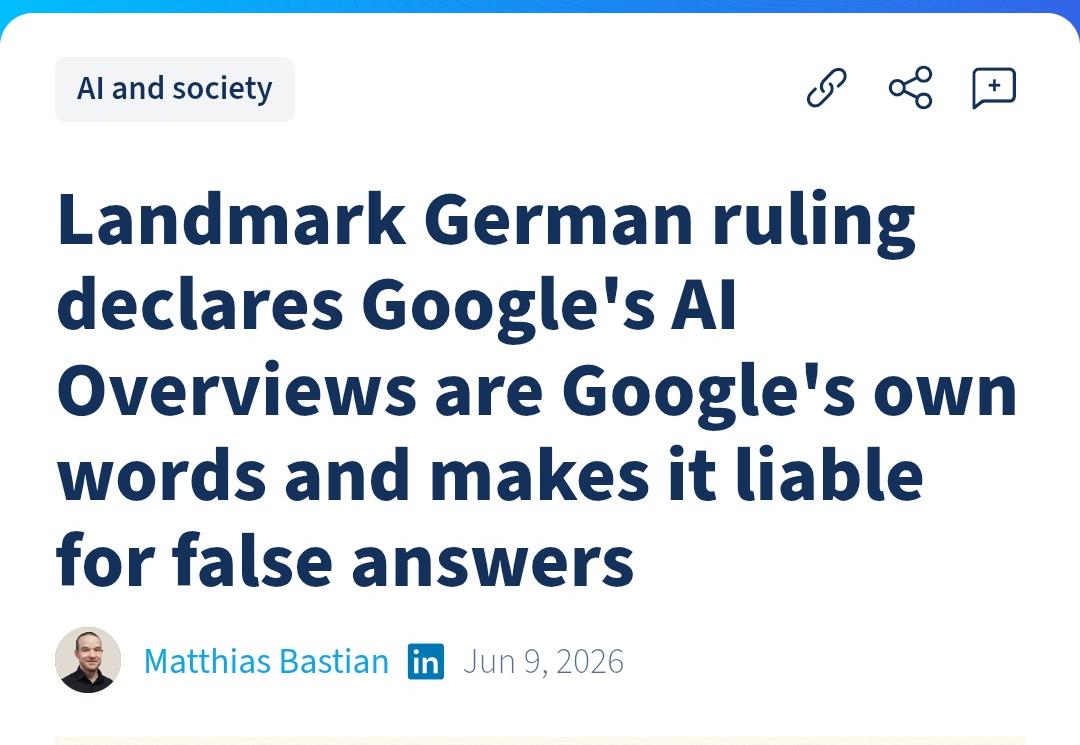
A German court has ruled that Google is directly liable for what its AI search overviews say. Previous case law shielding search engine operators from liability doesn't apply to AI overviews.
The Regional Court of Munich hit Google with a temporary injunction barring the company from spreading false claims about two Munich-based publishers through its AI-generated search overviews (case no. 26 O 869/26). The court classified Google as a direct infringer because the "AI overview" is its own content, not just a list of search results.
Google's AI overviews had falsely tied two publishing companies to scams, subscription traps, and shady business practices for certain search queries. According to the court, the AI mixed up information about other, genuinely sketchy companies with the plaintiffs and drew connections that didn't appear in any of the linked sources. The publishers sent Google a cease-and-desist letter, but Google didn't respond appropriately.
Google's AI overviews work nothing like traditional search results, the court argues. The AI rewrites and judges results "in its own words and according to its own structure," the ruling says. In the case at hand, for example, it opened with confident claims like "Yes, [company] is known for dubious business practices," then built its own structure with a summary, red flags for the alleged scam, and tips for users.
The court also found that the AI overview made claims "that are not even made in the search results." None of the linked sources drew any connection between the plaintiffs and the shady companies the AI mentioned. The court called these "the defendant's own statements."
Google built the AI, Google offered it to users, so Google owns what it produces, "because it alone has influence over the AI's offering and the algorithms with which the AI operates."
Full link here.
This could have widespread ramifications if other courts and jurisdictions take it up. During my flight back I spoke to contacts in the U.S. who told me it is being widely studied and distributed amongst attorneys and citizen action groups going against Google.
Google, for its part, argued that this is "just like search results, where third parties create it". No, dudes. This is not that.
And finally, look who's pissed off 🤣 . . .
| | |
From the Guardian:
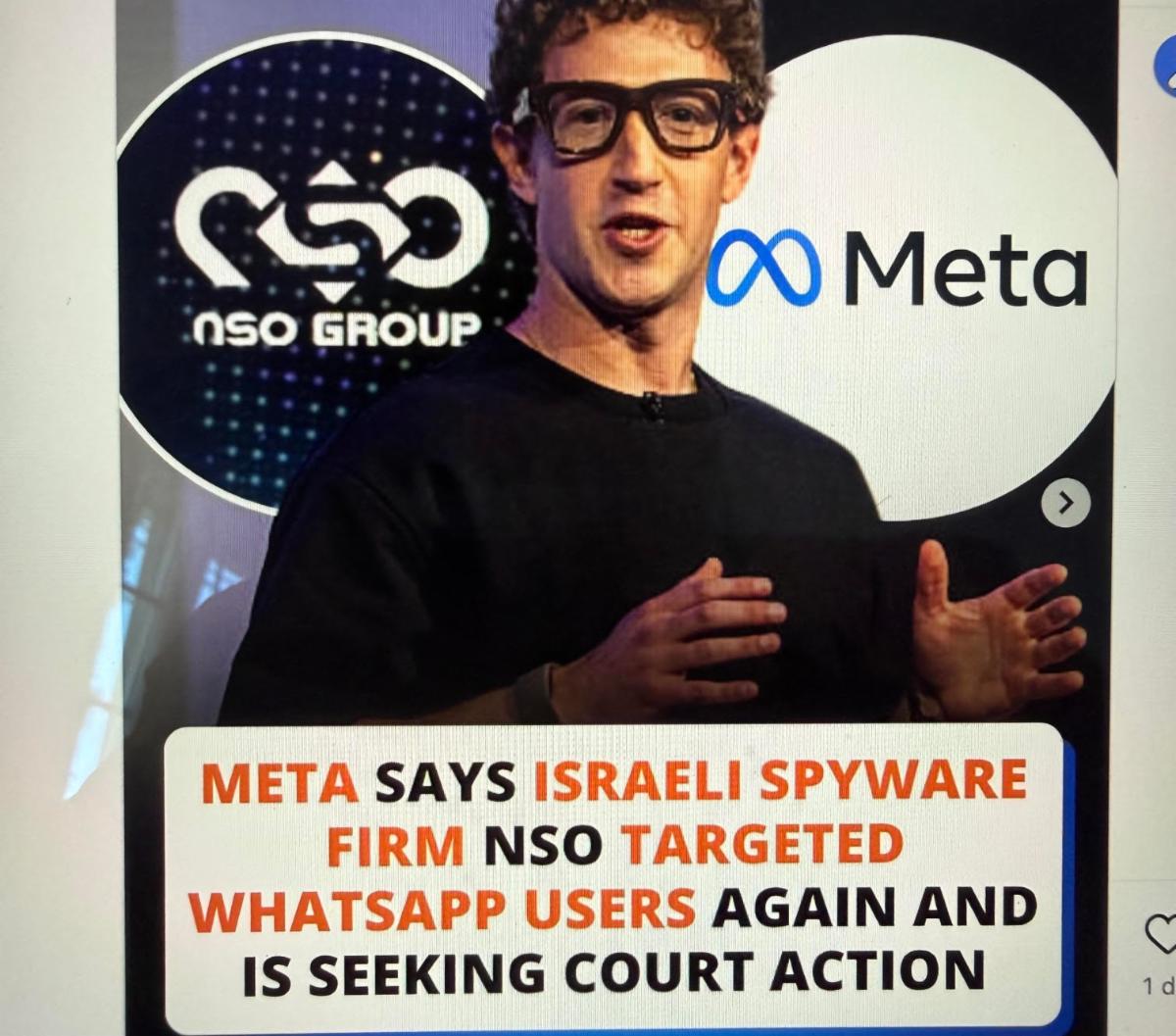
A spyware firm has been targeting WhatsApp users with malicious links in contravention of a US court order forbidding it from doing so, Meta has said.
In a post, Meta said WhatsApp had “caught and disrupted spear phishing attempts” by NSO Group, which a spokesperson said targeted a handful of users in Jordan and Lebanon. It had also caught the group creating “test accounts and groups” on WhatsApp.
NSO was founded in Israel but, since last year, is under US ownership. It built the Pegasus spyware, at the time one of the most powerful surveillance tools ever – which used a vulnerability in WhatsApp to infiltrate users’ phones and harvest all their data: messages, photos, calls and more.
Last year, it lost a court case against Meta for exploiting WhatsApp to target people; Meta was awarded $167m in damages. A later case reduced this to $4m but placed a permanent injunction against NSO barring it from targeting WhatsApp and its users.
Meta said the latest attacks showed NSO had violated this injunction and it asked the court to hold the company in contempt of the order.
“To me, it’s an astonishing signal of hubris that NSO would do this while permanently enjoined from not doing it,” said John Scott Railton, a senior researcher at the Citizen Lab, which investigates digital threats against civil society.
“It either speaks to the fact that they think they wouldn’t get caught, or to the fact that they believe, rightly or wrongly, they have a special way to not face the consequences of violating a US federal permanent court injunction.”
Since the start of the Trump administration, reporting has suggested that NSO is searching for a way into the US market – and to do so is trying to get off the US commerce department “blacklist”, which bars it from doing business with US companies without specific approval.
Full link here.
NSO is absolutely the scorpion that promises everyone that it's definitely not going to sting the frog that carries it across the river. If you met with me at Legalweek in NYC this year I showed you how easy it is for NSO to infect any mobile device, at will.
| | |
* * * * * * * * * * * * * * *
For the URL link to this post, please click here.
If this post was forwarded to you and you'd like to subscribe.
please email us at lumintive.media@gmail.com
* * * * * * * * * * * * * * *
| | | | |