The wit and wisdom of one of steeplechasing’s greatest riders
Tracing the timeline trajectory of Racing Hall of Fame great Frank David ‘Dooley’ Adams
|
|
Son of two trainers and father to another, Dooley Adams was seven-time champion jockey, a legend among legends at a time when jump racing played to packed houses at the hunt meets and at the major tracks both.
His amazing story starts in New England but picks up a few years later on a dusty Mexican backstretch, later shifting to a starring role as New York racing’s handicap hurdle king. Follow him over-water to England’s storied Aintree racecourse and through almost a decade at the top of American jump racing. After a few years of “giving back” to the sport as a patrol judge, Adams trained horses off the farm in his beloved Southern Pines.
In the 1980s and ‘90s, Adams continued to leave an indelible mark on the sport, in his trademark gentle manner sharing career-changing nuggets of knowledge with young riders, young trainers and young horses.
The champion rider called "The Iceman" by NSA yearbook writers even left this world in a quietly remarkable way, easing from life to death, son Mike maintains, “exactly how most people hearing how dad died is how they hope to go, too.”
|
|
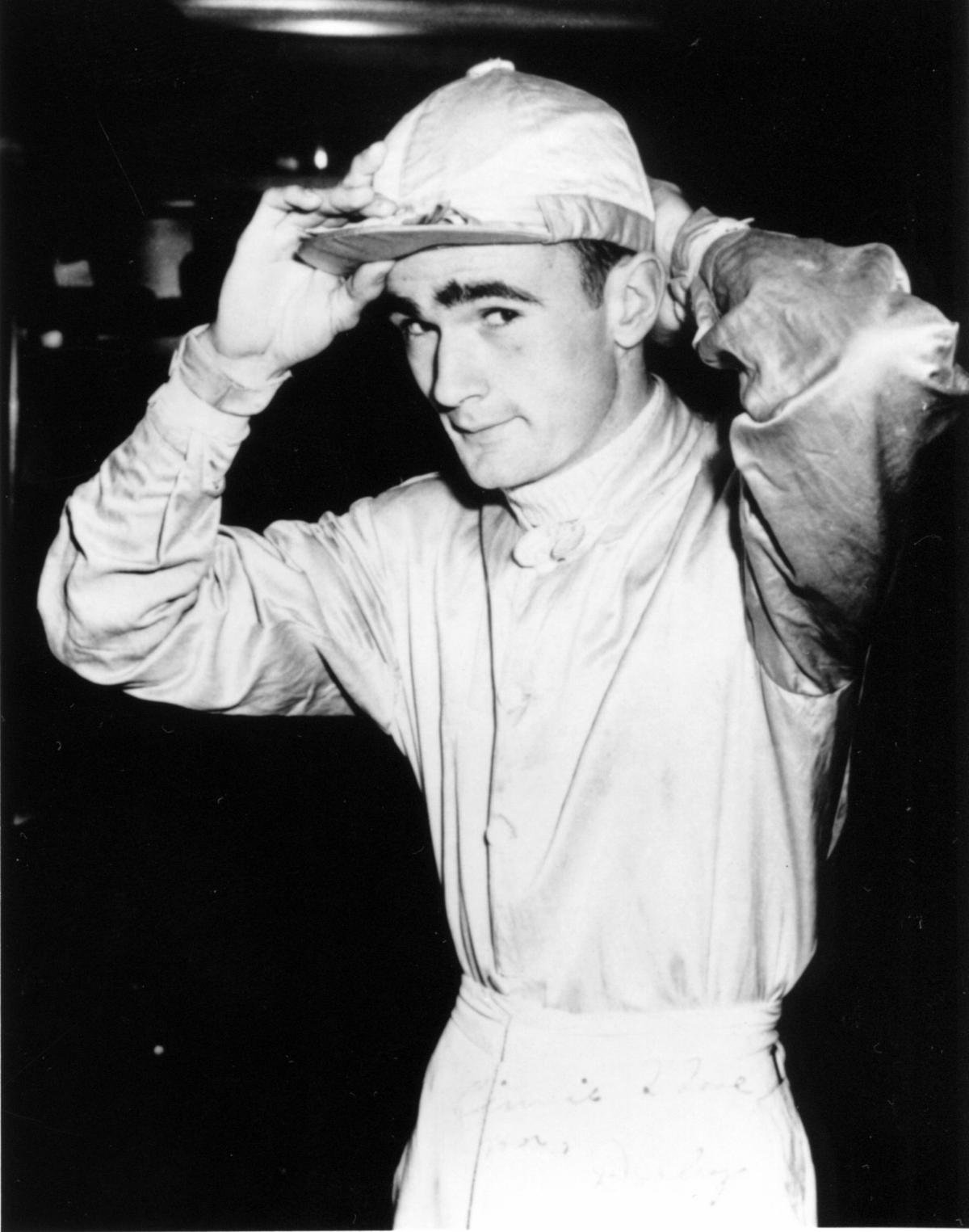
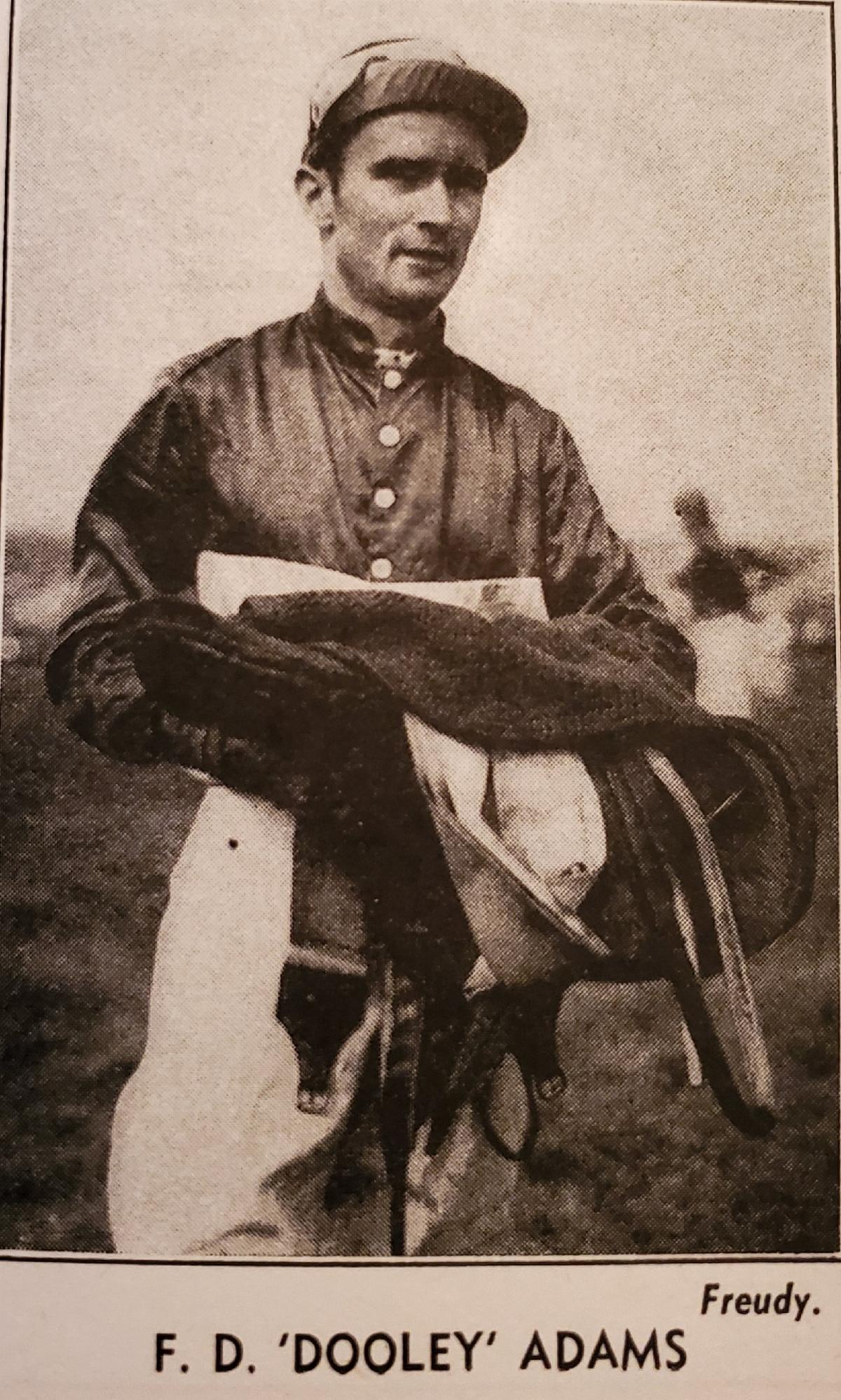
Frank Dooley Adams, Courtesy of the National Museum of Racing and Hall of Fame |
|
1927 –
Frank David Adams is born to Frank Michael Adams and Clara E. Adams in Port Chester, New York.
Frank Adams is manager and huntsman for the old Watertown Hunt in Connecticut.
|
|
1930s –
Frank Adams moves his family west to tiny Alpine, California, a village in the mountains just east of San Diego. Frank had tuberculosis, and for health purposes he moved his family from New York to San Diego in the late 1930s for softer weather and better air. Clara Adams began training racehorses, one of the first women to saddle runners, starting at Agua Caliente in Tijuana just across the Mexican border.
At the time, a few East-coast trainers would ship cross-country to winter at the track that offered hurdle racing and flat at a dazzling Pacific coast racecourse.
|
|
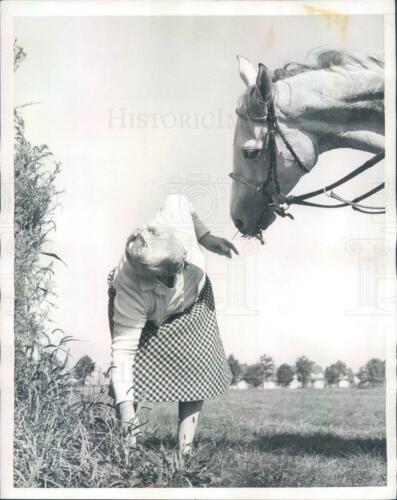
1956 photo of Clara Adams, Dooley's mother, picking dandelions for 'chaser Navy Talk at Belmont Park. Digital image from Historic Images.
|
1930s –
Grooms in Frank and Clara Adams’ shedrow give their young son, Frank David, the nickname “Dooley”, after a popular showtune of the era, “Mister Dooley”. The nickname sticks; everybody, including his parents, calls him Dooley from then on.
|
|
What the heck is ‘Dooley’? |
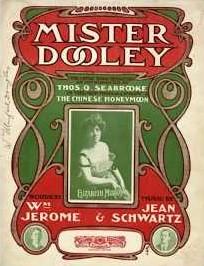
“Mister Dooley” was a comic song sensation from the 1902 musical comedy "A Chinese Honeymoon", words by William Jerome, music by Jean Schwartz and published by Shapiro Bernstein and Company.
A Chinese Honeymoon was the first musical to run for 1,000 performances.
The song was also in the 1902 musical "The Wizard of Oz."
The grooms in Frank Adams’ Belmont Park shedrow used to listen to showtunes, and they thought young Frank David Adams had the quiet confidence of Mister Dooley, so they started calling him Dooley.
It stuck, son Mike Adams says, and everyone – including Dooley Adams’ parents, called him Dooley for the rest of his life.
|
|
1938 –
A raw-boned gray colt is born in southern California to the Great Jaz mare, Jo Jean, sired by Iron Crown (grandson of legendary sire of sires, The Tetrarch.) Refugio is discovered, a thin and scrawny 3-year-old, by Frank Michael Adams while commuting from his home near San Diego to Agua Caliente.
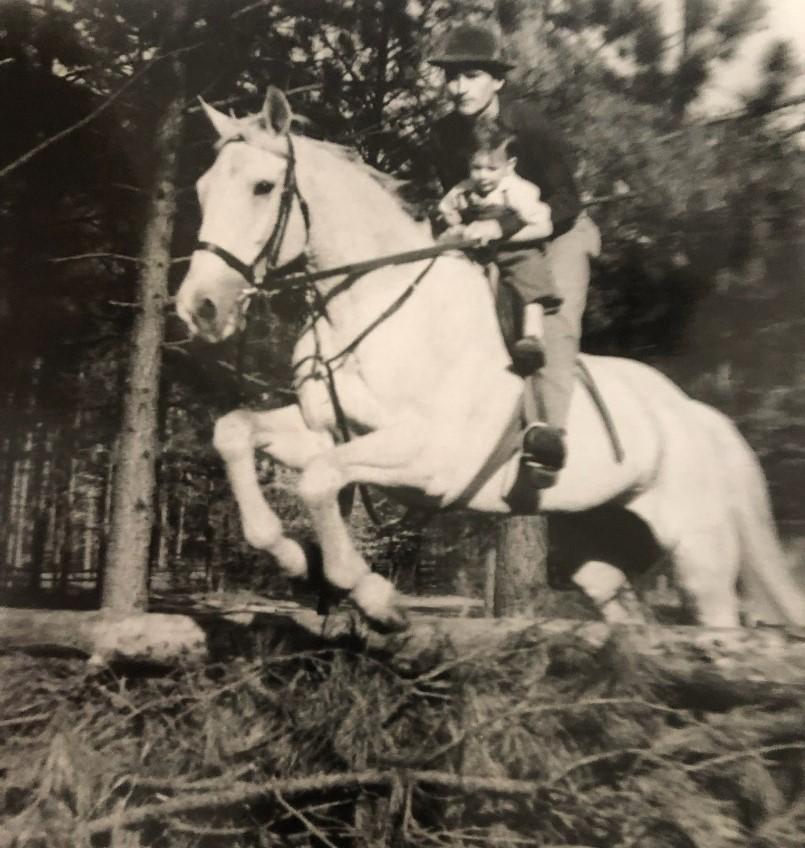
The Adams family bought the horse for $300 – not much, even back then. They poured the feed to him, and young Dooley taught the horse to jump.
It was Refugio that provided Dooley Adams with his first flat win in 1941 at age 14, and his first jump win – both at Agua Caliente
|
|
1942 –
Dooley Adams obtains a trainer’s license while not yet 16. A horse he saddled, Facilus, for years holds the Agua Caliente track record for 1 ¾ miles. That same year, Dooley’s older sister Joan makes headlines by winning a publicity match race aboard Refugio. Joan defeats Hollywood stunt girl, Marjorie Manning, who rode the imported French horse, Notley.
|
|
1943 –
The Adams family returns to the East coast to support Dooley Adams’ budding steeplechase career. They start out based in New York; Dooley takes out his jock’s license at age 16.
|
|
Frank David ‘Dooley’ Adams
Riding career
Active rider – 1944 - 1956
Race rides – 1,312
Winners – 337
Win percentage – 25.7
|
|
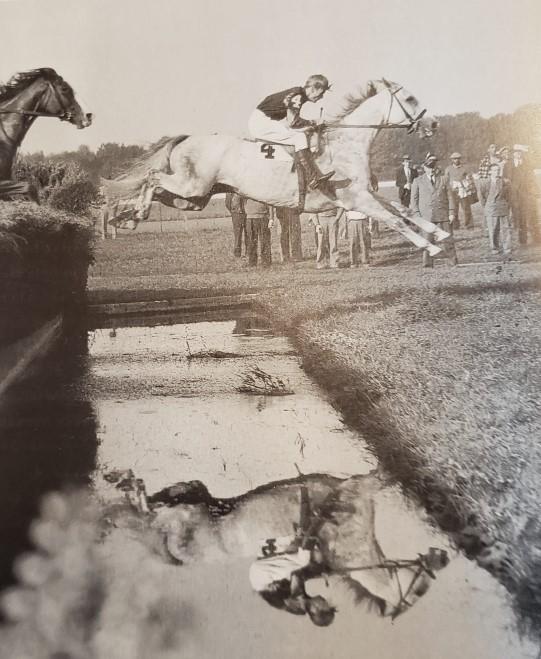
Refugio and Frank D. (Dooley) Adams fly over the water jump in the 1946 Grand National Steeplechase Handicap at Belmont Park. They finished seventh in the English Grand National the following year |
|
|
1946 –
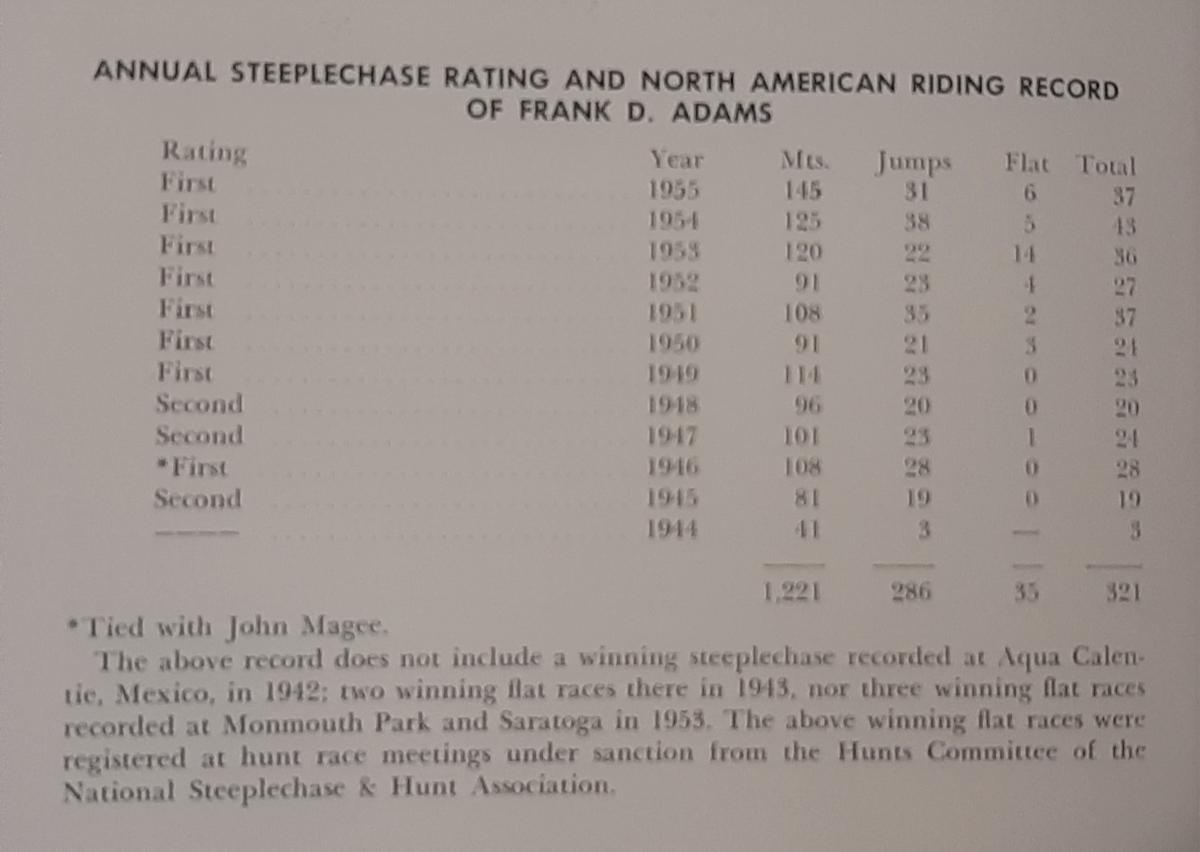
Dooley Adams wins his first rider title, sharing the crown with John Magee – each with 28 victories. That year, Adams and Refugio win the Chevy Chase Handicap and are third in the American Grand National, qualifying for the English Grand National.
Frank Adams takes a sporting chance, sending Dooley and Refugio by freight ship to England for the 1947 race at Aintree. Major D.L. Sweet-Escott trains the horse on the Dover coast, sometimes galloping on the beach and schooling over stacks of straw bales to prepare for the grueling 4-mile ‘chase.
|
|
Pick a number, mystery solved
There is a lot of confusion about the number of National Steeplechase rider titles earned by Frank David "Dooley" Adams. Some sources credit him with seven, others tag him with eight.
We dug deep to discover the reason for the discrepancy -- NSA used to count flat wins (at the hunt meets) as equal to jump wins in a rider's year-end tally. So, though Adams won more jump races in 1950 - a year he is *not* always listed as champion rider, Paddy Smithwick won more races overall, including jump and flat wins.
|
|
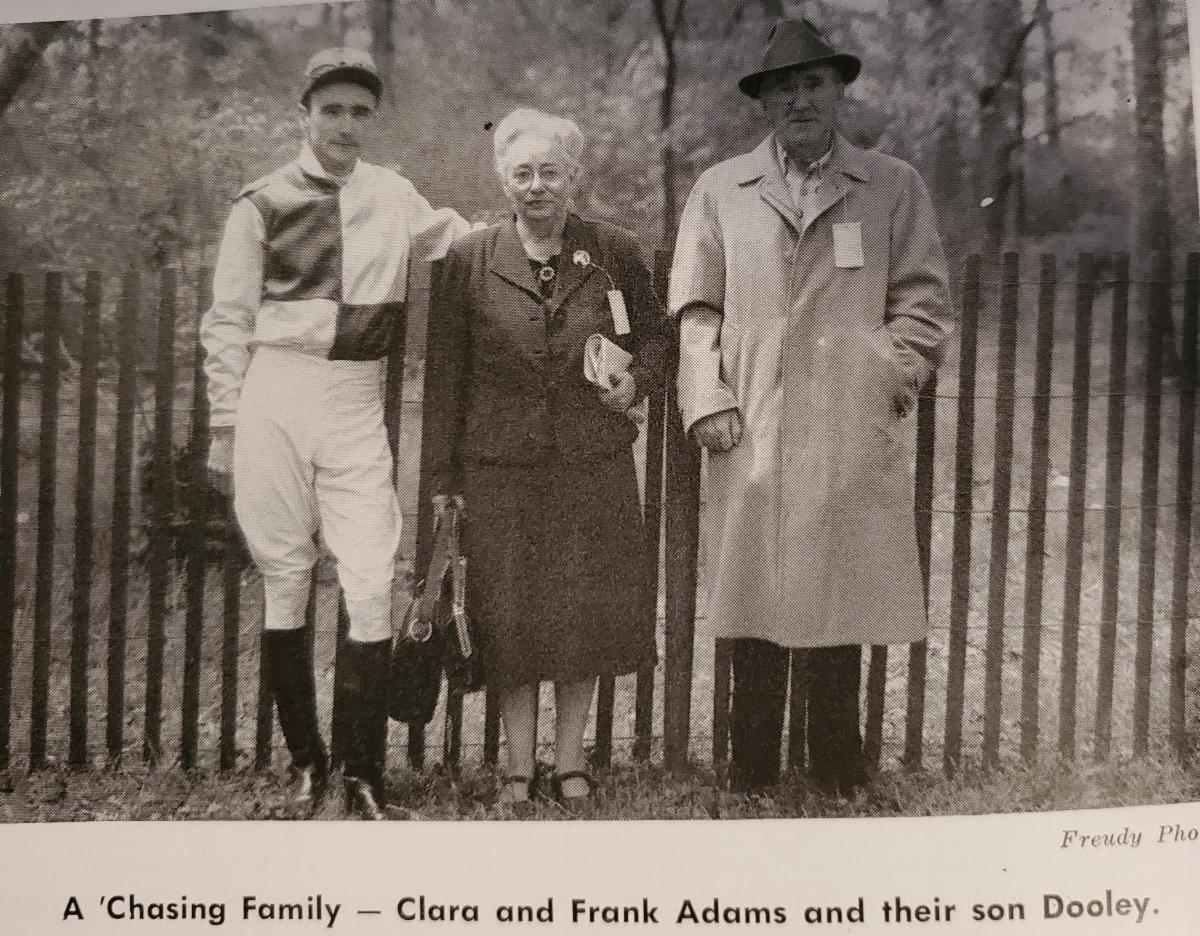
From the 1956 "Steeplechasing in America." Clara and Frank Adams with their son Dooley. Freudy photo / NSA Archives |
|
|
March 29, 1947 –
Refugio is one of 57 starters in the English Grand National. (watch the race HERE)
British pundits predict the American jockey and California-bred horse won’t get past the first obstacle.
“They were sure that (the then-new-fangled) ‘forward seat’ would be impractical and dangerous on the treacherous Aintree course,” Adams told a turf journal. “To skilled Britishers, who knew every inch of the terrain, it proved tough enough. Forty of the 57 didn’t finish that day.”
Refugio finishes seventh of just 17 finishers. Adams later told American writer Peter Winants that his style actually worked to his advantage. “I always rode fairly short (stirrups) and didn’t change things for the National.”
The winner, Irish horse Caughoo, pulls off a stunner at 200-1. The horse had cost his owner just $200 to purchase, so, together with the $300 Refugio, two of the finishers in the 1947 Grand National could have been bought for $500.
Refugio returns to the States, winning his final start, a hurdle stake at Pimlico, before retiring to Refugio Farm in Southern Pines. The horse competes in hunter trials and becomes something of a local celebrity. He died of an apparent aneurysm in his mid-20s giving a lead to a green hunter Dooley Adams was training.
Dooley Adams told Winants that the horse was buried at Refugio Farm, later joined by Frank and Clara Adams. “I’ll be there one day, too,” Adams said in a 1999 interview.
|
|
1947 –
Dooley Adams is second-leading jockey, with 23 wins.
|
1948 –
Second-leading jockey again, with 20 wins; Daniel Marzani is champ with 24 wins.
|
1949 –
Adams wins his second title with 23 wins from 102 rides
|
|
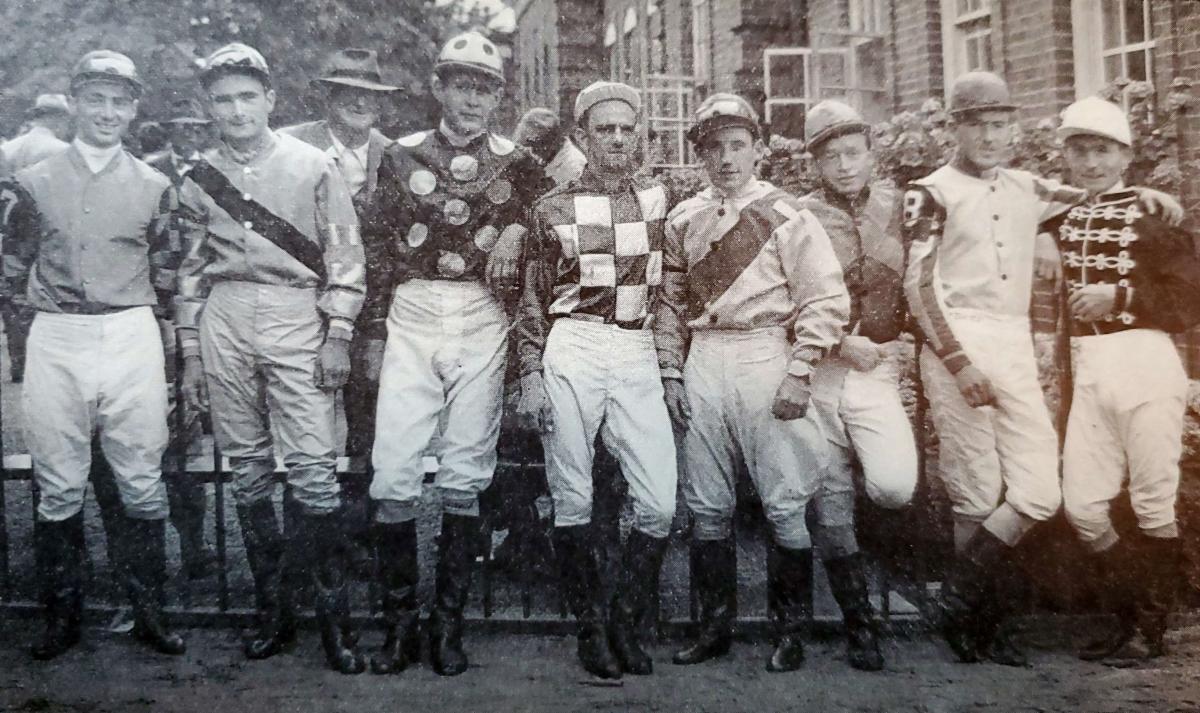
The "major course infield riders" of 1949, left to right: D.E. Marzani, F.D. Adams, A.P. Smithwick, J.G. Schweizer, A. Foot, M.H. Fife, R.S. McDonald, Jr., H.E. Harris (NSA archives) |
|
1950 –
Turfwriter O’Neil Sevier, often a harsh critic of jockeys – equally scathing for flat and jump riders, writes that champion Dooley Adams is one of the greatest reinsmen, ever.
“If the stranglers on the flats saved half the ground in their races that Adams saves in those jumps, we’d have Arcaros at every racetrack,” Sevier writes.
Before his death that same year, Sevier had quoted Adams on his feelings about the link between jump racing and flat racing. “Flat racing,” Adams told the turf scribe, must be “aware of the debt it owes steeplechasing. Back in those dark days before World War I, when Governor Hughes had made flat racing a memory, the (flat) sport was almost wiped out in this country. The spark of encouragement so necessary to breeders and horsemen to keep it alive was supplied by steeplechase and hunt meetings.
“Interest and enthusiasm were maintained at a time when a lack of it would have been the end of racing.
“Horsemen, especially the old-timers, know and remember the part that the jumpers played in this critical period.”
|
|
1951 –
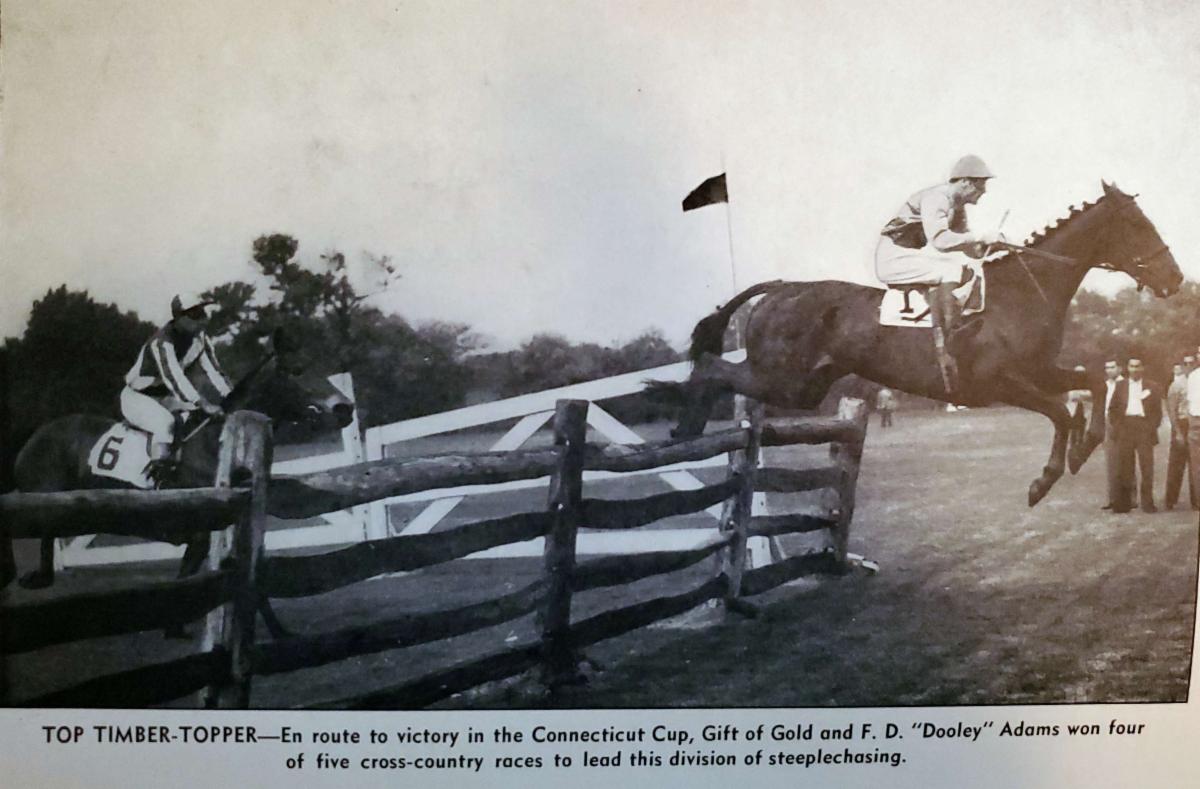
Carolina Cup winner Gift of Gold is one of Adams’ then-record 35 victories to kick off his 1951 championship campaign. Southern Pines neighbor Mickey Walsh trains the English import owned by his wife.
Son Frank Michael -- Mike -- Adams is born.
|
1952 –
Gift of Gold wins the Carolina Cup again, one of Adams’ 23 wins that championship year.
|
1953 –
Year-end champion with 22 winners from 120 rides.
|
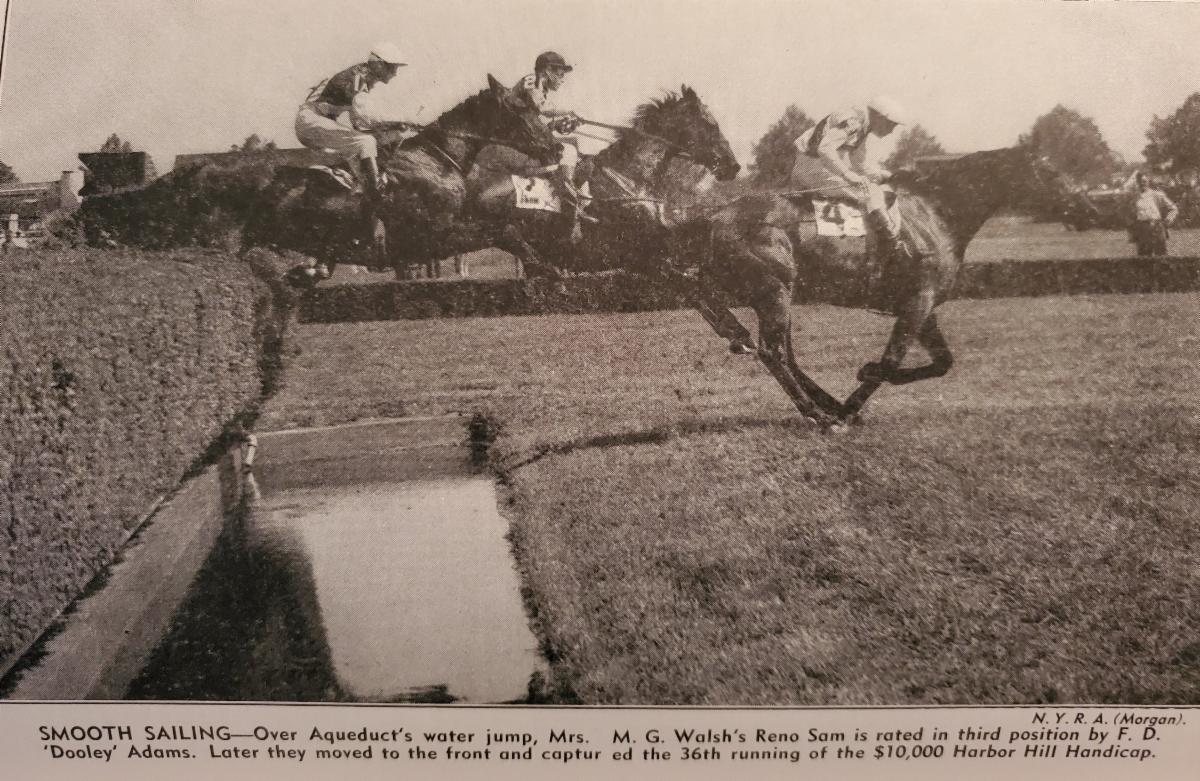
1953 photo of Adams (in third place in this photo) aboard Mrs. M.G. Walsh's Reno Sam, en route to winning the Harbor Hill Handicap. (NYRA / NSA Archives) |
1954 –
Year-end champion with 38 winners from 125 rides.
|
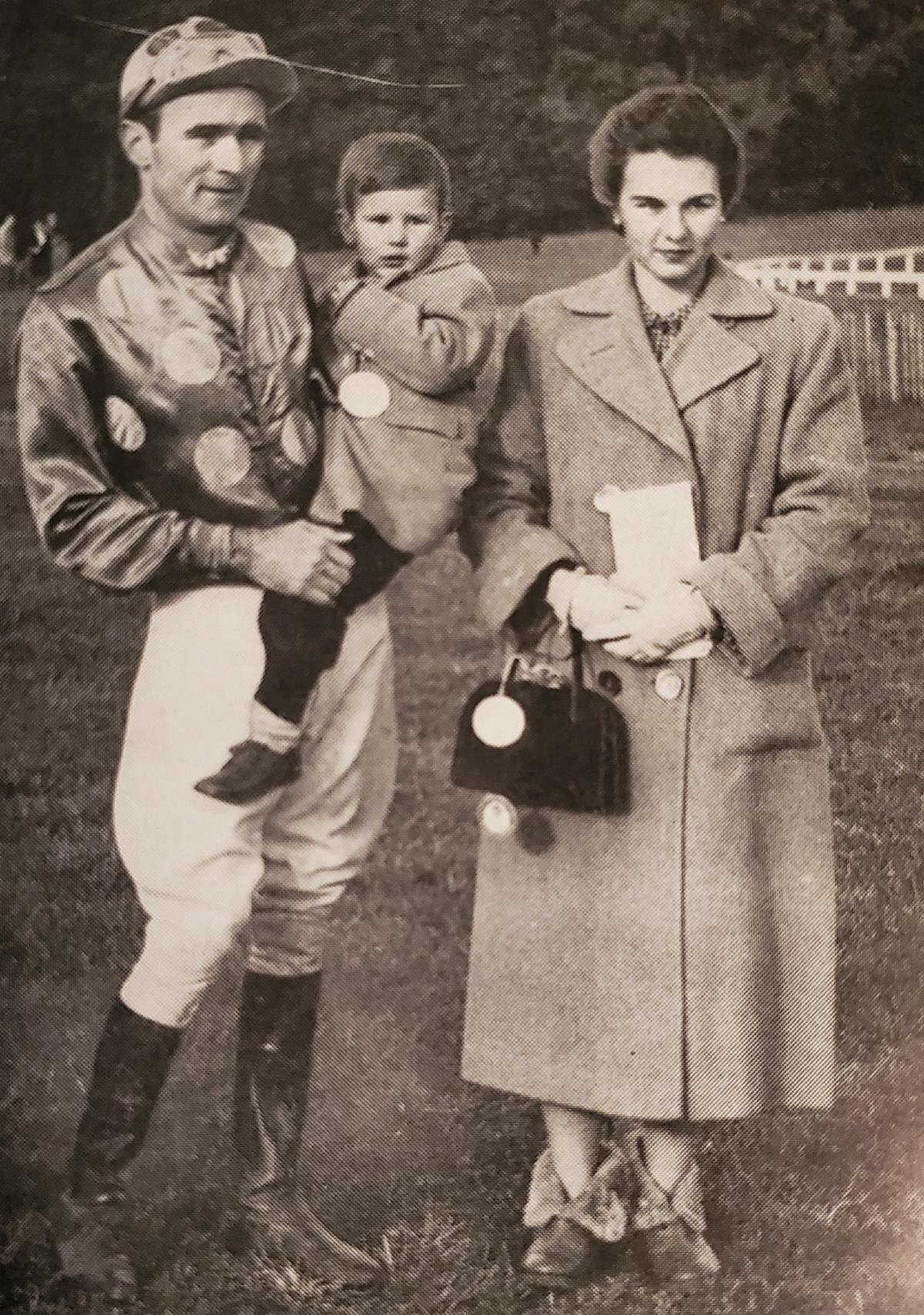
1954 "Steeplechasing in America" photo of Dooley Adams, three-year-old son Mike, and wife Cynthia. |
July 8, 1955 –
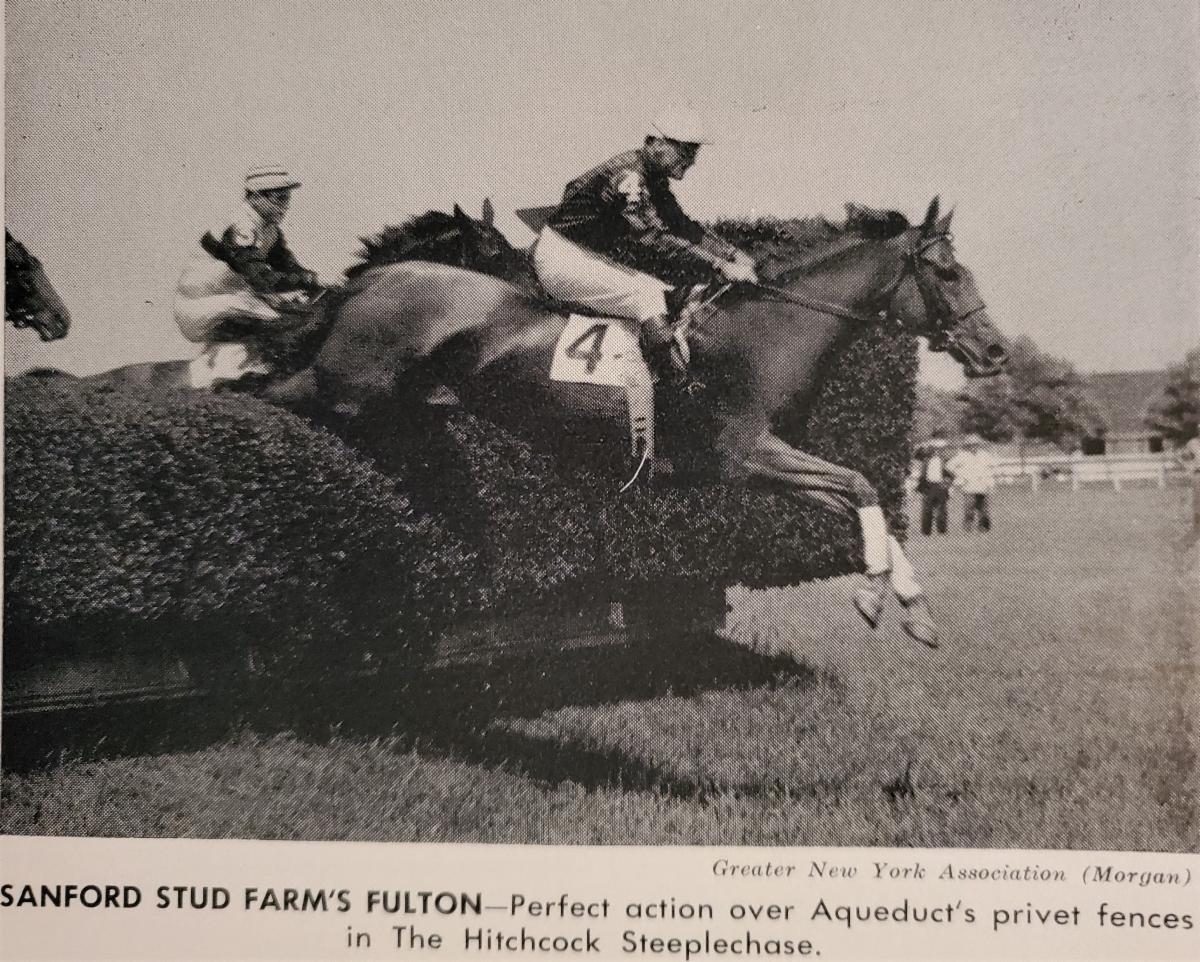
New York Times turfwriter Michael Strauss calls Adams a “sterling steerer” after he conjures a win with Sanford Stud Farm’s Fulton in a hurdle handicap, feature on an afternoon card at Aqueduct. It’s one of Adams’ 31 victories that year, his last championship season.
|
The 1955 "Steeplechasing in America" states, "While it is not necessarily news to state that Frank 'Dooley' Adams again led the list of steeplechase riders in 1955, it is interesting to note that he has held this position for seven consecutive years, a record never equaled on the American turf, by either a flat or steeplechase reinsman." |
1956 –
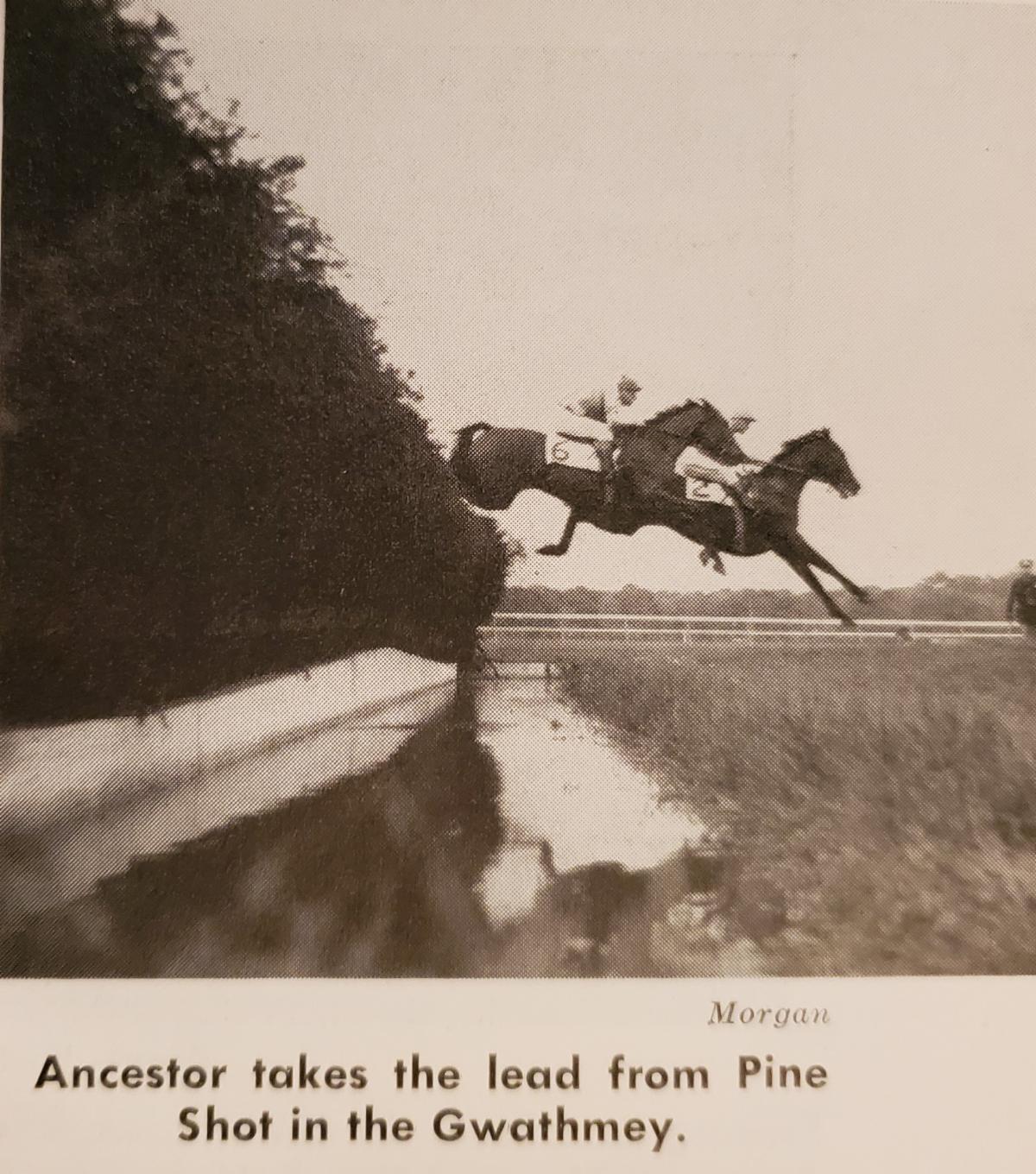
Dooley Adams retires from racing at age 29 after winning the Temple Gwathmey that year with Ancestor.
He accumulated a record 301 wins over jumps, plus 36 on the flat, and seven titles.
Son Mike Adams says his father opted for early retirement came because he “took a few falls, and those were the days they wore silk caps, not skull caps. You couldn’t do that too many times.”
After he retires from riding, Dooley works as a New York racing patrol judge for a few years. “Dad had always been pretty critical of race officiating,” Mike says. “This is how he said he wanted to give back to the sport and bring it up a notch. He was always about being fair.”
|
|
Mike Adams – Born to it
Retired jump jockey and flat trainer Mike Adams, now 70 and living in Texas since 1989, says he came by the horse-pro gene naturally. His father’s father was knighted by the Queen of England for having served in the Irish Lancers. His mother was a standardbred and thoroughbred trainer, one of the first women to saddle runners at the major tracks.
|
His mother’s father, Alex Fowble, was a trainer through the 1950s. He later worked for Bert Linder’s Hickory Hill Farm in Pennsylvania, selling bloodstock at the New York sales.
Mike learned to ride from his father at their Refugio Farm in Southern Pines, North Carolina, next to the old Stoneybrook racecourse. Mike rode about 200 races on the flat and about 100 over fences before weight caught up to him and he turned to training.
|
Mike Adams learning the ropes at a very young age from father Dooley Adams. (photo courtesy of Mike Adams) |
He worked as assistant trainer to Jim Maloney in New York, later training on the midwest and southwest circuits.
When he had stalls at Belmont, he was tickled to be assigned space in barn 43.
Frank Adams had stalls in Belmont Park’s the same barn 43, next to the old blacksmith shop. Across the courtyard was a modest little cabin that Frank and Clara lived in during the season. “That was fun to get his barn,” Mike says.
Mike Adams retired from training in 2015, bitter about the changes to his once-beloved industry. “It’s sad but true,” he laments, “but if you don’t have a bio-chemistry degree these days, you can’t compete. I’ve given up on horse racing, I’m afraid. It’s not like it was in the old days.”
Mike’s sister Melissa still owns and operates Refugio Farm, training kids and ponies and hunters.
Mike hunts with the Cloudline Hounds in Texas. He retired as whipper-in last year after seven seasons.
|
Mike Adams and father Dooley at Monmouth Park during Mike's steeplechase jockey days. |
He reflects on his father’s legacy. “I think dad never felt like he really ‘fit in’ with most of the other top riders” of his day, Mike says. “He wasn’t a heavy drinker, wasn’t a late partier. I think he felt a little like an outsider.”
It was somewhat the same, he adds, when his dad trained horses. “He was the ‘hay, oats and water’ type of trainer. He felt like to do right by his horses, he had to be a better horseman.”
When Mike Adams was training in New York, he remembers going to the track kitchen one day. He was approached “by a black guy, drunk as a hoot owl. He smelled terrible, hadn’t shaved in weeks. He calls me by name and is asking me for a job.
“Of course, I’m trying to slide away, but just to shut him up I said, ok, come by the office tomorrow morning after training hours.
“Sure enough, 10:15 next morning, here’s a knock on the door. This man is shaved, in a three-piece suit, smells nice. In his hand he has this win photo of him winning a jump race. My father was second.
“I didn’t even need any help, but I hired him on the spot.”
Henry Moore worked with Mike Adams for many years, Mike says.
|
Mike Adams says he doesn’t really miss jump racing, but on the other hand, he’s got a hunter right now he thinks would have been a top hurdler.
Tamnation (Texas-bred son of Early Flyer out of the blue hen, dual champion-producing Salt Lake mare, Salty Tam) won two of six races at Lone Star Park, but Mike says he’s a big, fast, smart horse that would have probably been a great hurdle horse.
“If I was back east, I’d definitely been tempted to run that sum’bitch. He’d lay 3/8ths down in :35 easy. Plenty of speed, and he’d run all day long.
“But those days are past.”
|
|
1964 –
Eventual Hall of Fame rider Joe Aitcheson Jr. surpasses Dooley Adams’ longtime single-season win record (38 in 1954) with 40 victories that year.
Aitcheson later told the Chronicle of the Horse that Adams was “a very, very intelligent rider. His mind was so good that he would plan things I couldn’t even calculate. When I broke his record, he wrote me a letter that said, ‘Joe, records were meant to be broken. Congratulations.’ That was a very classy thing to do.”
|
|
1966 –
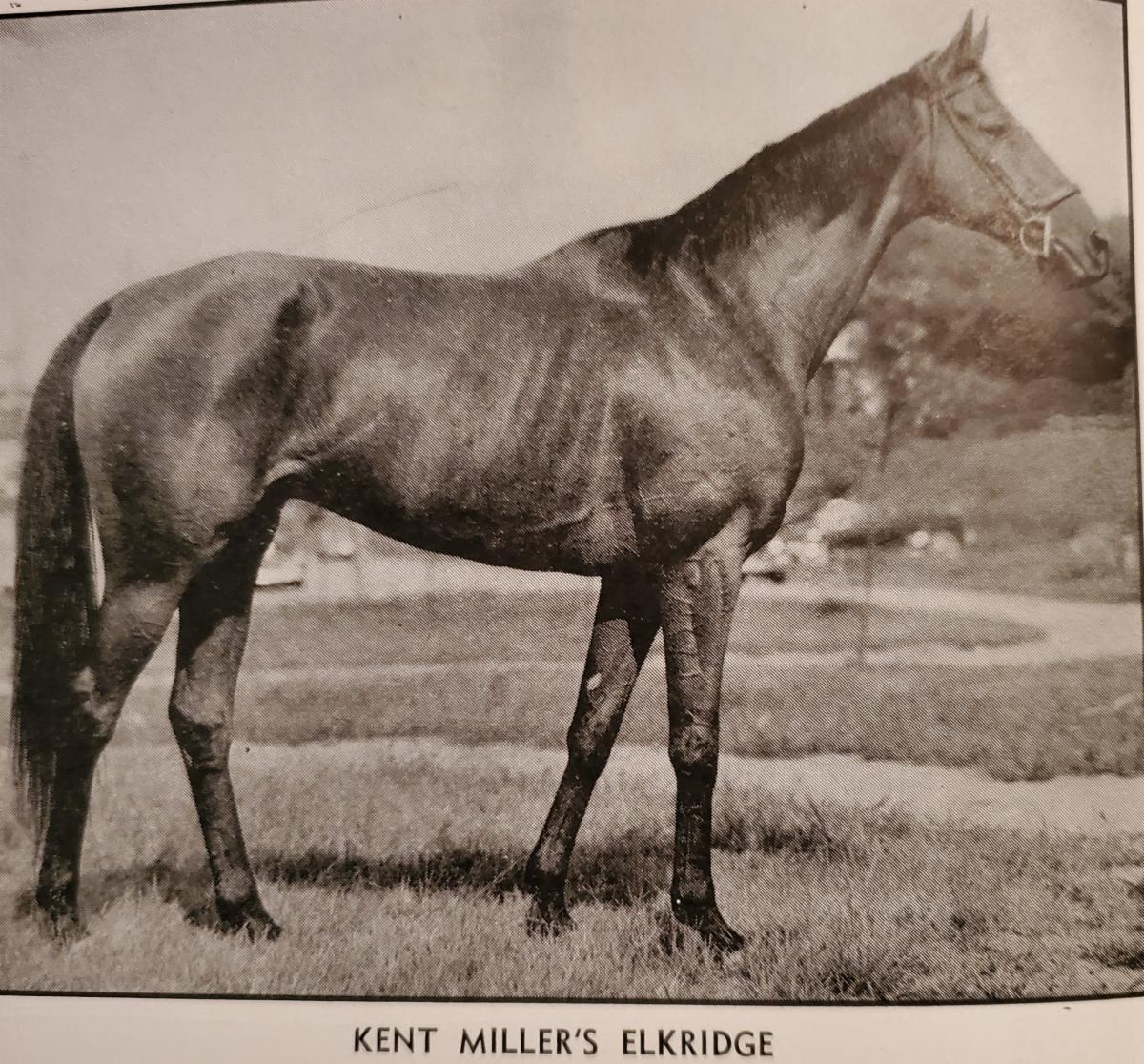
Two of the horses Adams rode extensively – champions Neji and Elkridge, are inducted into Racing’s Hall of Fame. Another, Oedipus, is inducted in 1978. Adams once called Elkridge “the finest horse” he ever rode.
Elkridge made 123 starts over 11 seasons without ever setting foot at a hunt meet, symbolic of Adams’ preponderance of wins at the major tracks since most of the nation’s top stakes races were conducted at flat tracks around the northeast in those days.
|
|
November 9, 1997 –
Arch Kingsley Jr. gets the call on a quirky 4-year-old California-bred trainer Dooley Adams had picked up for the shipping fee. Kingsley steers Al Skywalker to his maiden hurdle victory, launching an eight-year, multiple grade 1-winning career including the 2001 and 2003 Carolina Cups. Adams' Southern Pines neighbor Jennifer Majette trained Al Skywalker after 1999; Tom Foley was his chief rider.
The Charleston win is the one, Kingsley says, that notched his champion jockey title that season – he tied with Jonathan Kiser for the rider crown with 23 wins each.
Kingsley recalls he was pleased to get the ride from a trainer whose race riding career he knew was one to emulate. “Dooley was such a character, very unassuming and very humble,” Kingsley says. “Sure, he was pretty worn down by the sands of time when I rode Al Skywalker for him, but I totally looked up to him, because he was such a major player in this game.
“We really hit it off, and I liked it that he was full of old wisdom. I quote him all the time, and one of his favorite sayings really stuck with me.
“He’d say, ‘all a rider can do is get a horse beat. Good riders just get less horses beat than bad riders.’
“Dooley downplayed his own talents and accomplishments. He credited the horses, a quiet man of few words.”
|
|
May 2, 1998 –
Apprentice rider Petra Kappel gets the mount on Al Skywalker in 1998. She’d been working for Dan McCullum in Southern Pines; McCullum’s farm was next to Dooley Adams’ Refugio Farm.
Al Skywalker finishes third in the Brookhill starter handicap that day; the pair goes on to win at Strawberry Hill the next spring, following with a Brookhill feature score and a front-running victory in the grade 3 National Hunt Cup at Radnor May 15, 1999.
Like Kingsley, Kappel says she appreciated Adams for his status as a top jump rider of his day, but, just as much, for his soft, encouraging demeanor.
“Dooley deserves all the attention,” Kappel says. “He was a very kind, gentle person. I know people used to say he was like that with the horses when he was riding.
“The most important thing he ever said to me – and I was a bug rider, remember, so I was soaking it up – he said ‘be kind with your hands. The horse will talk to you.’
“I think that was really important to Dooley himself. He was more finesse than bullying.
“He was a great horseman and a great human. They don’t make them like that any more.”
|
|
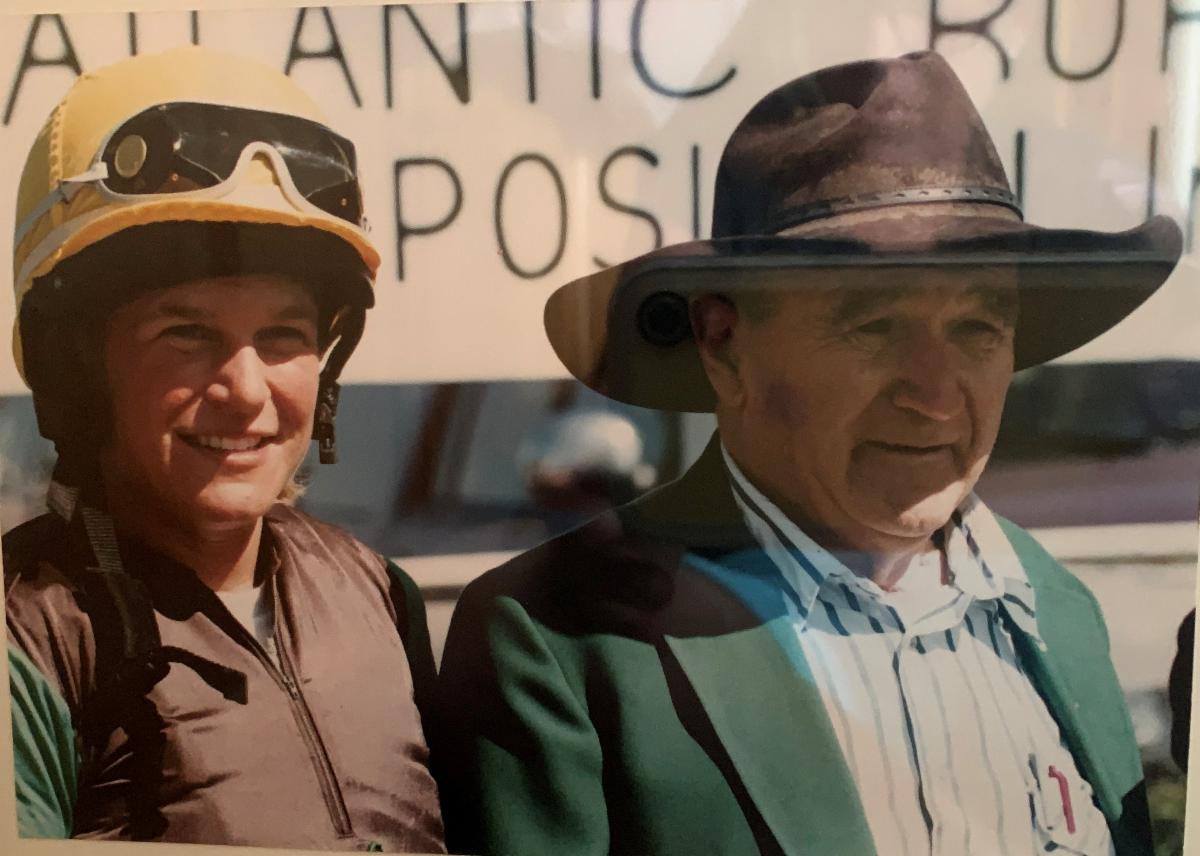
April 1999 photo of Petra Kappel and Dooley Adams, after a win with Al Skywalker in The Strawberry Hill Classic. (from Al Skywalker's win photo, courtesy of Mike Adams) |
|
|
November 12, 2004 –
According to the local newspaper, Dooley Adams dies “suddenly” at his Refugio Farm in Southern Pines. Like he told turfwriter Peter Winants, he's buried at the farm.
Son Mike Adams gives insight about his father’s passing at age 77.
“He was good up to the end,” Mike Adams says, saying his dad had high cholesterol. “He got in the hot tub (on the home’s back deck) that evening, and just died.
“He’d always made off-color jokes about how he hoped to die – something about climbing out a bedroom window, but I guess just sitting down in your hot tub at your house is close to perfect way to go.”
|
|
2005 –
The paddock at the Stoneybrook racecourse in the Carolina Horse Park in Raeford, North Carolina is posthumously named in Adams’ honor.
|
|
2012 –
Turfwriter Howard Rowe writes in the American Turf newsletter about the legend of Dooley Adams’ skill and fortitude in the saddle and out of it.
“Dooley …. was an intelligent and extremely industrious young man, surprisingly mature for his years. A true lover of horses, he was the leader of his profession because of a devotion to the sport itself, as well as the animals he rode.”
|
|
Mister Dooley lyrics
1. There is a man that's known to all, a man of great renown
A man who's name is on the lips of everyone in town
You read about him every day you've heard his name no doubt
And if he even sneezes they will get an Extra out
Chorus:
For Mister Dooley, for Mister Dooley
The greatest man the country ever knew
Quite diplomatic and democratic
Is Mister Dooley-ooley-ooley-oo
2. Napoleon had an army of a hundred thousand men
He marched them up the hill and then he marched them down again
When they were up why they were up, on that I'll bet a crown
And though Napoleon marched them up, who was it called them down?
Chorus:
'Twas Mister Dooley, 'twas Mister Dooley
He always knew a little parlevou
With Boni Partee, A la Ma Carty
Was Mister Dooley-ooley-ooley-oo
3. This country never can forget, forget we never will
The way the boys at San Juan they went charging up the hill
Though Teddy got the credit of that awful bloody fray
The hero who deserved it and the man who saved the day
Chorus:
'Twas Mister Dooley, 'twas Mister Dooley
Like a locomotive up the hill he flew
Who drove the Spaniards back to the Tanyards
'Twas Mister Dooley-ooley-ooley-oo
4. Now Wireless Telegraphy is cutting quite a dash
And messages across the sea, are sent now like a flash
With all the great inventors it has made an awful hit
And but few of them acknowledge that the man invented it
Chorus:
Was Mister Dooley, Mister Dooley
To Edison he taught a thing or two
And young Marconi, eats macaroni
Along with Mister Dooley-ooley-ooley-oo
5. Of Washington you've heard the tale about the Cherry tree
In fact it seems to be a part of Yankee History
Who cut that tree his father said, and George began to cry
Oh, father dear said little George, I cannot tell a lie
Chorus:
'Twas Mister Dooley, Mister Dooley
His father said now Georgie is it true
With meditation, was it Carrie Nation
Or Mr. Dooley-ooley-ooley-oo
6. Who settles all the labor strikes without a word or blow
And sees the men who work receive the right amount of dough
Who causes them to arbitrate, who uses all the grease
To keep the men of capital and labor both at peace
Chorus:
It's Mister Dooley, Mister Dooley
A man reporters like to interview
Who changed the manner of Marcus Hanna
Sure 'twas Mr. Dooley-ooley-ooley-oo
7. Of course you all remember the reception to the Prince
And every one who met him, voted Henny was immense
He says he had a bully time while he was over here
But the only man he ever met could beat him drinking beer
Chorus:
Was Mister Dooley, Mister Dooley
He drank more than the German's they could brew
The great adviser to Bill the Kaiser
Is Mr. Dooley-ooley-ooley-oo
8. Columbus he came over here in 1492
When New York was a vacant lot, if History is true
'Twas down at Castle Garden he first put his foot on land
And as he did the first one there to grab him by the hand
Chorus:
Was Mister Dooley, Mister Dooley
And he took him up Columbus Avenue
With head uncovered, said we're discovered
Did Mr. Dooley-ooley-ooley-oo
9. The great "400" haven't any leader so it seems
They want a man to show them how to eat their cakes and creams
It once was Ward McAllister who led the merry pace
And they claim there's only one man who can ever take his place
Chorus:
It's Mister Dooley, Mister Dooley
Who writes the jokes for Chauncey M. Depew
It seems that Chauncey took quite a fauncy
To the jokes of Mr. Dooley-ooley-oo
10. A doctor in this city, once his business it was bad
His name it was unknown, for not a customer he had
But now his name is famous, his success it is assurred
Just through a certain party, that this certain doctor cured
Chorus:
'Twas Mister Dooley, 'twas Mister Dooley
That made the Doctor known to me and you
For Dr. Munyon once cured a bunyon
For Mr. Dooley-ooley-ooley-oo
|
|
|
|
|
|
|