|
The NHS has a performance chief…. Tra…la!
I wonder what we expect her to do?
Count the numbers? Count the failures,
or … count our blessings, because…
… buried in all the dashboards, trajectories, league tables and recovery plans are NHS organisations and teams doing astonishingly well.
Perhaps the most important job in performance management isn't finding the worst, it's finding the best…and finding out why.
Take general practice. The 'performance chief' is set to give it a kicking.
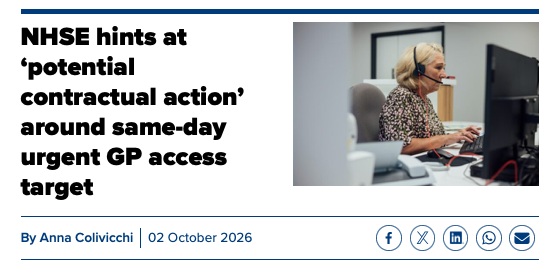
NHS England wants a stronger ‘operational grip’… yes, their words not mine… on GP access. Joy of joys, there’ll be…
- local improvement trajectories,
- recovery plans,
- regional performance reviews and, for practices falling short, the possibility of…
- contractual action... aka giving them the heave-ho.
It sounds muscular. It sounds like management, but …
…it's not improvement.
It's; look at me management, how tough am I! Performative claptrap.
Dentistry tells us that a public service does not collapse overnight. It leaks, practitioner by practitioner, patient by patient...
... until private provision becomes normal and NHS access becomes exceptional.
With private GP-use already four times its 2009 level, the leak has started. This sort of performance nonsense will accelerate it, and...
... there’s an inconvenient fact underneath all this.
General practice is actually getting back on its feet.
Apart from dealing with over a million appointments a day (yes, a day)… the latest figures show 75.9% of patients describe contacting their GP practice as easy.
Improving month-on-month and year-on-year.
On clinically urgent cases dealt with on the same day, performance has risen from 76.9% in June to 77.8% in August.
Not good enough but theses number are embers to fan into a bushfire of the better.
More interestingly, some places are doing much better.
Herefordshire and Worcestershire managed 87.2%.
That's not a failure to be managed. That's a blessing to be counted.
People who understand management have a name for this…
… Positive Deviance.
The idea is wonderfully simple.
In almost every organisation there are people achieving unusually good results despite working within broadly the same rules, resources and constraints as everyone else…
… it’s basis of the success of the Academy of Fabulous Stuff… sharing the good-stuff.
Instead of beginning with failure, begin with success. Before sending a letter to the 70-percenters...
... I'd get on a train to Hereford…
-
What are they doing?
-
How are appointments organised?
-
How does triage work?
-
What's their skill mix?
-
What happens when the phones light up on Monday morning?
-
What have they changed, and...
... perhaps most importantly, what have they stopped doing?
Then ask the question that rarely appears on a performance dashboard; what can the rest of us learn from it?
There is an important distinction here.
Performance measurement tells us where we are.
Performance management tells us where we're failing.
Performance improvement tells us how to get better.
They’re not the same thing.
Of course we need measurement, and...
... persistent poor performance cannot be ignored. A contract is a contract. If organisations continually fail patients, refuse help and cannot justify their performance, eventually someone has to intervene, but...
... intervention should be the end of the improvement process…
Edwards Deming said, in his seminal February 1993 seminar;
‘A bad system will beat a good person every time.’
If most practices are are struggling, with slow recovery and they are…look at the system, not the contract.
Which brings me back to the NHS performance chief, or more likely ‘the performative chief’… looking busy.
The NHS has mountains of data. We can compare system with system and practice with practice.
That creates an extraordinary opportunity.
Not simply to find the red but to
understand the green.
A dashboard tells us Hereford is at 87% and England is at 78%.
Performance management asks:
Why are the others only at 78%?
Performance improvement asks:
What on earth are they doing to get 87%… can we bottle it?
The job of a national performance function is to find the outliers. Visit them. Watch them work. Understand why they succeed.
Separate the genuinely transferable from the peculiarities of local circumstances. Then...
... connect people. Practitioner with practitioner. Practice manager with practice manager.
Show, don't tell.
The NHS already talks about spreading best practice. Has enough case studies to fill a library, but…
… when it comes to management, it’s easier to send out an insulting, threatening billet-doux than it is to find out, what’s good and nurture it.
Good managers are curious…
They keep asking why. Learn, unlearn and relearn. In a world changing too quickly for anyone to remain an expert for long, curiosity is more valuable than certainty.
Improving performance isn't about counting the failures. It's about counting our blessings and…
... counting on them.
|