|
Written by Kieran Delamont, Associate Editor, London Inc. | |
TECHNOLOGY
The controversial workplace ban you may need to consider
From sealed pouches to strict meeting rules, a growing number of companies are cracking down on employee phone use
| | |
IF YOU HAVE a kid in school, there’s growing signs that the days of using their phones on school property are limited. Just last week, Ontario’s education minister Paul Calandra mused about banning them, stating that “the evidence is becoming more and more clear that cellphone use in our schools … has become a problem.”
Ontario wouldn’t be blazing a new path here: around 40 per cent of jurisdictions, according to the Global Education Monitoring Report, have some kind of smartphone ban in schools.
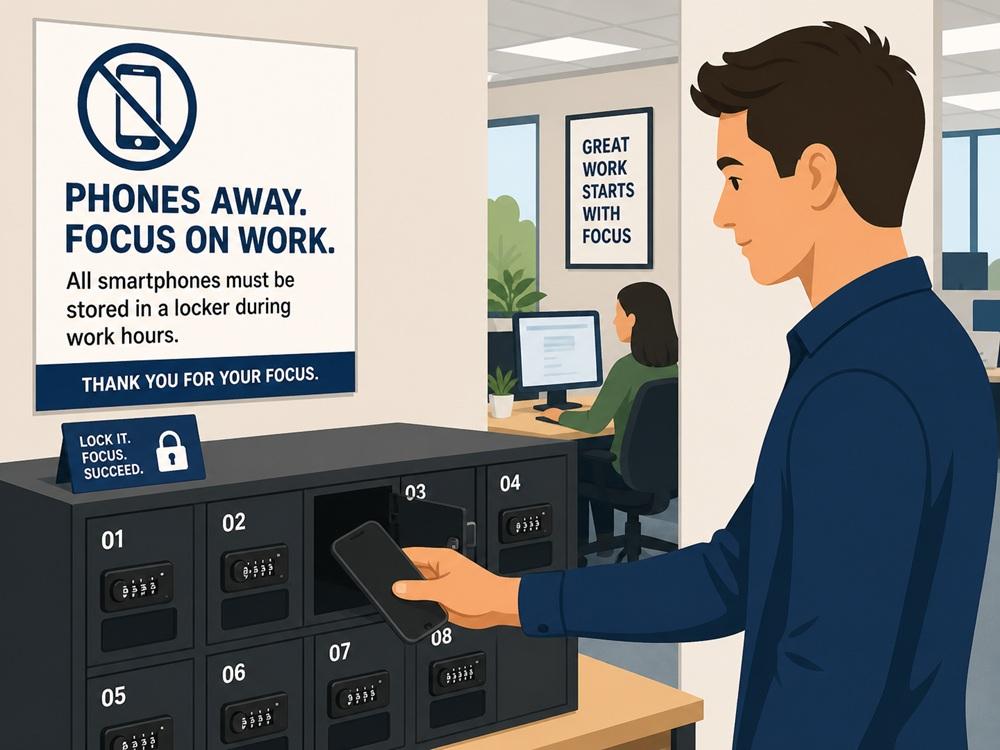
But what about in workplaces? A growing number of offices and employers are starting to wonder if what is good for the goose is good for the gander, and implementing similar smartphone bans on workplace property. “Some cite the motivation as preventing staff, intentionally or accidentally, from leaking sensitive information, such as customers’ private information or companies’ intellectual property,” reads a report from the Financial Times. “Others see them as simply a way to remove distractions, and build discipline, focus and team cohesion within their workforce.”
Some firms, wrote FT reporter Emma Jacobs, are having staff lock their phones away in Yondr bags (the type used by phone-free concerts, for instance) for the duration of their shift.
One of the most prominent firms to implement a phone ban is JPMorgan Chase, whose CEO, Jamie Dimon, appeared to have a personal vendetta against people using their phones at work. “People in meetings all the time who are getting notifications and personal texts or who are reading emails,” he complained in a letter to shareholders last year. “This has to stop. It’s disrespectful. It wastes time.”
It’s not just Dimon. According to the CEO of Yondr, Graham Dugoni, a larger number of workplaces are now reaching out about implementing anti-phone tech, acknowledging that asking people not to use their phones hasn’t always worked. “The organizations coming to us have usually already tried the honour system,” he told FT. “What these environments share is the recognition that a phone policy on paper is not the same as a phone-free environment.”
But there are unanswered questions about how effective it is to ban phones at work. According to productivity researcher Gloria Mark, “it takes an average of 23 minutes and 15 seconds to get back to the task” after an interruption of the sort phones offer. On the other hand, there is research to suggest that “micro-breaks,” where you release a bit of tension by scrolling your phone a little bit, “can be beneficial for both the employee and the organization,” according to researcher Sooyeol Kim.
But in practice, it may be worth exploring. According to the Financial Times, companies that have implemented bans report that — after an initial teething period — everyone seems to get on board. (Suggesting, perhaps, that many of us yearn to be free of our phones?) “In the first six months, violations were pretty frequent,” one senior VP at a software company said. But since then, things have settled. “I couldn’t tell you the last time we had anything like that.”
| |
HEALTH & WELLNESS
Paying the price
Canada’s mental health crisis is costing the economy an estimated $180 billion a year — and employers are shouldering most of the burden
| | |
WE GOT A new accounting on the cost of workplace mental health in Canada last week, with the release of a new report from the CSA Group’s Public Policy Centre. According to the report, which claims to be the most comprehensive costing to date, Canada’s mental health crisis is costing the country $180 billion every year, with employers absorbing $110 billion of those costs.
The dollar amounts attached to Canadian mental health has jumped substantially over the past two decades, the researchers warned. The previous benchmark figure often used came from the Mental Health Commission of Canada, which pegged the cost at $50 billion in 2011 dollars (around $67 billion in 2026), suggesting the costs paid have tripled. (The researchers also believe that even this is likely to be an underestimation, stemming from gaps in the data.)
What might alarm businesses is the interpretation by lead author Olga Morawczynski that employers are shouldering almost all the downstream costs — so much so that she called employers “the single largest payer for poor mental health in the country.”
The estimated $110 billion in costs borne by employers each year, the authors suggest, is largely made up of reactive costs: “disability leave, turnover, overtime, legal costs and investigations,” Morawczynski said. It might seem especially burdensome compared to public funding for mental health care, which amounted to just $23 billion in 2024.
“While the relationship is complex, mental health challenges are one of several factors that may contribute to workforce performance as nearly one in three Canadian workers report that their performance is directly affected by mental health challenges,” the report states. “At scale, this erosion of workforce effectiveness may be connected to Canada’s broader productivity problem and warrants closer examination.”
Workplaces and human resources departments can only do so much to combat a society-wide mental health crisis, but Morawczynski suggests firms can do something. For one, they can look at the data suggesting that only 14 per cent of the spending is done proactively (the rest being after-the-fact reactive spending) and start to shift the balance.
“It doesn’t have to be expensive or a crazy process,” said Morawczynski. “I did not find that a lot of organizations really invest in training their leaders around mental health and ensuring their leaders know how to support employees. A lot of them didn’t know exactly what types of resources companies were paying for.”
| |
| |
Terry Talk: The $24,000 pay gap that is quietly breaking your hiring process
| Employers hire with budgets, internal equity and financial reality in mind. Candidates price themselves based on market noise and partial information. When those two worlds don’t meet, trust breaks and offers die. In this Terry Talk, Ahria Consulting president & CEO Terry Gillis unpacks why recruiters don’t just find talent — they also translate reality early so expectations align from day one. | | | |
LEADERSHIP
The greying corner office
The average CEO age is up a decade from 2000. Will younger generations miss out on the top role?
| | |
AT LEAST TWO things were notable about the newly-announced CEO of Apple, John Ternus, who will replace Tim Cook in September. The first is that not many people had heard of him, having been a career employee within Apple who rose up the ranks; the second was that he isn’t all that old.
The average CEO among American companies is now 61 years old — up a decade since 2000 — and executives are reaching the top job later, with the average appointment age rising to 55, compared to 48 in 2000.
The National Bureau of Economic Research has studied this phenomenon and concluded in a recent working paper that it comes down largely to the type of skills and experience that land you in the corner office these days. There is, they suggest, “rising demand for generalist human capital,” which “leads firms to trade off peak ability for accumulated experience.” Firms, they wrote, “place greater weight on diversified managerial experience as operating environments have become increasingly uncertain and complex.”
The pace of this aging trend might be accelerating. Similar research from Revelio Labs from 2024 found that the average age of a CEO rose by three years between 2018 and 2024. “Companies are favouring older, more experienced leaders over younger ones,” its analysis concluded. “The shift might reflect a preference for the stability and extensive knowledge that seasoned leaders bring to the complex and rapidly evolving business landscape.”
One might interpret this as a rational response to uncertainty. A generalist with a long resume and a ton of experience might be seen as a safer pick than a younger choice. Under that interpretation, it might be a good decade to be an older executive, as “the premium will only increase,” according to Farzad Saidi, an author on the NBER report, who spoke to Axios.
The other interpretation some might have is this: boomers stay winning. Tempting, and perhaps cathartic, but Axios warns the interpretation might gloss over the fact that ageism is alive and well. “For many regular workers, ageism is a drag that eventually knocks them out of the workforce or keeps them from climbing the ladder,” they wrote, “but a select group of the 55-plus crowd is finding its way to the top.”
| |
AI & BUSINESS
Release the goblins
The unintended consequences of teaching AI to be nerdy
| | |
|
CHATGPT HAS BEEN talking a lot about goblins. And, apparently, other creatures, including gremlins, raccoons, trolls, ogres and pigeons. It apparently loves a bit of whimsy — so much so that OpenAI has had to step in and take the wheel.
Last week, the company published a corporate blog to try and explain things: “Starting with GPT-5.1, our models began developing a strange habit: they increasingly mentioned goblins, gremlins and other creatures in their metaphors. […] The habit became hard to miss: the goblins kept multiplying, and we needed to figure out where they came from.”
Suddenly, though, goblins were everywhere. According to OpenAI, use of the word goblin in the LLM’s outputs rose by 175 per cent; gremlins rose by 52 per cent. The culprit, it concluded, was the “nerdy” personality voice layer it had programmed into the chatbot, which OpenAI eventually retired last month.
Yes, it’s all cute (or creepy, depending on your view), but OpenAI had a larger point in coming clean on the goblin issue. “They are also a powerful example of how reward signals can shape model behaviour in unexpected ways, and how models can learn to generalize rewards in certain situations,” the firm wrote. “Taking the time to understand why a model is behaving in a strange way, and building out ways to investigate those patterns quickly, is an important capability.”
Indeed, in a professional world filled with more and more output content from LLMs, the goblin question is one worth thinking about, especially as courts rule that companies can be held liable for the chatbots they deploy. In 2024, Air Canada got dinged for this, with a B.C. court forcing them to honour a refund policy that its LLM-powered chatbot had hallucinated. It wasn’t goblin-related, but the point is a good one: it is worth understanding exactly how LLMs work, how they arrive at their outputs, if you’re going to make any use of them.
Roughly half of the workforce is now using an AI chatbot in some form or another, and the guardrails against tendencies as absurd as repeated goblin mentions aren’t necessarily that strong. It is worth, at very least, keeping in mind the conclusion drawn by Wharton professor Ethan Mollick, an oft-cited academic in the workplace-AI space, as you think about how to integrate AI into whatever you’re doing at work: “AIs are weird.”
|
| | | | |