Everyone has forgotten the Tariff Tantrum of April 2025: actual tariffs are lower than originally feared, tax cuts were extended indefinitely, and government largesse remains off the charts. Let's look at some data and tease out a likely path going forward.

Market Update - September 2025

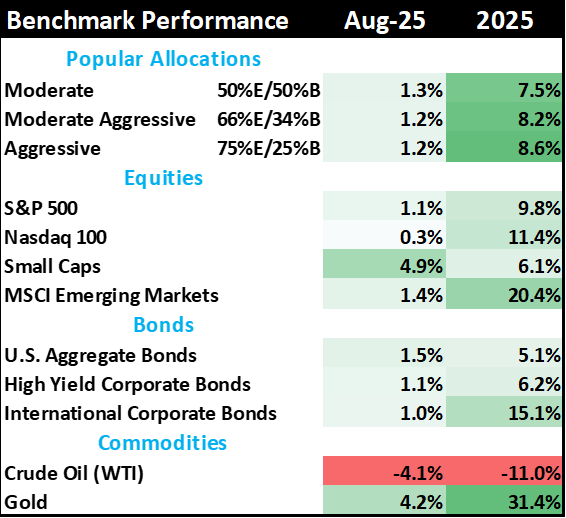
  • On the heels of the tax cut approval, small cap stocks put in a remarkable performance during August. Gold also did well as President Trump renewed his attack on the Federal Reserve by threatening to replace FOMC member Lisa Cook after she was caught committing mortgage fraud.


  • Year-to-date, Emerging Market stocks and International Bonds remain standouts as the dollar weakened and Chinese stocks rallied on the rollout of new stimulus programs.


  • Profits from artificial intelligence are the center pole holding up the tent of the markets. A recent MIT study reveals difficulty using this new technology.


  • Inflation remains muted; the bond market awaits the inevitable Fed rate cuts.

Broad market performance

Table 1: Market performance estimates as of 8/29/2025 (LIMW)

A little boost for stocks in August

Despite all the talking and headlines in August, the stock market only rose slightly during the month. The market seems tired after all the drama surrounding tariffs, taxes and Federal Reserve politics.


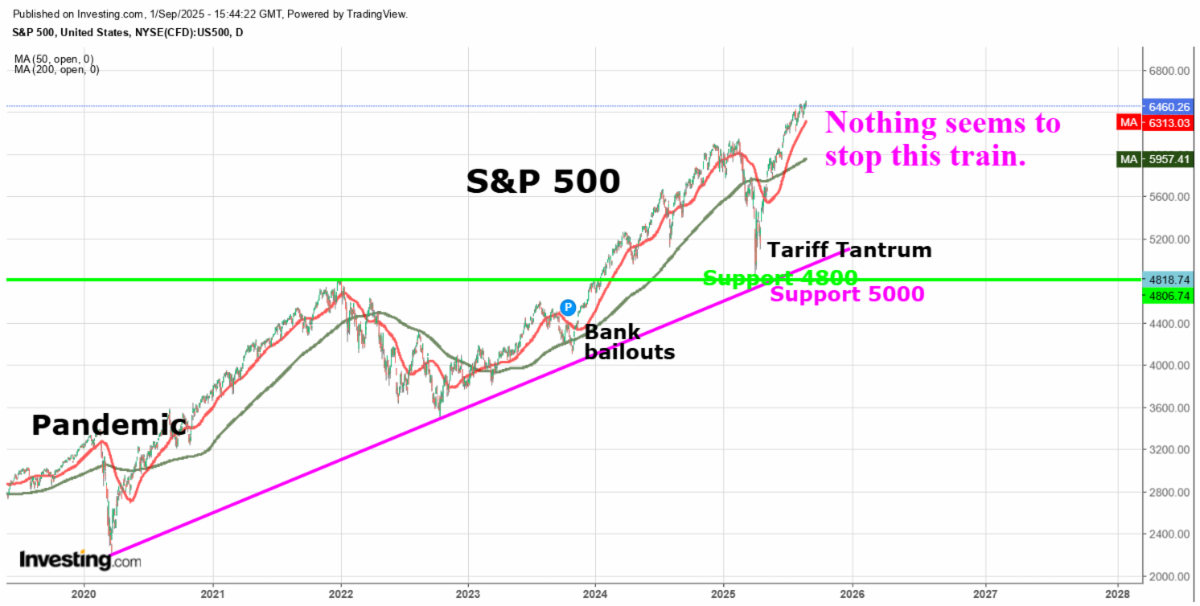
In the grand scheme of things, we can see that the period of March-April 2025 was a garden-variety "non-recessionary" bear market. The market has quickly recovered and rebounded to new highs.


From a trading perspective, the market looks pretty good: multiple levels of support were tested at the low 5,000 level and held. Core technology companies continue to put up good earnings, driving bullish sentiment.


Figure 1: S&P 500 performance 2020-2025 (LIWM)

However, we have to recognize that the stock market is a community of "haves" and "have-nots". Technology companies are raking in enormous profits as the artificial intelligence platforms get built, while the rest of the economy and market struggle with stagflation left over from the pandemic.


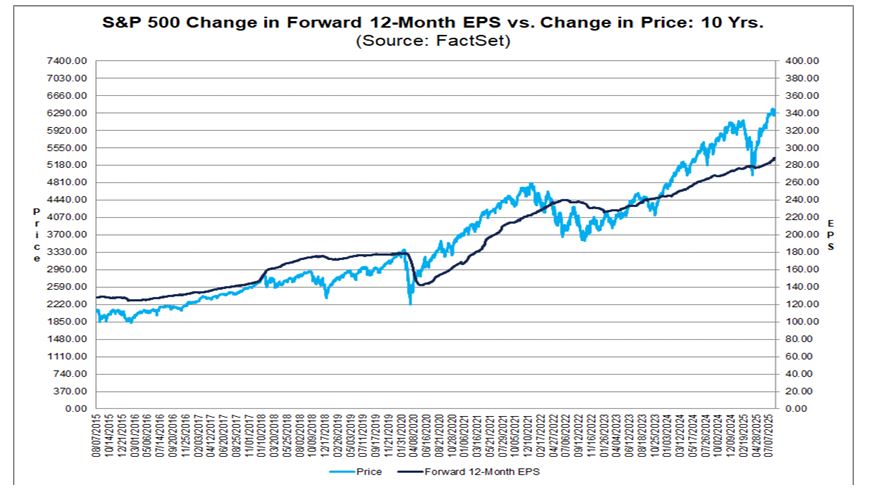
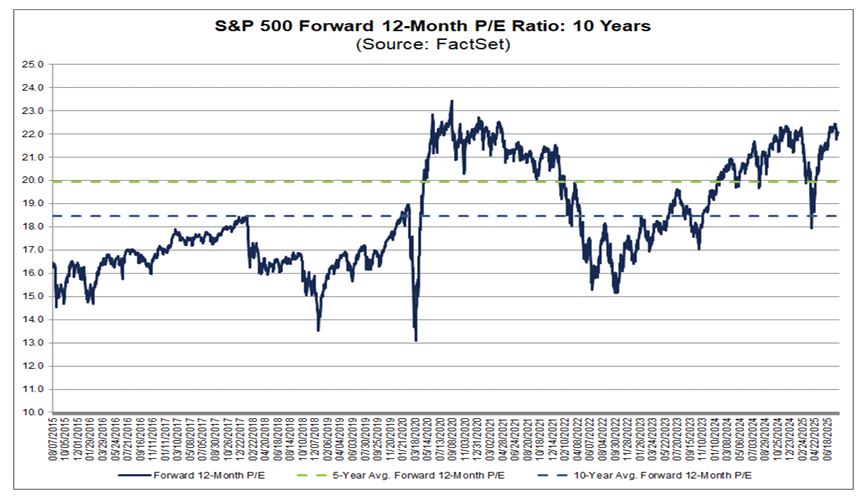
Earnings as a whole look good; valuations are historically high.


Figure 2: S&P 500 forward earnings (Factset)

Figure 3: S&P 500 Forward 12-month Price/Earnings ratio (Factset)

Are tech stocks in a bubble?

There are many ways to identify a stock market bubble, but none of them are precise. Many analysts use valuations or comparative performance charts to show historical periods, but it is difficult to apply them in real time.


The problem is that while history may rhyme, it does not repeat exactly. The circumstances we see in today's economy are similar, but not identical to other historical periods.


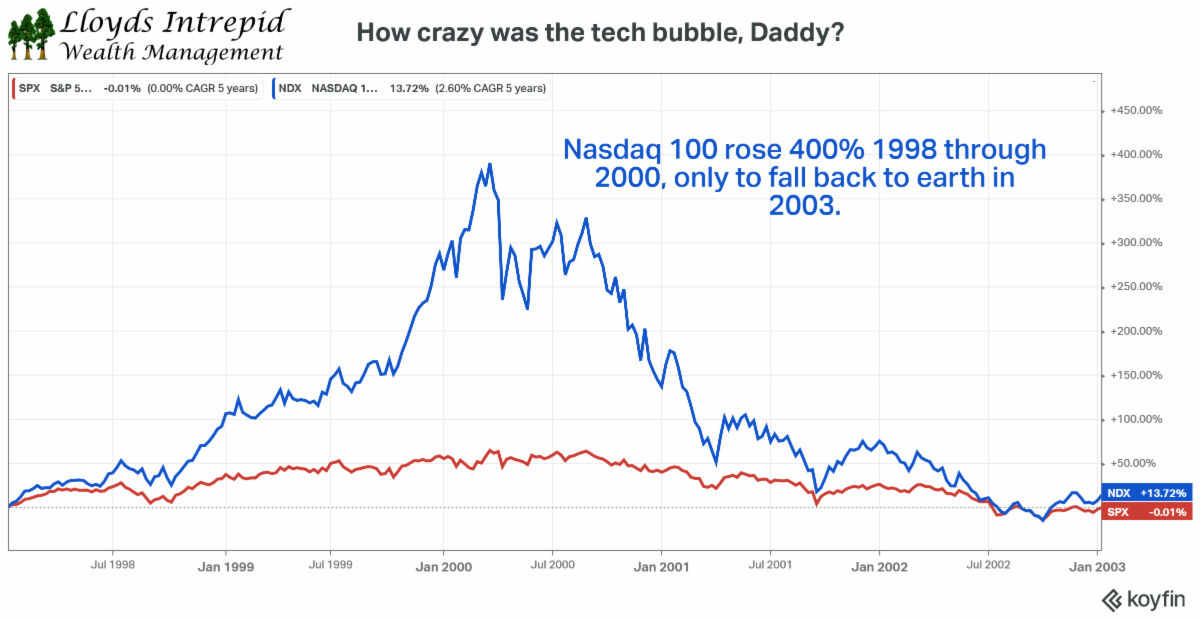
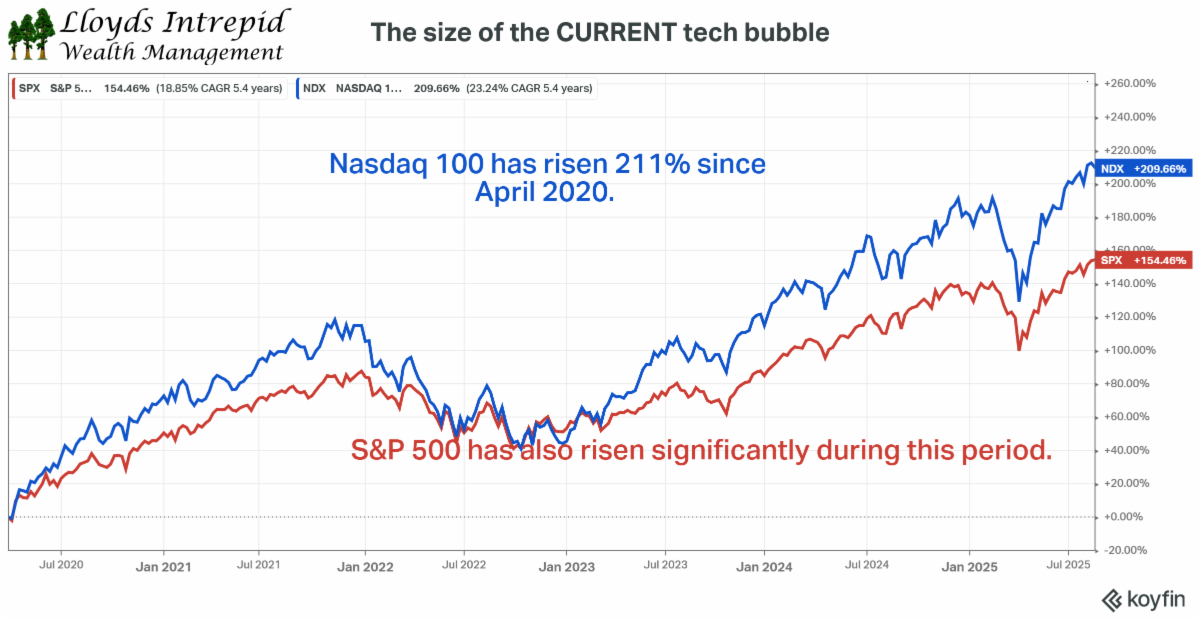
Let's compare how the Nasdaq performed during the 2000 tech bubble with today's price action. Note that the extreme price movement of the late 1990s is not present today.


Figure 4: Technology stocks significantly outperformed the S&P 500 1998-2000, but then gave it all back by 2003 (LIWM)

Figure 5: Technology stocks compared to the S&P 500 today: April 2020-August 2025 (LIWM).

In conclusion, even though we have record valuations by multiple metrics, the price action of the last few years does NOT resemble that of the 2000 tech bubble.

The AI rollout is not going well

The earnings growth from technology companies are an important support for current market valuations. So, naturally, we are interested in how artificial intelligence (AI) is getting used by Corporate America. After all, these are the organizations with the budget and manpower to test, develop and implement solutions.


So far, the results are very disappointing.


MIT recently published a report looking at $30-40 billion in enterprise AI investments across 300 different implementations. Only 5% of AI pilot programs were generating value, while most remain stuck with no measurable P&L impact.


Five Myths About GenAI in the Enterprise


1. AI Will Replace Most Jobs in the Next Few Years → Research found limited layoffs from GenAI, and only in industries that are already affected significantly by AI. There is no consensus among executives as to hiring levels over the next 3-5 years.


2. Generative AI is Transforming Business → Adoption is high, but transformation is rare. Only 5% of enterprises have AI tools integrated in workflows at scale and 7 of 9 sectors show no real structural change.


3. Enterprises are slow in adopting new tech → Enterprises are extremely eager to adopt AI and 90% have seriously explored buying an AI solution.


4. The biggest thing holding back AI is model quality, legal, data, risk → What's

really holding it back is that most AI tools don't learn and don’t integrate well into workflows.


5. The best enterprises are building their own tools → However, internal builds fail twice as often. 


The largest complaints about the AI rollouts: it doesn't adapt, can't be customized, requires too much context for each query, and it didn't learn from historical feedback.


Here is a link to the full report: MIT NANDA report on GEN AI


For now, money is getting spent rolling out this new technology out. Large companies hope to replace expensive employees with a cheaper software solution. However, if sponsors begin cutting projects, then the entire profit model for the market's largest companies is in peril.

Despite concern, inflation is muted

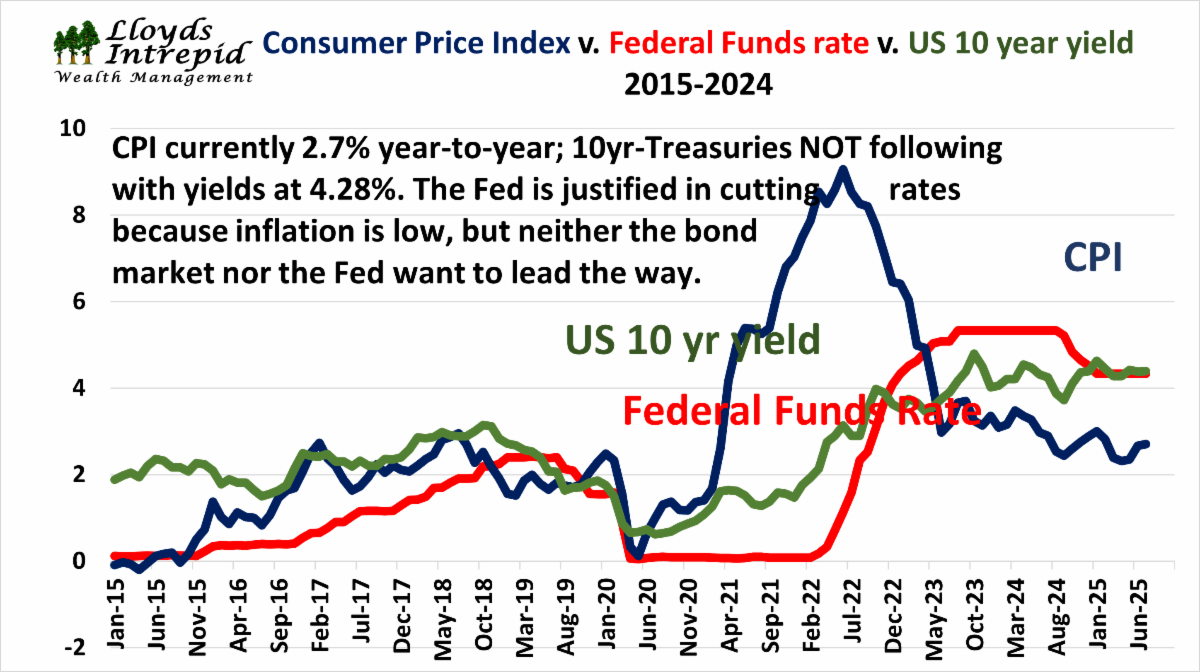
Inflation remains broadly muted. While not at the Fed's 2% target, the fears of rising inflation remain in the future, in our view.


Figure 6: Comparison of CPI, Federal Funds rate and US 10 year yield 2015-2025 (LIWM)

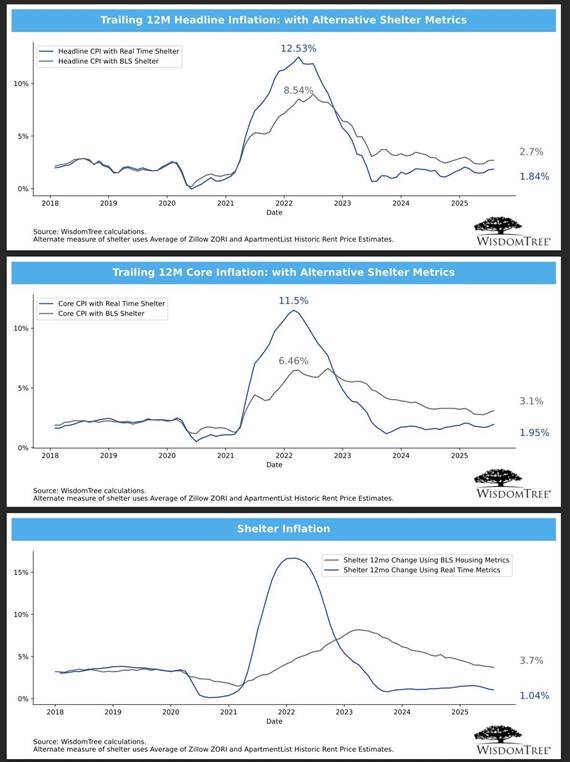
There is some evidence that the government inflation metrics are slightly inflated because they use shelter inflation data that takes time to flow into the official government statistics. Wisdom tree has several different cuts of the data using real-time shelter inflation over the last few years.


In general, this confirms our view of muted inflation in the SHORT term. However, the size of the Federal budget deficit is gargantuan and will create LONG term inflation problems. As rates fall, we expect bonds to rally.


Figure 7: Inflation metrics comparing Real Time metrics with BLS shelter inflation statistics (WisdomTree)

The bond market thinks the Fed will cut rates

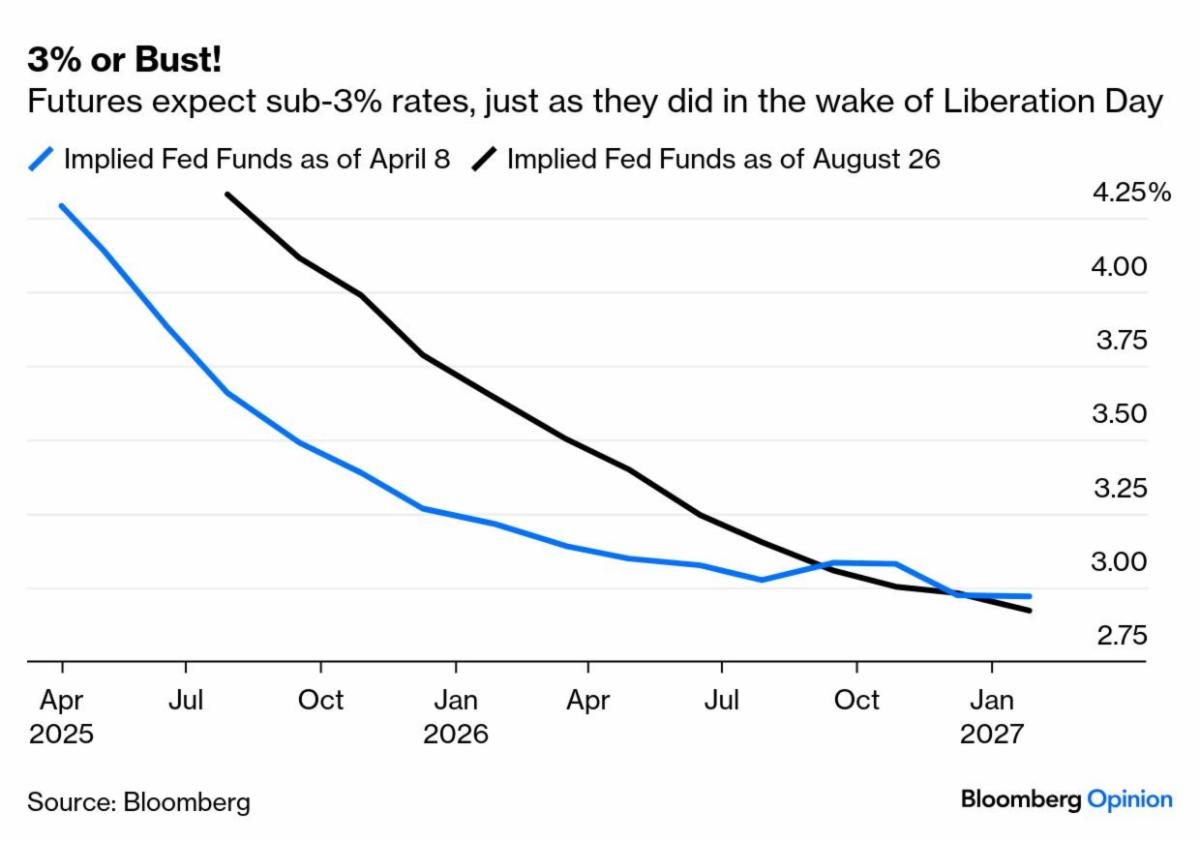
The bond market provides us an implicit forecast of Federal Funds interest rates that we can observe each day. The bond market is expecting the Fed to cuts rates soon and finish up at 3% by January 2027.


Figure 8: Implied Federal Funds rate (Bloomberg)

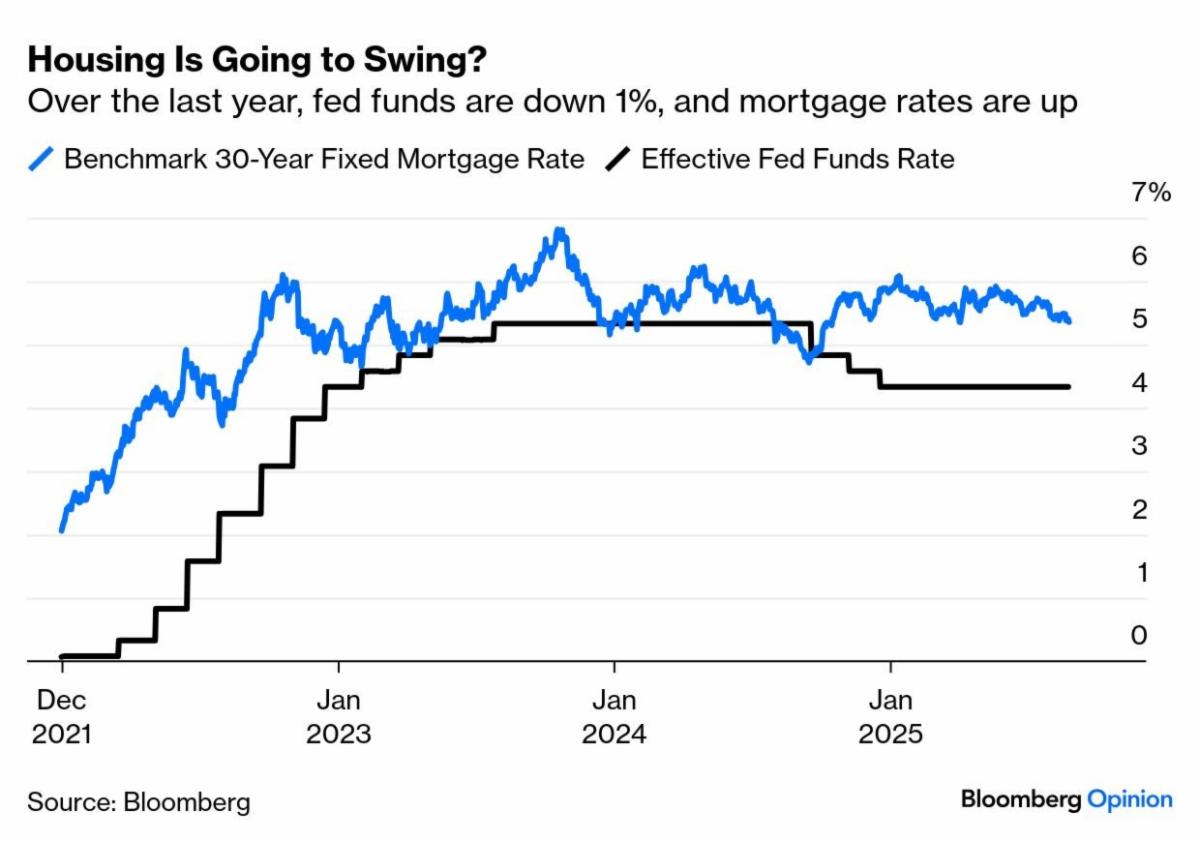
Mortgage rates have not been helped by the Fed's rate cuts in 2024. While mortgages are a large sub-set of the broad bond market, they play a significant role in voter happiness and housing market health. So far, they have NOT fallen with the Fed rate cuts.


It is difficult to tease out a single cause, but here are some likely candidates:


  1. Lower Fed Funds rate happens during slower economic growth, lowering the credit quality of mortgage bonds (ie default rates might rise).
  2. Long-term bonds are worried about inflation and have not fallen as much as the Fed cut rates.
  3. The Federal Reserve has been rebalancing their portfolio, letting mortgage bonds mature and rotating their exposure into US Treasury bonds.

Figure 9: Federal Funds rate versus 30-year Fixed Mortgage rate (Bloomberg)

The end of a busy summer

Lake Conroe in Texas is the place where Brenda and I have spent many days on the water. The open lake can be rough, but there are nooks and crannies where it is pleasant to anchor, fish or water ski. 


My nieces came to visit us in August, so we had an excuse to go out on the lake on weekdays. They were some of the most beautiful lake days we've ever had in the last 20 years: 92 degrees, a light breeze and a sea of glass. Just perfect.


It was a reminder that relaxation is part of life. While work is good, there must be times to step back and have some fun.


I hope you are all getting a few hours for yourselves as the summer winds down. 


Can you believe it is September already?

Final thoughts

The markets have successfully navigated trade wars, tax code changes, and a Mid-East war over the last six months. Employment and earnings are still good, so for now, the market may likely grind higher.


As always, we welcome your feedback and are happy to discuss our research and how it applies to your situation.

Rob 281-402-8284

Chris 281-547-7542

 
Robert_2 Social Media - Rounded Edges.png

Rob Lloyd, CFA®

Lloyds Intrepid Wealth Management

1330 Lake Robbins Dr., Suite 560

The Woodlands, TX  77380


281-402-8284

Robert.Lloyd@lloydsintrepid.com

www.lloydsintrepid.com

Christopher Lloyd, CFP ®

Vice President and Senior Wealth Planner

Lloyds Intrepid Wealth Management

1330 Lake Robbins Dr., Suite 560

The Woodlands, TX  77380


281-547-7542

Chris.Lloyd@lloydsintrepid.com

www.lloydsintrepid.com

X Share This Email
LinkedIn Share This Email
Facebook  Twitter  LinkedIn

Lloyds Intrepid LLC is an Investment Advisor registered with the State of Texas, where it is doing business as Lloyds Intrepid Wealth Management. All views, expressions, and opinions included in this communication are subject to change. This communication is not intended as an offer or solicitation to buy, hold or sell any financial instrument or investment advisory services. Any information provided has been obtained from sources considered reliable, but we do not guarantee the accuracy, or the completeness of, any description of securities, markets or developments mentioned. We may, from time to time, have a position in the securities mentioned and may execute transactions that may not be consistent with this communication's conclusions. Please contact us at 281.886.3039 if there is any change in your financial situation, needs, goals or objectives, or if you wish to initiate any restrictions on the management of the account or modify existing restrictions. Additionally, we recommend you compare any account reports from Lloyds Intrepid LLC with the account statements from your Custodian. Please notify us if you do not receive statements from your Custodian on at least a quarterly basis. Our current disclosure brochure, Form ADV Part 2, is available for your review upon request, and on our website, www.LloydsIntrepid.com. This disclosure brochure, or a summary of material changes made, is also provided to our clients on an annual basis.