Thinking Maps: A Language for Learning
Rollout: Week 7     Focus Map: MULTI-FLOW                                                           MAP
 

"Each school year should begin with some kind of Thinking Map introductory schedule. These introductory weeks allow teachers and students to refocus on all 8 Thinking Maps and give new hires and new students an opportunity to develop an ownership and expertise with the maps" (A Language for Learning Trainer's Guide).

Each Thinking Map will be taught and introduced through the gradual release of responsibility model. In this way, all students, TK through High School, will become responsible for the learning and use of the maps both with the teacher and independently.

September 25-September 29, 2017
Introduce, model, and teach the 
Multi-Flow Map.
The Multi-Flow Map allows students to answer questions such as, 
"What are the causes and effects of this event ?" 
or 
"Why did this event take place?"

Key Words: causes and effects, discuss the consequences, What would happen if?, if...then, predict, identify motives, why, results, outcomes, benefits

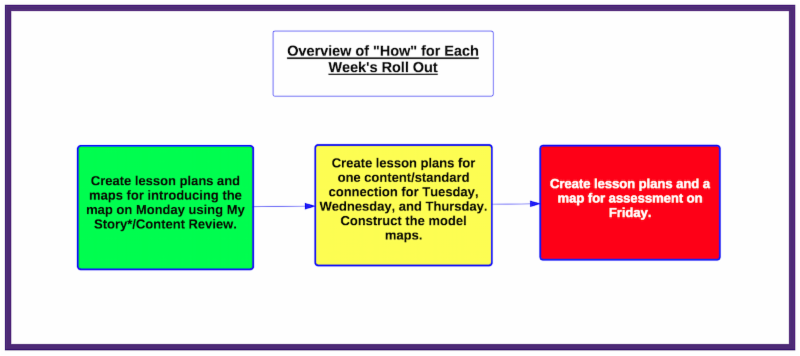
Each week, schools, teachers, and students will focus on learning one Thinking Map a week to develop ownership. Thinking Maps learned in previous weeks will continue to be incorporated in lessons.
Troubleshooting Multi-Flow Maps

      Multi-Flow Maps begin with the event in the center of the map.  The event should be a "happening" and not the name of a topic.  Notice that all arrows on a Multi-Flow point to the right. 


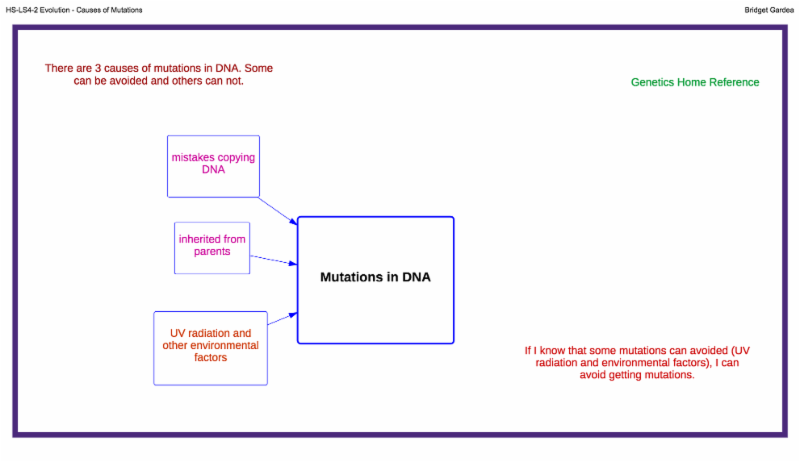
     Students can construct a one-sided Multi-Flow Map in order to focus on just the causes or reasons for an event or just the effects or outcomes of an event. The images below are examples of one-sided Multi-Flow maps.
     
This map focuses on the effects or outcomes of an event.
This map focuses on just the causes of an event.

Reference Pages for the book above:
Teaching Thinking Maps Using My Story
Elementary -- pages 108 and 110
Secondary--pages 109 and 110
Content & Grade level Suggestions
Literacy Links--Chapter 3 
Standards Based Connections--Chapter 4
Additional Information on the Multi-Flow Map:
Pages 60-65
Reference Pages for the book above:
Teaching Thinking Maps Using My Story-
Elementary-pages 115 and 117
Secondary-pages 116 and 117
Content & Grade Level Connections 
Literacy Links--Chapter 3 
Content Connections--Chapter 4
Additional information for the Flow Map:
Pages 60-64
Frame of Reference
Teach and utilize the Frame of Reference as you teach each map.

Frame of Reference
Thinking Maps in PUSD

Please use this link to submit photos of Thinking Maps being used in PUSD. Submission of photos does not guarantee that photos will be shared with others. All submissions must meet the following requirements.
  • The submitter has accurately described and provided any important information about the Thinking Map.
  • The Thinking Map is correctly drawn.
  • The Thinking Map and the thought process are accurately matched.
  • The Thinking Map is:
    • Legible
    • In focus
    • Right side up
    • No less than 120x80px (80x120px) and no more than 10MB.
  • The Thinking Map does not display student(s)' faces.
Location of curated Thinking Maps will be forthcoming.
Need Additional Support?
Click  here and request support from a Teacher Specialist.

~ Division of Educational Services ~