We envision a State where foundation leaders from every region are engaged in aligning and leveraging resources, developing and implementing inter-sectional approaches to community challenges, and being allies to advocates and community organizers who are addressing the needs of the most vulnerable and marginalized communities throughout New York.
|
|
Engage New York Grants
$1 Million to
COVID-19 Relief Efforts
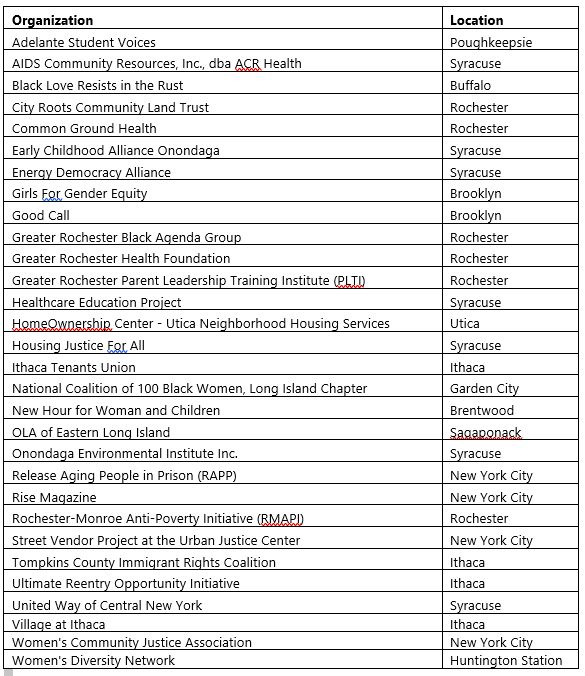
In early April, Engage New York received a $1 million dollar grant from a national foundation interested in supporting community-based groups in New York. Organizations that were prioritized in this grant process have a proven track record of working in communities most adversely affected by COVID-19 and the related economic crisis, center racial and gender justice in their theory of change, and in their programmatic work. Most of the groups that were awarded grants had not yet identified significant sources of funding, and/or their work with constituents was overlooked by other funding sources. Most importantly, the organizations awarded can connect their relief work to on-going efforts to address systemic inequity particularly as it relates to health, housing, criminal justice, racial justice, immigrants’ rights, and economic justice. The first round of grants was awarded in May, and the second round is being awarded in July.
To learn more about the organizations that were funded through the process, click here.
|
|
Racial Equity Pooled Fund Grantees Announced |
In mid-June, Engage New York released an invite-only RFP to organizations and coalitions that are well-positioned to advocate for equitable policies at the state level using data about how COVID-19 is disproportionately impacting communities of color across the State.
Food Chain Workers Alliance and the Workers Justice Center
Project Budget: $75,863
Funding Amount: $50,000
Project Focus: To support the implementation of a farmworker movement leadership development program that will bring together a cohort of farmworker leaders from different regions of New York State, to build both individual leadership and movement infrastructure for advancing long-term worker organizing and statewide policy change.
Deliverables: The project will convene farmworkers from Central and Western New York, the Hudson Valley, Catskills, and Long Island for a 10-month leadership development training program that will be rooted in political education, organizing skills development, and cross-regional solidarity. The farmworkers will develop solutions to the challenges confronting them and their peers.
Committee Rationale: The project seeks to bring groups that are currently working in silos to build a state-wide movement. COVID-19 has highlighted the need to bring more infrastructure for farmworker communities that are in crisis due to the lack of wage and safety protections. Given the passage of the 2019 Farmworker Bill, this project seeks to protect the policy gains in 2019, assist with implementation, and equip farmworker-led organizations to organize statewide campaigns. The policy goals for this project include: helping to win passage of the NY HEROS Act to ensure there are enforceable COVID-related health and safety precautions for essential workers, and to guarantee workers can defend and take full advantage of the legal protections won in the Farm Laborers Fair Labor Practices Act.
New York Renews
Project Budget: $1,093,670
Funding Amount: $50,000
Project Focus: To strengthen our organizing and membership in the Hudson Valley, Binghamton/S. Tier, Syracuse/Central New York, Rochester/Finger Lakes region, and develop the Coalition’s nascent efforts to engage Indigenous Nations in their work.
Deliverables: To expand the Coalition’s geographical reach and the capacity of its leadership and membership structures. The Organizing Committee for New York Renews seeks to strengthen geographical representation in the Coalition, as well as including more organizations led by people of color and labor organizations. The Coalition seeks to increase representation in political critical districts, the size, and makeup of the Coalition, as well as engage native people in a meaningful way in the work.
Committee Rationale: The proposal had a clear strategy for the stated deliverables above, as well as set realistic goals, outlined a clear policy agenda, and the proposal responded to all the questions in the LOI. The proposal was a clear match for the funding opportunity.
Upstate Downstate Housing Alliance/Housing Justice for All
Project Budget: $819,130
Funding Amount: $50,000
Project Focus: To support the work of the Alliance in organizing against the looming eviction crisis that has been exasperated because of COVID-19.
Deliverables: The Coalition will provide on the ground support for new tenant unions and homeless unions emerging in Upstate New York including regions/cities including Ithaca, Hudson, Albany, and Syracuse. The policy agenda established by the Coalition include a true eviction moratorium, true rent relief, and to cancel rent by September 15th.
Committee Rationale: COVID-19 has created a new housing crisis, on top of the already difficult housing injustices that exist in New York State. The Coalition is positioned to leverage their network, coalition, and their recent policy gains at the State level to fight for housing justice for all New Yorkers.
WE ACT for Environmental Justice
Project Budget: $50,000
Funding Amount: $50,000
Project Focus: To convene a nine-month planning process that engages leaders in the Environmental Health and Justice Movement and the Criminal Justice/Prison Reform Movement across New York State in developing a statewide policy agenda that addresses environmental health, climate threats to the state’s inmate populations in the aftermath of the COVID-19 crisis and culminating a virtual conference to unveil the policy agenda.
Deliverables: A statewide policy agenda developed at the intersections of environmental justice, health, housing, and criminal justice.
Committee Rationale: The proposal made a compelling case for the need for this type of Coalition to be convened to develop a policy agenda designed by environmental justice and criminal justice movement leaders. The work plan was carefully outlined, the project felt timely, the strategy is reasonable, and the deliverables are reasonable given the resources and timeline.
|
|
Legislative Advocacy Training through the Advocacy Institute is set to Begin This Month |
|
In July, Engage New York announced a strategic partnership with the Advocacy Institute to support legislative advocacy training for organizations across the State. This is the first training of its kind being offered by the Advocacy Institute. It is also the first time that the training will not be region-specific. The goal is to not only bring new learnings to organizations across the state, but to connect organizations across different issue areas and geographies to develop a cohort of leaders.
This six-part curriculum kicks off in October and will run bi-weekly. We are thrilled to be offering this opportunity to organizations to support their advocacy work.
|
|
EVENTS YOU DON'T WANT
TO MISS IN OCTOBER
|
Will New York Politicians Get to Pick Their Voters? Why Redistricting Matters
Tuesday, October 20, 2020 | 2:00-3:30 pm
Registration is required by October 12. PNY members can register directly. ENY members can register by sending an email to register@philanthropynewyork.org with your name, title, organizational affiliation, business mailing address, and phone number. Please indicate that you were invited by Engage New York and the $150.00 fee will be waived.
The exceptional 2020 Census and the memorable 2020 calendar year are both thankfully drawing to a close. But looking forward, the first nine months of 2021 will be crucial in shaping political representation in New York for the next ten years. The state faces the loss of one (possibly two) congressional districts, significant population shifts within the state, and a first-time-ever redistricting process driven by an “independent” Commission. Beyond a full, fair and equitable 2020 census count, redistricting is just as important to our democracy.
Although few people associate New York with the term “gerrymandering”, it is a fact that Albany legislators of both parties have historically used the redistricting process to benefit incumbents at the expense of communities-of-interest. Join us, along with the New York State Census Equity Fund, and an expert panel to discuss the challenges ahead, and consider opportunities for engaging communities in redistricting.
Explore
- The New York redistricting timeline and redistricting commission procedures
- Advocates and nonprofit coalitions engaging in map-making to influence how the Commission draws its maps
- Ways philanthropy can support redistricting work, including: public education; public gatherings; map-making workshops; legal challenges to discriminatory maps; and assessment of the Commission’s proceedings for improving redistricting in 2031.
Presenters
Panel Discussion
-
Elaine Frazier, Board Chair, Capitol Area Urban League
-
Samuel Wang, Professor of Neuroscience, Princeton University and Creator, Princeton Gerrymandering Project
-
Jeff Wice, Adjunct Professor and Senior Fellow, New York Law School and Director, New York Census & Redistricting Institute
-
Meaghan Winter (Moderator), Author, ALL POLITICS IS LOCAL: Why Progressives Must Fight for the States
A Peek into the Cloudy Crystal Ball Reality of Health and Human Service Budgets
Wednesday, October 21, 2020 | 1:00 – 2:15 pm
Registration is required by October 20. PNY members can register directly. ENY members can register by sending an email to register@philanthropynewyork.org with your name, title, organizational affiliation, business mailing address, and phone number. Please indicate that you were invited by Engage New York and the $150.00 fee will be waived.
The COVID-19 pandemic, combined with the resulting economic downturn on the heels of a pre-existing $4-6 billion NYS Medicaid deficit, will necessarily mean leaner times all around, especially for the nonprofit health and human services sector. Regardless of what happens with the November presidential elections, philanthropy will need to make important and difficult decisions as to what to support and why.
A straightforward look at budget realities—on the federal, state, and local level—is a first step for philanthropy to develop a thoughtful, practical, and needed response, both as a sector and as individual foundations. Come hear from experts from the Center for Budget Priorities and Policies in Washington, DC and the New York’s Citizens Budget Commission on the situation of government budgets currently and going forward to help inform your foundations spending decisions and directions.
Explore
- The current and short-term future realities of government budgets
- The issues that have contributed to these realities and the core choices ahead
- Timely opportunities and areas to focus foundation resources
Presenters
|
|
Articles, Research and Reports of Interest |
|
Conferences
Articles
Resources
-
The Bureau of Justice Statistics at the Department of Justice released the enclosed report, in August Probation and Parole in the United States, 2017-2018. This report highlights that NYS is 2nd in the national for incarcerating people for non-criminal technical violations of parole.
Calls to Action
-
North Star Fund has been curating a list of Calls of Action for New York State. Click here to learn more.
|
|
|
|
|
|
|