| | |
DATE: Friday, May 2, 2025
TIME: 9:00 AM to 10:00 AM
WHERE: Zoom (link sent upon registration)
TOPIC: Texas Election Update
~CLICK THE BUTTON TO REGISTER~
| | Don't miss our upcoming TEN Talk on May 2nd from 9-10 AM! Join us via Zoom for "Ballot Box to Legislative Chamber: Spring Election & Legislative Update" where we'll unpack the latest developments shaping Texas elections. Get the inside scoop on early voting trends in the spring elections and stay informed about crucial election reform bills currently navigating the legislative session. Whether you're a political enthusiast or simply a concerned voter, this timely discussion provides essential context for understanding how your vote connects to legislative action. Register now to ensure your place in this vital conversation about the future of Texas elections! | | MAY 3rd ELECTIONS – EARLY VOTING ENDS TODAY! | | |
SATURDAY, MAY 3, 2025
UNIFORM ELECTION DATE
Early Voting in Person:
Tuesday, April 22 – Tuesday, April 29
Last Day to Apply for a Ballot by Mail (Received, not postmarked):
Tuesday, April 22
Find out what is on your ballot and where your polling places are by calling your Elections Office HERE
| | | |
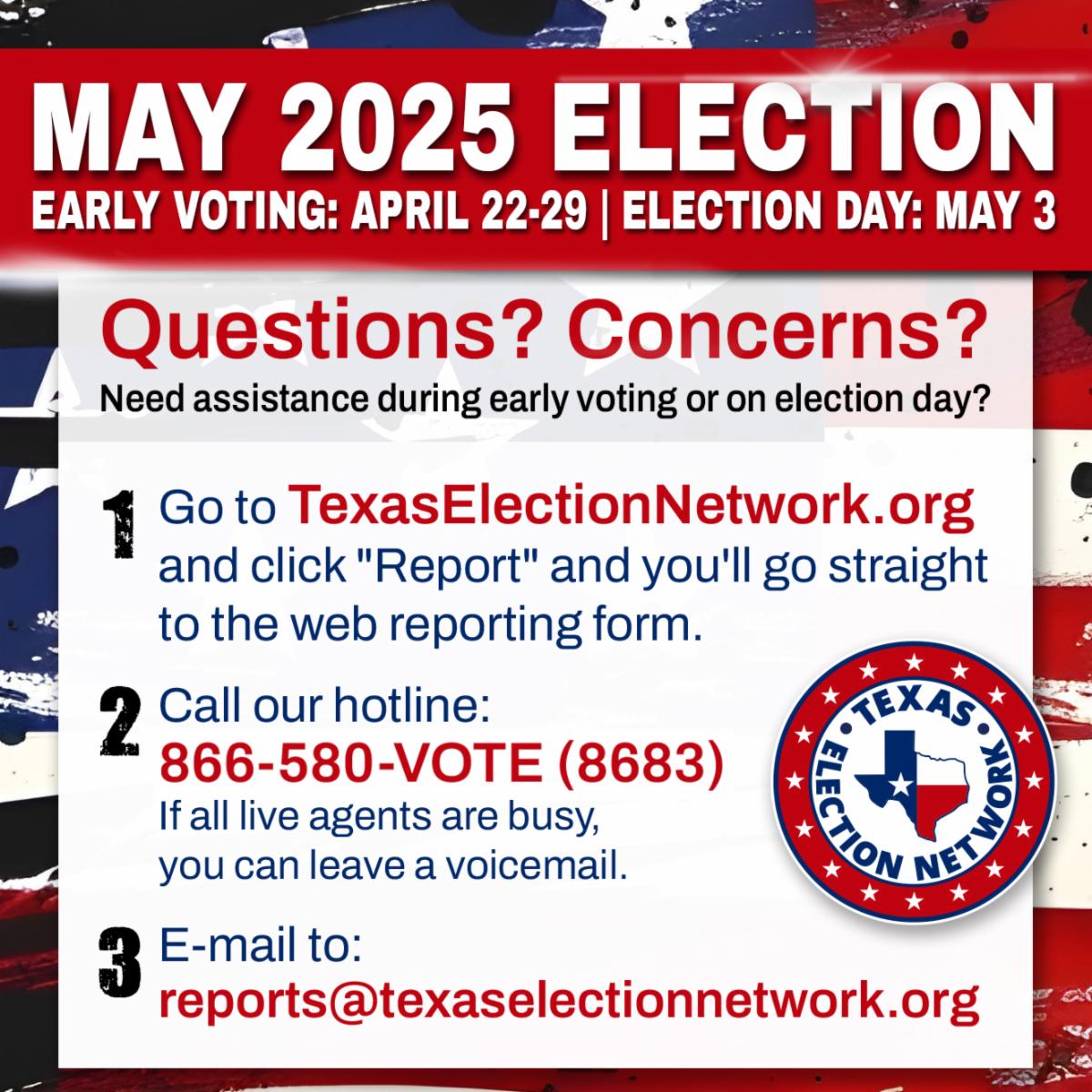
ELECTION QUESTIONS OR CONCERNS?
3 WAYS TO REPORT!
| | | | |
If you are leaving a voicemail message on our Hotline or composing an email, please provide your name, email address, and phone number, as well as the contact information of anyone else involved in the situation, if available. Please include the name of your county and the city and polling place or office where this event took place and provide as many details as possible for your question or to report an incident.
| | *These training classes are available on demand if you register. | | |
THIS WEEK'S BILL SPOTLIGHT:
SB 618 / HB 2773
| | |
Election law, rules, and procedures should be consistent across the state, which is why, during the 87th Legislature, there was a statute passed that prohibited any elected or election official from being able to alter election laws, rules, or procedures not explicitly allowed by the Texas Election Code. However, because there is no penalty attached to this prohibition, there are still those who continue to violate this provision. SB 618 seeks to establish civil penalties for election officials or elected officials who fail to conduct their elections according to the Texas Election Code after being advised by the secretary of state on how to correct the violation.
After SOS receives information about or discovers that a public official or election official is unlawfully altering election procedures, that official will be notified of SOS’s determination along with a demand that the official cease said violation(s), with instructions for the specific actions necessary to come into compliance. Beginning the second business day after the notification, the official is liable for a penalty not to exceed $1.000 per day up to the 7th day, then the penalty increases to $5,000 per day.
SOS will provide a monthly report of actions taken under this provision.
| | |
COURT BLOCKS KEY PROVISIONS
of Executive Order 14,248 on Voter Registration
In a significant legal development on April 24, 2025, a U.S. District Court in Washington, D.C. issued a ruling that temporarily blocks parts of Executive Order 14,248, which sought to modify federal voter registration processes. The court’s decision primarily affects two key provisions of the Executive Order, preventing the federal government from requiring documentary proof of citizenship during voter registration and from withholding voter registration forms in certain federal agencies.
The ruling comes after several plaintiffs, including civil rights groups and the Democratic National Committee (DNC), filed lawsuits challenging the Executive Order issued by President Trump. The Executive Order, signed in 2024, aimed to enhance the security and integrity of voter registration by making proof of U.S. citizenship a requirement for federal voter registration forms and adjusting how federal agencies distribute voter registration materials. READ MORE
CLICK HERE TO SEE RULING
| | |
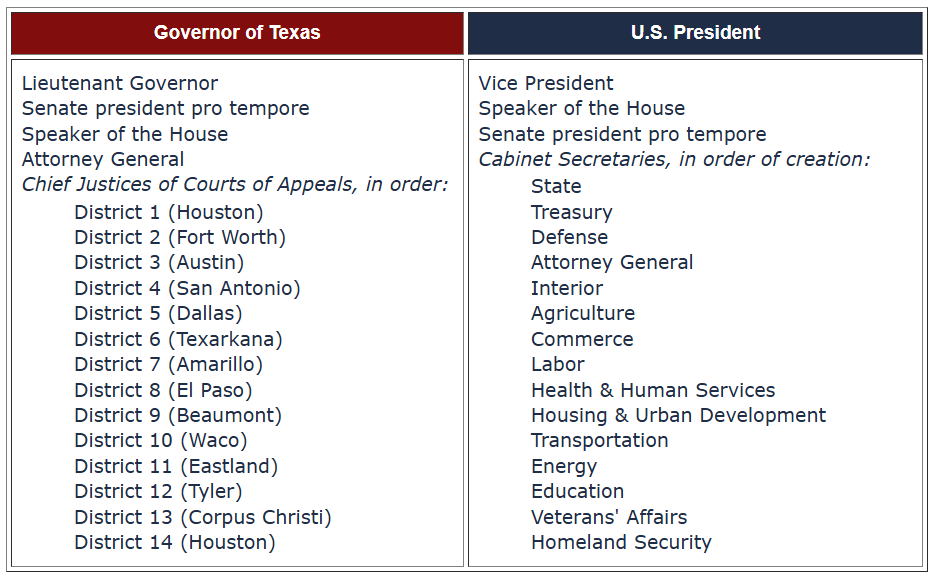
WHO'S NEXT?
Have you ever wondered who next is in the line of succession?
| | CONFERENCE COMMITTEE REPORTS | | |
When a conference committee is requested, the presiding officers each appoint five members from their respective chambers to serve on the committee. A conference committee’s charge is limited to reconciling differences between the two chambers, and the committee may not change, alter, amend, or omit text that is not in disagreement without the adoption of an “out of bounds” resolution by both chambers. The committee also may not add text on any matter that is not in disagreement or that is not included in either version of the bill in question without such a resolution.
After the committee has reached an agreement, a report is prepared for submittal to the House and Senate. The report must be approved by at least three conferees from each chamber and must contain the text of the bill as approved by the conference committee, a side-by-side analysis comparing the text of the compromise bill to both the House and the Senate versions, an updated fiscal note, and the signatures of those members of the conference committee who approved the report. A conference committee report is not subject to amendment by the House or Senate and must be accepted or rejected in its entirety
https://lrl.texas.gov/legis/conferencecommitteereports.cfm
| | |
What are the Governor’s options once a bill is enrolled?
On receiving an enrolled bill, the governor has the option to sign it, veto it, or allow it to become law without a signature. The governor has 10 days in which to act unless the bill was sent to the governor within 10 days of final adjournment, in which case the governor has until 20 days after final adjournment to act. If the governor elects to veto the bill and the legislature is still in session, the bill is returned to the chamber in which it originated with an explanation of the governor’s objections. A two-thirds majority in each chamber is required to override the veto. If the governor neither vetoes nor signs the bill within the allotted time, the bill becomes law.
| |  | |
How much are legislators paid?
The salary for Texas Legislators is set in Texas Constitution, Article 3, Section 24, and is currently $7200 per year. Legislators are also paid a per diem for each day during a regular or special session. The per diem is $221 for the Regular Session. The per diem is set by the Texas Ethics Commission in Texas Administrative Code Title 1, Part 2, Rule § 50.1. Most legislators also work separate, full-time jobs in addition to serving in the Texas Legislature.
| | |
Can members filibuster legislation? What is chubbing?
In Texas, a filibuster is allowed only in the Senate. A filibuster occurs when one senator holds the floor through talking or long speeches, without sitting down or leaving the vicinity of the senator's desk. Although the primary purpose of a filibuster is usually to kill a bill, sometimes this is also done to reach a compromise or to delay a vote as long as possible. The filibuster must be on topic; the bill may be read but irrelevant books (i.e. a telephone book) may not be read.
In the House, although members may not use the filibuster, they can use a technique called chubbing. Chubbing is the legislative practice of debating one bill at great length to the detriment of other bills waiting to be heard. It is frequently practiced near the end of session on legislative days that have imposed deadlines.
| | |
What is a point of order? (“POO”)
In parliamentary procedure, the point of order calls attention to a possible breach of the procedural rules. It is the duty of the House Speaker and Lt. Governor to ensure the rules are enforced, but the point of order is the legislator’s vehicle to alert the body that the established protocol is not being followed.
A point of order takes precedence on the floor and business may not continue until the point is sustained or overruled. At this time in the session, a point of order is mostly a delay tactic, but as we get closer to sine die a point of order can kill a bill.
Where can I find the RULES?
House: https://lrl.texas.gov/scanned/rules/89-0/89_House_Rules.pdf
Senate: https://lrl.texas.gov/scanned/rules/89-0/89_Senate_Rules.pdf
| | |
What is an omnibus bill?
An omnibus bill is legislation regarding a single subject that combines many different aspects of that subject. The Texas Constitution prohibits federal-style omnibus bills, which include many different topics (Texas Constitution Article 3, Section 35).
As we get later and later into the 89th Session and bills start missing deadlines, legislators will look for what is lovingly referred to as a “Christmas Tree Bill” so that they can add their languishing bill language to a bill with a broad enough caption that it would not be a point of order to do so.
Sometimes the “ornaments” are added to the “Christmas tree” to gain support from other legislators, interest groups, or constituencies.
| | | | | |
As of 04/28/25, Number of bills this session...
Left pending in House Committee or Subcommittee: 1,946
Passed to Engrossment by the House: 185
Left pending in Senate Committee or Subcommittee: 830
Passed to Engrossment by the Senate: 132
Bills signed by the Governor: 1
| | | | |
DATE: Friday, May 16, 2025
TIME: 9:00 AM to 10:00 AM
WHERE: Zoom (link sent upon registration)
TOPIC: Transparency in Texas Government
~CLICK THE BUTTON TO REGISTER~
| | This informative TEN Talk - Transparency in Texas Government: Understanding TPIA, TOMA, and FOIA - will demystify three powerful laws that give you access to government information and meetings. Whether you're a concerned citizen, community activist, or simply curious about how your local government operates, this session will equip you with practical knowledge about the Texas Public Information Act, Texas Open Meetings Act, and the federal Freedom of Information Act. Learn how to request public records at both state and federal levels, understand what information you're entitled to access, and discover how to effectively participate in open meetings. This informative hour will transform how you engage with government at all levels and empower you to become a more informed and effective advocate for transparency in your community. | | |
REGISTER TO ACCESS PREVIOUS TRAININGS
Texas Legislature Online (TLO) REGISTER
Effective Legislative Advocacy at the Texas Capitol REGISTER
ISSUE FORUM: Countywide vs. Precinct Polling Panel Discussion REGISTER
Bifurcation of the Texas Voter Roll REGISTER
Candidate Training REGISTER
Ranked Choice Voting: What it could mean for Texas Elections REGISTER
| | |
It's absolutely essential that we mobilize more voters for our upcoming Spring election. Local elections traditionally see dismally low turnout, yet these are precisely the elections that most directly impact your daily life, from school funding to infrastructure projects to public safety initiatives.
Important Dates to Remember:
- Early Voting ends TODAY - Tuesday, April 29th
- Election Day is this Friday, May 3rd
I want to close by expressing my sincere gratitude for your commitment to being the difference that strengthens Texas from the grassroots up! Your participation makes our state vibrant and responsive to community needs. Thank you for being an engaged Texan who recognizes that lasting change begins at the local level.
Melissa Conway
Texas Election Network
Managing Director
832-648-0770
| | Follow TEN on Social Media! | | | | |