|
First Monthly Memo
September 1, 2026
| | |
Greetings from EyesOpenIowa!
Happy September! Grab your coffee and settle in, because this issue is a full one. This month we are holding space for two causes that matter deeply, National Suicide Prevention Month and Childhood Cancer Awareness Month, and leaning into the quiet superpower behind both: a trusted adult who shows up, tells the truth, and listens.
But that is only the start. You will find a timely new training on the Iowa policies reshaping classrooms. And because you are part of our inner circle, you are getting first dibs and an exclusive peek at this year's Designer Purse Bingo before anyone else sees the bags. It is all just below, so keep scrolling. If anything here sparks a question or a conversation, hit reply or reach us anytime at info@eyesopeniowa.org.
We are starting where it matters most.
With gratitude,
— The EyesOpenIowa Team
| | This September, Connection Is Prevention | | September is National Suicide Prevention Month, with National Suicide Prevention Week falling September 6 through 12 and World Suicide Prevention Day on September 10. For the young people in our lives, this is far more than a few dates on the calendar. | | |
Suicide is the second leading cause of death among people ages 10 to 24 in the United States. The most recent CDC data show youth suicide rates beginning to decline, and that progress matters, but the numbers remain far too high, and too many young people are still struggling in silence.
Here is what gives us hope: connection is one of the most powerful protective factors we have. The CDC finds that feeling connected to family, school, and caring adults helps protect young people's mental health and lowers their risk. Showing up matters. Listening matters. Being a safe person to talk to matters.
This is where our work and youth mental health meet. Adolescence brings big changes, in bodies, in emotions, and in relationships. When young people have accurate, inclusive, shame-free information and adults they can bring their questions to, they are far less likely to fall into misinformation, mistreatment, or the loneliness of facing hard things alone. Normalizing honest conversations about our bodies, our boundaries, and our big feelings builds healthier individuals and more compassionate communities, where no young person has to face the hard parts alone.
You do not need the perfect words. You just need to be present.
| | If you or a young person you love is struggling, help is available 24 hours a day, 7 days a week. Call or text 988 to reach the 988 Suicide and Crisis Lifeline, or chat at 988lifeline.org | | What If Our Kids Don't Need Us to Fix It? | |
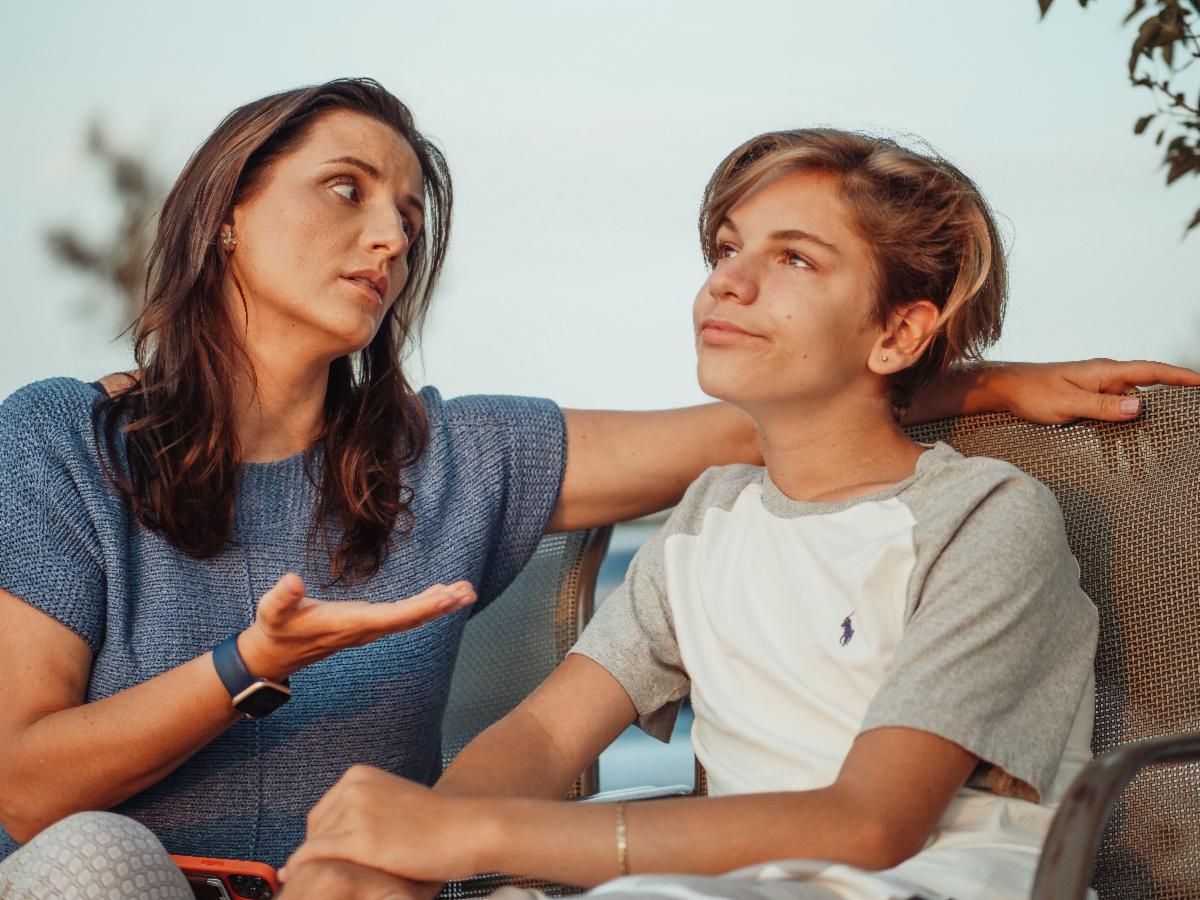
The other day, one of my children came to me with a problem.
I will spare you the details because as my children get older, I am increasingly aware that their stories belong to them and not to me. But suffice it to say: something had happened. My child was upset. And I immediately knew what needed to be done.
Obviously.
I had questions! Ideas! Strategies! I could send an email! We could make a plan!
Within approximately 30 seconds, I had mentally assembled a small task force to address the situation.
My child, meanwhile, wanted none of this.
Which was annoying, because my plan was excellent.
If you are a parent or caregiver, you probably know this feeling. One of the hardest parts of raising children is watching them experience something difficult when we can see a possible way out.
And when our children are small, fixing things is actually a significant portion of the job.
Toddler can't reach the cup? We get the cup.
Five-year-old can't tie a shoe? We help.
Eight-year-old forgot lunch? We run over to the school and drop off a lunch or send them money to buy one.
But somewhere along the way, the job starts to change.
Increasingly, our children encounter problems that we could potentially fix but perhaps shouldn't:
A friendship is difficult.
They don't know whether they want to go to the party.
Someone said something that hurt their feelings.
They have a teacher they don't like.
They like someone who may or may not like them back.
They have to decide whether something feels right for them.
And suddenly, the skill we're being asked to practice isn't fixing.
It's staying.
This is harder than it sounds.
Because when someone we love is uncomfortable, their discomfort often creates discomfort in us. We want the bad feeling to stop. We want to reassure them. We want to tell them what to do.
Sometimes we even mistake our own desire to stop feeling uncomfortable for helping.
| |
So what happens if, every once in a while, we don't?
What if instead of immediately saying, “Here's what I think you should do,” we say:
“Tell me more.” Or: “What do you think you want to do?” Or even: “That sounds really hard. Do you want ideas, or do you just want me to listen?” And for extra points, “I want you to know that I understand how bad this feels. I also know you will figure it out.”
This may seem like a general parenting strategy—and it is. But I also think it has everything to do with sex education.
Because someday, our kids will need to make decisions about relationships and bodies and sex when we aren't standing next to them.
They will need to figure out: Do I want this? Do I feel safe? Do I actually like this person? Am I doing this because I want to, or because everyone around me seems to be doing it? Something happened that made me uncomfortable. What do I want to do now?
There is no way to prepare them for every situation they will encounter.
And that's why one of the most important things we can help them develop isn't a list of correct answers.
It's a relationship with their own voice.
| |
We can help them learn that when something feels complicated, they don't have to immediately push the feeling away. They can get curious about it. They can take some time. They can talk to someone they trust. They can make a decision—and sometimes change that decision later.
And perhaps most importantly, they can learn that the people who love them don't need to take over in order to stay beside them.
I am still practicing this.
Sometimes I manage a calm, “What do you think?” Sometimes I make it approximately four minutes before saying, “Okay, but can I just tell you ONE THING?”
Parenting is a process.
But increasingly, I am trying to remember that my job isn't to make sure my children never struggle. It's to help them become people who trust themselves when they do.
And that may be one of the most important ways we prepare them for everything that comes next.
Gail Cowan, MSW, is EOI's Director of Development. A former therapist, she also runs her own coaching business. Find her at gail@gailcowan.com or gail@eyesopeniowa.org.
| | Because Connection Often Starts With A Conversation. | |
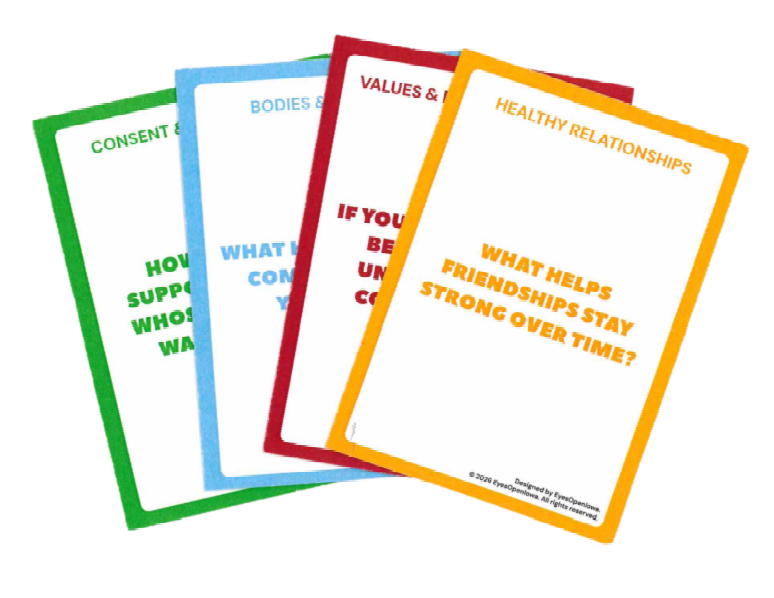
If there is one thing this work has taught us, it is that the big moments of connection usually begin with small, everyday conversations. That is exactly why we created Growing Sideways, a card game built to make real talk between young people and the trusted adults in their lives feel a little more natural, and a lot less awkward. It is a simple, playful way to open the door, so the harder conversations feel less daunting when they come.
| |
Classroom Resource
Fetal Development Video Resource (SF175)
Iowa schools are continuing to work toward compliance with the state's fetal development video requirement (SF175), and EyesOpenIowa is here to make that easier. Working with Iowa OB/GYN physicians and national partners, we have identified scientifically accurate, classroom-appropriate videos that meet the law's requirements.
| |
Newly available: a set of videos from Health Care Education and Training that comply with Iowa law. View the videos here
We also continue to recommend National Geographic's Pregnancy 101 and Britannica's How an Embryo Develops into a Fetus as accurate, age-appropriate options.
Additional guidance is available at eyesopeniowa.org/educators, and our staff are glad to provide technical assistance as you plan. Reach us anytime at info@eyesopeniowa.org.
| |
MORE WHERE THIS CAME FROM
One hour, one clearer path through Iowa policy, and it is just the start.
Whether you are an educator, a caregiver, or a trusted adult, we build professional development for the real conversations and real classrooms you navigate. Explore everything we have coming up, and see the full range of what we offer, at eyesopeniowa.org/training-events.
| New Report Card Shows Iowa Moms and Babies Still Need Us | |
The 2025 March of Dimes Report Card is out, and while Iowa isn't facing the worst outcomes in the country, the data is a clear reminder of why EyesOpenIowa's work matters.
In 2024, 10.1% of babies born in Iowa arrived preterm, before 37 weeks, amounting to 3,672 babies. That places Iowa 24th out of 52 states and territories nationally, roughly in the middle of the pack, but still meaningfully behind top-performing states. Nationally, the picture is even more sobering: the U.S. earned a D+ grade for the fourth year in a row, with a 10.4% preterm birth rate representing nearly 380,000 babies born too soon in 2024 alone.
A few other Iowa numbers worth sitting with:
-
7.3% of Iowa babies were born at low birthweight in 2024
-
5.1 per 1,000 live births was Iowa's infant mortality rate in 2023, 184 babies who didn't reach their first birthday
-
84.1% of Iowa infants were born to mothers who received adequate prenatal care in 2024, meaning nearly 1 in 6 did not
-
6.4% of Iowa women of childbearing age were uninsured in 2023
These numbers reflect exactly the kind of gaps EyesOpenIowa exists to help close: making sure young people and families have access to accurate health education, support, and resources long before a pregnancy ever becomes high-risk. Prevention, education, and early support aren't separate from maternal and infant health outcomes, they're foundational to them.
As we navigate our own funding challenges this year, reports like this one are a reminder of the stakes. The work isn't optional, and neither is our commitment to it.
Source: 2025 March of Dimes Report Card, PeriStats (marchofdimes.org/peristats)
|
| |
September asks us to sit with some heavy realities, so here is something worth holding onto: this work changes lives, and we have the numbers to prove it.
The U.S. teen birth rate just hit another record low. In 2024 it fell to 12.7 births per 1,000 teens, down more than 70 percent from its peak in 1991. That is not luck. It is the result of decades of better access to accurate information, honest conversations, and the kind of education that helps young people make informed decisions about their own lives. It is exactly the kind of work we do every day.
And here is one more: thanks to the HPV vaccine, precancerous cervical changes in young women have dropped by about 80 percent since 2008. A whole generation is growing up meaningfully protected from a cancer that once took far too many lives.
Progress like this is quiet and easy to miss, but it is real. It happens because people keep showing up for it, year after year. Every honest conversation, every accurate answer, and every trusted adult is part of how we got here, and how we keep going.
Sources: CDC/NCHS, Teen Births and CDC MMWR, Trends in Cervical Precancers, 2025
| |
Designer Purse Bingo
A Little Magic, Just for You
Because you read our newsletter and you have been in our corner from the start, we wanted to give you something no one else has yet: first look and first dibs.
Designer Purse Bingo is back this fall as A Little Practical Magic, and before a single other guest has seen them, here's an exclusive peek at a few of the designer bags you'll be playing for this year.
| | |
You're the very first to see some of the bags up for grabs!
Are you intrigued? Here are the details:
| |
Designer Purse Bingo: A Little Practical Magic
Wednesday, October 7, 2026 at The Monroe, West Des Moines
Ten rounds, ten designer bags, one every round. Raffles all night for even more designer prizes. Fully catered appetizers, a full bar with midnight margaritas, and a little witchy charm (costumes encouraged, never required). Tickets start at $65, and every ticket supports medically accurate, inclusive health education for young people across Iowa.
And because you read our newsletter, here's your gift: at checkout, use the promo code, WITCHPLEASE for $10 off. This code lives here and nowhere else, just for you, our readers. It's our little thank you for being with us from day one, and it's only good while our limited batch of discounted seats lasts. So grab yours soon, and feel free to pass it to the friends you're bringing. Once these discounted seats are gone, they're gone.
| |
Work a Little Magic for Your Business
Sponsoring Designer Purse Bingo puts your name in front of a room full of 200 engaged supporters from across the metro, all while backing medically accurate, inclusive health education for young people across Iowa. Levels start at just $100, so there's a fit for businesses of every size. Good exposure, even better karma.
Know a business that belongs in the room? Send them our way.
| |
WORTH A READ THIS MONTH
Start With This One (Editor's Pick)
| | |
Ms. Magazine, by Dr. April Bell, UC San Francisco
As sex education gets cut in schools and reproductive health care grows harder to reach, especially for young people of color, more teens are quietly turning to AI chatbots for the questions they aren't sure they can ask out loud. Written by a UCSF researcher who works directly with Black adolescent girls, this piece unpacks what's lost when an unregulated tool becomes the default sex educator: chatbots trained on biased data that can reinforce stereotypes or get health facts wrong. One study found popular chatbots answered health questions incorrectly nearly half the time. Her point is one we share. Young people deserve information that isn't just fast and private, but accurate, affirming, and accountable, which is exactly why trusted adults and digital literacy belong at the heart of sex education.
|
More Worth Your Time
American Psychological Association
Practical, non-alarmist guidance for staying the person your kid comes to first.
NPR
Simple conversation starters for opening up the topic without shutting it down.
New York Times
The federal government is overhauling the Teen Pregnancy Prevention Program, cutting dozens of evidence-based grants in favor of abstinence and "reproductive goals" messaging. A sobering read on the policy changes reshaping our field, and a reminder of why this work matters.
For Childhood Cancer Awareness Month
American Cancer Society
September is Childhood Cancer Awareness Month, a fitting time to revisit one of the few vaccines we have that actually prevents cancer. This look at a 3.5-million-person study shows just how much the HPV vaccine lowers the risk of HPV-related cancers.
|
|
Let’s Stay Connected!
Follow EyesOpenIowa for training opportunities, free resources, advocacy updates, and conversations that support the work you do with young people every day.
Click the icons below to connect with us on social media and stay up to date on everything happening at EOI!
| | | | |