Hearing The Word

A weekly newsletter delivering context and insight into the Sunday Gospels.


March 1, 2026

Second Sunday of Lent

Matthew 17:1-9


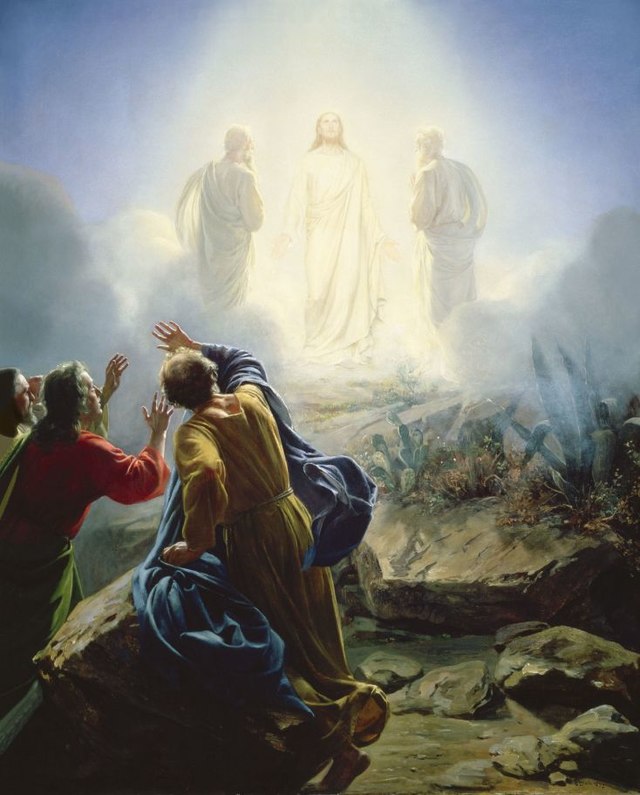
Jesus took Peter, James, and John his brother,

and led them up a high mountain by themselves.

And he was transfigured before them;

his face shone like the sun

and his clothes became white as light.

And behold, Moses and Elijah appeared to them,

conversing with him.

Then Peter said to Jesus in reply,

“Lord, it is good that we are here.

If you wish, I will make three tents here,

one for you, one for Moses, and one for Elijah.”

While he was still speaking, behold,

a bright cloud cast a shadow over them,

then from the cloud came a voice that said,

“This is my beloved Son, with whom I am well pleased;

listen to him.”

When the disciples heard this, they fell prostrate

and were very much afraid.

But Jesus came and touched them, saying,

“Rise, and do not be afraid.”

And when the disciples raised their eyes,

they saw no one else but Jesus alone.

As they were coming down from the mountain,

Jesus charged them,

“Do not tell the vision to anyone

until the Son of Man has been raised from the dead.”


+


A VIEW FROM THE PULPIT ...

providing insight into the Gospel's meaning


He Swore to Our Father Abraham


~Dr. Kelly Anderson, S.S.L., Ph.D.

Associate Professor of Biblical Studies for the Major Seminary, Saint Charles Borromeo Seminary + Philadelphia, Pa.


Every Second Sunday of Lent, the Church reads the Transfiguration, and the first reading is always an episode of the life of Abraham (Gen 12; 15; 22). I will explore the link between Abraham and the Transfiguration.


Genesis 12:1–4 (Year A) recounts God’s promise to Abraham of land, blessings, and descendants through whom all the communities of the earth will find blessings. The promise is repeated in Genesis 15:5 (Year C), where Abraham believes God and is declared righteous (15:6). In Gen 22:16–18 (Year B) after Abraham is willing to sacrifice Isaac, God makes a rare divine oath, that is, he swears by himself that the promise will come to pass. Later, God forgives the Israelites when they commit apostasy in the desert because of his oath (Exod 32:13) and the oath is even mentioned in the Magnificat and the Benedictus.


Now, in the Transfiguration, the apostles see the cloud and the Incarnate Son of God gleaming with uncreated glory, fulfilling the prophecy of 2 Macc 2:8: “…the glory of the Lord and the cloud will be seen…that the place might be greatly sanctified.” The revealed “place” is the enfleshed Logos, the temple of God. Heaven and earth are briefly united as Jesus converses with Moses and Elijah, and apostles fall in fear and terror before the awesome revelation of the power of God temporarily and proleptically transfiguring Jesus.


God’s declaration in the Transfiguration, “This is my beloved Son, with whom I am well pleased; listen to him,” is a compilation of OT quotes. It clarifies that the Abrahamic oath is fulfilled, while also saying that Jesus is the messiah (Psa 2:7), the son of Abraham who is to be sacrificed (Gen 22:2), the suffering servant of God who will give his life as a ransom for sins (Isa 42:1), and God’s firstborn son who is to be a holy priest (Exod 4:22). God solemnly announces that Jesus is the definitive fulfillment of the Old Testament prophecies, the fundamental and basic one being the great divine oath God swore to Abraham. And we, like the apostles, are to “listen to him."


A VIEW FROM THE PEW ...

offering testimonies on how the Gospel is meaningful


Figuring out the Transfiguration


~Thomas Volkert

Saint Vincent de Paul, Philadelphia + Pa.


Recently there was a documentary on TV about the American Revolution. It revealed the struggle, the suffering, the treachery, and the chaos that we often don’t hear about in the popular highlights of the founding of the country. But when I listened hard, I was able to understand how we are still part of the hard, ongoing work of freedom.


Growing up, I remember the Transfiguration story of Jesus was magnificent to imagine. But now I see it differently. This story comes right after Jesus tells his disciples that he will be persecuted, killed, and rise. He also explains that people are misunderstanding the signs of the times. So Jesus is doing everything a good friend would do, revealing himself more deeply and preparing them for what is coming even though they won’t understand until later. The presence of Moses and Elijah represents the amazing work of God in the past, and Jesus’s glory shows he is continuing that work — in fact fulfilling that work through his giving his very life for us. It is a tremendous moment but a hard reality to live with. Because, if we want to follow him, we may experience the same fate.


Unfortunately, Peter, afraid, still doesn’t get it. Can you blame him? His panic reaction is to hold on to this glorified moment by building tents so they will stay with them. He is missing the hard reality.


But the Voice - thank God! - interrupts Peter and repeats what God said at the start of Jesus’s ministry: “This is my beloved Son, listen to him.” No more needs to be said.


Like the story of the American Revolution, we all would prefer the painless version, but the hard work of love, justice and healing often bears the fruit. Lent is the time to listen deeply and discover our path.


How would you rate the overall quality of our Commentary Series?


X Share This Email
LinkedIn Share This Email
Instagram