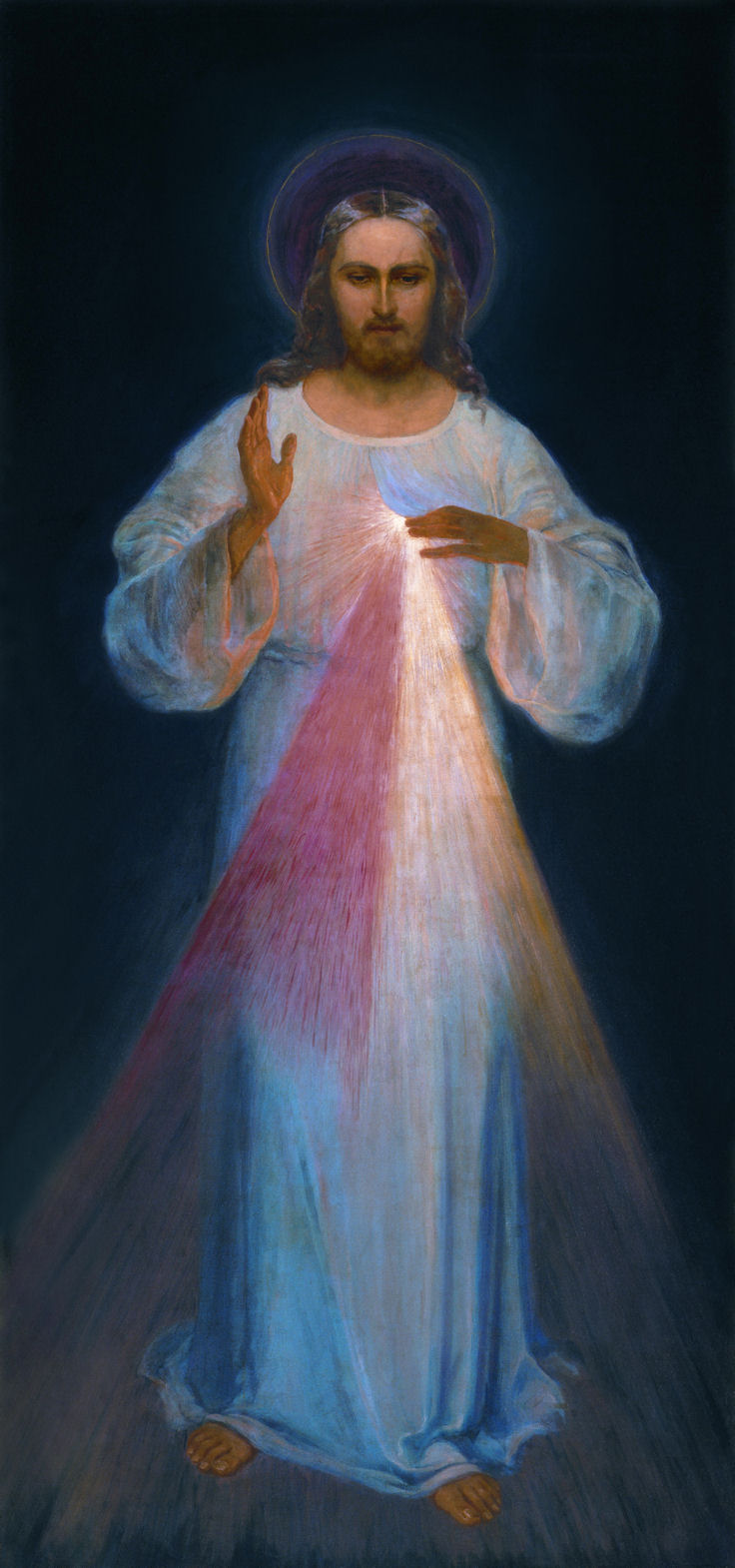
Hearing The Word

A weekly newsletter delivering context and insight into the Sunday Gospels.


April 12, 2026

Divine Mercy Sunday

John 20:19-31


On the evening of that first day of the week,

when the doors were locked, where the disciples were,

for fear of the Jews,

Jesus came and stood in their midst

and said to them, “Peace be with you.”

When he had said this, he showed them his hands and his side.

The disciples rejoiced when they saw the Lord.

Jesus said to them again, “Peace be with you.

As the Father has sent me, so I send you.”

And when he had said this, he breathed on them and said to them,

“Receive the Holy Spirit.

Whose sins you forgive are forgiven them,

and whose sins you retain are retained.”

Thomas, called Didymus, one of the Twelve,

was not with them when Jesus came.

So the other disciples said to him, “We have seen the Lord.”

But he said to them,

“Unless I see the mark of the nails in his hands

and put my finger into the nailmarks

and put my hand into his side, I will not believe.”

Now a week later his disciples were again inside

and Thomas was with them.

Jesus came, although the doors were locked,

and stood in their midst and said, “Peace be with you.”

Then he said to Thomas, “Put your finger here and see my hands,

and bring your hand and put it into my side,

and do not be unbelieving, but believe.”

Thomas answered and said to him, “My Lord and my God!”

Jesus said to him, “Have you come to believe because you have seen me?

Blessed are those who have not seen and have believed.”

Now, Jesus did many other signs in the presence of his disciples

that are not written in this book.

But these are written that you may come to believe

that Jesus is the Christ, the Son of God,

and that through this belief you may have life in his name.

+


A VIEW FROM THE PULPIT ...

providing insight into the Gospel's meaning


The Peace of Mission


Rev. Patrick Brady. S.T.D., S.S.L., M.DIV.

Vice Rector, Director of Admissions, Saint Charles Borromeo Seminary + Ambler, Pa.


Shalom, Peace be with you, appears three times in this Gospel. We offer peace at every Mass. It is a recognition that the risen Lord is present among us, present in the Eucharist. When the Jesue says eirēnē hymin (peace to you) he is not offering a pleasantry. He is offering his mercy. 


The first day of the week, the doors locked, and the apostles hiding. The room they occupy is not a sanctuary; it is a bunker. Past the bolted door, past the barricaded hearts, Jesus “came and stood in their midst.” 


He offers them peace. This peace does not depend on calm circumstances or solved problems. God’s mercy does not wait for us to finish grieving, resolve our doubts, or earn forgiveness. The risen Lord begins with a gift. 


The second time Jesus offers peace inaugurates mission. “As the Father has sent me, so I send you” (20:21). The same sending that defines the Son now defines the community. Peace is not merely consolation; it is the precondition of missionary activity. We cannot bring peace to the world from a posture of fear. The person who has met the risen Lord and heard his “shalom” becomes a channel through which that peace flows outward. 


Then Jesus breathes on them and says, “Receive the Holy Spirit” (20:22). The Greek verb enephysēsen appears only here in the New Testament and two other passages: Gen 2:7, when God breathes life into Adam, and Ezek 37:9, when breath enters the dry bones and they live. Jesus oofers new creation, breathing life into a new humanity. The disciples are not merely forgiven; they are remade. The Church exists to carry forward what happened in that locked room. 


The third offer meets Thomas in his doubt. His cry, “My Lord and my God,” is the strongest profession of faith in the entire Gospel, and it comes from the doubter. The beatitude that follows is for all of us who have never stood in that room. Faith is not the absence of struggle. It is staying in the community until the Lord comes. 


A VIEW FROM THE PEW ...

offering testimonies on how the Gospel is meaningful


Teaching Little Souls About

a Big Mercy


~Linda Davis

Saint Mary Catholic Church + Lancaster, Pa.


As a mother, Divine Mercy Sunday feels more urgent with each passing hour. When I look at the world my children will grow up in, I see so much confusion, division, and open rejection of God. Sin no longer hides quietly- it is often celebrated from all sides. At times, this reality fills me with worry for their future and for their souls. Yet Divine Mercy Sunday reminds me that no darkness in the world is greater than the mercy of Christ.


Jesus told St. Faustina, “Mankind will not have peace until it turns with trust to My mercy” (Diary, 300). These words feel written for our times. We search for solutions in politics, technology, and culture, yet true peace can only come when our hearts return to God. As a mother, I feel called not only to teach my children what is right, but to teach them where they can run when they fail-straight into the merciful Heart of Jesus.


I see daily how sin touches even our small home-impatience, selfishness, hurt feelings. But I also see how thoroughly mercy heals. When I forgive my children, I glimpse how God forgives me. Jesus reassured St. Faustina, “The flames of mercy are burning Me-clamoring to be spent; I want to pour them out upon souls” (Diary, 1074).


In a world wounded by sin, Divine Mercy Sunday gives me hope. I pray that my children will grow up with the simplest cry written on their hearts: Jesus, I trust in You.


How would you rate the overall quality of our Commentary Series?


X Share This Email
LinkedIn Share This Email
Instagram