November 9, 2026 | Issue #45
Facebook  Instagram  LinkedIn  X

Support of the Monday Morning Update

For 2026 please consider a donation to help support delivery of the Monday Morning Update to your email every week by 5:30 am. Our distribution of this update is over 12,000 and growing. Your consideration is greatly appreciated. Thank you!

Monthly Member Spotlight

Hively Celebrates 50 Years of Community Impact


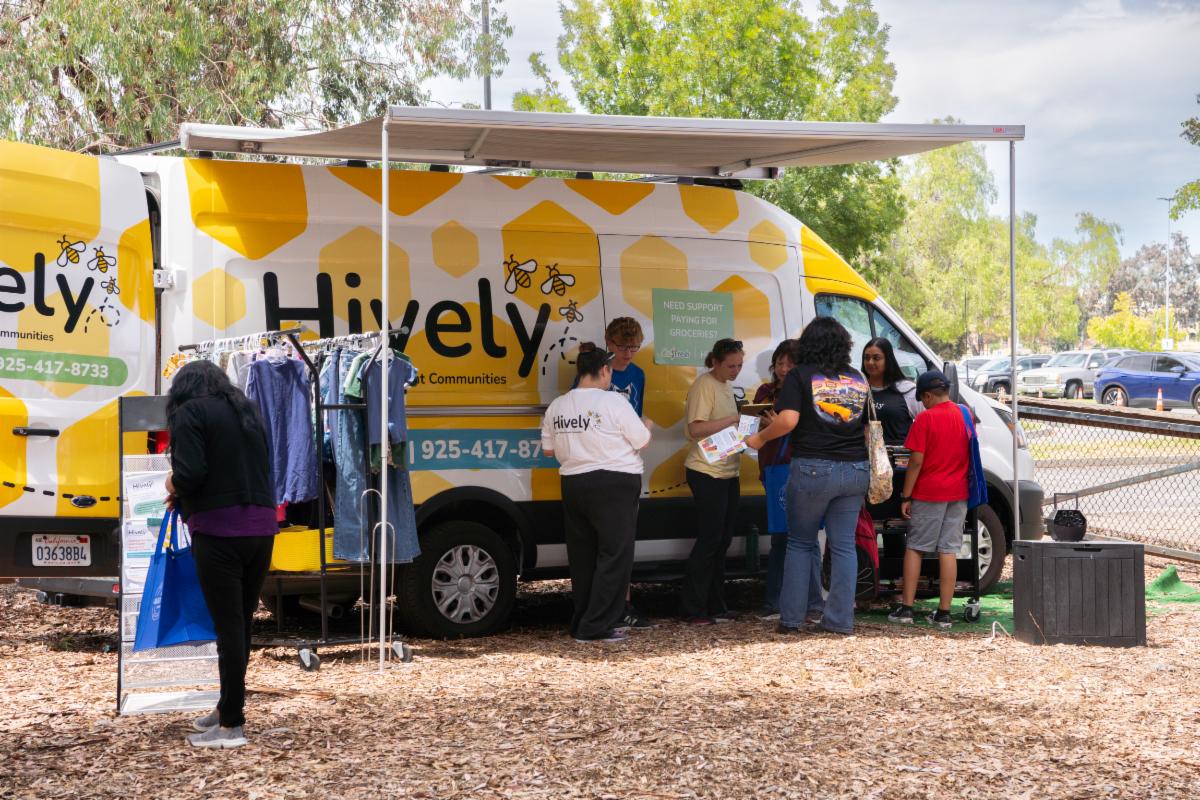
Since its founding in 1976, Hively has grown into a comprehensive support network for early childhood care providers and families throughout Alameda County, ensuring every child has access to the resources they need to thrive. Hively provides child care referrals and subsidies, training and resources for child care providers, mental health support, and essential supplies like diapers, children’s clothes and pantry staples available at the organization’s family resource centers and the Hive on Wheels, a mobile resource van.

Click the video above to learn about Hively's legacy in Alameda County.

Led by CEO Mary Hekl since 2022, Hively has grown significantly over the past four years, innovating to develop services and programs that meet the community’s shifting needs. Hively's leadership team also includes sector leader Mona Shirk, Chief Program Officer with nearly 20 years of experience and Elaine Lenore, Chief Financial Officer, who has played a key role in Hively's growth. Hively’s staff of over 50% bilingual professionals serves the region’s diverse community with dignity, care, and compassion.


In the last year alone, Hively supported over 10,000 people across all of its programs and services, providing subsidies for 3,842 children, over $43 million in payments to child care providers, and 7,801.5 hours of therapy and case management. This year, Hively is celebrating  its 50th anniversary and five decades of community impact.

The Election Is Over. The Struggle for Working Families Is Not.


By Denyne Micheletti

CEO, Thriving Families CA Foundation


The ballots have been cast, and the 2026 election has delivered a powerful reminder: Americans are deeply concerned about their economic security, the rising cost of living, and whether elected leaders understand the daily struggles of working families.


With the election of Xavier Becerra as California's next Governor, our state enters a new chapter of leadership at a time when families are struggling to keep pace with rising costs. The opportunity before Governor-elect Becerra and the Legislature is not simply to make new commitments, but to finally deliver on promises already made.


Few promises are more consequential than ensuring families can access affordable child care and that providers are paid rates reflecting the true cost of delivering quality care.


Across California, parents face impossible choices. They weigh child care expenses against rent, groceries, transportation, and health care. Some reduce their working hours, decline employment opportunities, or leave the workforce altogether because they cannot find or afford dependable care.


For families living paycheck to paycheck, child care is not a luxury. It is the foundation of economic stability.


Yet California continues to confront a troubling contradiction. Families desperately need child care, providers struggle to remain financially viable, and hundreds of millions of dollars intended to support child care have reportedly gone unspent.


This is not simply a funding challenge. It is a systems challenge that demands meaningful reform.


California has repeatedly committed to expanding child care access and transforming reimbursement rates to reflect the actual cost of providing care. The passage of the True Cost of Childcare Act represents an important step toward that commitment. But legislation and promises alone do not pay providers, stabilize programs, or create additional child care opportunities for families.


Providers cannot be expected to deliver quality care, compensate their workforce fairly, meet increasing regulatory requirements, and keep their doors open when reimbursement rates fail to reflect their actual operating costs.


Equally important, increasing reimbursement rates without expanding access leaves too many families behind.


California must pursue both priorities together: pay providers what it truly costs to provide care and ensure substantially more families can actually receive it.


That requires protecting existing child care investments, immediately redirecting unspent funding to unmet needs, removing unnecessary administrative barriers, and strengthening the community-based organizations that connect families with services.


It also requires acknowledging that child care does not exist in isolation. Families struggling with housing instability, food insecurity, transportation challenges, and rising health care costs need coordinated support systems that

recognize the interconnected realities of their lives.


Governor-elect Becerra brings extensive experience in public service and health and human services leadership. His administration will have an opportunity to translate California's longstanding commitments into measurable outcomes: sustainable provider reimbursement, more children served, fewer families waiting, and a system that responds to need rather than administrative limitations.


At a time of federal funding uncertainty and competing state budget pressures, the temptation may be to delay difficult decisions. But working families cannot afford another cycle of promises without implementation.


The measure of California's commitment to children and families should not be how much funding is announced, but how many families actually receive care and whether providers can sustainably deliver it.


The election is over. The responsibility to govern has begun.


Now is the time to turn promises into progress, investments into access, and California's commitment to working families into a reality they can finally experience.

CA Election Results

by CalMatters


The votes are still coming in!


Read here!

Making Headlines: Child Care Affordability and the 2026 Midterms

by The First Five Years Fund


Important Ballot Measures and Props

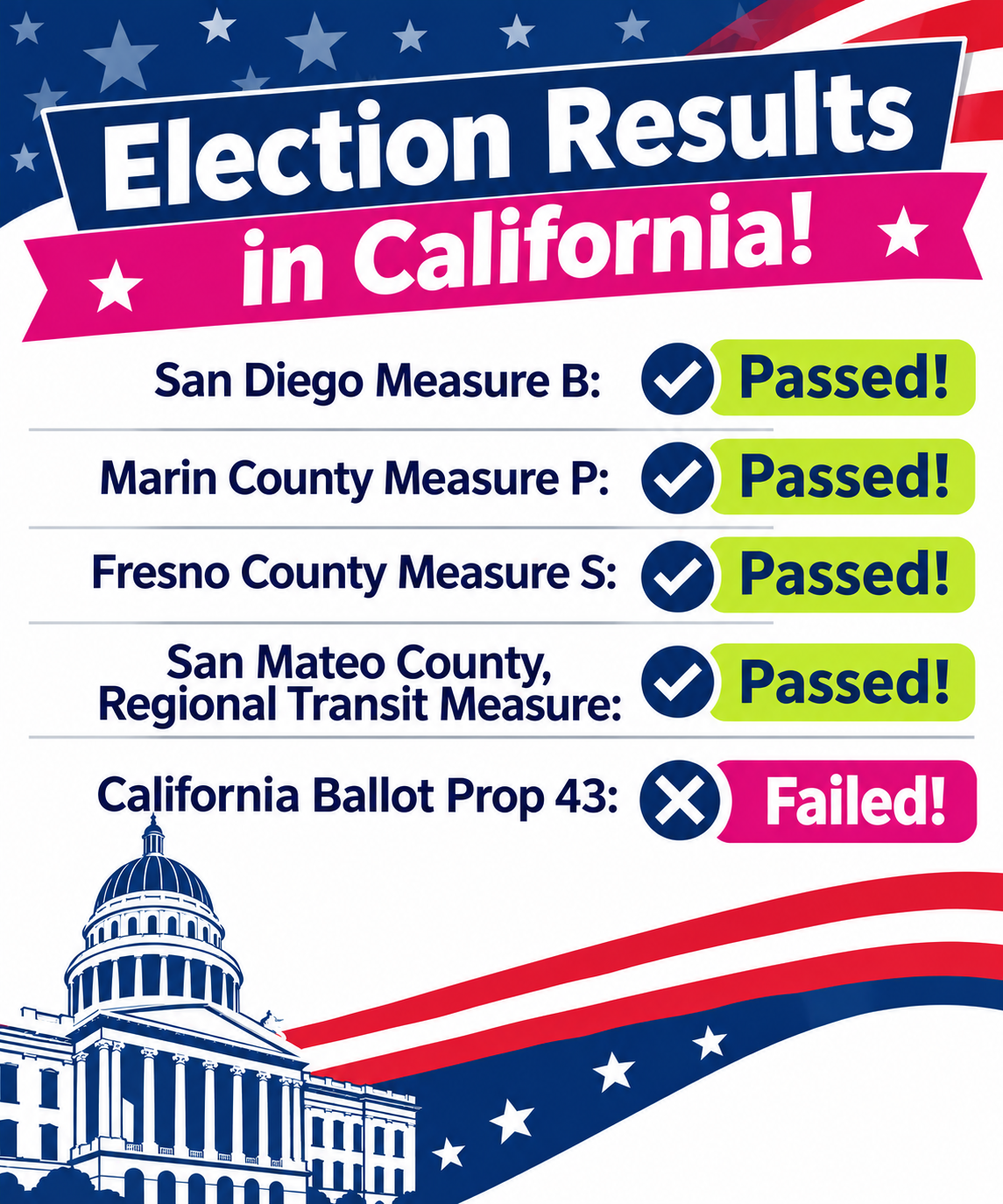
These measures that TFC was tracking are to infuse local funding into programs that support families, such as child care, transportation, and other family support services.


San Diego Measure B: Passed!

Results and more information.


Marin County Measure P: Passed!

Results.

More information.


Fresno County Measure S: Passed!

Results and more information.


San Mateo County, Regional Transit Measure: Passed!

More information.


California Ballot Prop 43: Failed!

Parent Voices of Oakland Op-Ed: Op-ed | What We Lose if Prop 43 Passes


Candidates Who Engaged With TFC And Were Elected


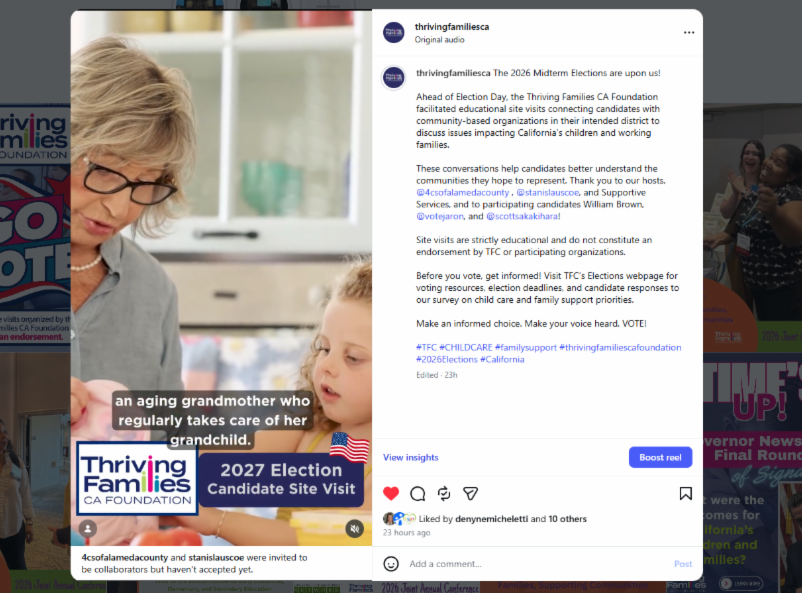
Congratulations to the winning candidates who took the time to engage with the Thriving Families CA Foundation during this election cycle! We want to thank you for participating in our candidate survey or attending a community site visit. We appreciate your willingness to learn more about the issues impacting California’s economy and your commitment to engaging with the local organizations and their communities. We wish you success in your new roles and look forward to continued conversations about strengthening support for California's working families!


Stay tuned for future updates as ballots continue to be counted.


Candidate site visits facilitated by TFC Foundation are nonpartisan and do not constitute an endorsement of any candidate.

"Strong Families, Strong Economy" Advocacy Day

Advocacy Day Partners Planning Meeting


November 19, 2026, at 1 p.m.

Register here!

Organizations across California are coming together to build a stronger, unified voice for the services and supports that help families thrive and make our state’s economy possible!


With participating organizations including Thriving Families CA (TFC) Foundation, First 5 Association, the R&R Network, and the Child Abuse Prevention Center, this growing coalition is bringing together partners who recognize that child care, family supports, and community-based services are essential economic infrastructure for California’s families and communities.


Organizations of all sizes and across sectors are encouraged to participate. This is an opportunity to build new partnerships, share perspectives, and strengthen a collective voice for the services and supports California families rely on. Join an upcoming Advocacy Day Planning Meeting to learn more, share your ideas, and explore how your organization can contribute to this collective effort at the State Capitol.


Families make California work, so California should work for families!


A North Star for California’s Next Governor: The Chance to Advance a Bold Agenda to End Child Poverty


From the End Child Poverty Coalition


Thriving Families CA (TFC) Foundation is a proud member of the End Child Poverty CA Coalition (ECPCA), a coalition working to advance policies that address poverty and strengthen economic security for California families.

Through its IMAGINE Agenda, the ECPC outlines priorities for California's next Governor, including expanding access to affordable, quality child care and ensuring fair compensation for the child care workforce.


The agenda calls on California to fulfill its promise of creating 200,000 new child care spaces by 2027, while ensuring that providers have the resources necessary to deliver quality care, support their workforce, and meet the needs of working families.


The report emphasizes:


We Are Respected: Dignity, Fair Pay, Worker Justice

Make Quality Child Care Accessible to All Families so Children can Thrive


California cannot achieve economic security for families without ensuring that child care is affordable, accessible, and adequately funded. California must protect and build upon its promise to create 200,000 new child care slots by 2027 while ensuring that expansion does not come at the expense of quality, affordability, or the child care workforce. We urge the next Governor to adopt a reimbursement methodology that truly fulfills the intent of legislation passed nearly six years ago to establish a full-cost-of-care rate. Child care providers must receive the resources necessary to pay workers fairly, maintain high-quality programs, and serve children with the greatest needs. When families can access reliable care, parents can work, children can learn and thrive, and child care providers can earn a living wage." 


Did you miss a child care licensing webinar?

Rewatch previous webinars with translations into multiple languages here.

November 2026 Monday Morning Update Sponsor
Kindersystems

California State Preschool Program Voluntary and Temporary Transfer of Funds

New for FY 2026-27: 

Beginning in FY 2026-27, CDE has added a January VTT period to provide an additional opportunity for contractors to submit VTT requests. The January VTT period is intended to provide contractors with greater flexibility to manage contract funds and address anticipated funding needs earlier in the fiscal year.

Contractors may submit VTT requests during the following periods:

  • November 1-15
  • January 1-15
  • May 1-15


Contractors interested in participating in a VTT should submit their request during one of the periods listed above. VTT guidance and letters of request are available on the CDE website at https://www.cde.ca.gov/fg/aa/cd/vttresources.asp


If you have any questions about this guidance, please contact your assigned Early Education and Nutrition Fiscal Services fiscal analyst. The CDE Fiscal Analyst Directory can be accessed at https://www.cde.ca.gov/fg/aa/cd/faad.asp.

Upcoming Events

NEW! Child Care Center Work Group

November 13, 2026
8:30 a.m. - 10:00 a.m.

Meeting Link

This workgroup discussion is limited to Child Care Centers only, not Family Child Care Homes.

NEW! CCDD Monthly Contractor Meeting
Thursday, November 19th

10:00 a.m. - 11:00 a.m.

Register Here

This meeting series is open to CCDD contractors only.

2028-30 CCDF State Plan Input Sessions

Thursday, November 19th

10:00 a.m. - 12:30 p.m.

Virtual Early Childhood Policy Council (ECPC) Meeting

Register here


Save the date for the upcoming 2028-2030 Child Care and Development Fund (CCDF) State Plan input sessions. The goal of these sessions is to gather regional community input from our partners on various topical sections of the 2028-2030 CCDF State Plan.

2026 Program for Infant/Toddler Care Academy for Program Directors – Applications Open!


The Program for Infant/Toddler Care (PITC) Academy for Program Directors is a virtual event for infant/toddler program leaders that builds awareness and supports the utilization of new materials developed as part of the California Early Learning and Development System. The Academy for Program Directors is presented by the PITC, a collaboration between the California Department of Social Services and WestEd.


Event Dates:

Tuesday, November 10, 2026

Thursday, November 12, 2026

Tuesday, November 17, 2026

Thursday, November 19, 2026

All sessions are held from 1:00 to 3:00 p.m.


Applications close on October 15 so apply today!


Please visit PITC for more information and for questions, contact PITCEvents@wested.org.


Participate in a Research Study on Supporting Dual Language Learners


The American Institutes for Research (AIR) is currently seeking early childhood educators, including family child care home providers and center-based classroom teachers, who are interested in enhancing their practice with dual language learners (DLLs).


AIR is inviting eligible providers to participate in a research study focused on improving instructional practices for DLLs.


Participants will receive information about professional development opportunities related to DLLs.


Upon completion of all study activities, a stipend will be provided to eligible participants.


Eligible participants must:

  • Be providing care to children who receive child care subsidies
  • Serve preschool-aged dual language learners
  • Have NOT previously completed DLL-focused professional development
  • Be based in Southern California
  • If you are interested in participating or would like your staff to participate, please fill out the interest form today or reach out directly to the AIR team at ccpartnership@air.org for more information.

CDSS PIN 26-14-CCLD: Guardian Training for Licensees and Providers

Released October 22, 2026


CDE Management Bulletin 26-09: California State Preschool Program Funding Opportunities: Voluntary Temporary Transfers

Released October 19, 2026


CDSS PIN 26-13-CCLD: (Supersedes in Part PIN 21-06-CCLD) Update to the Frequently Asked Questions (FAQ) for Communication With Complainants

Released October 14, 2026


CDSS Child Care Bulletin (CCB) 26-24: Fiscal Year 2026-27 California Alternative Payment Program (CAPP) Slots Allocations

Released October 14, 2026

What is California doing to transition toward an alternative methodology for setting child care reimbursement rates?


On November 2, 2026, the California Department of Social Services (CDSS), in a new partnership with NORC at the University of Chicago and the Center for Early Learning Funding Equity (CELFE) at Northern Illinois University, held a public webinar introducing the next phase of California's alternative methodology cost study.


The webinar, titled 2027 California Alternative Methodology Cost of Care: Virtual Overview & Timeline, outlined the state's upcoming cost study, preliminary data collection approaches across different types of subsidized early learning providers, and opportunities for public input. This effort will build on previous cost-of-care work done by P5 Strategies in order to refine the methodology used to inform future child care reimbursement rates. Once the methodology tool is developed, it will be shared publicly so various stakeholder groups can give input and feedback.


The transition is also reflected in AB 1981 (Aguiar-Curry), Chapter 567, Statutes of 2026, which reinforces the state's intent to move away from traditional regional market-rate surveys and establishes a new framework for how California sets child care reimbursement rates. Rather than relying on what families pay for child care, the state will work toward rates that better reflect what it actually costs providers to deliver care. This includes considering differences in location, type of provider, children's ages, hours of care, and the additional costs of supporting children with special needs.

Why is California moving away from the traditional Regional Market Rate (RMR) Survey, and when was the last survey conducted?


California's most recent Regional Market Rate (RMR) Survey was conducted in 2021, with data collection taking place primarily between June and November. However, the state never incorporated the 2021 survey findings into its reimbursement rate schedules. As a result, California's RMR reimbursement rates continued to be based on the 2018 survey, leaving the state's market-based reimbursement benchmarks nearly a decade behind actual market conditions.


Historically, California used market-rate surveys to establish reimbursement ceilings based on the prices families paid for child care in different regions. Under the traditional framework, state law allowed surveys to be conducted no more frequently than once every two years. However, market-rate surveys reflect what families pay for care, rather than the actual cost of providing it.


California's transition to an alternative methodology is intended to better account for the costs of operating subsidized child care programs and the differences across provider types and regions. Click here for more information on California's transition to a reimbursement system based on the true cost of providing care.

Provider Training Requirements: What Applies Now and What Changes in 2027


California's 2026 budget legislation changed training requirements for licensed child care providers. AB 190, the Early Care and Education budget trailer bill, amended Health & Safety Code §1596.866 and temporarily rolled back some of the broader requirements enacted in June through AB 150.


Now through September 30, 2027: At least one director or teacher at each child care center, and each family child care home licensee who provides care, must complete 15 hours of Health & Safety Training (pediatric First Aid, CPR, preventive health practices, and nutrition training when applicable).


Beginning October 1, 2027:

  • The 15-hour requirement expands to all staff who provide care at centers and family child care homes, each family child care home licensee, and substitute adults in family child care homes.
  • These same individuals must also complete 12 hours of continuing education every year. This is in addition to the 15-hour Health & Safety Training.


CDSS has released PIN 26-11-CCP with implementation information and will issue more guidance in the coming weeks.


Read the full Q&A, including the annual training topics and why requirements changed during the budget process, on our Provider Information website page.

Webinar Recording

Preparing for Forthcoming Changes in CCDF NPRM

Click here to watch the 30-minute webinar from CLASP & NWLC


Stay Updated: Updates on CCDF NPRM Coordination 

US Congress Update


Democrats have a chance before they take power in January to undercut President Trump’s Iran war checkbook. Not everyone is on board.


Lawmakers will have to pass another funding bill by mid-December to avoid a government shutdown. Though Republicans maintain their majorities until the end of the year, some Democrats — ready to flex their new influence after a midterm blowout — want any year-end spending measure to block cash for the military conflict.


But the move could spark a shutdown fight that extends into the next year and overshadows their new majority and other policy goals.


Democrats will have to weigh the pros and cons of instigating a confrontation they won’t necessarily win.


The top Democratic appropriators, at least, didn’t appear to rule out a fight. More: Some Democrats don’t want to wait for January to block Trump’s war in Iran - POLITICO 


More: What happens after the ‘blue wave’? Your questions on the US midterm election results answered | The Guardian 


Following the results of the elections, the Democratic Women’s Caucus (DWC) celebrated the more than 100 Democratic women elected to serve in the 120th Congress. Their positions in the House of Representatives will increase DWC membership next Congress to a historic high. The 120th Congress will mark the first time in history that the Democratic Women’s Caucus surpasses 100 members in the U.S. House of Representatives, representing an increase of more than 60% since 2016. 


We continue to urge Congress to invest more than the $10 million increase in CCDBG and Head Start that the House proposed for FY27. More: House Republican 2027 Funding Bills Fall Far Short of What Is Needed to Help Families, Support Core Services | Center on Budget and Policy Priorities 

Centering Family and Provider Voice in Early Childhood Systems Change Webinar


During the webinar, you’ll learn how to: 

  • Center family and provider voices in systems planning and decision-making. 
  • Translate lived experience into advocacy and policy change. 
  • Build authentic, lasting partnerships with families and providers.  


Date: Tuesday, November 10 

Time: 3 p.m. CT 

Register

Most Viewed Bills of the Week


  1. H.R.6509 [119th] SAFE Drugs Act of 2025
  2. H.R.4818 [118th] Treat and Reduce Obesity Act of 2023
  3. H.R.1 [119th] An act to provide for reconciliation pursuant to title II of H. Con. Res. 14.
  4. S.2296 [119th] National Defense Authorization Act for Fiscal Year 2026
  5. H.R.139 [119th] Sunshine Protection Act of 2025
  6. H.R.5269 [119th] RESULTS Act
  7. S.3516 [118th] A bill to impose a fee on certain remittance transfers to fund border security.
  8. S.5653 [119th] Bipartisan American Affordability and Jobs Act of 2026
  9. H.R.5316 [119th] Drug Shortage Compounding Patient Access Act of 2025
  10. H.R.35 [119th] Agent Raul Gonzalez Officer Safety Act

On Our Reading List

What The New Congress Could Mean For Mothers And Caregivers

How could the 2026 midterm elections change child care, paid leave, Medicaid and health insurance? What the new Congress could mean for mothers and caregivers.

Reports:


  1. 120th Congress: A Child Care and Early Learning Agenda


Articles:


  1. Voters in Boulder County, San Antonio and Colorado Said Yes to Paying for Child Care. St. Louis’s Prop B Got 47% and Lost.
  2. Making Headlines: Child Care Affordability and the 2026 Midterms

Social Media Spotlight

Happening This Week, November 9th - 13th


Monday, November 9th:

  • TFC Program Integrity Workgroup Meeting @ 1:00 p.m.
    

Tuesday, November 10th:

  • CalHR Monthly Forum (Invite Only) @ 10:00 a.m.
  • TFC Weekly Connections at 1:00 p.m. Email to register


Wednesday, November 11th:

  • Veteran's Day
    

Thursday, November 12th:

  • TFC and CDSS Bi-Monthly Meeting @ 10:00 a.m.


Friday, November 13th:

  • Child Care Center Work Group, 8:30 - 10:00 am. (Child Care Centers only) Meeting Link & Agenda
    

Have an event to add? Email thriving@thrivingfamilies-ca.org.


Visit the TFC Master Calendar to find upcoming TFC meetings, partner events, trainings, conferences, and other opportunities in one place.

The Weekly Good

An uplifting way to start the week, for those of us who need a break from the chaos that is our lives.


Each week we will celebrate everyday heroes, inspiring movements and great things happening in our field. 

Quick Links


TFC Member Only Benefits


Not a member?

Find out how to join today!

TFC Weekly Member Connections via Zoom:


Our commitment to you is to have scheduled at least once per week a call wherein we can all connect. As questions arise, forward them to TFC so that we can address them on these calls. Look for a weekly email to register. Recording and Q&A will also be posted on the Member's Only page. 

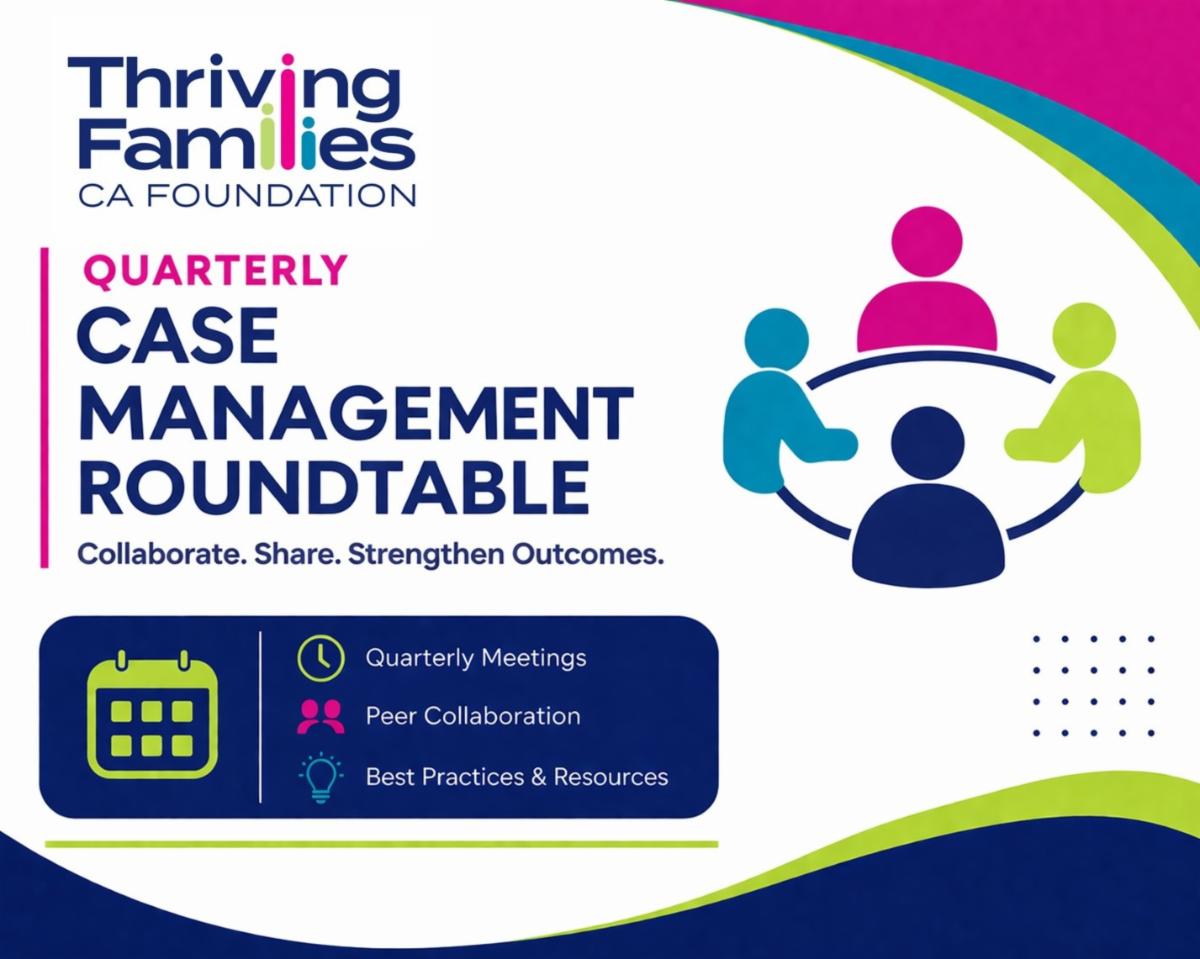
We’re excited to introduce a new member benefit designed to support connection, learning, and shared success across our network—our Quarterly Case Management Roundtable.


This interactive series brings together professionals from across the field (via Zoom) to engage in meaningful conversations, exchange ideas, and strengthen practices that support families and communities.


Email for more information and registration.

Job Descriptions and Salary Information


TFC has collected more than 85 job descriptions from member agencies that you can view and use when you create your agency's next job posting!


Visit the Member's Only website to view today!


TFC's 2026-27 Board of Directors

PRESIDENT

Rev. Gina Fromer, Ph.D.

GLIDE


VICE PRESIDENT

Michelle Graham

Children's Resource & Referral of Santa Barbara County 


SECRETARY

LaVera Smith

Supportive Services, Inc. Fresno


TREASURER

Beth Chiaro

Child Care Resource Center


PAST PRESIDENT

Rick Richardson

Child Development Associates


PUBLIC POLICY CO-CHAIR

Phillip Warner

Children's Council of San Francisco


PUBLIC POLICY CO-CHAIR & MEMBERSHIP CHAIR

Adonai Mack

Child Action, Inc.


MEMBERS AT LARGE

Mona Shirk
Hively 


Jeanne Fridolfs

Napa County Office of Education


Joie Owen

Valley Oak Children's Services


Karen Marlatt

Valley Oak Children's Services 


Jessica Kranz

Go Kids, Inc.


Mike Michelon
Siskiyou Child Care Council


Daniel Johnson 

Davis Street Community Center


Denyne Micheletti

TFC CEO


The representation of the TFC Foundation board spreads across all agency types and sizes, and represents voices from nearly every region in California.

Click Here to see.

DSS & CDE Updates


October 2, 2026:

CDSS Child Care Bulletin (CCB) 26-23: Alternative Payment Program Administrative Support Allocation.


October 9, 2026: CDE CAPSDAC Update #11 - Announces the temporary pause in monthly certification requirements.


October 8, 2026:

CDE Management Bulletin 26–10:

iscal Year 2027-28 Continued Funding Application information, forms, and instructions for California State Preschool Program contractors


September 29, 2026:

CCB 26-24: Fiscal Year 2026-27 California Alternative Payment Program (CAPP) Slots Allocations


September 22, 2026:
CCB 26-22:
Cost Of Care Plus Rate Payments To Child Care Providers Pursuant To Assembly Bill 150


September 14, 2026:

CCB 26-21: California Work Opportunity And Responsibility To Kids (CalWORKs) Stage One Child Care Program Monitoring Initiative


September 1, 2026

Management Bulletin 26-08: Implementation of the Attorney General Model Policies for Immigration Enforcement Requirements


September 21, 2026:

County Fiscal Letter 26/27-10E: Errata to the Fiscal Year (FY) 2026-27 Allocation for the Emergency Child Care Bridge Program for Foster Children


September 1, 2026: Management Bulletin 26-08: Implementation of the Attorney General Model Policies for Immigration Enforcement Requirements

Job Openings

Is Your Organization Hiring?

Post your job announcement here for thousands to see!

There is no charge for TFC members.


Non-members will be charged a fee of $75.

Please email us your posting!


Executive Director
Del Norte Child Care Council


Chief Operating Officer
Family Resource Center- San Joaquin County


Associate Manager - Early Childhood Education

Placer COE


Child Care Services Specialist

Community Action Partnership of San Luis Obispo


Bilingual Program Assistant – Case Management

Changing Tides Family Services


Multiple Positions Open
Hively


Community Resource Navigator

Connections for Children


Family and Provider Programs Administrator

CDA San Diego


--Child Care Case Manager & Support Specialist

--Child Care Case Manager

--Teacher Aide

--Primary Care Teacher

--Maintenance/

Facility Technician

Glenn County Office of Education


Multiple Positions Open
4Cs of Sonoma County


Advocacy Manager Catalyst Family Inc.


-Finance Director

-Center Director at Roosevelt

Davis Street


Family Advocate

YMCA of San Diego County


Pathways LA- Multiple Job Openings

Nutritional Aid, Child Care Provider Training Coordinator, Child Care Case Worker,

Preschool Associate Teacher, Child Care Professional Dev. Coach and Payment Processor

Of Interest

Childcare Providers Begin Receiving Measure C Funds


California’s Persistent Poverty Crisis: 2024 Rates Remain Alarmingly High


Experts Talk Costs and Supply in California’s Child Care


Apprenticeships Aimed at Boosting Child Care Careers Have Been Flourishing


Childcare Costs and the Shifting Economic Landscape: Investment Opportunities in a Post-Pandemic World


Field Happenings and Resources


Recognizing how our agencies continue to engage and communicate with families and providers.


Del Norte Child Care Council November Newsletter


4Cs of Alameda Current Newsletter

Upcoming Valley Oak Children's Service Events


4Cs Sonoma Upcoming Events


Connections for Children Upcoming Events


Hively Upcoming Events

Become a Monday 

Morning Update Partner! 

Our Monday Morning Update supports our Early Learning & Child Care field with timely information about what is going on in California and nationally; as well as dates to be aware and upcoming events. 


Our weekly Monday morning distribution is to nearly 10,000 federal and state local agencies, resource and referrals, contractors, legislators and their staffs', centers, parents, providers, state departments and advocates. 


To help support the continuation of this resource and or advertise in the Monday Morning Update, click HERE.


To advertise in the update, click here.


The Thriving Families CA Foundation is a non-profit organization (501(c)3), Taxpayer Identification Number is 03-0521444. Your generous donation is tax deductible.

Thank You to Our Generous 2024-25 Thriving Families CA Foundation Champions!


Thank you to the following Champions who stepped up in 2024-25, with funding to enhance our ability to serve the field. These agencies have made it possible for TFC to support our field with more tailored support of individual organizations, ability to pay for legal, advocacy and social media supports, enhanced regional trainings, improving data collection, and more.

 
Facebook  Instagram  LinkedIn  X