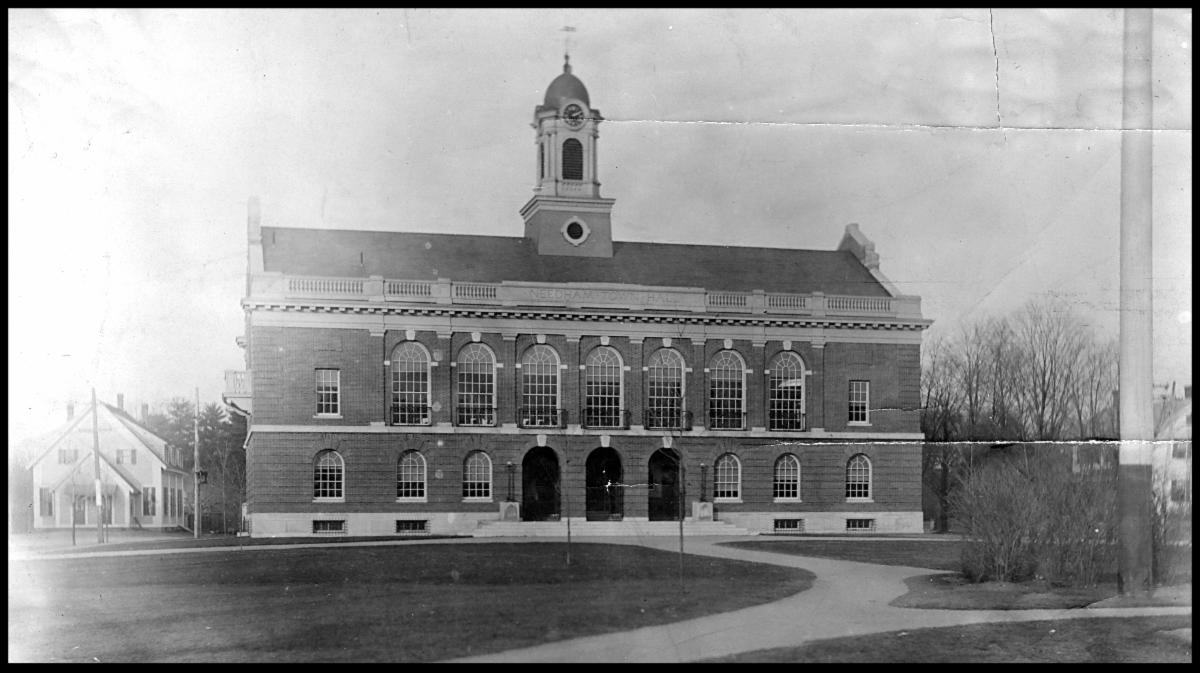
The first picture of Needham Town Hall, taken just after it was completed in 1903. The building to the left is the former Evangelical Congregational Chapel (that gave Chapel Street its name), which by that point had been converted into tenements.
"A Proper and Fitting Accommodation"
Guest Columnist: Polly Attridge, Archivist, Needham History Center & Museum
Many thanks to Polly for filling in for me this week!
As you walk or ride through the center of downtown Needham you can't help but see a beautiful brick neo-Georgian style building. Patterned after Independence Hall in Philadelphia and topped with a shiny gold cupola, the Town Hall looks out over a well-cared-for Common, with trees and benches that seem to invite you to stay a while. Of course at this time of year you might want to wait for a little warmer weather, but even now there are picnic tables so you can relax and enjoy a snack or meal from one of the many restaurants in town.
But the Town Hall wasn't always a building to admire. In fact, for many years, town government had no separate building for conducting its business. In order to tell you why I'll have to tell you a bit about the Poor Farm. In the 18th century, if a person was destitute, the parish became responsible for their maintenance. Just one woman was supported by the town when it was incorporated in 1711. Contributions were collected for her on Sundays. As time went on more people needed aid from the town. For some, the town paid relatives for their care. For others who were entirely dependent and had no relatives, the town held an annual “auction” for townspeople to bid for their keep. Those who were most able to do some work received the highest bids. The auctions were held in a tavern, where the owner supplied the drink and billed the town. As early as 1773, and again in 1778, the town rejected the idea of obtaining “a work House for the Poor of the Town.” A Work House, also called a Poor Farm, was a parish-owned structure that provided accommodation for the destitute in return for their labor. The subject was repeatedly brought up in Town Meeting, with the same negative result.
Back to the Town Hall. The first meeting house was erected in 1712, when the church and town were so connected that any meeting of one concerned the other. The custom continued until 1773 when the church was destroyed by fire. The next year the Town Meeting was held at the house of Lt. William McIntosh, who was an innkeeper. Despite the fact that the church was soon rebuilt, Town Meeting had no permanent home. In 1778 and for a few years after, it was held in the West Meeting House, from where it was customary to adjourn to various taverns. In 1773 it was brought to order and adjourned in the home of innkeeper Ephraim Bullard. Many meetings were held in the homes of prominent citizens. For a few years Town Meeting was held taking turns first in the East Meeting House, and then the West Meeting House, but the citizens of neither parish approved. During the Revolutionary War most meetings were held in either the McIntosh or the Bullard Tavern.
Finally, in 1828 the town bought the Capt. Caleb Kingsbury farm, on what is now Wellesley Avenue near Babson College - fifty-five years after the idea was first considered. Shortly after that, the town bought a copper bath tub for the Poor Farm “for the use of the town.” But somehow the bill wasn't paid, and in 1833 a letter was received asking for payment. Needham's reply was that it would be paid as soon as the Town allowed it. The next weekend the Poor Farm was struck by lightning and the Selectmen immediately voted to pay for the tub.
For the next ten years the town meeting was held in a room in the Kingsbury farm house. In 1838 the town voted to take down the old house and outbuildings and build a new Poor House, with a large room attached to serve as a Town Meeting hall. As late as 1852 there were still no seats in the new Town Meeting room, except for certain officials and such as were brought in for aged men (of course, no women were allowed to attend.) Also, at town meetings the dogs were allowed in and were almost as numerous as the voters; in George K. Clarke's History of Needham it was said that “these noble animals greatly disturbed the meetings.” But the room was adequate and everything was fine until 1881, when the East Parish (Needham) and the West Parish (Wellesley) split into separate towns. The site of the Poor House/Town Hall became a part of Wellesley and the poor were accommodated by paying Wellesley to take charge of them.
The separation of the towns once again left Needham without a home for its Town Hall, so the town was forced to rent space for the town’s business. It used a succession of retail blocks on Great Plain Avenue - Parker Hall, Village Hall, the Odd Fellows Building, and the Moseley Block, all of which have since been razed. In 1888, yet another committee was formed to see if a new building was needed, but again failed to convince the townspeople. Just two rooms were rented in the Moseley Block, and in 1884 the town voted that the Town Treasurer was authorized to lease the rooms for another five years, with a hall when needed for meetings. Space was at a premium, used at various times by the selectmen, assessors, town clerk, registrars of voters, and auditors. The water commissioners had a small building on Chapel Street, and the treasurer took his work home. The town records were a real problem, with each town official taking his home each time a new person was elected. In 1817 a wooden box had been procured for the Town Clerk's records and in 1819 a trunk was purchased for the use of the selectmen. In 1853 the town bought a safe. Our records don't give a clue as to where these items were kept, but it is assumed that they were carried around to whatever space was used for a town hall at the time, or even to private homes. It was obvious that a secure and fire-proof room was needed for papers and books.
It took a long time, many committees, and a lot of argument and letters to the Editor of the Needham Chronicle, but on May 2, 1902 Town Meeting finally approved the building of the present Town Hall to be “a proper and fitting accommodation” for the town’s business. As the trite saying goes, “The Rest is History.”
Oh, if you're wondering what is now on the site of the Poor House, bought in 1828 – Welcome to the Wellesley Country Club!
Polly Attridge has been Archivist of the Needham History Center for more years than Gloria can count, and Gloria is endlessly grateful for her knowledge and assistance.
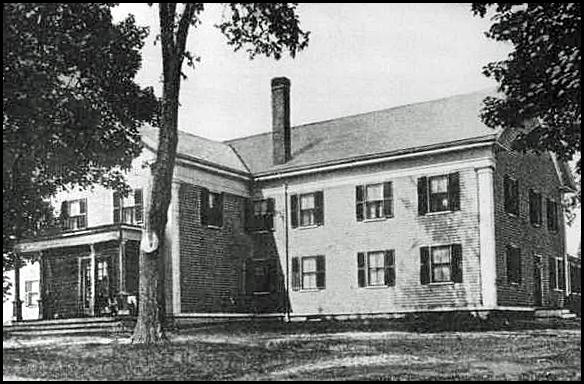
Below: The old Poor Farm, on Wellesley Avenue, built in 1838 to replace the old Caleb Kingsbury house. The town used the building as a poor farm and town meeting hall until Needham and Wellesley split in 1881. Wellesley continued to use it until 1910, when it was leased to the new Wellesley Country Club. The building was torn down in 2008 when the country club built its new clubhouse.