Weekly update from the National Housing Conference | | News from Washington | By Brittany Webb | | |
Senate passes 21st Century ROAD to Housing Act
The Senate passed the 21st Century ROAD to Housing Act with a vote of 89 to 10, marking the largest housing bill to move in decades. The legislation represents a comprehensive package of over 40 different provisions designed to improve and modernize a wide range of housing and community development programs, from Community Development Block Grants (CDBG) and manufactured housing to lifting the public welfare investment cap for banks. The legislation is supported by many housing groups, including the National Housing Conference (NHC).
“We commend the Senate for passage of the 21st Century ROAD to Housing Act, an important step forward in addressing the severe shortage of affordable housing facing communities across the country. With the country millions of homes short of what is needed and housing costs continuing to rise, it is encouraging to see Congress come together around bipartisan solutions aimed at expanding supply and modernizing key housing programs,” said NHC President David Dworkin in a press release. “This legislation includes important provisions to boost housing supply, support for state, local, and tribal housing planning, expand manufactured housing, increase the public welfare investment cap, streamline environmental reviews, and modernize the HOME program. It also improves interagency coordination, updates USDA’s Rural Housing Service, encourages landlord participation in the Housing Choice Voucher program, reforms disaster recovery, and promotes housing for veterans.”
Whether the bill will move to conference committee between the House and Senate remains unclear, particularly given uncertainties about whether President Trump will ultimately sign it into law. While the legislation’s strong bipartisan support is encouraging, some housing groups have raised concerns about the provision banning institutional investors from build-to-rent properties. They argue that the measure could have a chilling effect on housing construction, potentially undermining efforts to increase supply within an otherwise significant legislative achievement.
| | | |
Limited Seats Remaining for the
Must-Attend Event for Housing Communicators
On April 8, the National Housing Conference will convene housing communications leaders from across the country for Solutions for Housing Communications at the National Press Club in Washington, D.C.
This one-of-a-kind event is the only national convening dedicated exclusively to housing communications, bringing together housing experts, thought leaders, policymakers, and journalists for a full day of dynamic discussions. Attendees will explore proven and emerging communications and messaging strategies to elevate public understanding of the importance of affordable housing—both nationally and within local communities.
Whether you’re shaping narratives, influencing policy, or engaging the media, this convening offers practical insights and valuable connections to strengthen housing advocacy through effective communications.
Members of the media receive complimentary registration.
Please contact kbeigay@nhc.org for more information.
| | |
White House issues long-awaited housing EOs
The White House issued two executive orders (EOs) aimed at decreasing the cost of housing, with a focus on regulatory barriers to construction and promoting greater access to mortgage credit. The two orders, which have been rumored for months, lay out a series of ways to reduce overall regulatory costs and burdens that limit housing development and purchase affordability, directing a wide range of government agencies to review how they can streamline operations to the benefit of consumers. The EOs also highlight how smaller community banks can be better utilized to foster innovation, growth, and consumer choice.
NHC issued a statement in support of the EOs’ goals, noting that a healthy housing market depends on competitive and accessible mortgage systems and the opportunity to expand access to first-time homebuyers, while emphasizing the need for thoughtful reform that engages housing stakeholders.
“Modernizing mortgage regulations, updating appraisal requirements, streamlining reporting rules, and expanding digital mortgage tools can help community banks and smaller lenders better serve their communities. Reducing unnecessary compliance burdens can expand access to responsible mortgage credit, particularly for first-time buyers, rural communities, and small residential builders,” the statement said. However, the statement noted that “while supporting smaller banks is important, regulatory modernization should benefit lenders of all sizes so the entire mortgage system can operate more efficiently and expand access to credit.”
The Mortgage Bankers Association (MBA) welcomed the EOs but cautioned that limiting reforms to community banks would limit the impact for consumers. “America’s housing finance system is the best in the world because it’s competitive,” MBA President and CEO Bob Broeksmit, CMB, said in a statement released Friday. “We support efforts to increase bank participation in mortgage lending and servicing, and the goal should be to revise overly burdensome rules for lenders of all sizes and business models. This includes credit unions that support their members and independent mortgage banks (IMBs), who serve most FHA, VA, and Rural Housing borrowers, making homeownership possible for first-time buyers, low- and moderate-income families, veterans, and those living in rural communities.”
| |
Industry coalition calls on House to pass housing bill with needed changes to increase housing supply
A broad coalition of housing groups wrote to House leaders on March 13, noting strong support for legislation that expands housing supply and affordability. “We stand ready to work with you to ensure the final bill advances this goal.” The letter urged modification of a provision in the bill “which would effectively eliminate the production of Build-to-Rent (BTR) housing. Put simply, this provision inexplicably takes new housing units off the table and would exacerbate our housing crisis,” the letter said. If the House modifies the bill, it will have to go to conference with the Senate to negotiate unified language. It’s also possible that the House and Senate could informally negotiate a compromise that would pass in the House.
BTR is underwritten, financed, constructed, and often zoned as multifamily housing, typically on a single tax lot or legal parcel of land. In 2025, nearly 47,000 BTR units were delivered, according to Yardi Matrix data that tracks BTR communities of at least 50 units. “At a time when our nation has a severe affordability and supply crisis, BTR is also a segment of the market generating tens of thousands of new units that would not otherwise have been constructed,” the letter said.
The letter was signed by the Affordable Housing Tax Credit Coalition, CRE Finance Council, Institute of Real Estate Management, Leading Builders of America, Mortgage Bankers Association, National Affordable Housing Management Association, National Association of Home Builders, National Apartment Association, National Housing Conference, National Leased Housing Association, National Multifamily Housing Council, Nareit, National Rental Home Council, and The Real Estate Roundtable.
| |
HUD appeals CoC preliminary injunction
The U.S. Department of Housing and Urban Development (HUD) announced in a press release that it has appealed the preliminary injunction from the Federal District Court of Rhode Island regarding HUD’s attempted changes to the Continuum of Care (CoC) program. The district court had previously rejected HUD’s argument to lift the injunction, keeping it in place. HUD has now formally appealed the ruling and is asking the appellate court to lift the preliminary injunction while the appeal is under consideration.
“Through the use of weaponized litigation, twenty-one states, the District of Columbia, and a handful of activist groups and local municipalities sued HUD. This lawfare has blocked HUD’s ability to revise the funding conditions and select the best and most effective projects, delaying important funding deadlines,” the press release states.
The plaintiffs argue in their responses that HUD’s recent appropriations updates do not make their actions any more lawful than they had been previously, and dissolving the preliminary injunction would throw CoC program recipients into chaos that creates immediate harm.
“The preliminary relief is just as warranted now as it was before,” the response reads. “As Defendants continue to sow uncertainty, Plaintiffs and their members continue to face risk of irreparable harms: Permanent supportive housing projects have closed, landlords have refused to renew leases with program participants, and people have been forced onto the streets in the cold. The chaos and confusion imposed by Defendants stands in stark contrast to the stability and consistency the CoC Program was designed to promote. If this Court dissolves the preliminary injunction, these harms will only get worse.”
| | | |
VA and DOJ allow guardianship for vulnerable veterans
The Department of Veterans Affairs (VA) announced a memorandum of understanding (MOU) with the Department of Justice (DOJ) to adjust services for vulnerable veterans seeking healthcare, including veterans who are homeless or at risk of falling into homelessness. The MOU gives DOJ the capability to appoint VA attorneys as special assistant U.S. attorneys, allowing them to initiate and enact guardianship or conservatorship proceedings in state cases for transitions of care for such veterans.
“Our new partnership with the Justice Department reflects our ongoing commitment to ensuring that every Veteran receives timely, appropriate care, even in complex cases,” said VA Secretary Doug Collins.
The National Coalition for Homeless Veterans issued a statement in response to the change, urging some caution. “Ensuring that vulnerable veterans receive appropriate care is essential. In some circumstances, the appointment of a legal guardian can help veterans access treatment and transition safely to more appropriate care settings. However, guardianship and other forms of involuntary intervention are serious legal actions that remove significant personal autonomy. They must be used sparingly, with strong safeguards, and always with the best interests and rights of the veteran at the center of the process…Policies that expand legal authority over a veteran’s decision making risk undermining trust between veterans and the systems designed to support them if they are not implemented with extreme care and transparency."
| | | |
Inflation holds steady as mortgage rates rise
New Consumer Price Index (CPI) data released shows inflation remaining relatively steady in February, but with shelter costs continuing to account for a large share of the overall increase. The report showed overall inflation rose 2.4% year-over-year, the same as in January, with shelter costs rising 3%. Month-over-month, shelter costs rose 0.2%, once more the largest contributor to monthly gains for overall CPI of 0.3%. Analysts note that while inflation has cooled from its peak, housing-related expenses continue to exert upward pressure on the Index. While rent growth has begun to moderate compared with earlier highs, housing costs still represent a substantial share of CPI and remain elevated relative to household incomes, and these numbers do not yet reflect the economic changes expected from the recent conflict with Iran. Mortgage rates have already moved above 6% after briefly falling to recent lows in a reversal of positive trends. Though the rates are moving back up, outlooks for buyers remain somewhat positive.
"Borrowers continue to take advantage of mortgage rates around 6%," said Bob Broeksmit, president and chief executive officer of the Mortgage Bankers Association. "Despite ongoing geopolitical tensions and broader economic uncertainty, overall demand remains strong."
| | | |
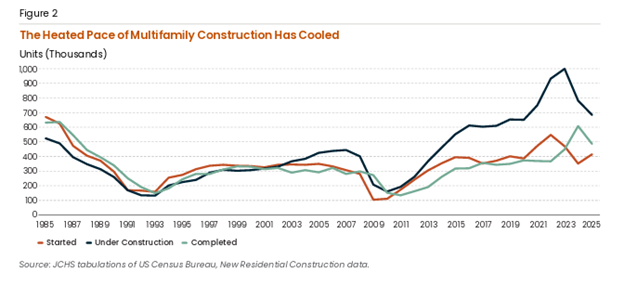
Multifamily starts continue slowing from peak
The Joint Center for Housing Studies’ America’s Rental Housing 2026 report shows the recent multifamily construction boom is cooling off, though it remains elevated. Units under construction (black line) hit a high in 2023 of 996,000 and have been steadily falling in the years since, with 686,000 under construction in 2025. Units started (orange line) are shown peaking at 547,000 in 2022, and in 2025 slowing down to 416,000, while unit completions peaked more recently in 2024 at 608,000 and 488,000 in 2025. The research notes that the construction slowdown is likely due to a 42% increase in the cost of construction materials between 2020 and 2025, along with higher salary demands of construction workers. The costs were further reflected in higher rents, with units renting at $1,400 or higher growing by 11.8 million.
| | |
An NPR story explores how communities are embracing factory-built housing to combat affordability challenges and longstanding stigma. It describes how prefab and modular units can slash construction costs and timelines by producing homes off-site for quick assembly, helping meet urgent demand without traditional onsite labor hurdles. The piece highlights growing adoption as places seek solutions to meet urgent housing demand and scale factory production despite past failures to revolutionize the industry.
An Urban Institute publication examines strategies to boost homeownership by addressing both supply shortages and demand barriers, highlighting programs in Atlanta and Washington, D.C. It argues that increasing housing stock through relaxed zoning and streamlined permitting, alongside targeted mortgage supports like down payment assistance, can help more households transition from renting to owning without inflating prices further. The analysis emphasizes that supply expansion must be paired with demand-side policies to close racial and generational homeownership gaps.
A Punchbowl News article details Senate efforts to advance the 21st Century ROAD to Housing Act as a key infrastructure deliverable for President Trump while navigating political pressures of competing priorities. The article dives into negotiations between parties and chambers, with a focus on how Republicans are approaching the affordable housing bill and its viability under continued pressure from the President to focus on voter identification legislation.
| | The National Housing Conference is a diverse continuum of affordable housing stakeholders that convene and collaborate through dialogue, advocacy, research, and education, to develop equitable solutions that serve our common interest. | | Defending Our American Home since 1931 | | Copyright © 2024. All Rights Reserved. | | | | |