Tirador Compliance helps investment firms focus on their clients and business
|
|
Pointers For Annual Amendments
(Due March 31!)
|
|
If you haven't started your firm's ADV Annual Amendment,
don't wait! There are some "toe-stubbers" due to new questions and changes in how you report your Assets Under Management.
Any firm whose fiscal year ends December 31 is required to file an ADV Annual Amendment by March 31, whether you have any changes to report or not.
SEC-registered firms get a reminder, but most state-registered firms do not.
Below are a few issues that have cropped up regularly with my clients, and how I have understood and addressed them. You should refer to your own compliance consultant or CCO for how these may apply to your firm's situation.
Best regards,
Mark
|
|
Use Completeness Check to save your sanity
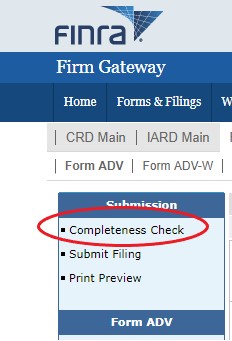
The navigation bar is on the left hand side, once you are in the ADV Part 1.
Note the first item, Completeness Check - a quick click here will give you all the edits and errors before you get down to submitting the form It is a quick way to find out where your ADV Part 1 needs work according to the system.
Be sure to read through each item anyway, even if you think you are familiar with your ADV.
After you click Completeness Check, you will get all the errors that the system has identified, and a link to the page or section where the error is.
For state-registered advisers, there are two execution (signature) pages, and the page for Part 1B is hard to find. Completeness Check will get you right to it.
|
|
Branch Offices (Part 1A, Item 1.F.5)
"
What is the total number of offices, other than your
principal office and place of business
, at which you conduct investment advisory business as of the end of your most recently completed fiscal year?"
- Note that the question asks about offices other than your principal office. If you only have one office, this would be answered "0."
|
|
Clients Without Managed Assets (Part 1A, Item 5.C.(1))
"
To approximately how many
clients
for whom you do not have regulatory assets under management did you provide investment advisory services during your most recently completed fiscal year?"
- Like many items on the ADV, this one is asked backwards. (You can pronounce that however you wish!)
- My paraphrase is: "In FY 2017, how many clients did you provide planning or other advisory services for, but not asset management?"
|
|
Assets Under Management ("AUM") by Client Type and Amount (Part 1A, Item 5.D.)
This new table replaces the radio-button selection with ranges of percentages. Now they want the specific number of clients and the dollars of AUM attributable to each category. The instructions for this table are actually good - read them.
- Note that the total of AUM in the columns will have to equal the total of AUM you report for discretionary and non-discretionary assets in Item 5.F.
|
|
"Separately Managed Account Clients" (Part 1A, Item 5.K., and Schedule D Item 5.K.(1) through 5.K.(4))
Arrrggh! This is what happens when someone who has never worked in the industry designs a form. (I'm just guessing...)
In the ADV, “separately managed accounts” means any AUM
not in a mutual fund
that you manage, a private fund
that you manage, or a business development company
that you manage.
If you don't manage assets for a mutual fund, private fund, or business development company, this would be
all of your AUM.
"Separately Managed Accounts” often refers to asset management by a third-party institutional manager, but not in this context.
|
|
Custodians With Over 10% of Your AUM (Part 1A, Item 5.K.(4), and Schedule D, Item 5.K.(3))
You already read the item above about what "Separately Managed Accounts" means, right?
Item 5.K.(4) should be answered "Yes" if any custodian has 10% or more of your AUM. When you get to Schedule D, Item 5.K.(3), you will need to create a record for
each custodian with 10% or more of your AUM.
|
|
Firm Net Worth (Part 1B, Item 2.B.(4))
For Colorado-registered firms, there is a new requirement effective May 15, 2017, regarding firms' adjusted net worth (Current Assets minus Liabilities):
- All RIAs must have a positive net worth.
- Firms with discretionary authority must have a net worth of at least $10,000.
- Firms with custody must have a net worth of at least $35,000.
Firms that don't meet the above net worth requirements must purchase a bond for the deficit, rounded up to the nearest $5,000.
Rule 51-4.13(IA)
|
|
Reference Date for Part 2A, Item 2: Material Changes
The Material Changes item in your ADV Part 2 is cumulative from one annual amendment to the next, not just from one version to the next. For my clients, I use the wording, "Since the last annual amendment dated <MM/DD/YYYY>, the following material changes have occurred:"
Any subsequent material changes to your ADV Part 2 will land on this list and stay there through the next year's Annual Amendment, then the list starts over.
|
|
Remember to Update ADV Parts 2A and 2B
The IARD system should prompt you to amend your Part 2 Brochures, but about half of the time, it hasn't worked this year, and the Completeness Check has missed it.
- The AUM that you report in Item 4 can technically be for any date within 90 days prior to the date you file the form (but shouldn't be earlier than 12/31). Whatever date you choose, use the same "as of" date for AUM as you do on ADV Part 1.
- Your ADV Part 2 Brochure(s) should be ready to go in searchable pdf format before you submit your filing, since you will upload them as part of the submission process.
|
|
You are receiving this email because you are a listed regulatory contact for an RIA registered in the State of Colorado, or you have requested to receive these emails. If you do not want to receive these updates, please use the unsubscribe link below.
Tirador Compliance LLC is not affiliated with the Colorado Division of Securities.
|
|
|
|
|
|
|