Friends,
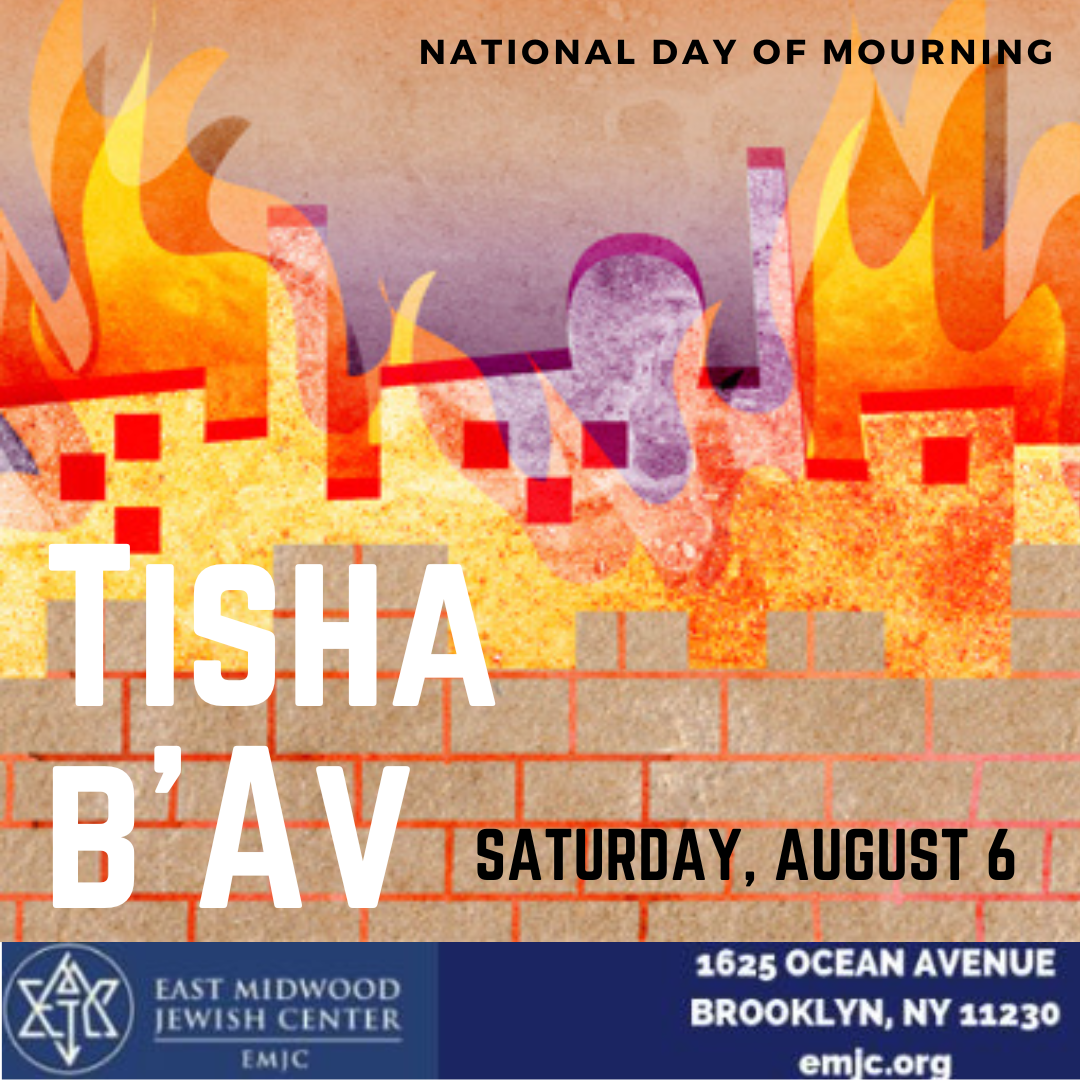
Tisha b’Av is a unique occasion on the Jewish calendar. Commemorating events going back two and a half thousand years, our national day of mourning recalls the destruction of the First Temple in 587 BCE and the Second Temple in 70 CE, as well as a host of other calamities in our people’s history.
The central features of Tisha b’Av observance in the synagogue are the reading of the Book of Lamentations, the recitation of kinot – poetical dirges from some of the great masters of liturgical poetry throughout our history – and the setting of a mood of mourning: we sit on the floor or on low stools, we refrain from wearing leather shoes (as on Yom Kippur), and we conduct the service by lamplight and candlelight. Of course, Tisha b’Av is also a fast day, beginning at sunset on the eve-of and ending after dark the next day.
The themes of Tisha b’Av vary dramatically. On the one hand, we admit culpability in a highly penitential mode – we tell God that we deserve the terrible things that have befallen us. On the other hand, there is a body of literature (mostly Rabbinic, but also some Biblical passages) which sharply rebukes God – what on earth could we possibly have done to deserve such a bitter fate?, the passages ask. One famous source from the Talmud (Gittin 55b-56a) explains that the cause of the destruction of the second temple was the (comparatively innocuous) sin of sin’at chinam – “baseless hatred.” The passage explains that “Jerusalem was destroyed on account of Kamtza and bar Kamtza. There was a certain man whose friend was named Kamtza and whose enemy was named bar Kamtza. He once made a large feast and said to his servant: Go bring me my friend Kamtza. The servant went and mistakenly brought him his enemy bar Kamtza.” Bar Kamtza shows up and is asked to leave. He offers to pay the cost of the entire feast if only he be allowed to stay, in order to avoid the humiliation of being kicked out. His pleas fall on deaf ears, even though many of the guests are important rabbis who should have come to his defense, and he ends up seeking revenge. In the end, he informs against the community to the Roman authorities, and that ultimately leads to the destruction of Jerusalem and the Holy Temple. We will look at some of these sources on Sunday afternoon in a short study session prior to Mincha.
We will be observing Tisha b’Av this coming Saturday night and Sunday. The ninth of Av falls on Shabbat this year, so the observance of Tisha b’Av is postponed until the 10th of Av, after Shabbat, because the mood of mourning is incompatible with the joyful day of rest.
SERVICE TIMES AND LOCATIONS
Please note the following times for services, and especially that Mincha on both Shabbat and Sunday will take place at 2:00 pm. Mincha is early on Shabbat so that those who are fasting will be able to have their se’udah shlishit (third Shabbat meal) prior to the fast, which begins at sundown.
Also, please note that all services will be on Zoom with the exception of Saturday night, 9:00 pm, which will be HYBRID. Weather permitting, we will gather outside in the courtyard.
Here are the times for services:
Saturday
2:00 pm Shabbat Mincha (no Pirkei Avot study on erev Tisha b’Av)
9:00 pm Ma’ariv for Motza’ei Shabbat and Tisha b’Av service (reading of Lamentations)
THE 9:00 PM SERVICE WILL BE HYBRID
Sunday
8:00 am Shacharit for Tisha b’Av
2:00 pm Mincha for Tisha b’Av (and brief study session)
8:50 pm Ma’ariv
ZOOM LINKS:
All Zoom links will be as usual:
Shabbat Mincha and then Ma’ariv will use the usual Saturday evening link.
Sunday morning as usual.
Sunday afternoon and then evening can both use the weekday evening link.
Please contact the office or email info@emjc.org for Zoom links if you need them.
I hope that you can join us for the very meaningful observance of Tisha b’Av.
Rabbi Sam Levine