 |
|
|
 |
|
Tobacco Leaching Adjustments 2020
|
Weather conditions have been wet and cool for the 2020 tobacco crop. We have been fortunate in Johnston and Wilson Counties, receiving less rainfall than some areas to the south, east, and west but we have still had too much.
The leaching adjustments table on page 71 of the
2020 Flue-Cured Tobacco Guide
is a good guide to help you with leaching decisions, however this guide does not extend beyond 7 weeks into the season. For tobacco that is within 7 weeks of transplanting, the table is the best guide. Today our crop is 6-9 weeks after planting, and some fields have received multiple leaching events including rain this week.
Fertilizer applied prior to Monday, June 15th has had plenty of rain to be dissolved making it available for leaching or uptake by roots. As fields begin to dry out, the color of the crop will probably be the best indicator of whether further leaching adjustments are needed, especially in tobacco that is at lay-by stage or later. In these cases, if the tobacco crop is too yellow, then further leaching adjustments are likely in order.
Ways to Make Leaching Adjustments on tobacco that is too big to cultivate:
Option 1.
Apply up to 10 lb/a of nitrogen from a UAN solution in 50 GPA of water similar to a sucker control application. This method has been frequently used and is fairly simple to apply. It is generally safe, however, on tender tobacco this can cause leaf burn.
Option 2.
Apply fertilizer to the soil surface. This can be accomplished with long drop nozzles applying a UAN solution to the soil surface or by spreading dry fertilizer materials. For dry materials, the tobacco needs to be dry before applying.
Product and Rate Evaluations - 2013
Nitrogen leaching adjustment decisions are always difficult to make. A year to compare with similar conditions was 2013 where the tobacco crop received around 10" of rain in June. To help make decisions that year, Norman Harrell, County Extension Director in Wilson County and I did some research on late leaching adjustments for tobacco. Our efforts were on tobacco that was from early button to early flower. Our initial effort was to compare different application methods and materials. We used three foliar fertilizers compared to what we felt would be an appropriate nitrogen rate from both dry fertilizer and UAN solutions. We also compared stalk drench of UAN solutions to applications directed on the soil surface. We felt that 10 lbs. of nitrogen was the proper adjustment and we applied a comparison of 20 lbs. thinking this would be over-fertilization.
Summary of 2013 Demonstration:
1.
Stalk drench application of 4GPA 24S in 50 gallons of water gave some leaf burn.
2.
Soil applications eliminated injury and crop response was just as quick.
3. Foliar products did not improve yield when compared to the untreated tobacco.
4. Nitrogen adjustments of 10 pounds or more increased yield.
In 2013, we underestimated the amount of nitrogen that was needed. In general, if tobacco was yellow, 10 lbs. of nitrogen did not give an adequate response and 20 lbs. of nitrogen was not too much. As a follow-up to the test, we did a second research study and selected some of the best treatments from the first effort. Treatments included nitrogen rates to illustrate what we thought was too little, enough, and too much with 10, 20, and 30 pounds of nitrogen per acre, respectively.
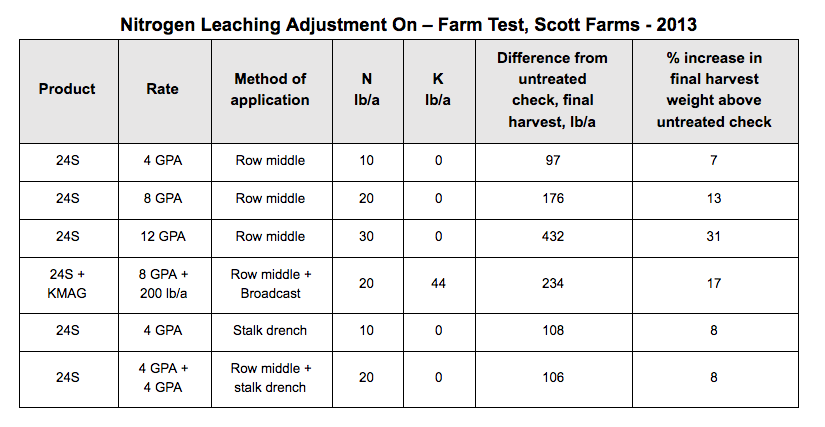
In 2013, we experienced foliar burn from UAN solutions in both experiments when applied over-the-top. We never felt that we achieved over-fertilization of the tobacco and our tendency was to estimate the rate too low. Applying KMAG in addition to the liquid UAN provided some added benefit to yield.
Warning:
This is NOT a general recommendation to apply 30 pounds of nitrogen to our current crop. However, with "late" nitrogen adjustments, wet soils, and limited roots it may take more nitrogen than typical. The penalty for too much is of course green tobacco which is not marketable.
|
|
|
|
|
|
|
Anyone who receives text messages can subscribe to receive text alerts about the tobacco crop in Johnston County. To subscribe send a text message to 40404. The message should be
Follow @Tobaccodoc
You can also click the button below to "like" our Johnston County Cooperative Extension Facebook page to stay updated on general news.
|
|
|
|
|
|
|
|
Distributed in furtherance of the acts of Congress of May 8 and June 30, 1914. North Carolina State University and North Carolina A&T State University commit themselves to positive action to secure equal opportunity regardless of race, color, creed, national origin, religion, sex, age, veteran status, or disability. In addition, the two Universities welcome all persons without regard to sexual orientation. North Carolina State University, North Carolina A&T State University, U.S. Department of Agriculture, and local governments cooperating.
Disclaimer agrichemicals:
Recommendations for the use of agricultural chemicals are included in this publication as a convenience to the reader. The use of brand names and any mention or listing of commercial products or services in this publication does not imply endorsement by North Carolina Cooperative Extension nor discrimination against similar products or services not mentioned. Individuals who use agricultural chemicals are responsible for ensuring that the intended use complies with current regulations and conforms to the product label. Be sure to obtain current information about usage regulations and examine a current product label before applying any chemical. For assistance, contact your county Cooperative Extension agent.
|
|
|
|
|
|
|